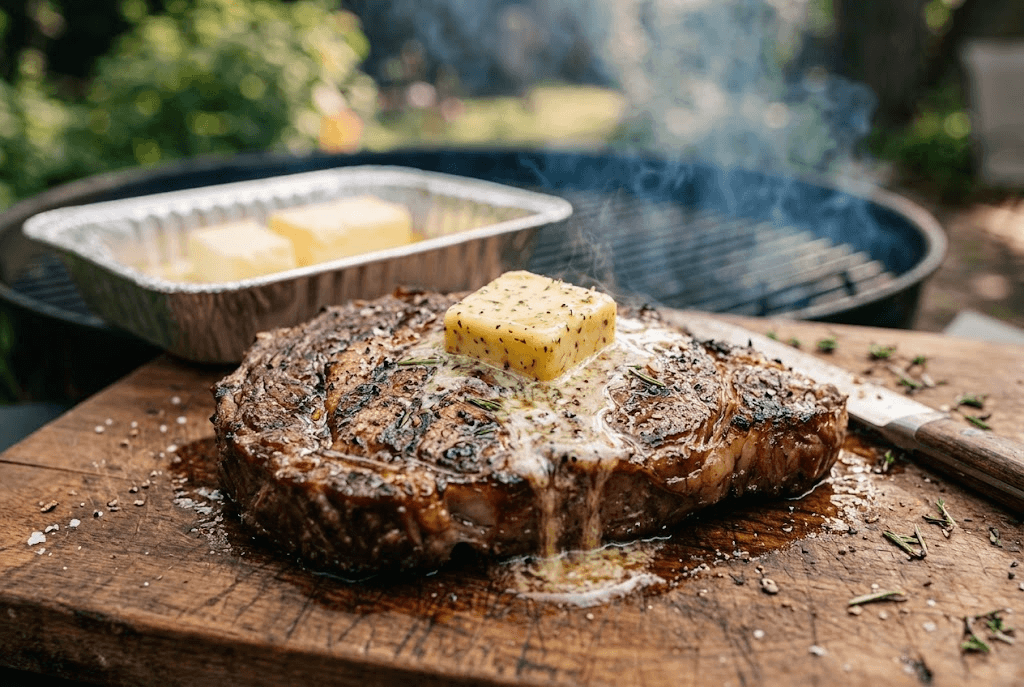
Smoked butter is regular butter that has soaked up real wood smoke on your grill or smoker. It tastes rich, a little sweet, and a lot like a campfire. A spoonful on a hot steak, corn, or a baked potato makes plain food taste like it came off a pit.
This smoked butter step-by-step recipe uses one pound of butter, a shallow pan, and about an hour on your smoker. You do not need special gear. A pellet grill, a charcoal grill, or an offset smoker will all work.
The trick is low heat and light smoke. Butter melts at roughly 90°F (32°C), so we plan for that instead of fighting it. Below, you will get exact temps, times, wood picks, and fixes for the problems that trip up first-timers.
Quick Answer: To make smoked butter, set your smoker to 200°F (93°C), put 1 lb (0.45 kg) of unsalted butter in a shallow foil pan, and smoke it with apple or cherry wood for 60 to 90 minutes, stirring every 20 minutes. Pull it when fully melted and golden, then chill it solid. Keep it at 40°F (4°C) or below.
Why This Smoked Butter Recipe Works
Butter is mostly fat, and fat grabs onto smoke flavor easily. When butter melts in a wide, shallow pan, more of its surface touches the smoke. That means more flavor in less time.
A low smoker temperature keeps the butter from burning. Butter has milk solids that brown fast above about 250°F (121°C. At 200°F (93°C), the butter melts and absorbs smoke without turning into brown butter.
Stirring helps too. Smoke settles on top, so folding the butter every 20 minutes mixes smoky fat from the surface into the rest. You get even flavor from edge to edge.
Finally, using unsalted butter gives you control. You can add salt after smoking, and you can taste the smoke instead of guessing how salty the butter is.
Ingredients and Equipment
This recipe is short on purpose. The butter is the star, so buy the best you can afford.
Ingredients (makes about 1 lb / 0.45 kg)
- 1 lb (0.45 kg) unsalted butter, 4 sticks, cold
- 1/2 teaspoon flaky sea salt, optional, added after smoking
- Wood pellets, chips, or chunks (see wood picks below)
Optional flavor add-ins (stir in after smoking)
- 2 cloves roasted or fresh garlic, minced, for smoked garlic butter
- 1 tablespoon chopped fresh herbs such as parsley, thyme, or chives
- 1 teaspoon honey or maple syrup for a sweet butter
- 1/2 teaspoon smoked paprika or cracked black pepper
Equipment
- A smoker or grill that holds steady at 200°F (93°C), such as a pellet grill (see our guide to a beginner pellet grill if you are shopping)
- 1 half-size foil pan, about 9 x 13 in (23 x 33 cm), or a cast iron skillet
- Silicone spatula
- Instant-read thermometer
- Mason jars, a glass bowl, or silicone molds for chilling
- Cheesecloth, optional, for straining
- Hand mixer, optional, for whipping
Which wood is best for smoked butter?
Pick mild wood. Butter takes on smoke fast, so strong woods can turn bitter.
| Wood | Flavor | Good For |
| Apple | Light, sweet, fruity | All-purpose, great first choice |
| Cherry | Mild, slightly sweet | Steak, corn, rolls |
| Pecan | Nutty, soft | Baked goods, potatoes |
| Maple | Gentle, sweet | Pancakes, biscuits |
| Hickory | Strong, classic BBQ | Use only a small amount |
| Mesquite | Very strong | Skip it for butter |
Substitutions
- Salted butter: Works fine. Skip added salt and taste before serving.
- Plant-based butter: Results vary. Some brands separate or taste bitter.
- European-style butter: Higher fat gives a richer result and less water to separate.
- No smoker: Use the oven backup in the variations section.
Choosing and Prepping the Butter
Start with cold, unsalted butter. Cold sticks are easier to cut, and they melt slowly, which gives you a longer smoke window before the pan turns to liquid.
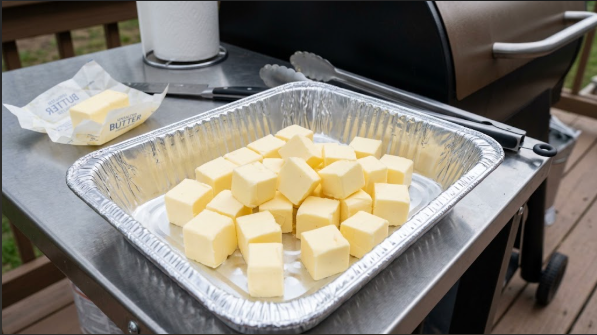
Cut each stick into 8 pieces. Spread the cubes in a single layer in the foil pan. More surface area means more smoke contact and faster flavor.
Skip the brine and the heavy seasoning. Butter does not need either one. Any salt, garlic, or herbs go in after smoking so the smoke can shine and the add-ins do not scorch.
Place the foil pan on a baking sheet if your grill grate is wide and the pan feels flimsy. Hot liquid butter is slippery, and a spill makes a smoky mess. A sturdy pan saves you from that.
Pitmaster Tip: Set the pan on a wire rack or directly on the grate, not in a spot with direct flame under it. Direct heat can scorch the bottom of the butter even when the grill dial says 200°F (93°C). On a charcoal grill, keep the pan on the cool side.
Smoked Butter: Step-by-Step Instructions
This is the full process, start to finish. Plan for about 90 minutes of cooking and a few hours of chilling.
- Preheat the smoker to 200°F (93°C). Use apple, cherry, or pecan wood. Let the grill run 15 minutes until the smoke looks thin and pale blue. White, billowing smoke tastes harsh, so wait for it to clean up.
- Prep the butter. Cut four cold sticks of unsalted butter into cubes and place them in the foil pan in one layer.
- Place the pan on the grate. Put it on the cooler side if you cook on charcoal. Close the lid.
- Smoke for 20 minutes. The cubes will start to slump and then melt. Do not open the lid early.
- Stir with a silicone spatula. Fold the smoky top layer into the center. Close the lid fast to keep the smoke in.
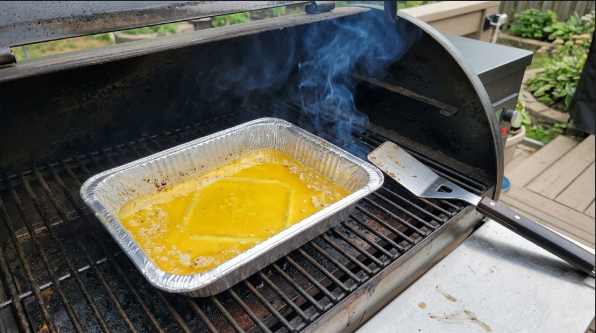
- Repeat every 20 minutes. Stir at the 40-minute and 60-minute marks. Most batches are done between 60 and 90 minutes.
- Check color and smell at 60 minutes. The butter should be fully melted, slightly deeper yellow, and smell like a campfire. It should not look brown or smell burnt.
- Pull the pan. Use heat-proof gloves. Be careful, because the butter is hot, usually somewhere between 150 and 180°F (66 to 82°C).
- Rest for 20 minutes. Let the pan cool on the counter. Stir once or twice.
- Pour into jars, a glass bowl, or silicone molds. Use cheesecloth if you want to strain out any wood bits.
- Chill in the fridge. Whisk or stir every 15 minutes for the first 45 minutes, which helps keep the butter from separating. Then let it set fully, about 3 to 4 hours.
- Optional: whip. Once firm, whip with a hand mixer for 2 to 3 minutes for a smoother, spreadable texture. Fold in salt, garlic, or herbs now.
Common Mistake: Using a hot grill, like 300°F (149°C) or more. The butter browns, the milk solids burn, and the smoke flavor turns bitter. Keep the grill at 200°F (93°C) or lower, and use the lid only when you need to.
Time and Temperature Table
| Stage | Smoker Temp | Time | What You Should See |
| Preheat | 200°F (93°C) | 15 min | Thin blue smoke |
| Cubes slump and melt | 200°F (93°C) | 0 to 20 min | Soft, glossy cubes |
| First stir | 200°F (93°C) | 20 min | Mostly liquid with a few lumps |
| Smoke and stir | 200°F (93°C) | 40 to 60 min | Fully melted, deeper yellow |
| Done | 200°F (93°C) | 60 to 90 min | Campfire smell, no browning |
| Counter rest | Room temp | 20 min | Warm, stirred |
| Fridge chill | 40°F (4°C) or below | 3 to 4 hr | Firm, spreadable |
If your grill runs hot, drop the time. At 225°F (107°C), start checking at 45 minutes.
How to Tell When Smoked Butter Is Done
Trust your eyes and nose more than the clock. Smoke levels change with wood, weather, and how often you open the lid.
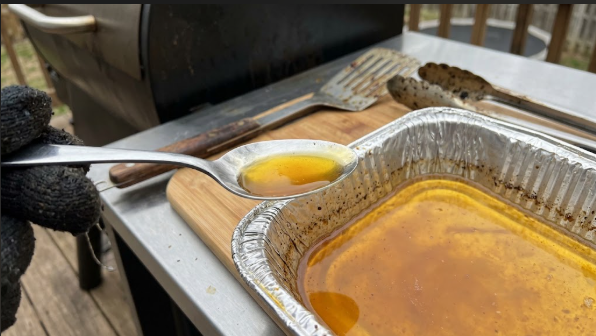
Fully melted butter with a golden tint is the first sign. A faint smoky smell that reaches your nose from a foot away is the second. Dip a clean spoon, let a drop cool, and taste it. It should taste like butter first and smoke second.
If you taste almost nothing, give it another 15 to 20 minutes. If it tastes harsh or bitter, pull it now and plan a lighter batch next time.
There is no official pull temperature for butter, since it is not meat. What matters for safety is how you handle it after smoking, which we cover in the storage section. The USDA’s Danger Zone guidance says food should not sit between 40°F and 140°F (4°C to 60°C) for more than 2 hours.
Resting, Slicing, and Serving
Let the butter cool on the counter for about 20 minutes before it goes in the fridge. Putting a hot pan straight into the fridge raises the inside temperature for everything else in there.
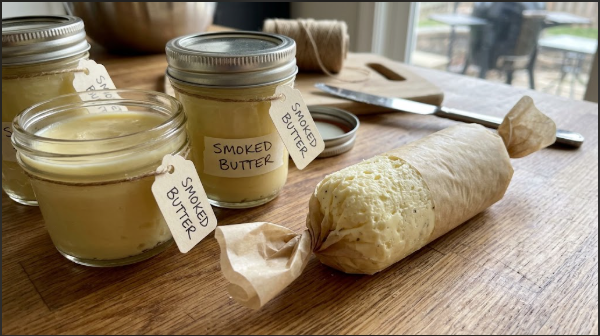
Once chilled, the butter will be firm like regular butter. Slice it into pats, scoop it into balls, or roll it in parchment paper like a log. A log is great for slicing coins onto a hot steak.
Smoked butter is best when it melts on something hot. Spread it on bread, toss it with hot vegetables, or let it melt over a steak during the last minute of resting. A small amount goes a long way.
For a smoother texture, whip it. Whipped smoked butter looks closer to store-bought butter because air gets worked back in. It spreads easily on warm rolls.
What to Serve With Smoked Butter
Think about foods that are plain, hot, and a little starchy. They soak up smoky fat well.
- Steak and burgers: Place a pat on top of the meat while it rests.
- Corn on the cob: Brush it on right off the grill. Add a pinch of salt.
- Baked or mashed potatoes: Stir it in for a smoky, rich finish.
- Cornbread and biscuits: Try it with our homemade cornbread recipe.
- Popcorn: Drizzle melted butter and toss with salt.
- Bacon and eggs: Fry eggs in a spoonful. If you are already firing up the grill, our guide to bacon on a pellet grill pairs well.
- Poultry: Baste a turkey breast. Our turkey breast at 250 method is a good match.
- Desserts: Use it in a smoked pecan pie crust or filling for a deeper flavor.
If you are planning a holiday menu, browse our Thanksgiving smoker recipes and add smoked butter for the rolls and mashed potatoes.
When using butter to baste poultry, the meat still needs to hit a safe temperature. Cook poultry to 165°F (74°C), the USDA safe minimum internal temperature
Storing, Freezing, and Reheating Smoked Butter
Smoked butter is a dairy product, so treat it like regular butter. Keep it chilled and covered, and do not leave it on the counter for hours.
Refrigerator
Store smoked butter in a sealed jar or wrapped in parchment inside an airtight container. Keep your fridge at 40°F (4°C) or below. Regular butter is generally good for 1 to 3 months in the fridge according to the USDA FoodKeeper guidance. Because homemade smoked butter has no commercial packaging, use it within about 2 to 3 weeks to be safe, and check for off smells.
Freezer
Smoked butter freezes well. Portion it into 2 tablespoon pats or small logs, wrap tightly, and freeze at 0°F (-18°C). The USDA’s freezing guidance explains that foods stay safe indefinitely at 0°F, though quality drops over time. For best flavor, plan to use frozen butter within 3 to 4 months . If you like smoked seafood too, see how we handle freezing smoked salmon.
Reheating and melting
Thaw frozen smoked butter in the fridge overnight. To melt it, warm it in a small pan over low heat or microwave in 10-second bursts. Do not boil it, since high heat can burn off the smoky flavor.
If butter sits out more than 2 hours (or 1 hour above 90°F / 32°C), toss it, per the USDA’s two-hour rule .
Variations: Pellet Grill, Offset, Charcoal, and Oven Backup
You can make this recipe on almost any cooker. The goal is always the same: low heat, clean smoke, and indirect cooking.
Pellet grill
This is the easiest method. Set the dial to 200°F (93°C) or use the “smoke” setting if your grill has one, which often runs around 160 to 180°F (71 to 82°C) . Use fruitwood pellets and follow the main recipe. If your grill struggles to hold a low temp, expect to add 15 to 20 minutes.
Offset smoker
Offsets run hot near the firebox, so place the pan at the far end of the cook chamber. Use a small, clean fire with oak, apple, or cherry splits. Our guide to lump charcoal in an offset smoker can help with fire management. Watch the pan closely and stir every 15 minutes.
Charcoal kettle grill
Bank a small pile of lit coals to one side and add one small chunk of apple or cherry wood. Set the pan on the cool side, away from the coals, and keep the vents mostly closed to hold 200°F (93°C). If you need a refresher, read how to start a charcoal grill before you try it. Expect to adjust vents often.
Gas grill
Turn on one burner on low and put wood chips in a smoker box over it. Place the butter on the far side with the burner off. Aim for 200°F (93°C). Gas grills can run hot, so use a thermometer at grate level.
Cold smoked butter (advanced)
Cold smoking keeps butter solid. Use a smoke tube in a cool grill, keep the temperature under 90°F (32°C), and set the butter on a rack over a pan of ice. Smoke for 1 to 2 hours. This works best in cold weather and needs extra care. Watch for temps climbing and keep the butter cold at all times.
Oven backup
No smoker? Melt butter in a pan on the stove, add 1/4 teaspoon of a quality liquid smoke per pound , and stir. Hold it at 200°F (93°C) in the oven for 30 minutes. It will not taste like real wood smoke, but it comes close.
Troubleshooting Common Problems
The butter tastes bitter or too smoky. The smoke was too heavy or too dirty. Use a milder wood, shorten the time, and wait for thin blue smoke before the pan goes on.
The butter browned or smells burnt. The grill ran too hot. Keep the pan away from direct heat and hold 200°F (93°C) or lower.
The butter separated into layers. This is normal for melted butter. Water, fat, and milk solids split as they cool. Stir while chilling, or pour off the water layer once chilled. Whip it for a more even texture.
There is barely any smoke flavor. You may need more time or more wood. Add 15 to 20 minutes, and use a wider pan so more surface touches the smoke.
The texture is grainy. Slow cooling can cause grainy crystals. Chill faster in a shallow dish, then whip for a smoother finish.
It tastes sour or off. Throw it out. Smoked butter that smells sour has spoiled, and your fridge may be too warm.
Recipe Card: Smoked Butter
| Item | Details |
| Servings | About 32 tablespoons (1 lb / 0.45 kg) |
| Prep time | 10 minutes |
| Cook time | 60 to 90 minutes |
| Chill time | 3 to 4 hours |
| Smoker temp | 200°F (93°C) |
| Wood | Apple, cherry, or pecan |
| Pull sign | Fully melted, golden, smells like campfire |
| Storage | Fridge at 40°F (4°C) or below, freezer at 0°F (-18°C) |
Ingredients: 1 lb (0.45 kg) unsalted butter, 1/2 tsp flaky salt (optional), wood for smoking.
Short steps:
- Preheat smoker to 200°F (93°C) with fruitwood.
- Cube butter and spread it in a foil pan.
- Smoke 60 to 90 minutes, stirring every 20 minutes.
- Pull when melted and golden.
- Cool 20 minutes, pour into jars.
- Chill and stir for 45 minutes, then set 3 to 4 hours.
- Whip, season, and store cold.
FAQ
Can you smoke butter?
Yes. You can smoke butter in a shallow pan at about 200°F (93°C) for 60 to 90 minutes. It will melt as it smokes, so use a pan with sides. Chill it afterward and it sets back into a spreadable, smoky butter you can use on meat, bread, and vegetables.
How long do you smoke butter?
Most batches need 60 to 90 minutes at 200°F (93°C), stirring every 20 minutes. Go shorter for a light smoke flavor and longer for a bolder one. Taste a small drop after it cools. Stop when it tastes like butter first and smoke second, not bitter or harsh.
What is the best wood for smoked butter?
Apple and cherry are the best picks. They give a sweet, gentle smoke that does not overpower the dairy. Pecan and maple also work well. Use hickory sparingly, and skip mesquite, since butter soaks up strong smoke fast and can turn bitter.
Can you cold smoke butter?
Yes, but it takes care. Keep the grill under 90°F (32°C), set the butter on a rack over ice, and use a smoke tube for 1 to 2 hours. It works best in cool weather. Keep the butter cold the whole time and refrigerate it right after.
How long does smoked butter last?
Stored in a sealed container at 40°F (4°C) or below, plan to use homemade smoked butter within 2 to 3 weeks. For longer storage, freeze it in small portions at 0°F (-18°C). Toss any butter that smells sour, looks moldy, or has been out too long.
What do you use smoked butter on?
Try it on steak, corn, baked potatoes, mashed potatoes, popcorn, biscuits, and grilled bread. It also works for basting turkey or chicken, finishing seafood, and scrambling eggs. Because the flavor is strong, start with a small pat and add more to taste.
Conclusion
This smoked butter step-by-step recipe is simple: cube the butter, smoke it low at 200°F (93°C) with a mild wood, stir every 20 minutes, and chill it until set. You get a rich, smoky spread that makes ordinary meals taste like they came off a pit.
Start with a small batch of one pound, taste as you go, and keep notes on your wood and timing. Once you nail it, try the garlic and herb versions. Smoked butter is one of the easiest ways to bring backyard smoke flavor to the whole menu.
Laura Smith

I'm Laura, I like all the kind of delicious grilled foods which makes me hungry all the time I see them. That's why I built this blog to share with you all of my Grilling experiences, recipes, and all the tips about foods that I've learned from food experts.