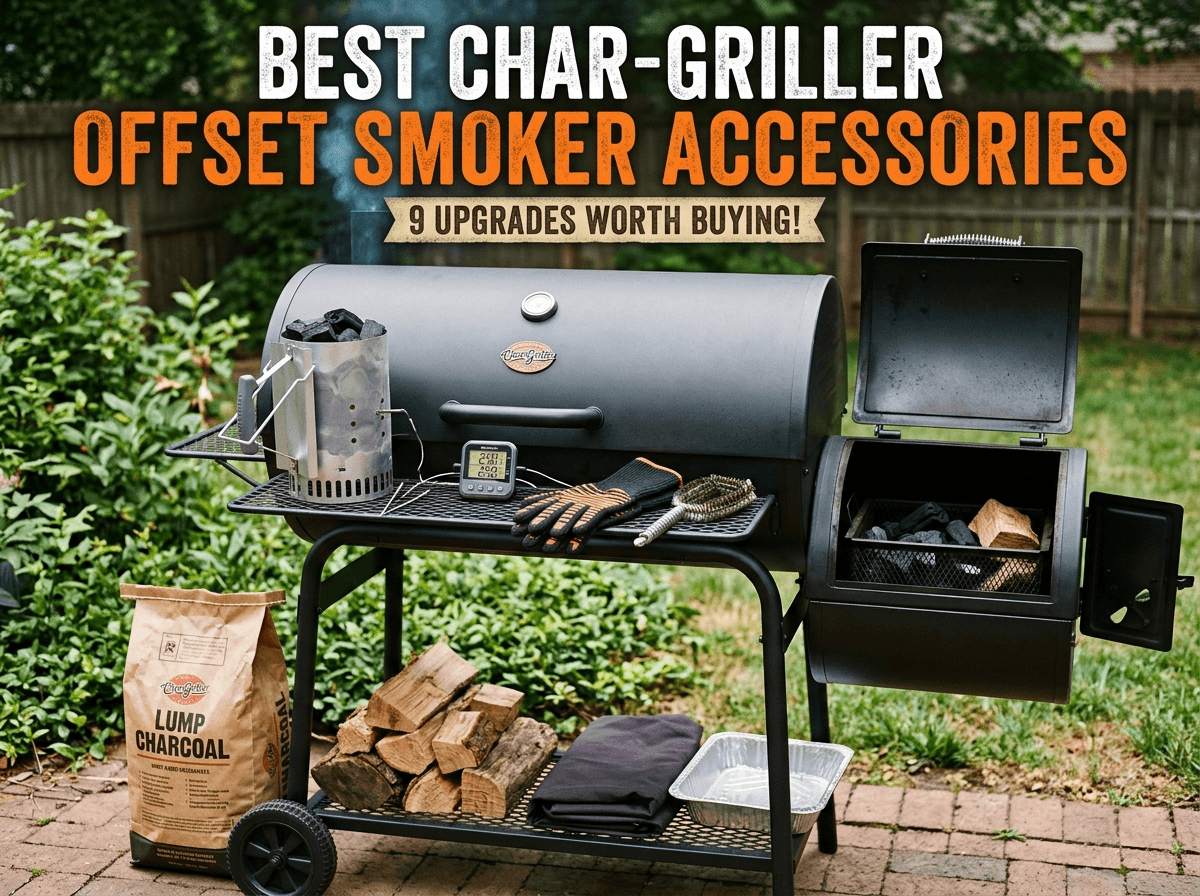
A Char-Griller offset smoker gives you real Texas-style smoking at a friendly price, but the bare cooker needs a few add-ons to run steady. The best Chargriller offset smoker accessories fix the common problems: a fire that burns too fast, temperatures that swing, food that sits too close to the firebox, and a steel body that rusts when left out.
This guide covers nine accessories for Char-Griller barrel-and-side-fire-box smokers such as the Competition Pro, Smokin’ Pro, and Dakota. You will see who each one suits, what it does well, and where it falls short. Where I could confirm a spec on Char-Griller’s own pages, I used it. Everything else is flagged.
Quick Answer: The best Chargriller offset smoker accessories are a charcoal basket for steady fuel (top pick), a trigger release chimney starter (budget pick), and a dual-probe digital thermometer (upgrade pick). Add lump charcoal, wood chunks, a fitted offset smoker cover, and heat-proof gloves. Match every part to your model number.
Best Chargriller Offset Smoker Accessories at a Glance
Prices are ranges, not quotes, and every range is flagged because retail prices change often.
| Accessory | Key spec | Best for | Price range |
| Charcoal basket | 17 x 5 x 3.5 in (43 x 13 x 9 cm) | Steady fuel in the side fire box | 20-30 |
| Trigger release chimney starter | Char-Griller branded | Fast, clean lighting | 20-30 |
| Lump charcoal | All-natural hardwood | Clean burn and flavor | 12-20 per bag |
| Wood chunks | Hickory, oak, apple, cherry | Smoke flavor | 10-25 |
| Offset smoker cover | Universal barrel and offset cover | Weather protection | 30-50 |
| Dual-probe thermometer | Grate probe plus meat probe | Accurate temps | 15-120 |
| Water or drip pan | Sits under the food | Moisture and cleanup | 5-20 |
| Grill gloves | Heat-resistant, long cuff | Handling hot parts | 15-40 |
| Bristle-free brush | Stainless steel coil | Safe grate cleaning | 10-20 |
The 9 Best Chargriller Offset Smoker Accessories
1. Char-Griller Charcoal Basket (Top Pick)
Who it’s for: Anyone who wants a steadier fire in the side fire box.
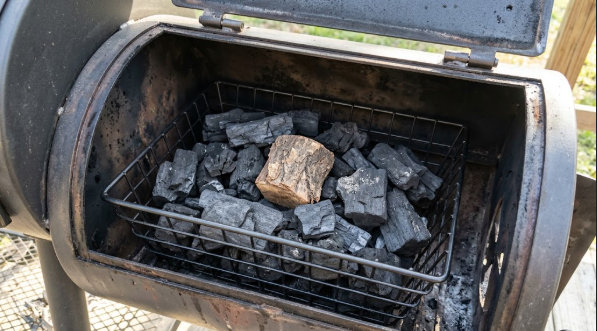
Char-Griller lists a 17 x 5 x 3.5 inch charcoal basket on its Competition Pro, Smokin’ Pro, and Dakota pages. A basket keeps coals piled together instead of spreading across the firebox floor. That helps the fire breathe from below and burn evenly, which is the main goal when you smoke at 225-275°F (107-135°C).
The basket also makes refueling cleaner. You can lift it out, tip the ash, and drop it back in, rather than raking loose coals around a hot box. Fit still matters, so measure your firebox first.
Pros
- Keeps coals together for a steadier burn
- Easier ash cleanup
- Sold by Char-Griller for these models
Cons
- Holds a limited amount of fuel
- Sits hot after a cook; use gloves
- Not every Char-Griller model uses the same firebox size
2. Trigger Release Chimney Starter (Budget Pick)
Who it’s for: Every offset owner, especially beginners.
Char-Griller’s own guide for the side fire box says to fill a chimney, light it, and wait about 15 minutes until the coals glow and are coated with ash. Then you dump the hot coals into the firebox. That method gives you a clean-burning fire with no lighter fluid taste. Our guide on starting your grill covers the basics.
The trigger release style lets you drop coals without tipping the whole chimney. That is handy at the side of a hot barrel, where tipping a heavy chimney is awkward. Char-Griller also sells natural fire starters, which pair well with the chimney].
Pitmaster Tip: To add fuel mid-cook, light a fresh chimney instead of tossing unlit charcoal on the fire. Char-Griller’s own advice is that already-burning coals hold temperature better than cold fuel.
Pros
- No chemical taste from lighter fluid
- Fast and repeatable
- Trigger release is easier on the hands
Cons
- The chimney body gets very hot
- Needs a safe, non-flammable surface while it burns
3. Lump Charcoal
Who it’s for: Cooks who want clean smoke and less ash.
Char-Griller sells its own lump charcoal, and the product pages list it as a recommended add-on. Lump burns hotter and leaves less ash than most briquettes, which matters in a small firebox where ash can choke airflow. For a deeper look at fuel choices, read our post on lump charcoal in an offset smoker.
Char-Griller’s guide says burning only wood makes it hard to hold a steady temperature. So use lump as the base fuel and add wood for flavor. That mix is the simplest way to get steady heat and good smoke.
Pros
- Lights fast and burns clean
- Less ash than many briquettes
- Pairs well with wood chunks
Cons
- Piece size varies from bag to bag
- Burns faster if the vents run wide open
4. Wood Chunks
Who it’s for: Anyone chasing real smoke flavor.
Wood chunks last longer than chips in a side fire box and give you a steadier smoke. Hickory and oak suit pork and beef. Apple and cherry are milder and good for chicken and ribs. The Char-Griller guide says to add chips or chunks when you load the hot coals into the firebox.
Use two or three chunks at a time, not a pile. Too much wood makes thick, white smoke and a bitter taste. You want thin, pale blue smoke drifting out of the chimney.

Common Mistake: Loading the firebox with wood only. It burns fast and makes temperatures swing, as Char-Griller’s own guide warns. Build the fire on lump or a charcoal base and use wood as a seasoning.
Pros
- Real smoke flavor
- Easy to control by the chunk
- Many wood types to try
Cons
- Quality and dryness vary
- Too much smoke can ruin a cook
5. Universal Barrel Grill and Offset Smoker Cover
Who it’s for: Owners who keep the smoker outside.
Char-Griller lists a Universal Barrel Grill and Offset Smoker Cover on its Competition Pro and Smokin’ Pro pages, along with a universal grill cover. The Dakota page lists a model-specific cover instead. Pick the one made for your cooker, because an ill-fitting cover traps water and flaps in the wind].
Steel smokers rust where moisture sits. A cover keeps rain and morning dew off the body, the lid, and the firebox. For more on what to look for, see our roundup of heavy-duty grill covers. Always let the smoker cool completely before covering it.
Pros
- Protects paint and steel from weather
- Keeps pollen, dust, and bugs out
- Cheaper than replacing a rusted lid
Cons
- Fit varies between models
- A wet cover can trap moisture if left on damp steel
6. Dual-Probe Digital Thermometer (Upgrade Pick)
Who it’s for: Anyone cooking brisket, pork butt, or ribs.
Offset smokers run hot near the firebox and cooler at the far end. A built-in lid gauge only tells you about the air at one spot. A dual-probe unit lets you clip one probe at grate level next to the food and place the other in the meat.
You cannot judge doneness by color, so the USDA recommends using a food thermometer for all meat and poultry. Check accuracy in ice water, which should read 32°F (0°C). Choose a model with wires rated for smoker heat].
Pitmaster Tip: Char-Griller’s guide suggests rotating food every 2-3 hours, moving the pieces closest to the smoke farther away. A grate probe tells you when it is time.
Pros
- Shows real grate and meat temperatures
- Alerts keep you from opening the lid too often
- Works on any smoker you own later
Cons
- Cheap probes can drift
- Wireless models need batteries and a good signal
7. Water or Drip Pan
Who it’s for: Cooks who want moister meat and easier cleanup.
Char-Griller’s side fire box guide suggests placing a pan of water under the food, or misting it about once an hour with apple juice, water, or beer. A pan also catches drippings, so grease does not pool in the barrel. Use a disposable aluminum pan or a spare steel pan you do not mind blackening.
Put the pan between the food and the heat. Refill it with hot water when it runs low so you do not drop the cooker temperature.
Pros
- Adds moisture to the cooker
- Catches grease and protects the barrel
- Very cheap
Cons
- Needs refilling on long cooks
- Takes up grate space
8. Heat-Resistant Grill Gloves
Who it’s for: Anyone who handles hot grates, baskets, or chimneys.
Char-Griller sells grill gloves for removing hot accessories, tending coals, and handling hot surfaces. On an offset you will constantly reach near a hot side box and chimney. Long cuffs matter, because the firebox and barrel stay hot long after you finish].
They also help when you move big cuts. If you cook holiday meals, our Thanksgiving smoker recipes are a good place to put them to work.
Pros
- Protect hands and forearms
- Useful for baskets, grates, and chimneys
- Washable on most models
Cons
- Bulky for fine work
- Wet gloves conduct heat fast
9. Bristle-Free Grill Brush
Who it’s for: Anyone cleaning cast iron or expanded metal grates.
Char-Griller sells a bristle-free brush with a stainless steel coil. Loose wire bristles from cheap brushes can end up in food, so a coil design is the safer pick. Brush the grates while they are warm, then wipe them with a lightly oiled paper towel.
Expanded metal grates catch debris in their diamond gaps. A coil brush reaches into those gaps better than a flat scraper. Cast iron grates need a light coat of oil afterward to prevent rust.
Pros
- No loose wire bristles
- Fast cleanup
- Works on several grate types
Cons
- Coils clog with grease and need rinsing
- Does not replace a periodic deep clean
Which Char-Griller Offset Do You Own? A Quick Fit Guide
Model numbers decide whether an accessory fits. Char-Griller’s product pages show differences between its offsets, so check before you buy.
| Model | Primary cooking area | Total cooking area | Notable listing details |
| Competition Pro (8125) | 720 sq in (0.46 sq m) | 1,010 sq in (0.65 sq m) | Expanded metal grates, front shelf, dual dampers |
| Smokin’ Pro | 580 sq in (0.37 sq m) | 1,130 sq in (0.73 sq m) | Cast iron grates, EasyDump ash pan, adjustable charcoal grate |
| Dakota (8235) | 580 sq in (0.37 sq m) | See product page | Lid and door gaskets, folding front shelf |
The Char-Griller guide also says the side fire box fits all Char-Griller charcoal grills, including Dual Fuel models, and can work as a portable grill with its included legs. If you own one of those, the charcoal basket, chimney, and lump advice still applies. Covers and racks may not.
Putting the Best Chargriller Offset Smoker Accessories to Work
Here is how the basics come together on one cook. This plan uses the chimney, lump, wood, basket, thermometer, water pan, and gloves on an 8 lb (3.6 kg) bone-in pork butt.
- Season the cooker. Before the first cook, Char-Griller says to wipe the unit down, dry it, and coat the inside and out with oil. Then burn a small fire in the side fire box for 30 minutes.
- Light a chimney. Fill it with lump and wait roughly 15 minutes until the coals glow and wear a light gray ash.
- Load the basket. Dump the hot coals into the charcoal basket in the side fire box. Add two chunks of hickory or oak.
- Set the vents. The Char-Griller guide says to open the firebox vent and the barrel chimney vent at least halfway, with the lids closed. Aim for 225-275°F (107-135°C), with 250°F (121°C) as the target.
- Prep the pan and probes. Set a water pan under the pork and clip the grate probe next to it. Insert the meat probe into the thickest part, away from the bone.
- Cook and rotate. Rotate the pork every 2-3 hours so the side nearest the firebox does not dry out. Refuel with a freshly lit chimney.
- Pull and rest. Pull the pork at 200-205°F (93-96°C) when the probe slides in like butter. Rest it wrapped for 30-60 minutes, then shred with a pair of forks or claws.

Plan on about 1 to 1.5 hours per pound (0.45 kg), so an 8 lb butt takes roughly 8-12 hours. Always go by temperature, not time.
Time and Temperature Table
Whole cuts of pork and beef are safe at the USDA’s minimum internal temperature of 145°F (63°C) with a 3-minute rest. The higher pitmaster temps below are for tenderness, not safety.
| Cook | Smoker temp | Rough time | Pitmaster pull temp | USDA minimum |
| Pork butt, 8 lb (3.6 kg) | 250°F (121°C) | 8-12 hours | 200-205°F (93-96°C) | 145°F (63°C) + 3 min rest |
| Brisket, 12 lb (5.4 kg) | 250°F (121°C) | 10-14 hours | 200-205°F (93-96°C) | 145°F (63°C) + 3 min rest |
| Spare ribs, 3 lb (1.4 kg) rack | 250°F (121°C) | 5-6 hours | Tender when the rack bends | 145°F (63°C) + 3 min rest |
| Chicken thighs, bone-in | 275°F (135°C) | 1.5-2 hours | 175-185°F (79-85°C) | 165°F (74°C) |
Poultry has a different rule. The USDA minimum for all poultry is 165°F (74°C), so check chicken in the thickest part without touching bone. If you want a smaller poultry cook, our post on turkey breast at 250 shows the method.
How to Choose the Best Chargriller Offset Smoker Accessories
Use this checklist before you buy:
- Confirm your model. The Competition Pro, Smokin’ Pro, and Dakota have different cooking areas and covers.
- Fix fire control first. A basket, a chimney, and lump solve most steadiness problems.
- Add measurement next. A dual-probe thermometer is cheaper than a ruined brisket.
- Protect the cooker. A fitted cover matters more than any gadget if your smoker lives outside.
- Check heat ratings. Anything near the firebox must handle high temperatures.
- Buy in stages. Add pieces as your cooks get more ambitious.
If you are still choosing a cooker, our guides to the best cheap offset smoker and the best affordable offset smoker compare the field. Serious tinkerers may also like our look at a custom reverse flow smoker.
How We Picked These Accessories
We built this list from Char-Griller’s own product pages and its side fire box guide. We favored items Char-Griller lists for its offsets, then added universal tools that solve common offset problems.
Each pick was judged on five criteria: fit, heat tolerance, ease of use, durability, and value. This guide does not claim lab testing or hands-on benchmarks. Anything we could not confirm is marked so you can check it before you publish or buy.
Care and Maintenance Tips
A few habits keep a steel offset smoker running for years:
- Dump ash after every cook. Wait until everything is fully cold, then empty the firebox and ash pan into a metal container.
- Wipe grease from the barrel. Built-up grease can burn and smell bitter on the next cook.
- Oil the grates. Cast iron and steel grates rust if left bare. A thin coat of cooking oil after cleaning helps.
- Keep vents clear. Ash and soot choke airflow and cause temperature swings.
- Cover only when cool. A warm cover can melt or trap moisture.
- Check seals. Leaky doors and lids waste fuel and smoke.
Pitmaster Tip: After a cook, close the vents fully to starve the fire. Unburned lump can be reused on the next cook.
Frequently Asked Questions
What accessories do I need first for a Char-Griller offset smoker?
Start with a chimney starter, lump charcoal, and a dual-probe thermometer. Those three give you clean lighting, steady fuel, and real temperature data. Add a charcoal basket and a fitted cover next. Wood chunks and gloves round out the basic setup for safe, flavorful cooks.
Do I need a charcoal basket in the side fire box?
You do not need one, but it helps. A basket keeps coals together for a steadier burn and makes ash cleanup easier. Char-Griller sells a 17 x 5 x 3.5 inch basket for its offsets. Check fit for your model before buying, since firebox sizes can differ.
What is the best wood for a Char-Griller offset smoker?
Hickory and oak are classic choices for pork and beef because they give a strong, balanced smoke. Apple and cherry are milder and suit ribs and chicken. Use two or three chunks at a time on a bed of lump charcoal, and avoid burning wood alone.
How do I keep temperature steady in a small offset?
Use lump as your base fuel and add wood for flavor. Light a fresh chimney when you need more fuel. Keep the firebox vent and chimney vent at least halfway open, and make small adjustments. Char-Griller suggests aiming for about 250°F (121°C) and rotating food every 2-3 hours.
Do I need a water pan in an offset smoker?
A water pan is optional, but it adds moisture and catches drippings. Char-Griller’s guide suggests setting a pan of water under the food or misting meat about once an hour. Refill it with hot water so you do not drop the cooker temperature during long cooks.
What cover fits a Char-Griller offset smoker?
It depends on the model. Char-Griller lists a Universal Barrel Grill and Offset Smoker Cover for the Competition Pro and Smokin’ Pro, and a separate cover for the Dakota. Check your model number and the cover’s listed dimensions before buying, and always cover the cooker only after it cools.
Conclusion
The best Chargriller offset smoker accessories are the ones that make your fire steadier and your temperatures honest. For most owners that means a charcoal basket, a chimney starter, good lump, and a dual-probe thermometer, followed by a fitted cover and heat-proof gloves.
Buy in stages, confirm fit for your model, and use USDA temperatures as your safety baseline. If you ever want a hands-off cooker for the same low-and-slow results, our list of best pellet grills for beginners is a good next read.
Laura Smith

I'm Laura, I like all the kind of delicious grilled foods which makes me hungry all the time I see them. That's why I built this blog to share with you all of my Grilling experiences, recipes, and all the tips about foods that I've learned from food experts.