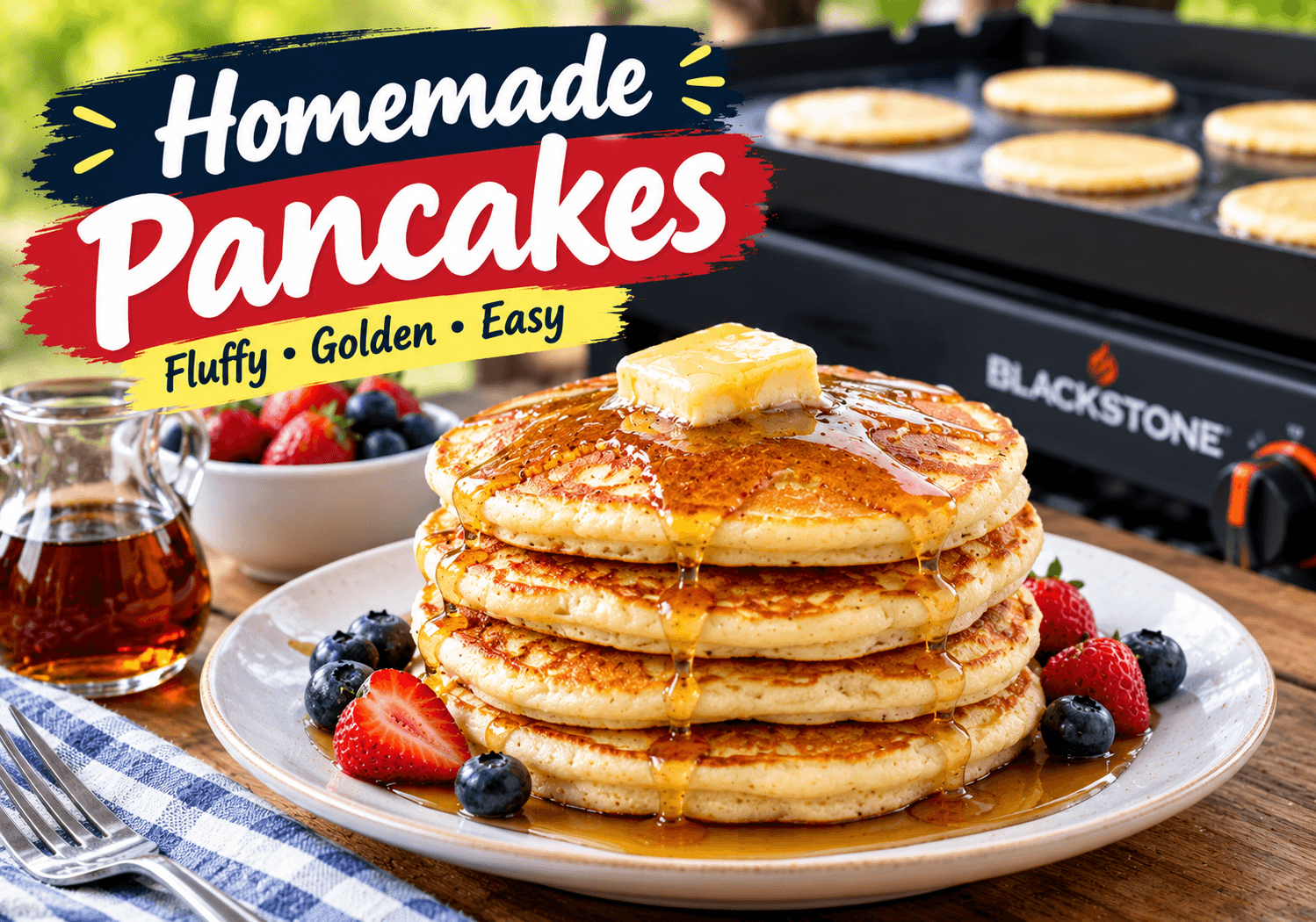
Good homemade pancakes come down to a simple batter, a hot griddle, and a little patience. You don’t need a mix, and you don’t need fancy ingredients. Flour, baking powder, eggs, milk, and butter are enough to get tall, tender pancakes with crisp golden edges.
This recipe makes about 12 four-inch (10 cm) pancakes in 30 minutes. It works on a Blackstone, an electric griddle, a cast iron skillet, or a plain nonstick pan. Below you’ll find exact amounts, griddle temperatures, how to tell when to flip, and fixes for flat or gummy batches.
Quick Answer
For fluffy homemade pancakes, whisk 2 cups (250 g) flour, 2½ tsp baking powder, 2 eggs, 1¾ cups (420 ml) milk, and 4 tbsp (57 g) melted butter just until combined, leaving small lumps. Rest 5–10 minutes. Cook on a 350°F (175°C) griddle, about 2–3 minutes per side. Makes about 12 pancakes in 30 minutes.
Why These Homemade Pancakes Work
Most pancake problems come from the same handful of mistakes: overmixed batter, a griddle that’s too hot or too cold, and flipping too early. This recipe is built around fixing all three.
- A short mix keeps them tender. Stirring develops gluten, and too much gluten makes rubbery pancakes. A few small lumps are fine, because they cook out.
- Baking powder does the lifting. It makes bubbles when it meets the liquid and again when it heats up. A fresh can and a short rest give you the best rise.
- Melted butter adds flavor and tenderness. It also helps the edges brown and crisp.
- A steady 350°F (175°C) surface gives the pancakes time to rise before the outside sets. Too hot and the outside burns while the center stays raw. Too cool and they spread thin and pale.

Ingredients and Equipment
This makes about 12 four-inch (10 cm) pancakes, enough for 4 people at 3 pancakes each.
Dry Ingredients
- 2 cups (250 g) all-purpose flour
- 2 tbsp (25 g) granulated sugar
- 2½ tsp baking powder
- ½ tsp fine salt
Wet Ingredients
- 1¾ cups (420 ml) whole milk, at room temperature if you can
- 2 large eggs
- 4 tbsp (57 g) unsalted butter, melted and slightly cooled
- 1 tsp vanilla extract
For the Griddle
- 1 to 2 tbsp neutral oil or butter, for greasing
Equipment
- Large mixing bowl and a whisk
- ¼-cup (60 ml) measuring cup or ladle
- Wide spatula
- Griddle, cast iron skillet, or nonstick pan
- Wire rack and sheet pan for keeping batches warm
- Instant-read thermometer (optional, for checking the center)
Easy Substitutions
- No milk: Use half milk and half water in a pinch, or any unsweetened plant milk.
- Buttermilk version: Swap the milk for 1¾ cups (420 ml) buttermilk, drop the baking powder to 2 tsp, and add ½ tsp baking soda.
- Brown butter: Cook the butter until it smells nutty, then cool it for a deeper flavor.
- Egg-free: Replace each egg with ¼ cup (60 g) unsweetened applesauce. The pancakes will be a bit denser.
- Dairy-free and vegan: Use plant milk, oil instead of butter, and the applesauce swap. The vegan breakfast ideas page has more plant-based options.
Prepping the Batter
A few quick prep steps make a noticeable difference.
Measure the flour correctly. Spoon flour into the cup and level it off with a knife. Scooping straight from the bag packs it down and can add up to an extra ounce, which makes dense pancakes. A kitchen scale makes this easy: 250 g is the target.
Take the chill off. Cold milk firms up the melted butter into little clumps. Let the milk and eggs sit out for 15 to 20 minutes, or warm the milk for 20 seconds in the microwave.
Whisk the dry ingredients first. Combine the flour, sugar, baking powder, and salt in the large bowl and whisk well. This spreads the baking powder evenly so every pancake rises the same.
Mix the wet ingredients separately. Whisk the milk, eggs, melted butter, and vanilla in a second bowl or large measuring cup. Pour them into the dry ingredients all at once.

Step-by-Step Instructions
- Whisk the dry ingredients. Add the flour, sugar, baking powder, and salt to a large bowl and whisk for 20 seconds.
- Combine the wet ingredients. In another bowl, whisk the milk, eggs, melted butter, and vanilla until smooth.
- Mix just until combined. Pour the wet mix into the dry and stir with a spatula or whisk for about 15 to 20 seconds. The batter should look thick and a bit lumpy.
- Rest the batter. Let it sit 5 to 10 minutes. It will thicken slightly and start to bubble on the surface.
- Preheat the griddle. Set it to 350°F (175°C). On a stovetop pan, use medium heat for about 3 minutes. Test it with a drop of water: it should sizzle and skitter, not instantly vanish.
- Grease lightly. Brush on a thin film of oil or butter. Too much fat gives you fried, greasy edges instead of an even golden surface.
- Pour the batter. Use about ¼ cup (60 ml) per pancake. Leave 2 inches (5 cm) between them so you can flip easily.
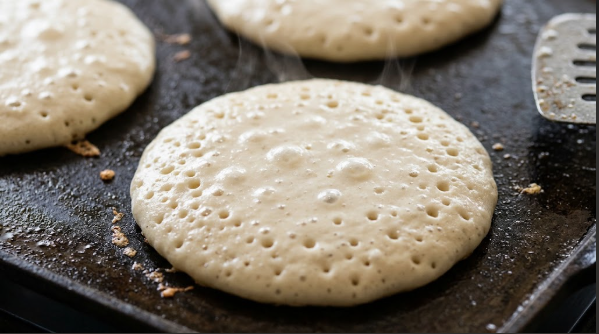
- Wait for the signs. Cook 2 to 3 minutes until bubbles form across the top, some pop and stay open, and the edges look dull and set.
- Flip once. Slide the spatula fully under and turn it in one smooth motion. Don’t press it down.
- Finish the second side. Cook another 1 to 2 minutes until golden and the center springs back when pressed lightly.
- Keep batches warm. Set a wire rack on a sheet pan in a 200°F (95°C) oven and hold finished pancakes in a single layer.
- Re-grease between batches. Wipe the surface and add a little fat as needed.
Pitmaster Tip: Expect the first pancake to be a test. Griddles often run hotter in the center than at the edges, so use the first one to check your heat. If it browns in under 90 seconds, lower the temperature. If it takes more than 3 minutes to color, turn it up a notch.
Common Mistake: Pressing the pancake down with the spatula after flipping. It squeezes out the air you just built and turns a fluffy pancake into a dense disk. Let it cook undisturbed.
Time and Temperature Table
| Step | Target | Time |
| Rest the batter | Room temperature | 5 to 10 minutes |
| Preheat griddle | 350°F (175°C) | 5 to 10 minutes on a flat-top, 3 minutes on a stovetop |
| First side | Bubbles across the top, edges set | 2 to 3 minutes |
| Second side | Golden brown, springs back | 1 to 2 minutes |
| Keep warm | 200°F (95°C) oven | Up to 20 to 30 minutes |
| Cool before storing | Room temperature | Within 2 hours |
| Fridge storage | 40°F (4°C) or below | 3 to 4 days |
| Freezer storage | 0°F (-18°C) | Up to 3 to 4 months for best quality |
How to Tell When Homemade Pancakes Are Done
Don’t rely only on the clock. Watch for the signs.
- Before the flip: Bubbles appear across the surface, and a few have popped and left small holes. The edges lose their shine and look slightly dry.
- Under the spatula: The bottom should be an even golden brown, like toast. If you lift an edge and it’s pale, give it another 30 seconds.
- After the flip: The pancake puffs up a little, and the center springs back when you press it lightly.
For food safety, the egg in the batter needs to be fully cooked. USDA guidance for egg dishes uses 160°F (71°C) as the target. A thin pancake that’s golden on both sides and set in the center is well past that, but you can check with an instant-read thermometer if you’re unsure. Also skip tasting raw batter, since it contains raw egg and raw flour.
Resting, Stacking, and Serving
Pancakes taste best within a few minutes of leaving the griddle. If you’re feeding a group, hold the finished ones on a wire rack in the warm oven rather than stacking them, because stacks trap steam and turn the bottom ones soft.
When you’re ready to serve, stack 3 pancakes and top with a pat of butter. Let it melt for 20 to 30 seconds before adding syrup. Warm maple syrup spreads better and doesn’t cool the pancakes down.
For a nicer plate, try a spoonful of smoked butter on top. The light smoky flavor goes well with sweet syrup and fits right in with a backyard breakfast.
What to Serve With Homemade Pancakes
Pancakes are a blank canvas, so you can go sweet, savory, or both.
Classic Toppings
- Butter and warm maple syrup
- Fresh berries and whipped cream
- Sliced bananas and a drizzle of honey
- Powdered sugar and lemon wedges
Fancy Toppings
- Caramelized bananas. The Blackstone bananas foster recipe is an easy dessert-for-breakfast upgrade.
- Cinnamon apples cooked in butter
- Whipped mascarpone with fruit preserves
Savory Sides
- Crispy bacon or breakfast sausage
- Scrambled or fried eggs
- Fresh fruit salad
- Hash browns or breakfast potatoes
If you’re planning a full breakfast spread, check out these easy breakfast recipes for more ideas, or healthy breakfast ideas if you want a lighter plate on the table.
Storing, Freezing, and Reheating Leftovers
Refrigerating
Cool the pancakes in a single layer on a wire rack, then refrigerate within 2 hours, following USDA FSIS leftover guidance. Store in a sealed container or zip bag, with a sheet of parchment between layers so they don’t stick. Plan to eat them within 3 to 4 days at 40°F (4°C) or below.
Freezing
Freezing works well for pancakes, since they reheat quickly.
- Cool them completely.
- Freeze in a single layer on a sheet pan for 1 hour.
- Move to a freezer bag with parchment between each pancake, and squeeze out the air.
- Label with the date.
Properly packaged leftovers keep their best quality for about 3 to 4 months in the freezer at 0°F (-18°C), per the same FSIS guidance. They stay safe longer, but may dry out.
Reheating
- Toaster or toaster oven: The best option for crisp edges. Reheat frozen pancakes straight from the freezer for 2 to 3 minutes.
- Skillet: Warm over medium-low heat for 1 to 2 minutes per side.
- Oven: Bake on a sheet pan at 350°F (175°C) for 8 to 10 minutes, covered loosely with foil.
- Microwave: Wrap in a damp paper towel and heat 20 to 30 seconds per pancake. They’ll be softer but quick.
USDA recommends reheating leftovers to 165°F (74°C) before eating. Heat them until they’re hot and steaming all the way through.
Variations: Griddle, Pellet Grill, Charcoal, and Oven Backup
This recipe is flexible, and it works on whatever you have.
- Blackstone or flat-top griddle: Preheat to 350°F (175°C), or medium heat. These large surfaces let you cook 6 to 8 pancakes at once. If you’re shopping for one, the Blackstone 22 vs 28 inch comparison can help you pick the right size for your family.
- Pellet grill with a cast iron pan: Heat a cast iron skillet on a pellet grill at 375°F (190°C) for about 10 minutes. Cook the pancakes the same way, but expect a little extra browning.
- Charcoal grill: Set up a two-zone fire and place the skillet over the cooler side, aiming for medium heat. Adjust vents to keep the temperature steady.
- Offset smoker firebox: You can use the flat top of an offset firebox if yours has one. It’s less steady, so keep a close eye on color.
- Oven backup, sheet-pan style: Pour the batter into a greased, rimmed half sheet pan and bake at 400°F (200°C) for 12 to 15 minutes until golden and set . Cut into squares. This is a good way to feed a crowd without standing at the stove.
Flavor Variations
- Blueberry: Fold in ¾ cup (110 g) berries, or sprinkle them onto each pancake just after pouring.
- Chocolate chip: Scatter ½ cup (85 g) mini chips on the pancakes right after pouring so they don’t burn.
- Cinnamon: Add 1 tsp ground cinnamon to the dry ingredients.
- Lemon ricotta: Replace ½ cup (120 ml) of the milk with ½ cup (125 g) ricotta and add 1 tbsp lemon zest.
- Whole wheat: Swap half the flour for whole wheat, and add 2 tbsp more milk because whole wheat absorbs more liquid.
Troubleshooting Homemade Pancakes
| Problem | Likely Cause | Fix |
| Flat pancakes | Old baking powder, or overmixed batter | Use fresh baking powder and mix only 15 to 20 seconds |
| Gummy or rubbery | Too much stirring | Leave lumps in the batter and avoid whisking after combining |
| Burnt outside, raw inside | Griddle too hot | Lower to 350°F (175°C) and let it settle before cooking |
| Pale and thin | Griddle too cool or batter too thin | Preheat longer or add 2 tbsp flour to the batter |
| Won’t bubble | Batter too thin or old baking powder | Check the powder, and let the batter rest 5 to 10 minutes |
| Sticking | Not enough fat or a dirty surface | Wipe clean and re-grease lightly between batches |
| Uneven color | Hot spots on the griddle | Rotate pancakes and use the first one as a heat test |
| Dense and heavy | Too much flour | Spoon and level the flour, or weigh it at 250 g |
| Raw center | Pancakes too thick or flipped early | Spread the batter slightly, and wait for bubbles before flipping |
| Tastes flat | Not enough salt or vanilla | Add a full ½ tsp salt and the vanilla |
Homemade Pancakes Recipe Card
Yield: About 12 four-inch (10 cm) pancakes, 4 servings
Prep time: 15 minutes (plus a 5 to 10 minute rest)
Cook time: 15 to 20 minutes
Total time: about 30 to 40 minutes
Ingredients: 2 cups (250 g) all-purpose flour; 2 tbsp (25 g) sugar; 2½ tsp baking powder; ½ tsp salt; 1¾ cups (420 ml) milk; 2 large eggs; 4 tbsp (57 g) melted butter; 1 tsp vanilla; oil or butter for the griddle.
Steps:
- Whisk the dry ingredients in a large bowl.
- Whisk the wet ingredients in a second bowl.
- Combine them just until mixed, leaving small lumps.
- Rest the batter 5 to 10 minutes.
- Heat the griddle to 350°F (175°C) and grease lightly.
- Pour ¼ cup (60 ml) per pancake.
- Cook 2 to 3 minutes until bubbles form and edges set.
- Flip once and cook 1 to 2 minutes more.
- Keep warm on a rack in a 200°F (95°C) oven and serve right away.
Frequently Asked Questions
What makes homemade pancakes fluffy?
Fresh baking powder and a light hand with the batter. Mix only until the flour disappears, leave small lumps, and rest it 5 to 10 minutes. Then cook on a steady 350°F (175°C) surface and flip only once, without pressing the pancake down.
Should you let pancake batter rest?
Yes. A 5 to 10 minute rest lets the flour hydrate and the baking powder start working, which gives you a thicker batter and more lift. It also relaxes the gluten, so the pancakes cook up more tender. You’ll see small bubbles on the surface when it’s ready.
What temperature should a griddle be for pancakes?
Aim for 350°F (175°C), or medium heat on a stovetop. A drop of water should sizzle and dance across the surface. If pancakes brown in under 90 seconds, turn it down. If they take over 3 minutes to color, turn it up slightly.
Can you make pancake batter the night before?
You can, but it’s not ideal. Baking powder starts working as soon as it’s wet, so the rise fades overnight. For the best result, mix the dry ingredients ahead of time and store them in a jar, then add the wet ingredients in the morning.
How long do homemade pancakes last in the fridge?
They last 3 to 4 days when stored in an airtight container at 40°F (4°C) or below, following USDA leftover guidance. Cool them within 2 hours of cooking first. For longer storage, freeze them in a single layer, then bag them with parchment between each.
How do you reheat pancakes so they stay soft?
Use a toaster for crisp edges, a skillet over medium-low heat for 1 to 2 minutes per side, or an oven at 350°F (175°C) for 8 to 10 minutes, covered with foil. In the microwave, wrap pancakes in a damp paper towel and heat 20 to 30 seconds.
Conclusion
Great homemade pancakes don’t need a mix or a trick. Use fresh baking powder, mix the batter briefly, rest it, and cook on a steady 350°F (175°C) surface. Flip once when the bubbles pop, and keep finished batches on a rack so they stay crisp at the edges.
Once you’ve got the base recipe down, you can add fruit, chocolate chips, or spices, or take it outside to the griddle. Cool leftovers within 2 hours, refrigerate them for 3 to 4 days, or freeze them for quick breakfasts later. Now, fire up the griddle and make a batch of homemade pancakes.
Laura Smith

I'm Laura, I like all the kind of delicious grilled foods which makes me hungry all the time I see them. That's why I built this blog to share with you all of my Grilling experiences, recipes, and all the tips about foods that I've learned from food experts.