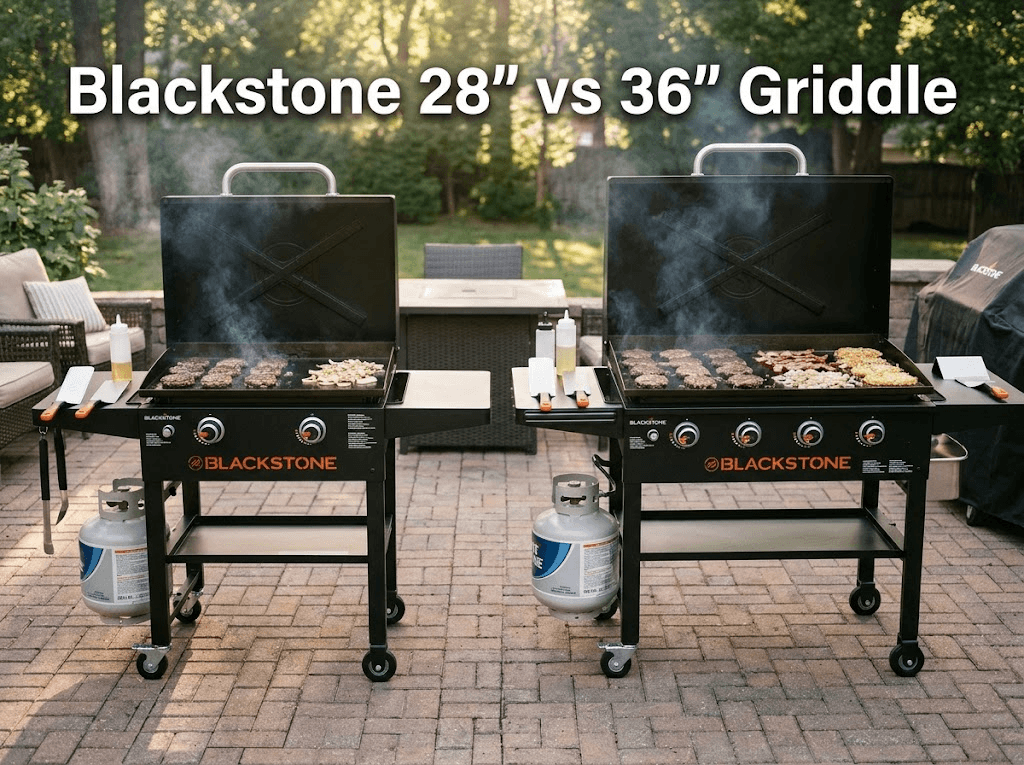
The Blackstone 28 vs 36 inch decision comes down to three things: how many people you cook for, how much patio space you have, and how often you cook more than one thing at the same time. Both griddles use the same basic design, the same style of cold-rolled steel top, and a lot of the same accessories. The difference is room to work.
The 28 inch is the compact, easy-to-store option that fits most families. The 36 inch gives you more heat zones and a lot more room for crowds. Below, you’ll find a side-by-side breakdown of specs, cooking performance, propane use, cleanup, and cost, plus a clear recommendation at the end.
Quick Answer: Blackstone 28 vs 36 Inch
Choose the 28 inch for households of 2 to 5, smaller patios, and tighter budgets. Choose the 36 inch if you regularly feed 6 or more, cook several foods at once, or want four separate heat zones. Both cook great. The 36 inch simply gives you more space and more control.
Blackstone 28 vs 36 Inch: Side-by-Side Comparison
Specs change by model, year, and retailer. Blackstone sells several versions of each size, including Original, Omnivore, XL, Culinary, and Iron Forged lines. Retailer listings for the same size sometimes disagree, so treat the numbers below as typical ranges, and confirm the exact model you’re buying against the product page or manual.
| Feature | Blackstone 28 inch | Blackstone 36 inch |
| Cooking surface | About 470–524 sq in (about 612 sq in for the XL 3-burner) | About 720–768 sq in |
| Burners / heat zones | 2 (3 on XL) | 4 |
| Total BTU output | About 34,000 (48,000 on XL) | About 60,000 on most models |
| Cooking surface size | About 28¾” × 18¼” | About 35¾” × 21½” |
| Typical burger capacity | About 20–24 | About 28–35 |
| Best for | Small families, small patios, budget buyers | Large families, entertaining, multi-zone cooking |
| Typical price range | About 300–500 | About 400–650 |
| Ease of storage | Easier | Needs more room |
Key Differences
Cooking Space
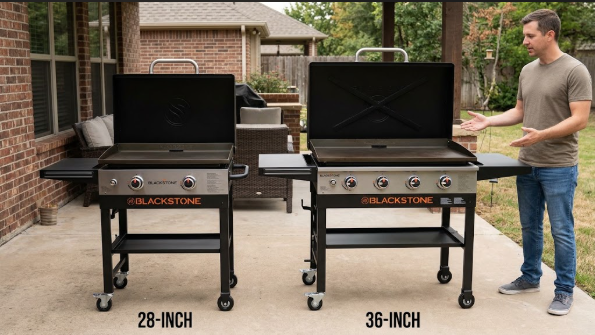
This is the biggest difference. A 28 inch griddle gives you roughly 500 square inches of flat top, which is enough for a full family breakfast or a dozen smash burgers at once. The 36 inch has about 40% more surface, which is a big jump.
More surface means you can cook proteins and sides at the same time. On the 28, you’re often cooking in rounds: burgers first, then onions, then buns. On the 36, everything finishes together.
Heat Zones and Control
The 28 inch has two burners, so you get two zones: roughly a left and right side. That’s enough to run one side hot for searing and one side lower for keeping food warm.
The 36 inch has four burners and four zones. You can run one zone at 450°F (232°C) for smash burgers, another at 350°F (177°C) for pancakes, a third at 300°F (149°C) for eggs, and leave the last one off as a landing spot for finished food. That level of control is the main reason experienced Blackstone owners move up to the 36.
Pitmaster Tip: On any Blackstone, make a “cool zone” by turning one burner to low or off. It gives you somewhere to park cooked food and clear the main cooking area without overcooking things.
Heat Output (BTU) and Heat-Up Time
Total BTUs matter less than how they’re spread across the surface. The 28 inch puts about 34,000 BTUs across two burners. The 36 inch commonly puts about 60,000 across four. Per square inch, they’re close, so both can hit smash-burger heat.
In practice, the 36 inch takes a bit longer to preheat because it has more steel to heat. Expect roughly 8 to 12 minutes to reach 400°F (204°C) on either size, with the 36 inch on the longer end. These are typical estimates, so use an infrared thermometer to check your own surface.
Propane Use
A bigger griddle with more burners can use more propane, but only if you run all four burners at full blast. A 20 lb (9 kg) tank holds roughly 430,000 BTUs of fuel. At full power, that’s about 12 hours on a 34,000 BTU griddle and about 7 hours on a 60,000 BTU one. Real use is lower because you rarely run everything on high.
If you only use two burners on the 36 inch for a small meal, your fuel use will be close to a 28 inch. The extra burners cost you nothing until you use them.
Even Heating
Both sizes use thick steel and are designed for even heat, but every griddle has some variation. Larger flat tops can show more hot and cold spots, particularly toward the edges and corners. That’s normal.
To work with it, preheat for a full 10 minutes, then use a thermometer to map your surface. Note where the hottest spot is, and keep your delicate foods away from it.
Portability and Storage
The 28 inch is easier to move and fits on a smaller patio, a balcony, or in a garage corner. Many 28 inch models weigh in the 80–90 lb (36–41 kg) range with cart and hood]. Plan to roll or lift it with another person if you’ll be loading it into a vehicle.
The 36 inch is wider, heavier, and takes up real room. Measure your patio, your door frames, and your storage space before you buy.
Cleaning and Maintenance
A bigger surface means more steel to scrape, wipe, and re-oil. The routine is identical, but the 36 inch simply takes longer. Plan on roughly 5 to 10 extra minutes for a full cleanup after a big cook.
Both sizes have a rear grease management system, so the grease runs into a catch cup. Empty it regularly. A good cover also matters more than you’d think, and our guide to the best heavy-duty grill covers explains what to look for.
Accessories
Spatulas, scrapers, squeeze bottles, and presses work on both. The difference comes with covers, hoods, and any size-specific add-ons such as a cover or an enclosure. Always check that an accessory is made for your exact size and model.
What You Can Cook: Real-World Capacity
Here’s what each size handles in a single round. These are estimates, so use them as a guide.
| Food | 28 inch | 36 inch |
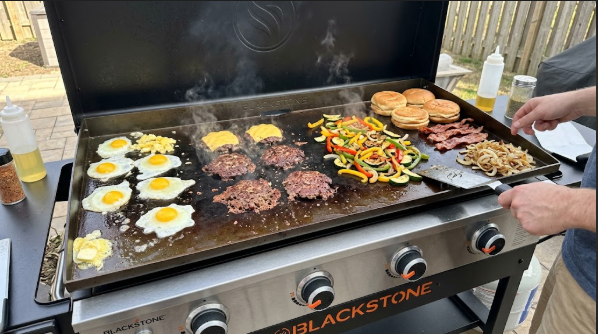
| Smash burgers (3 oz / 85 g patties) | About 12–16 with room to flip | About 20–24 |
| Pancakes (4 in / 10 cm) | About 10–12 | About 16–20 |
| Fajita or stir-fry for | 4–5 people | 8–10 people |
| Full breakfast (eggs, bacon, hash browns) | 4–5 people | 8–10 people |
| Hot dogs | About 20–28 | About 36–72 |
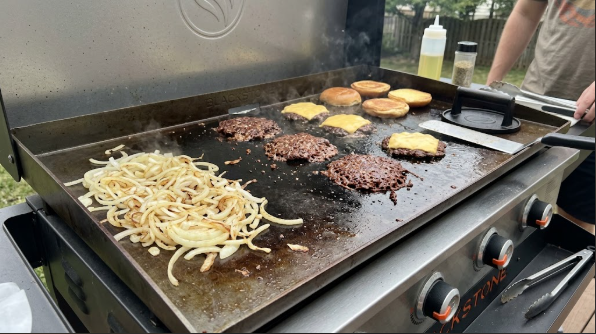
For burgers, the USDA’s safe minimum internal temperature for ground beef is 160°F (71°C), and for chicken it’s 165°F (74°C). A thin smash patty gets there in a couple of minutes, but chicken needs more care. Use an instant-read thermometer, and read the USDA’s guidance on using a food thermometer for the correct technique.
Common Mistake: Overcrowding the griddle. Even on a 36 inch, packing the surface full of cold food drops the steel temperature, and your food steams instead of searing. Cook in batches, and leave space between items.
When to Choose the Blackstone 28 Inch
The 28 inch makes sense if:
- You cook for 2 to 5 people. A couple or small family rarely needs more than 500 square inches.
- Your patio is small. It’s easier to fit, store, and move.
- You’re on a tighter budget. The upfront price is lower, and so are the cover and accessory costs.
- You mostly cook one meal at a time. Breakfast, burgers, or a stir-fry fits easily.
- You’re new to griddle cooking. A smaller surface is quicker to learn, preheat, and clean.
If you’re also weighing other outdoor cookers, our list of the best pellet grills for beginners can help you decide whether a griddle alone is enough or you want a smoker too.
When to Choose the Blackstone 36 Inch
The 36 inch is the better pick if:
- You feed 6 or more people regularly. More surface means fewer batches and less waiting.
- You like to cook several foods at once. Four zones let you run proteins, vegetables, and eggs together.
- You entertain often. If you plan a lot of cookouts, our tips for hosting a summer BBQ party at home on a budget pair well with a bigger griddle.
- You want hibachi-style cooking. Cooking rice, protein, and vegetables side by side is easier on a larger surface.
- You have the space. You’ll need room for the griddle, a cover, side prep space, and a propane tank.
Features Worth Comparing Between Models
Before you buy either size, check these:
- Hood or no hood. A hood protects the surface and can help melt cheese or steam vegetables. Not every model includes one.
- Burner count on the 28. The XL 3-burner version of the 28 inch adds a zone and more BTUs, closing part of the gap with the 36.
- Side shelves and a front shelf. Prep space matters more than you’d expect.
- Propane tank placement. Cabinet models hide the tank, and cart models leave it exposed.
- Side burner. Some setups add a side burner for sauces or boiling. If you’re curious what it’s for, read about what a side burner on a gas grill is used for.
- Warranty. Blackstone’s warranty terms vary by model and region, so confirm the details in the manual.
Cost Comparison
Prices vary by retailer, season, and model, so use ranges as a starting point. [VERIFY all prices before publishing.]
| Cost item | 28 inch | 36 inch |
| Griddle (typical range) | About 300–500 | About 400–650 |
| Cover | About 30–60 | About 35–70 |
| Starter accessory kit | About 25–60 | About 25–60 |
| Propane (20 lb refill/exchange) | Varies by area | Varies by area |
The price gap between sizes is often smaller than people expect, especially during sales. When the difference is $50 to $150, the extra cooking space of the 36 inch is often a better value, as long as you have the room. The 28 inch is the smarter pick if space or budget is tight.
Remember the ongoing costs: seasoning oil, scrapers, squeeze bottles, a cover, and propane. These are similar for both sizes.
How to Decide in Two Minutes
Ask yourself these questions:
- How many people do I cook for most often? Up to 5: 28 inch. Six or more: 36 inch.
- How much space do I have? If your patio is small, the 28 inch is safer.
- Do I cook multiple foods at once? If yes, lean toward the 36 inch.
- Will I move or store it often? If yes, lean toward the 28 inch.
- What’s my budget, including cover and accessories? Add up the full cost, not just the griddle.
If you land in the middle, such as four people who like to cook big weekend breakfasts, either works. In that case, choose based on space. A griddle you can’t fit comfortably is one you won’t use.
Seasoning and First Cook on Either Size
Both griddles ship with bare steel, so you’ll need to season before the first cook. The process is the same:
- Wash the top with warm soapy water, then dry it completely.
- Heat the griddle on medium-high until the steel starts to darken.
- Wipe on a very thin layer of cooking oil (flaxseed, avocado, or a seasoning blend) with a paper towel and tongs.
- Let it smoke, then repeat 3 to 5 times until the surface turns a deep, even bronze or black.
The 36 inch takes a little longer because there’s more surface, but the steps don’t change. After every cook, scrape off food, wipe the surface while it’s still warm, and add a thin film of oil. If you’re new to gas appliances in general, our guide on how to start a grill covers safe lighting basics.
FAQ
What size Blackstone griddle should I buy?
For most households of two to five people, the 28 inch is plenty. If you regularly cook for six or more, or you want four separate heat zones, step up to the 36 inch. Your patio space and budget should be the tiebreakers.
Is the 36 inch Blackstone worth it over the 28 inch?
It’s worth it if you feed larger groups, cook multiple foods at once, or entertain often. You get roughly 40% more surface and four heat zones. If you cook for a small family and have limited space, the 28 inch is the better value.
How many burgers fit on a Blackstone 28 inch?
Around 12 to 16 smash burgers fit comfortably with room to flip. Some retailer listings claim 20 or more, but crowding drops the temperature and hurts your sear. Cook in batches for the best crust.
Does the 36 inch Blackstone use more propane?
Only if you run all four burners at full power. It has a higher maximum BTU output, but if you use two burners for a small meal, fuel use is similar to the 28 inch. A 20 lb tank lasts many hours either way.
Can a family of four use a 28 inch griddle?
Yes. A 28 inch griddle handles a full family breakfast, a dozen burgers, or a big stir-fry for four. It becomes limiting mainly when you host large groups or want to cook several separate dishes at once.
Do accessories fit both sizes?
Most hand tools, like spatulas, scrapers, and squeeze bottles, work on both sizes. Covers, hoods, and enclosures are size-specific, so always match the accessory to your exact griddle size and model before buying.
Conclusion: The Blackstone 28 vs 36 Inch Verdict
The Blackstone 28 vs 36 inch choice isn’t about which griddle is better. It’s about which one fits your life. Pick the 28 inch if you cook for two to five people, have limited space, or want the lower price. Pick the 36 inch if you feed bigger groups, want four heat zones, and have the patio room.
If you’re still stuck, our recommendation is simple: if you have the space and budget, buy the 36 inch. You’ll rarely wish you had less room, but you’ll often wish you had more. If space or budget is tight, the 28 inch is a great griddle that will serve most families well.
Laura Smith

I'm Laura, I like all the kind of delicious grilled foods which makes me hungry all the time I see them. That's why I built this blog to share with you all of my Grilling experiences, recipes, and all the tips about foods that I've learned from food experts.