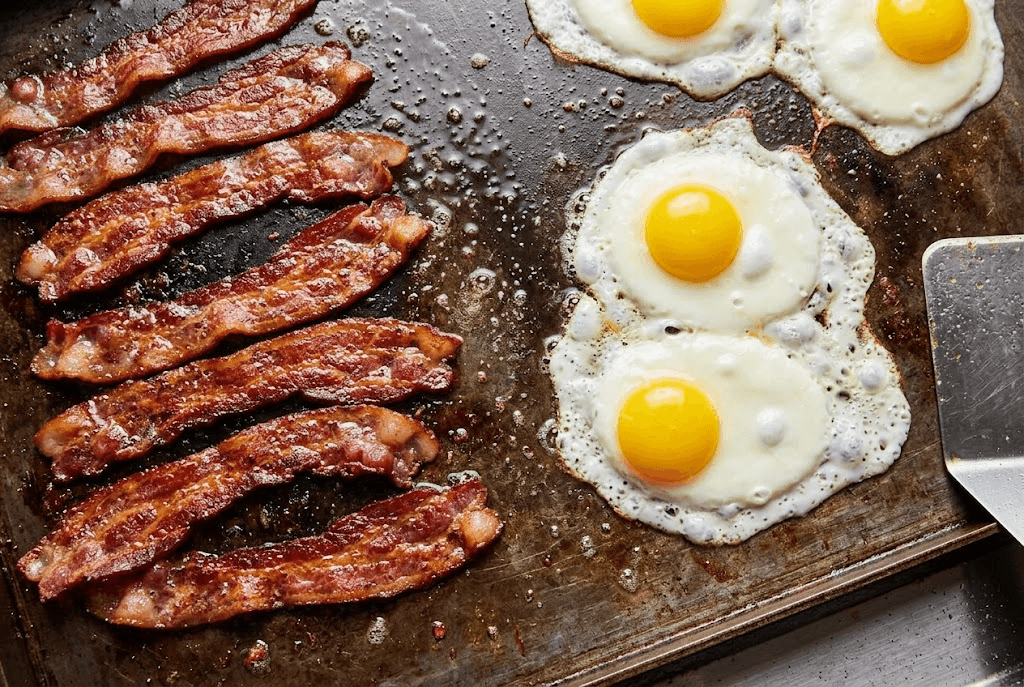
Blackstone bacon and eggs is the breakfast that made a lot of people buy a flat top in the first place. You get a huge cooking surface, steady heat, and room to cook bacon and eggs side by side, so everything hits the plate hot at the same time.
This guide shows exactly how to cook bacon and eggs on a Blackstone griddle: the surface temperatures, the timing, the order of operations, and the fixes for sticking, flare-ups, and rubbery whites. Follow the steps once and you will not need a recipe again.
Quick Answer
Blackstone bacon and eggs: Preheat the griddle to 325°F (163°C) for bacon and 275°F (135°C) for eggs. Cook bacon 8-12 minutes, flipping often, until crisp. eggs in a little bacon fat for 2-3 minutes. eggs until the whites and yolks are firm, per USDA guidance.
Why This Blackstone Bacon and Eggs Method Works
Most bad griddle breakfasts come from one problem: one heat setting for two foods that want different temperatures. Bacon needs moderate heat so the fat renders slowly and the meat crisps without burning. Eggs need gentler heat so the whites set without turning brown and tough.
This method uses a two-zone setup. One side of the griddle runs hotter for bacon, and the other side runs cooler for eggs. The bacon fat that renders on the hot side gets moved to the cool side and becomes your egg cooking fat, so you do not need much extra oil.
There are three other reasons it works:
- Steel holds heat. Once the cold-rolled steel top is fully preheated, it recovers fast when food hits it, so bacon sizzles instead of steaming.
- A flat surface means even contact. Bacon lies flat and browns edge to edge, unlike in a pan where it bunches up.
- You control the order. Bacon goes on first, eggs go on late, and nothing sits around getting cold.
Ingredients and Equipment
Ingredients (serves 4)
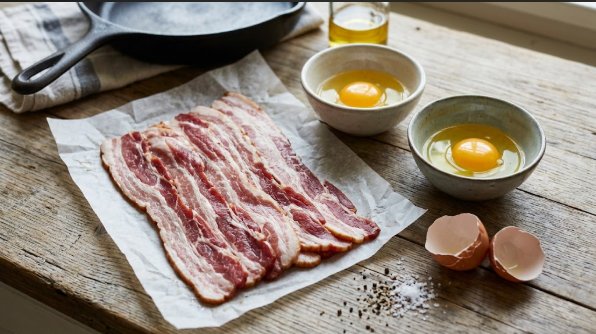
- 1 lb (0.45 kg) bacon, regular or thick-cut
- 8 large eggs (use pasteurized eggs if you like runny yolks)
- 2 tbsp butter or avocado oil, only if needed
- Black pepper, to taste
- Optional: 4-8 slices of bread, 1 tbsp chives, hot sauce
Equipment
- Blackstone griddle (any size, 28-inch or 36-inch)
- Propane supply with at least a quarter tank
- Infrared thermometer for checking surface temperature
- Long metal spatula and a bench scraper
- Squeeze bottle for oil or water
- Egg rings (optional, for neat edges)
- Basting dome or large metal bowl for steaming eggs
- Heat-safe cup or paper towels for extra grease
- Instant-read thermometer for checking scrambled eggs
Substitutions
| Ingredient | Swap | Note |
| Regular bacon | Thick-cut bacon | Add 3-5 minutes |
| Bacon | Turkey bacon | Needs 1 tbsp oil, browns faster |
| Butter | Avocado oil | Better at higher heat |
| Eggs | Egg whites or liquid eggs | Cook as scramble, 3-4 minutes |
| Bread | English muffins | Toast in leftover bacon fat |
Choosing and Prepping the Bacon and Eggs
Picking the bacon
Regular-cut bacon cooks fast and crisps evenly, which makes it the easiest choice for a first run. Thick-cut bacon gives you chewier, meatier strips but needs more time and a lower heat. Smoked varieties like hickory or applewood add flavor without any extra work.
Look for strips with an even balance of meat and fat. Very fatty bacon shrinks more and leaves a lot of grease on the steel.
Prepping the bacon
Pull the bacon out of the fridge 10-15 minutes before cooking. Slightly cool bacon separates easily, while bacon straight from a cold package tears. Cut a full pound of strips in half if you want them to fit more easily across the griddle and turn faster.
No brining or seasoning is needed. Bacon is already cured and salty. Wait on black pepper until after cooking, since pepper can scorch on hot steel.
Prepping the eggs
Crack eggs into a bowl or small ramekins first. This lets you spot shell bits and keeps yolks whole when you pour them onto the griddle. For scrambled eggs, whisk with a splash of water, not milk, which can brown and stick on hot steel.
Keep eggs refrigerated until you are ready. The USDA recommends keeping eggs at 40°F (4°C) or below and not leaving them out more than 2 hours.
Step-by-Step Blackstone Bacon and Eggs
1. Season and preheat
Clean the griddle with a scraper and wipe it down. If it looks dry or gray, rub on a thin coat of oil. Light the burners and preheat on medium for 8-10 minutes with the lid or hood open if you have one.
Set up two zones. Left side on medium-low, right side on low. Check with the IR thermometer. You want about 325°F (163°C) on the bacon side and 275°F (135°C) on the egg side.
2. Lay out the bacon
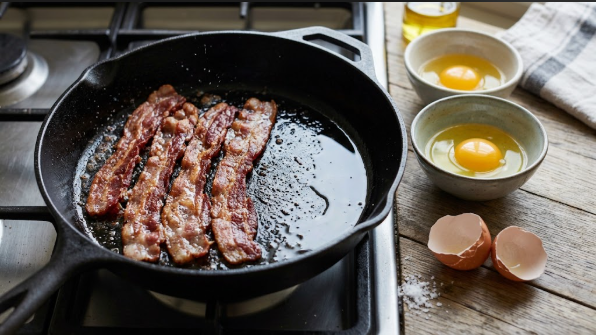
Place strips on the hot side in a single layer with a small gap between them. They should sizzle softly right away. If the sizzle sounds like a roar, turn the heat down.
Do not crowd the surface. Bacon that overlaps steams and stays pale.
3. Flip and move the bacon
After 3-4 minutes, flip the strips. Slide any ones that are browning too fast toward a cooler edge. Strips in the center usually cook faster than strips at the edges, so rotate them.
Regular bacon takes 8-12 minutes total. Thick-cut takes 12-16 minutes. Flip every 2-3 minutes after the first turn so both sides brown evenly.
4. Drain the grease
As the fat renders, it pools and the bacon begins to fry in it. Use the scraper to push most of the grease toward the grease trap. Leave a thin film on the egg zone, about 1 tbsp, to cook the eggs in.
Move finished bacon to a paper-towel-lined plate or a wire rack.
5. Start the eggs
When the bacon is about two-thirds done, start the eggs on the cooler side. Drop a small knob of butter or spread bacon fat. Pour or slide each egg onto the surface. For neat circles, set egg rings first and fill them.
The white should turn opaque at the edge within 20-30 seconds with a faint hiss. If it spits and browns, the surface is too hot.
6. Cook to your style
- Sunny side up: 2-3 minutes. Cover with a dome for the last 30-45 seconds to set the top of the white.
- Over easy: 2 minutes, flip, then 20-30 seconds more.
- Over medium: 2 minutes, flip, then 45-60 seconds more.
- Over hard: 2 minutes, flip, break the yolk gently, then 60-90 seconds more.
- Scrambled: Pour on the surface, fold continuously with the spatula for 2-3 minutes until just set and no liquid egg remains.
To be safe, the USDA says to cook eggs until the yolks and whites are firm , and egg dishes should reach 160°F (71°C). If you eat runny yolks, choose pasteurized eggs.
7. Toast the bread (optional)
In the last 2 minutes, lay bread in the leftover bacon fat on the warm zone. Toast 60-90 seconds per side until golden. It will taste like a diner.
8. Plate and serve
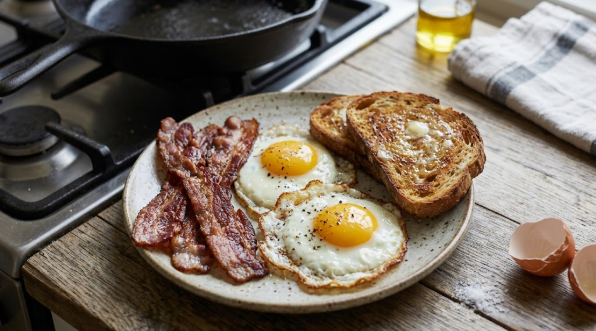
Slide eggs onto plates, stack the bacon, and serve immediately. Finish with pepper and chives.
Pitmaster Tip: Cook the bacon in a gentle sizzle, not a hard sear. Bacon that starts too hot curls, burns at the edges, and stays chewy in the middle. If you want flat strips, rest a second spatula or a bacon press lightly on top for the first 2 minutes.
Common Mistake: Cranking every burner to high. A Blackstone heats fast, and high heat turns bacon bitter and makes eggs rubbery with brown, crispy bottoms. Keep the burners at medium or lower, and check the steel with a thermometer instead of guessing.
Time and Temperature Table
| Item | Surface temp | Time | Done when |
| Regular bacon | 325°F (163°C) | 8-12 min | Deep amber, crisp edges |
| Thick-cut bacon | 300-325°F (149-163°C) | 12-16 min | Browned, firm but not brittle |
| Turkey bacon | 325°F (163°C) | 6-8 min | Golden, slightly crisp |
| Sunny side up | 275°F (135°C) | 2-3 min | Set white, jiggly yolk |
| Over easy | 275°F (135°C) | 2 min + 30 sec | Set white, runny yolk |
| Over hard | 275°F (135°C) | 3.5-4 min | Fully firm yolk |
| Scrambled | 275°F (135°C) | 2-3 min | No visible liquid, 160°F (71°C) |
| Toast | 300°F (149°C) | 2-3 min | Golden brown |
How to Tell When It’s Done
Bacon: There is no internal temperature to hit, since bacon is cooked for texture. The strip should be a deep amber, the bubbles in the fat should slow down, and the edges should look slightly dried. Lift a strip with the spatula. It should droop a little when hot and snap once it cools for a minute.
Pull it just before it reaches the crispness you want. Bacon keeps crisping as it cools, and it goes from perfect to burnt quickly on hot steel. The USDA’s bacon guidance notes that bacon is a raw product that must be cooked before eating.
Fried eggs: The white should be fully opaque with no clear, jelly-like patches. A sunny-side-up yolk should wobble when you nudge the plate. For firm yolks, press the center gently with the spatula. It should feel set, not squishy.
Scrambled eggs: They should look soft and glossy with no wet liquid pooling. Check a thick portion with an instant-read thermometer for 160°F (71°C), the USDA safe minimum for egg dishes.
Resting, Slicing, and Serving
Bacon does not need a long rest, but give it 1-2 minutes on paper towels or a rack so the surface fat sets and the strips firm up. Do not stack hot bacon in a tight pile, since the trapped steam softens it.
Eggs should go straight from the griddle to the plate. They continue to cook from residual heat, so scoop them out a few seconds before they look finished.
Serve on warm plates if you can. A warm plate keeps the yolk runny and the bacon crisp for the first few bites. For a crowd, hold finished bacon on a rack in a 200°F (93°C) oven while you finish the eggs.
What to Serve with Blackstone Bacon and Eggs
The griddle makes it easy to cook everything at once. Add these in the open space while the eggs finish:
- Hash browns or breakfast potatoes: Start these first on the hot zone. Shredded potatoes take 8-10 minutes to crisp.
- Griddle toast or English muffins: Toast in leftover bacon fat for extra flavor.
- Sliced tomatoes: Sear for 1-2 minutes per side.
- Fresh fruit: Melon, berries, or orange slices cut the richness.
- Pancakes: Cook on the medium-low zone at about 350°F (177°C), 2-3 minutes per side.
- Corn bread: For a Southern-style brunch, try our corn bread recipe on the side.
- Coffee and juice: The only thing you do not make on the griddle.
Storing, Freezing, and Reheating Leftover Blackstone Bacon and Eggs
Leftovers are best kept simple. Cool the food quickly and refrigerate within 2 hours. The USDA says leftovers last 3-4 days in the refrigerator , and that is the safest window for cooked eggs.
- Bacon: Store cooked strips in an airtight container with paper towels between layers. Freeze for longer storage.
- Eggs: Best eaten fresh. Cooked scrambled eggs reheat acceptably, but fried eggs turn rubbery.
- Reheating: Heat all leftovers to 165°F (74°C), the USDA’s reheating temperature. A toaster oven at 350°F (177°C) for 3-5 minutes re-crisps bacon better than a microwave.
Variations
Pellet grill method
If you do not have a griddle, you can cook bacon on a pellet grill. Our guide to bacon on a pellet grill covers temperature and time, and it adds a light smoke flavor. A beginner-friendly pellet grill works for this too.
Stovetop pan backup
No outdoor setup? Use a large nonstick or cast iron pan over medium-low heat. A quality pan such as the ones in our Henckels granitium pan review will cook eggs without sticking. If you use an electric range, check our notes on nonstick pans on electric stoves.
Oven backup for bacon
Lay strips on a rimmed sheet pan and bake at 400°F (204°C) for 15-20 minutes. It is hands-off and very flat, though you lose the griddle crust.
Flavor twists
- Maple bacon: Brush with maple syrup in the last 2 minutes. Watch carefully since sugar burns fast.
- Peppered bacon: Press on cracked pepper before the final flip.
- Breakfast sandwich: Stack bacon, a fried egg, and cheese on a toasted English muffin. Melt the cheese under a dome for 30 seconds.
- Bacon-wrapped egg cups: Line muffin rings with half a strip, crack an egg in the center, and cook covered for 5-6 minutes.
Troubleshooting
| Problem | Likely cause | Fix |
| Eggs stick to the steel | Surface too dry or not hot enough | Add 1 tsp fat per egg, let the steel hold 275°F (135°C) |
| Bacon curls and cooks unevenly | Heat too high | Lower burners, use a press for 2 minutes |
| Bacon stays chewy | Surface too cool or strips overlapping | Raise heat slightly, spread strips out |
| Eggs have brown, crispy bottoms | Egg zone too hot | Drop heat to 250-275°F (121-135°C) |
| Rubbery whites | Overcooked | Cook less time, dome for last 30 seconds |
| Grease flare-ups | Fat pooling next to burners | Push grease to the trap often, keep a spray bottle of water ready |
| Smoky griddle | Old burned-on residue | Scrape clean and re-season before cooking |
| Bacon tastes bitter | Overheated fat | Wipe burned grease off, lower heat |
If bacon smell lingers in your clothes or kitchen after cooking, our tips for removing kitchen odors can help.
Cleanup
Cleaning a Blackstone after bacon is easy if you do it while the steel is still warm. Scrape grease toward the trap, then pour a little water on the steel and scrape the residue away. Wipe with paper towels and apply a very thin coat of oil to protect the surface. Do not leave bacon grease sitting in the trap for days.
Recipe Card: Blackstone Bacon and Eggs
Prep time: 10 minutes Cook time: 15 minutes Total time: 25 minutes Servings: 4 Griddle temps: 325°F (163°C) bacon zone, 275°F (135°C) egg zone
Ingredients
- 1 lb (0.45 kg) bacon
- 8 large eggs
- 2 tbsp butter or oil, as needed
- Salt-free pepper to finish
- Optional bread, chives, hot sauce
Steps
- Preheat griddle to two zones: 325°F (163°C) and 275°F (135°C).
- Lay bacon in a single layer on the hot zone.
- Flip after 3-4 minutes, then every 2-3 minutes until crisp (8-12 minutes).
- Push extra grease to the trap, leaving about 1 tbsp.
- Cook eggs on the cool zone for 2-3 minutes, to your preferred doneness.
- Check scrambled eggs reach 160°F (71°C), and cook whites and yolks until firm.
- Plate immediately and serve hot.
FAQ
What temperature do you cook bacon on a Blackstone?
Cook bacon at about 325°F (163°C) on the griddle surface, using medium-low heat. This renders the fat slowly and crisps the strips without burning. Thick-cut bacon does better at 300-325°F (149-163°C). Check with an infrared thermometer, since the knob setting alone is not reliable.
Do you cook bacon or eggs first on a griddle?
Cook the bacon first. It takes longer, and its rendered fat becomes the cooking fat for the eggs. Start eggs when the bacon is about two-thirds done. That way, both finish at the same moment, and nothing sits long enough to go cold or soggy.
How do you keep eggs from ssticking to a Blackstone?
Preheat the steel fully, hold it near 275°F (135°C), and use a thin layer of bacon fat, butter, or oil under each egg. Make sure the griddle is well seasoned. Let the egg set for at least 30 seconds before you try to move it.
How long does bacon take on a Blackstone?
Regular-cut bacon takes 8-12 minutes, flipping every 2-3 minutes. Thick-cut needs 12-16 minutes. Timing depends on the actual surface temperature, strip thickness, and wind or weather. Pull it when it is deep amber and crisp at the edges.
Is it safe to eat runny eggs from a griddle?
The USDA advises cooking eggs until the yolks and whites are firm, and egg dishes to 160°F (71°C). If you prefer runny yolks, use pasteurized eggs and keep them refrigerated. Higher-risk groups, including young children, older adults, and pregnant people, should eat fully cooked eggs.
How long do leftover bacon and eggs last?
Cooked bacon and eggs keep 3-4 days in the refrigerator when stored within 2 hours of cooking, according to USDA leftover guidance. Reheat to 165°F (74°C) before eating. Eggs lose texture, so scrambled holds up better than fried. Freeze bacon for longer storage.
Conclusion
Great Blackstone bacon and eggs comes down to three things: a preheated, two-zone griddle, moderate heat, and good timing. Start the bacon first, move the grease to the cool side, and drop the eggs in when the bacon is nearly done.
Once you have the temperatures dialed in, this breakfast takes about 25 minutes and feeds a crowd. Try the variations, such as a breakfast sandwich or maple bacon, and make Blackstone bacon and eggs your weekend routine.
Laura Smith

I'm Laura, I like all the kind of delicious grilled foods which makes me hungry all the time I see them. That's why I built this blog to share with you all of my Grilling experiences, recipes, and all the tips about foods that I've learned from food experts.