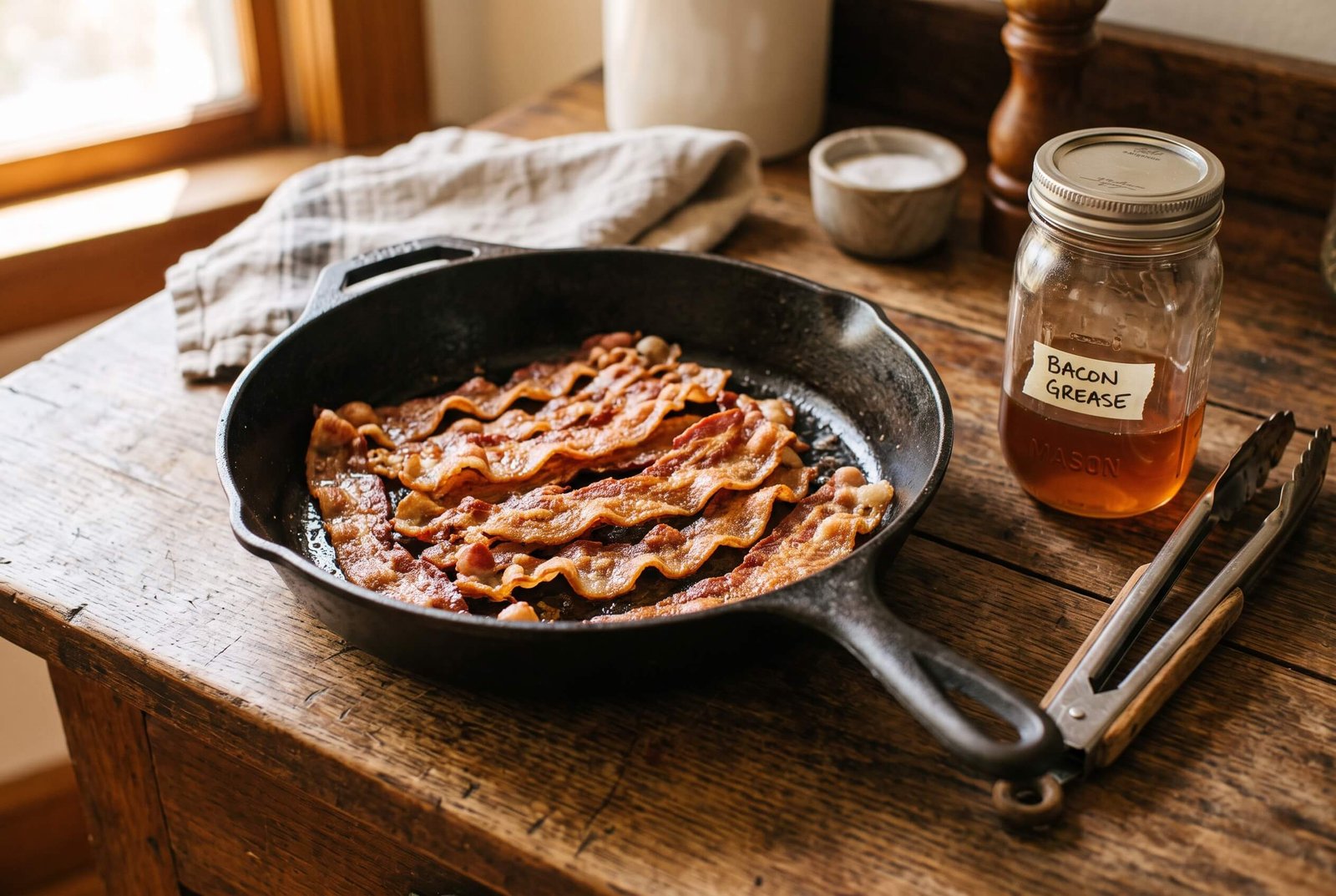
Cast iron bacon is the easiest way to get crisp edges, chewy centers, and strips that lie flat instead of curling into pretzels. A heavy skillet holds steady heat, so the fat renders slowly instead of scorching. You also end up with clean, flavorful bacon grease to use all week.
The method for perfect cast iron bacon is simple: start cold, keep the heat at medium-low, and flip often. This guide covers the pan, the heat, the timing, and fixes for every common problem. It works on a stove, in the oven, or on a grill.
QUICK ANSWER For cast iron bacon, lay strips in a cold skillet, heat to medium-low (about 300-325°F / 149-163°C), and cook 10-15 minutes for regular-cut or 15-20 for thick-cut, flipping every 3-4 minutes. Drain on paper towels. Bacon is cured, so judge doneness by color and crispness.
Why Cast Iron Bacon Works So Well
Bacon is roughly half fat. Your goal with cast iron bacon is to melt that fat slowly so the meat crisps in it. Cast iron is perfect for this because it is heavy and holds heat evenly.
A thin pan swings hot and cold. The fat flashes, the edges burn, and the middle stays rubbery. A cast iron skillet absorbs the burner’s heat and spreads it across the whole cooking surface, so strips brown at the same pace.
Here is what you gain by using cast iron:
- Even browning. Thick metal evens out hot spots from a gas flame or electric coil.
- Better crunch. Steady heat renders fat without steaming the meat.
- Great grease. The fat stays clean and amber instead of scorched.
- Free seasoning. Bacon fat adds a thin layer of oil to the pan each time you cook.
- Flexibility. The same skillet goes from stove to oven to grill.
Ingredients and Equipment for Cast Iron Bacon
You need very little for cast iron bacon. The pan and the bacon do the work.
Ingredients
- 1 lb (0.45 kg) bacon, about 12-16 regular-cut strips or 10-12 thick-cut strips
- Optional: 1-2 tbsp (15-30 ml) maple syrup, 1 tbsp (14 g) brown sugar, or black pepper
Equipment
- A 10- or 12-inch (25 or 30 cm) cast iron skillet
- Tongs (long ones keep your hands away from splatter)
- Paper towels and a plate, or a wire rack over a sheet pan
- A heat-safe jar for the grease, with a fine-mesh strainer
- Optional: a splatter screen, a bacon press, an infrared thermometer
Substitutions
- No 12-inch skillet? Use a 10-inch and cook in two batches. Do not crowd it.
- No bacon press? Rest a smaller pan or a foil-wrapped brick on the strips.
- No wire rack? Stack paper towels on a plate. It works fine for a quick breakfast.
- Turkey bacon? It has little fat, so add 1 tsp of oil to the pan and expect a shorter cook.
If you cook on an electric range, you may wonder if cast iron is a good match. It is, though the burner cycles on and off, so watch the heat. Our guide on nonstick pans on an electric stove explains how those burners behave.
Choosing and Prepping Your Bacon
The bacon you buy changes how long it takes and how crisp it gets. Here is how the common types behave.
Regular-Cut vs. Thick-Cut
Regular-cut bacon is about 1/16 inch (1.5 mm) thick and cooks fast. It gets crisp and shatters easily. Thick-cut is closer to 1/8 inch (3 mm) and stays chewier in the center. It takes five to eight minutes longer and releases more fat.
Cure and Flavor Matter
Sugar-cured and maple bacon browns faster because the sugar caramelizes. Drop your heat a notch with those. Applewood- and hickory-smoked bacon cook the same as plain bacon, but the smoky flavor stands out more in a skillet. Dry-cured bacon tends to spatter less than wet-cured bacon because it has less added water.
Prep Steps
- Take the bacon out of the fridge about 10-15 minutes before cooking. Slightly cool bacon separates easily without tearing.
- Pull strips apart one at a time. Do not rip a cold block apart in the pan.
- Pat the strips with a paper towel if they look wet. Less water means less splatter.
- Cut strips in half if you want them to fit a smaller skillet.
A Quick Safety Note
Bacon is sold raw, and it needs to be cooked before you eat it. The USDA’s bacon guidance says it is not ready-to-eat, must stay refrigerated or frozen, and must be cooked before eating. Wash your hands and tongs after touching raw strips, and keep raw bacon off cutting boards that touch ready-to-eat food.
COMMON MISTAKE Preheating the skillet until it smokes, then dropping bacon in. The strips seize, curl, and burn on the outside before the fat renders. Start cold and let the pan and bacon come up to temperature together.
How to Cook Cast Iron Bacon: Step-by-Step
This is the stovetop method for cast iron bacon. It takes 15-20 minutes with almost no skill required.
- Lay the strips in a cold skillet. Place them side by side in a single layer. A slight overlap on the edges is fine, because the strips shrink as they cook. Do not stack them.
- Turn the burner to medium-low. On most stoves that is a setting of 3 or 4 out of 10. Your pan surface should reach about 300-325°F (149-163°C). If you have an infrared thermometer, aim it at the metal, not the grease.
- Wait for the first sizzle. It usually starts in 2-3 minutes. You want a gentle, steady bubbling, not a violent crackle.
- Flip after 3-4 minutes. Use tongs and turn each strip once. The underside should be light golden with a few darker spots.
- Keep flipping every 3-4 minutes. Rotate strips from the hot center to the cooler edges as you go. Cast iron runs hotter in the middle on many burners.
- Pour off extra grease if needed. When the pan holds about 1/4 inch (6 mm) of fat, carefully pour it into a heat-safe jar. Too much fat makes bacon fry rather than crisp.
- Check for color at 10 minutes. Regular-cut is usually done at 10-15 minutes. Thick-cut takes 15-20. Look for deep amber with a little dark red near the edges.
- Pull strips onto paper towels. Move them with tongs the moment they look right. Bacon keeps cooking in the hot pan, so do not leave it there.
- Rest for 1-2 minutes. The strips firm up and crisp as the fat cools.
- Strain and store the grease. Once the pan cools slightly, pour the fat through a fine strainer into a clean jar.
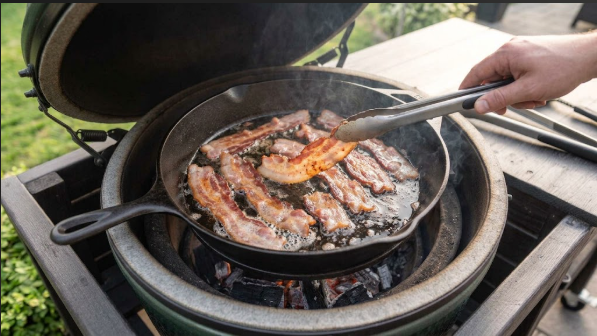
PITMASTER TIP Cook the last strips of cast iron bacon a little lighter than you want them. Bacon continues to crisp for a minute after it leaves the pan. If you pull it at perfect crispness, it can turn brittle or bitter by the time it hits the plate.
Want Bacon Even Flatter?
Set a bacon press or a smaller pan on top of the strips for the first 5 minutes. Weight keeps the meat in contact with the iron, so it browns evenly and curls less. Remove it once the strips are mostly set.
Time and Temperature Table for Cast Iron Bacon
Use this as a starting point. Stoves and skillets vary, so trust your eyes first.
| Method | Heat / Setting | Regular-Cut | Thick-Cut | Flip |
| Stovetop, cold start | Medium-low, 300-325°F (149-163°C) pan | 10-15 min | 15-20 min | Every 3-4 min |
| Stovetop, with press | Medium-low | 10-12 min | 15-18 min | Once at 5 min |
| Oven, skillet | 400°F (204°C) | 15-20 min | 20-25 min | Once at halfway |
| Charcoal or gas grill, indirect | 350-375°F (177-190°C) | 15-20 min | 20-25 min | Every 5 min |
| Pellet grill | 350°F (177°C) | 15-20 min | 20-25 min | Once at halfway |
| Side burner | Medium-low | 10-15 min | 15-20 min | Every 3-4 min |
Doneness cue: Deep amber, firm but not hard, with small bubbles slowing in the fat.
How to Tell Cast Iron Bacon Is Done
With cast iron bacon, color and texture tell you more than a thermometer does. Strips cook unevenly, and bacon is thin, so probing is not practical.
Look for these signs:
- The edges are dark golden to light mahogany.
- The fat is translucent or lightly browned, not milky white.
- Bubbling slows and the sizzle shifts from a splash to a fine crackle.
- The strip stays slightly flexible when lifted, then stiffens as it cools.
Texture preferences
- Chewy: Pull at 8-10 minutes for regular-cut when the edges just turn golden.
- Classic crisp: Pull at 12-14 minutes when the strip is mostly amber.
- Shatter-crisp: Go to 15 minutes, and use a press for the first half.
On safety: the USDA’s safe minimum temperature chart lists fresh pork at 145°F (63°C) with a 3-minute rest. The chart does not list cured bacon separately [VERIFY], so cook it until it is browned and crisp throughout. Pan-cooked bacon at a proper crispness is well past that mark, and you should not eat strips that are pale, limp, or raw in spots.
Resting, Draining, and Serving
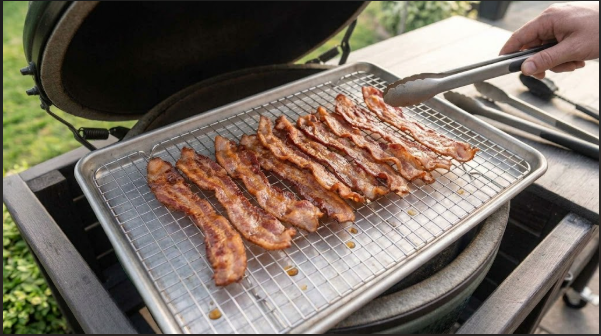
Move the strips to a paper-towel-lined plate or a wire rack set over a sheet pan. The rack keeps them crisper because air circulates underneath, while paper towels soak up surface grease.
Let cast iron bacon rest for 1-2 minutes before serving. It firms up and the fat sets. Use a sharp chef’s knife for chopping, and a good set of knives for cutting meat makes crumbling thick-cut strips much easier.
Serve cast iron bacon right away. It is at its best in the first 10 minutes. After that, moisture creeps back in from the air and the crunch fades.
What to Serve With Cast Iron Bacon
Bacon is rich, salty, and a little sweet. It pairs with plain, starchy, or fresh foods.
Breakfast plates
- Scrambled or fried eggs, cooked in a splash of the bacon fat
- Buttermilk pancakes or waffles with maple syrup
- Buttered toast, English muffins, or biscuits
- Crispy hash browns or home fries
- Grits, with a pat of butter and black pepper
Lunch and dinner
- BLT sandwiches on toasted bread with ripe tomato
- Crumbled over baked potatoes, mac and cheese, or a wedge salad
- Wrapped around dates, jalapeños, or green beans
- Folded into cornbread. Try the bacon fat in our cornbread recipe for a savory crust.
Fresh sides
- Sliced cantaloupe, berries, or pineapple
- Sliced tomatoes with salt and pepper
- A simple green salad with a sharp vinaigrette
Acidic or fruity sides help cut the richness. Pickled onions and fresh fruit both work well beside a plate of cast iron bacon.
Storing, Freezing, and Reheating Leftovers
Leftover cast iron bacon is still a leftover, so handle it like one. Get it into the fridge fast and keep it cold.
Cooling and fridge
- Refrigerate cooked bacon within 2 hours of cooking. Do not leave it out in the “danger zone” between 40°F and 140°F (4-60°C) [VERIFY the FSIS danger-zone page].
- The USDA says leftovers keep 3-4 days in the refrigerator. That applies to cooked bacon.
- Store strips in an airtight container, with paper towels between layers to absorb moisture.
Freezer
- Frozen leftovers hold their best quality for about 3-4 months, according to the same USDA guidance. Keep the freezer at 0°F (-18°C).
- Freeze strips flat on a sheet pan first, then bag them. They will not clump together.
Reheating
- The USDA says to reheat leftovers to 165°F (74°C). In practice, bacon should be steaming hot.
- Skillet: 1-2 minutes per side on medium-low. This restores the best crunch.
- Oven: 350°F (177°C) for 5-8 minutes on a rack.
- Microwave: 15-30 seconds on a paper towel, but expect softer strips.
Raw bacon storage: Unopened and opened packages have different limits. Check the package date and the USDA’s raw bacon storage chart [VERIFY exact refrigerator and freezer times before publishing].
Bacon grease
- Strain it through a fine mesh to remove burnt bits.
- Keep it in a clean, lidded jar in the fridge.
- Storage time is not confirmed in the sources I could check [VERIFY]. When in doubt, throw it out.
- Never pour hot grease down the drain. It hardens and clogs pipes.
Cast Iron Bacon Variations
Once you have the base cast iron bacon method down, change the cooker, the cure, or the finish.
Oven Cast Iron Bacon (Hands-Off Backup)
Set the oven to 400°F (204°C). Lay strips in a cold skillet or on a rack inside it. Bake 15-20 minutes for regular-cut and 20-25 for thick-cut. Flip once at the halfway mark. This is great when you need two pans’ worth of bacon at once.
Pellet Grill Cast Iron Bacon
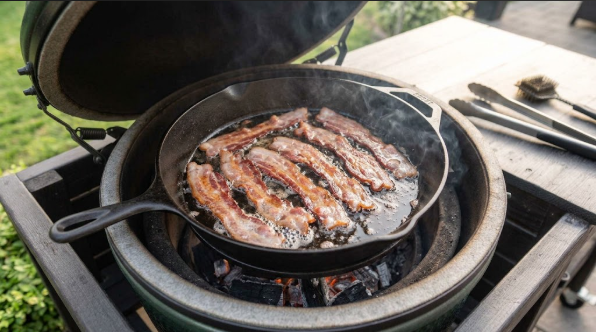
Set the pellet grill to 350°F (177°C) and place the skillet on the grate. Use a mild wood such as apple or cherry. Heavy woods like hickory and mesquite can overwhelm the bacon. For a full walkthrough, see our guide on bacon on a pellet grill. If you are shopping for a cooker, our list of pellet grills for beginners is a good place to start.
Charcoal or Gas Grill
Set up a two-zone fire with coals or burners on one side only. Put the skillet on the cool side and close the lid. Keep the temperature at 350-375°F (177-190°C). If you need help lighting your fire, read how to start a grill the safe way. Watch for flare-ups, because grease can drip if a strip hangs over the edge.
Side Burner Method
A side burner is perfect for cast iron bacon on a hot day, because it keeps the heat and smell outside. Learn what a side burner is used for if your grill has one. Use medium-low heat and watch for wind, which can pull the flame sideways.
Flavor Twists
- Maple-glazed: Brush 1 tbsp (15 ml) maple syrup on strips during the last 3 minutes.
- Brown sugar and pepper: Press 1 tbsp (14 g) brown sugar and a pinch of black pepper on each side. Lower the heat, because sugar burns fast.
- Spicy: Add 1/2 tsp cayenne to the sugar.
- Candied bacon: Bake on a rack at 375°F (190°C) for 20-25 minutes with brown sugar.
Troubleshooting Cast Iron Bacon
Most cast iron bacon problems come from heat that is too high or a pan that is too full. Here are the fixes.
| Problem | Likely Cause | Fix |
| Bacon burns before it crisps | Heat too high | Lower to medium-low and start cold |
| Strips curl and bunch up | Pan too hot or no weight | Use a press for the first 5 minutes |
| Bacon is chewy or rubbery | Heat too low, or too much fat | Pour off fat and raise heat slightly |
| Uneven color | Hot spots on the burner | Rotate strips and rotate the pan |
| Heavy splatter | Wet bacon or high heat | Pat dry, lower heat, use a splatter screen |
| Bacon sticks | Pan not warm enough when flipped | Wait for the strip to release by itself |
| Smoky kitchen | Burnt grease or high heat | Strain fat, lower heat, open a window |
| Bitter taste | Fat scorched | Pour off grease more often |
Smoke and smell can linger after a big batch. Our tips for kitchen odors can help clear the air.
Pan care after bacon
Let the skillet cool until it is warm, not hot. Wipe out most of the fat with a paper towel, then rinse with hot water and a brush. Dry it fully on a burner for 1-2 minutes, then rub in a thin film of oil. Bacon does not ruin seasoning. A skillet that is well seasoned handles it easily.
Fire safety: If grease ever ignites, slide a lid over the pan and turn off the heat. Never throw water on it.
Cast Iron Bacon Recipe Card
Yield: 4 servings (about 12-16 regular-cut strips) Prep time: 10 minutes Cook time: 10-20 minutes Total time: 20-30 minutes Pan: 12-inch (30 cm) cast iron skillet
Ingredients
- 1 lb (0.45 kg) bacon, regular-cut or thick-cut
- Optional: 1 tbsp (15 ml) maple syrup or 1 tbsp (14 g) brown sugar
Steps
- Let bacon sit out 10-15 minutes, then separate strips.
- Lay strips in a cold skillet in one layer.
- Heat to medium-low (300-325°F / 149-163°C pan surface).
- Cook 10-15 minutes (regular) or 15-20 (thick), flipping every 3-4 minutes.
- Pour off excess fat as it builds.
- Drain on paper towels or a wire rack.
- Strain the grease and refrigerate the cooked bacon within 2 hours.
FAQ: Cast Iron Bacon
Should you start bacon in a cold cast iron pan?
Yes. A cold start lets fat melt slowly while the meat heats up with the pan. This gives you crisp, flat strips with less splatter. A hot pan sears the surface first, which makes strips curl and burn before the fat has a chance to render.
What temperature should cast iron be for bacon?
Aim for medium-low, with a pan surface around 300-325°F (149-163°C). On most stoves that is a dial setting of 3 or 4 out of 10. Use an infrared thermometer to check the metal. If the fat smokes or spits hard, lower the heat.
How long does it take to cook bacon in cast iron?
Regular-cut bacon takes 10-15 minutes on medium-low heat. Thick-cut takes 15-20 minutes. Flip every 3-4 minutes and pull strips when they are deep amber. Remember that bacon keeps crisping for about a minute after you take it off the heat.
Does bacon ruin cast iron seasoning?
No. Bacon fat is a good seasoning fat, and cooking bacon often helps build a smooth surface. Problems come from scrubbing hard with harsh soap, soaking the pan, or leaving it wet. Rinse, dry on a burner, and wipe on a thin layer of oil.
Can you cook bacon in cast iron in the oven?
Yes. Set the oven to 400°F (204°C) and bake strips in the skillet or on a rack inside it for 15-20 minutes for regular-cut, 20-25 for thick-cut. Flip once at the halfway point. This method is hands-off and works well for big batches.
How long does cooked bacon last in the fridge?
The USDA says cooked leftovers keep 3-4 days in the refrigerator at 40°F (4°C) or below, and about 3-4 months in the freezer for best quality. Refrigerate cooked bacon within 2 hours, store it airtight, and reheat to 165°F (74°C) before eating.
Conclusion
Cast iron bacon rewards patience more than skill. Start with a cold skillet, keep the heat at medium-low, flip often, and pull the strips just before they look done. You get crisp edges, a tender bite, and a jar of good grease for tomorrow’s eggs.
Once you master the stovetop method, try the oven for big batches or the grill for a smoky twist. Keep bacon cold, cook it until it is crisp, and reheat leftovers to 165°F (74°C). A good cast iron skillet and 20 minutes are all you need for the best breakfast on the table.
Laura Smith

I'm Laura, I like all the kind of delicious grilled foods which makes me hungry all the time I see them. That's why I built this blog to share with you all of my Grilling experiences, recipes, and all the tips about foods that I've learned from food experts.