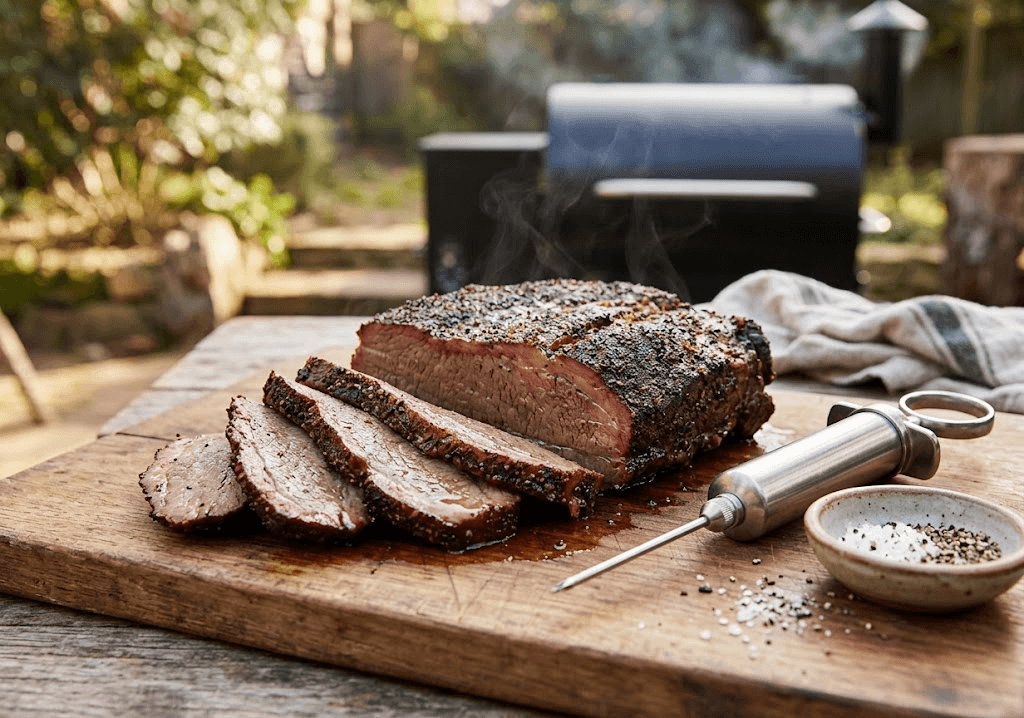
Chuck roast is the cheapest way to get brisket-style beef off your smoker. It is also lean in the center and packed with connective tissue that needs hours to melt. This chuck roast injection recipe solves the dry-spot problem by pushing a savory beef broth mix deep into the meat before it ever touches the heat.
I’ll walk you through the whole cook: how to pick the roast, how to mix and place the injection, what to set your smoker to, and when to pull the meat. You end up with a dark, peppery bark and beef that stays moist all the way to the center. Plan on about 6 to 8 hours start to finish, plus resting time.
This guide is written for beginner backyard cooks and pellet grill owners. The same steps work on an offset, a kettle grill, or even your oven.
Quick Answer: For the best chuck roast injection recipe, inject 1 cup (240 ml) of warm beef broth, Worcestershire, and garlic into a 4 lb (1.8 kg) roast, rub it, and smoke at 250°F (121°C) for 5-7 hours. Pull at 200-205°F (93-96°C) when a probe slides in like butter. Rest 45-60 minutes.
Why This Chuck Roast Injection Recipe Works
Chuck comes from the shoulder, a hard-working muscle full of collagen and intramuscular fat. Low heat slowly turns that collagen into gelatin. That is why a well-smoked chuck eats a lot like brisket, which is also why people call it poor man’s brisket.
A 3 to 4 inch thick roast has a lot of meat between the surface and the core. A rub only seasons the outside. Injection puts moisture and flavor in the middle, where it counts.
The three jobs of the injection
- Moisture: broth gives the lean center a buffer against drying out during a long cook.
- Flavor: Worcestershire, soy, garlic, and onion season the meat from the inside.
- Richness: a little melted butter or beef tallow adds the fat that lean sections lack.
Here is the honest part. Injection does not tenderize beef by itself. Time and temperature do that. What injection does is make the finished roast juicier and better seasoned, especially in the thick center.
One safety note matters here. A needle can carry surface bacteria into the middle of a cut, so the USDA treats needle-tenderized beef carefully. The USDA’s safe minimum internal temperature for beef roasts is 145°F (63°C) with a three-minute rest, and mechanically tenderized cuts should meet it too. We cook far past that for tenderness, so you are covered. Just never pull the roast early.
Ingredients and Equipment
For the roast and rub
- 1 chuck roast, 4 lb (1.8 kg), 2-3 inches (5-7.5 cm) thick
- 2 tbsp yellow mustard (binder)
- 1 tbsp kosher salt
- 1 tbsp coarse black pepper
- 1 tsp granulated garlic
- 1 tsp smoked paprika
- 1/2 tsp onion powder
For the injection
- 1 cup (240 ml) low-sodium beef broth, warmed
- 1 tbsp Worcestershire sauce
- 1 tsp soy sauce
- 1 tsp garlic powder
- 1 tsp onion powder
- 2 tbsp melted butter or beef tallow
For the spritz and wrap
- 1/2 cup (120 ml) apple cider vinegar mixed with 1/2 cup (120 ml) water
- 1/4 cup (60 ml) beef broth for the wrap
- Pink butcher paper or heavy-duty foil
Equipment
- A pellet grill, offset, or kettle that holds 250°F (121°C) steady. If you are shopping, our list of beginner-friendly pellet grills is a good start.
- A meat injector with a 1 to 2 oz barrel and a thick-bore needle
- An instant-read thermometer and a leave-in probe
- A spray bottle, a small saucepan, and a rimmed sheet pan
- A dry cooler and old towels for resting
Easy substitutions
- No Worcestershire: use extra soy sauce and a pinch of sugar.
- No beef broth: dissolve 1 beef bouillon cube in 1 cup (240 ml) hot water, then cut the salt in the rub to 2 tsp.
- No tallow: use butter or leave the fat out. The broth does most of the work.
- No butcher paper: use foil, but expect a softer bark.
- Wood: oak or pecan is mild and safe. Hickory adds a stronger beef-friendly punch. Cherry adds color. Go light on mesquite.
Choosing and Prepping the Chuck Roast
Look for a roast that is thick and even, not a long flat slab. Thick cuts cook evenly and stay juicy. Pick one with white marbling streaks running through the meat, because those streaks melt and baste it from inside.
A 3.5 to 4.5 lb (1.6-2 kg) roast is the sweet spot. It feeds 6 to 8 people and finishes in a single day.
Trimming
Trim off any hard, waxy fat lumps and loose silver skin. Leave a thin layer of fat, about 1/4 inch (6 mm), on top. Pat the whole roast dry with paper towels so the rub sticks and the bark forms well.
Dry brine (optional but worth it)
Salt the roast with the 1 tbsp kosher salt and set it uncovered on a rack in the fridge for 4 to 12 hours. This seasons the meat and dries the surface for better bark. If you are short on time, salt it right before the rub goes on.
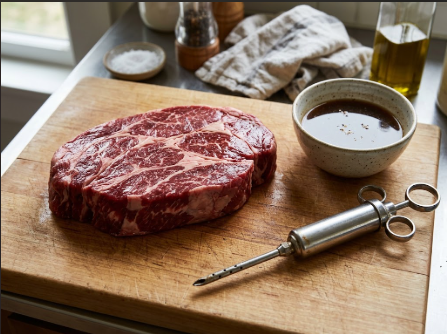
Step-by-Step Chuck Roast Injection Recipe
- Mix the injection. Warm the broth in a saucepan until it is hot to the touch but not boiling. Whisk in the Worcestershire, soy, garlic powder, onion powder, and melted butter until fully dissolved. Let it cool to warm so the butter doesn’t seize in the needle.
- Pour a working portion. Pour about 1 cup into a clean bowl. Draw from that bowl only, and do not dip a used needle back into your main batch.
- Inject in a grid. Push the needle straight in, running with the grain of the meat when you can. Space your injection sites about 1 inch (2.5 cm) apart. Slowly push the plunger as you pull the needle out so the liquid spreads along the channel.
- Watch for leaks. Aim for roughly 1/2 oz (15 ml) per site, about 16 to 20 sites in all. If liquid shoots out the surface, stop and move to a new spot. Wipe the surface dry with paper towels.
- Bind and season. Rub a thin layer of mustard over the roast. Mix the rub ingredients and coat every side evenly. Let the roast sit at room temperature for 30 minutes while the smoker heats up.
- Fire up the smoker. Set it to 250°F (121°C). Add oak, pecan, or hickory pellets or chunks. Wait for thin, blue-ish smoke before the meat goes on.
- Smoke unwrapped. Put the roast on fat side up, and insert the leave-in probe into the thickest part, away from the fat. Smoke for 3 to 4 hours, until the internal temperature reaches about 165°F (74°C).
- Spritz. After the first 90 minutes, mist the roast every 45 to 60 minutes. Keep the lid open as briefly as you can.
- Wrap at the right moment. When the bark is a deep mahogany and doesn’t smear when you touch it, around 165-170°F (74-77°C), wrap tightly in butcher paper with 1/4 cup (60 ml) beef broth poured over the top.
- Cook to tenderness. Return it to the smoker. Keep going until the internal temperature is 200-205°F (93-96°C) and a probe slides in with almost no resistance. This takes another 1.5 to 2.5 hours.
- Rest. Move the wrapped roast to a dry cooler lined with towels for 45 to 60 minutes. Then slice or pull.
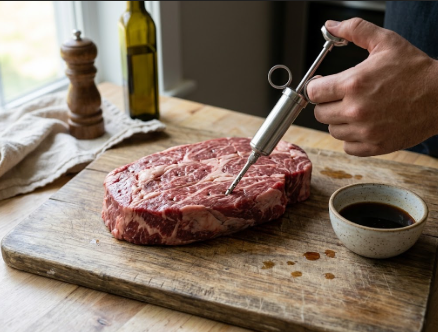
Pitmaster Tip: Inject along the grain, not across it. The channels hold more liquid and the broth doesn’t run straight out the other side. Also, chill the roast for 30 minutes after injecting if you can. Cold meat holds the liquid better while the rub sets.
Common Mistake: Wrapping too early. If you wrap at 140-150°F (60-65°C), the bark hasn’t set and turns into a soggy, gray crust. Wait for the dark color and the firm feel, then wrap.
Time and Temperature Table
Stages of the cook at 250°F (121°C)
| Stage | Meat temp | Approx. time | What you’ll see |
| Preheat and rest rub | Room temp | 30 min | Rub looks wet, then tacky |
| Smoke, unwrapped | 40 to 165°F (4-74°C) | 3-4 hours | Color deepens, bark starts forming |
| The stall | 150-170°F (65-77°C) | 45-90 min | Temperature flatlines |
| Wrapped cook | 165-205°F (74-96°C) | 1.5-2.5 hours | Bark stays set, roast softens |
| Probe tender | 200-205°F (93-96°C) | Check often | Probe slides in like butter |
| Rest | Above 140°F (60°C) | 45-60 min | Juices settle |
Total time by roast weight at 250°F (121°C)
| Roast weight | Total cook time | Plus rest |
| 3 lb (1.4 kg) | 4-5 hours | 45 min |
| 4 lb (1.8 kg) | 5-6.5 hours | 45-60 min |
| 5 lb (2.3 kg) | 6-8 hours | 60 min |
Treat these times as a guide only. Thickness, weather, and how often you open the lid all change the clock. Cook to temperature and feel.
How to Tell When It’s Done
Temperature gets you in the right zone, but feel gives the final answer. Poke the probe into the thickest part and a few spots around it. It should slide in with almost no resistance, like pushing into soft butter or warm peanut butter.
The pull temperature is usually 200-205°F (93-96°C). If it still grabs the probe at 205°F, give it another 20 to 30 minutes and check again. Chuck can go to 210°F (99°C) without trouble.
The roast will also look different. The bark is dark and firm, the edges are slightly pulled back, and the whole roast jiggles when you move the pan. If you tilt it, it sags under its own weight.
The FoodSafety.gov safe minimum temperature chart lists 145°F (63°C) for beef roasts. Your roast sails past that long before it is tender, so the pitmaster pull temp is the one that matters here.
Resting, Slicing, and Serving
Resting matters as much as the smoke. Wrap the roast in its paper, then in a towel, and set it in a dry cooler. It stays hot for an hour or more and the juices redistribute through the meat.
Keep the roast above 140°F (60°C) during the rest. That is the top edge of the USDA danger zone]. Don’t let it sit out on the counter for hours.
Slicing or pulling
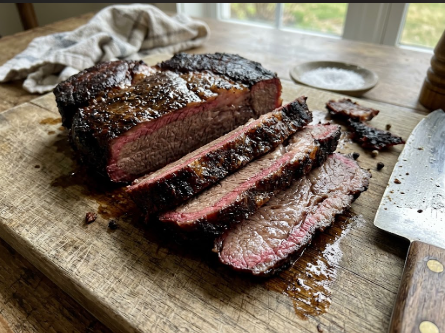
For sliced beef, cut against the grain into 1/4 inch (6 mm) slices. Chuck has grain running in different directions, so turn the roast as you go. A sharp blade makes this easy, and our guide to the best knives for slicing meat covers good picks.
For pulled beef, tear it apart with two forks or gloved hands. Pull out any big chunks of fat as you go. Toss the shreds with a few spoonfuls of the juices left in the paper.
Use the wrap juices
Pour the juices from the paper into a cup and skim the fat. Drizzle it over the meat or serve it on the side as au jus. Because those juices cooked to 200°F or higher, they are safe to serve. Don’t serve any leftover raw injection, though. Toss it out.
What to Serve With Smoked Chuck Roast
This beef is rich, so pair it with sides that are creamy, tangy, or crisp.
- Starches: baked beans, smoked mac and cheese, or garlic mashed potatoes.
- Bread: a skillet of our cornbread recipe or soft potato rolls for sandwiches.
- Fresh and tangy: vinegar coleslaw, pickled red onions, and dill pickles.
- Sauces: horseradish cream, a mustard-based BBQ sauce, or the skimmed au jus.
For sandwiches, pile the pulled beef on a toasted bun with pickles and onions. It makes a fine brisket stand-in at a fraction of the price.
Storing, Freezing, and Reheating Leftovers
Cool leftovers quickly. The USDA says to refrigerate cooked leftovers within two hours (one hour if it is above 90°F outside) . Slice or shred the meat and pack it in shallow containers so it chills fast.
How long it keeps
- Fridge: 3 to 4 days at 40°F (4°C) or below.
- Freezer: best quality for 2 to 3 months in airtight bags with the air squeezed out. Add a spoonful of juices to each bag. Frozen food stays safe longer, but the texture slips.
- Thawing: defrost overnight in the fridge, not on the counter.
Reheating
Reheat leftovers to 165°F (74°C), per USDA guidance . The best way to keep the meat moist is the oven. Place the meat in a foil pan with 1/4 cup (60 ml) of broth, cover tightly, and warm at 300°F (150°C) for 20 to 30 minutes. A microwave works for single servings. Cover it and add a splash of liquid.
Variations: Pellet Grill, Offset, Charcoal, and Oven
Pellet grill
This is the easiest route. Set it to 250°F (121°C), use oak or pecan pellets, and follow the steps above. If your grill swings in temperature, see our pellet grill temperature tips for steadying the cook.
Offset smoker
Burn a small, clean fire with split oak and aim for 250°F (121°C) at the grate. Our guide to lump charcoal in an offset smoker explains how to hold steady heat. Shopping for a first offset? See this affordable offset smoker roundup.
Kettle or charcoal grill
Build a two-zone fire with the coals piled on one side and a foil pan of water on the other. Put the roast over the cool side and add a chunk of hickory or oak every hour. If you need help with the fire, read how to start a grill. Expect to add 10 to 12 unlit coals every 45 minutes.
Oven backup
No smoker? Rub the roast and sear it in a hot skillet. Wrap it tightly in foil with 1/2 cup (120 ml) of broth and cook at 275°F (135°C) for 4 to 5 hours, until probe tender. You will miss the smoke, but you will still get a juicy roast. For a different oven approach, try our oven roast beef method.
Flavor twists
- Spicy: add 1/2 tsp cayenne to the injection and 1 tsp chili powder to the rub.
- Coffee rub: add 1 tbsp finely ground coffee to the rub for a darker, earthier bark.
- Pot roast style: after 3 hours of smoke, move the roast to a pan with carrots, onions, and broth, cover it, and braise it. If you prefer a classic stovetop dinner, see our classic pot roast.
Troubleshooting Common Problems
| Problem | Likely cause | Fix |
| Roast is dry | Pulled too late, or no wrap | Spritz more, wrap with broth, and pull at 200°F |
| Roast is tough | Pulled too early | Keep cooking and test with the probe, not the clock |
| Meat is mushy | Overcooked above 210°F | Pull at probe tender and rest in a cooler |
| Bark is soft | Wrapped too early, or foil used | Wait for firm bark and use butcher paper |
| Too salty | Regular broth plus heavy rub | Use low-sodium broth and dry brine lightly |
| Temperature stalls | Normal evaporative cooling | Wait it out or wrap at 165°F |
| Injection leaks out | Too much per site | Use 1/2 oz per site, inject slowly, and chill the roast |
| Finishes early | Small roast, hot cooker | Keep it wrapped in a cooler for up to 2 hours |
Recipe Card: Smoked Injected Chuck Roast
Servings: 6-8 | Prep time: 30 minutes (plus optional overnight dry brine) | Cook time: 5-7 hours at 250°F (121°C) | Rest: 45-60 minutes
Ingredients: 4 lb (1.8 kg) chuck roast; 1 cup (240 ml) low-sodium beef broth; 1 tbsp Worcestershire; 1 tsp soy sauce; 1 tsp each garlic and onion powder; 2 tbsp melted butter or tallow; 2 tbsp yellow mustard; 1 tbsp kosher salt; 1 tbsp coarse black pepper; 1 tsp granulated garlic; 1 tsp smoked paprika; 1/2 tsp onion powder; 1/4 cup (60 ml) broth for the wrap.
Quick steps:
- Trim and dry the roast. Dry brine if you have time.
- Mix the warm injection and inject in a 1-inch grid.
- Coat with mustard and rub. Rest 30 minutes.
- Smoke at 250°F (121°C) to about 165°F (74°C), spritzing after 90 minutes.
- Wrap in butcher paper with broth. Cook to 200-205°F (93-96°C), probe tender.
- Rest 45-60 minutes. Slice against the grain or pull.
Frequently Asked Questions
Can you inject a chuck roast?
Yes. Chuck is thick, dense, and prone to dry spots in the center, so it takes injection well. Use a thin, savory liquid like beef broth, spread it in a one-inch grid, and keep the total near 1 cup (240 ml) for a 4 lb (1.8 kg) roast.
What do you inject into a chuck roast?
Warm low-sodium beef broth is the base. Add Worcestershire sauce, garlic and onion powder, a splash of soy sauce, and a little melted butter or beef tallow for richness. Keep the mix thin and fully dissolved so it flows through the needle without clogging.
What internal temp is a chuck roast done?
Pull a smoked chuck roast between 200 and 205°F (93-96°C), when a probe slides in with almost no resistance. The USDA safe minimum for beef roasts is 145°F (63°C), but chuck stays tough there because the collagen hasn’t melted.
How long does it take to smoke a 4 lb chuck roast?
Expect 5 to 6.5 hours at 250°F (121°C) for a 4 lb (1.8 kg) roast, including a stall around 160-170°F (71-77°C). Cook to temperature and tenderness, not the clock, because thickness, weather, and wrapping change the time. Add 45 to 60 minutes for resting.
Should I wrap a chuck roast?
Wrapping is optional but helpful. Once the bark is dark and set, around 165-170°F (74-77°C), wrapping in butcher paper speeds the stall and keeps the roast moist. Foil is faster and gives softer bark. Skip the wrap if you want the crustiest, driest bark.
How long should a smoked chuck roast rest?
Rest the roast 45 to 60 minutes, wrapped, in a dry cooler lined with towels. This lets the juices redistribute and makes slicing cleaner. Keep it above 140°F (60°C) during the rest, following USDA danger zone guidance, then slice against the grain.
Final Thoughts on This Chuck Roast Injection Recipe
This chuck roast injection recipe turns a budget cut into something you will be proud to serve. The injection keeps the center juicy, the rub builds a peppery bark, and the slow smoke melts the collagen into tender, beefy bites.
The key points are simple. Inject in a grid, smoke at 250°F (121°C), wrap when the bark is set, and cook until the probe slides in at 200-205°F (93-96°C). Rest it for an hour, and you will have a roast that slices cleanly or pulls apart with a fork.
Try it once as written, then tweak the rub and the injection to match your taste. Let us know how yours turned out.
Laura Smith

I'm Laura, I like all the kind of delicious grilled foods which makes me hungry all the time I see them. That's why I built this blog to share with you all of my Grilling experiences, recipes, and all the tips about foods that I've learned from food experts.