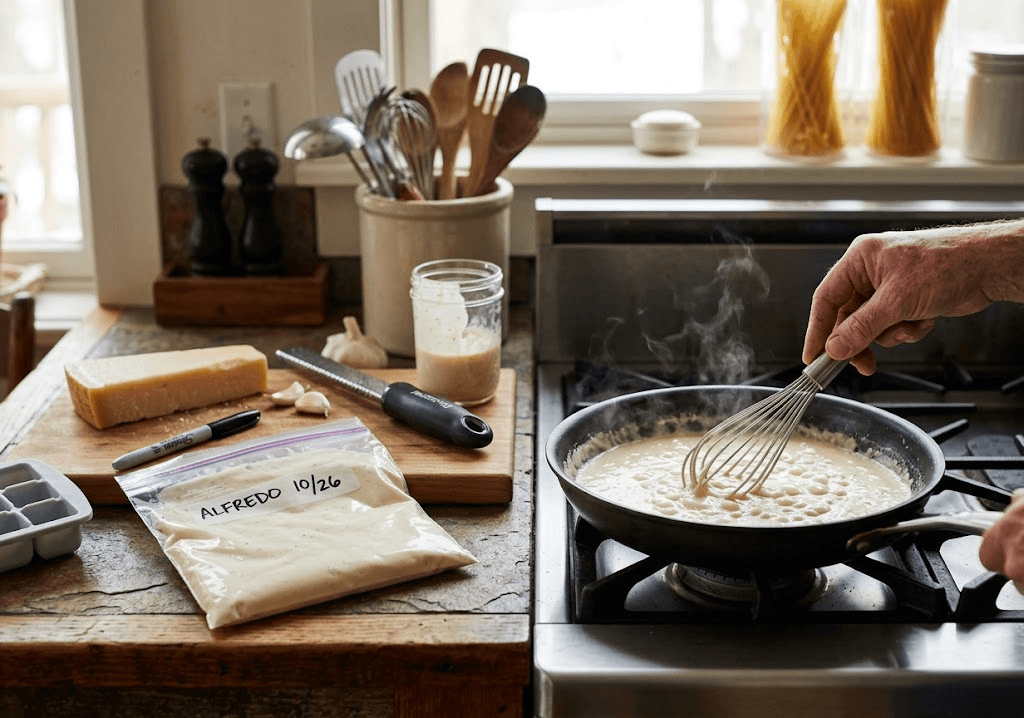
Yes, you can freeze Alfredo sauce, and it’s a handy way to save a big batch. But this is a cream, butter, and cheese sauce, so it doesn’t always come out of the freezer smooth. The good news is that a few small steps make a big difference.
Most failed batches come down to two things: how the sauce was made and how it was thawed and reheated. Skip those details and you get a greasy, grainy mess. Get them right and your sauce comes back creamy and ready for pasta night.
This guide covers whether you can freeze Alfredo sauce, how to do it, and how to thaw it safely. It also covers how to fix a sauce that splits, and how long it keeps.
⚡ Quick Answer
Yes, you can freeze Alfredo sauce for about 2-3 months for best quality. Cool it fast, pack it in airtight portions with a little headspace, and freeze at 0°F (-18°C). Thaw it overnight in the fridge, then reheat gently on low heat, whisking in a splash of cream or milk.
Can You Freeze Alfredo Sauce? The Honest Answer
Alfredo sauce freezes fine from a food safety standpoint. Texture is the real problem.
Classic Alfredo is an emulsion. That means fat (butter and cream) and water are held together in a smooth, glossy blend, with melted cheese helping. Freezing forms ice crystals that can push that blend apart. When you thaw it, you may see oil on top and tiny clumps of cheese protein.
This doesn’t make the sauce unsafe. It just means you need to rebuild the emulsion when you reheat. With a good whisk and low heat, most batches come back together.
Here’s how different sauces tend to behave in the freezer:
- Made with heavy cream and a flour roux: freezes best. The flour helps hold the sauce together.
- Made with heavy cream only: freezes fine, but expect more separation.
- Made with milk or half-and-half: more likely to turn watery or grainy.
- Made with cream cheese: usually freezes well, because cream cheese is already stabilized.
- Store-bought jarred sauce: often freezes well, since it’s built to stay shelf-stable.
In my experience writing about kitchen storage, the single biggest upgrade is making the sauce with freezing in mind from the start. That’s covered below.
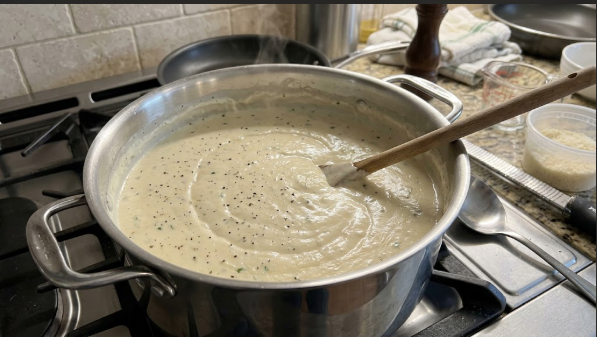
Why Alfredo Sauce Separates in the Freezer
Understanding the “why” helps you fix it. Three things go wrong.
1. Ice crystals break up the fat. As water in the cream freezes, sharp crystals form and shove fat droplets together. When thawed, the fat doesn’t blend back in on its own.
2. Cheese proteins tighten. Parmesan is a hard, aged cheese. When it freezes and thaws, the proteins can clump into small grains. That’s the “sandy” texture people complain about.
3. Low-fat dairy has less protection. Heavy whipping cream (about 36% milk fat) holds up better than milk or half-and-half. Less fat means a thinner, more fragile emulsion.
None of this is a mystery you can’t solve. Stabilizing the sauce before freezing and reheating it gently handle most of it.
Can You Freeze Homemade vs. Store-Bought Alfredo Sauce?
Both work, but they behave a little differently.
Homemade Alfredo Sauce
Homemade sauce is fresher and usually richer, which makes it more likely to split. It’s also easier to tweak. If you plan to freeze it, make the sauce slightly thicker than you normally would. You’ll thin it back out with cream when you reheat.
If your batch is too thin before freezing, check our guide on how to thicken Alfredo sauce first.
Store-Bought (Jarred) Alfredo Sauce
Jarred sauce contains stabilizers and often some starch, so it tends to handle freezing better. If you opened a jar and won’t use it all, you can freeze the extra.
Don’t freeze it in the original glass jar. Liquid expands as it freezes, and glass can crack. Move the sauce to a freezer-safe container or bag, and follow the storage directions on the label for how long an opened jar lasts in the fridge.
How to Freeze Alfredo Sauce Step by Step
Follow these steps for the best result. This is the method I’d use for a big batch of homemade sauce.
What You Need
- Freezer-safe zip-top bags or airtight containers
- A permanent marker and masking tape (or bag labels)
- A baking sheet (for freezing bags flat)
- A whisk and a saucepan for reheating later
- Optional: a silicone freezer tray or ice cube tray for small portions
Step-by-Step Method
- Make the sauce a little thick. If you’re cooking a fresh batch, a small roux (1 tablespoon each of butter and flour per 1 cup of cream) helps the sauce hold together after freezing.
- Cool it quickly. Don’t leave the sauce on the counter. The USDA says perishable food shouldn’t sit out more than 2 hours (1 hour if it’s above 90°F / 32°C), as covered in its leftovers and food safety guidance. Pour the sauce into a shallow container to cool faster.
- Chill it in the fridge first. Get the sauce to 40°F (4°C) or below before freezing. A cold sauce freezes faster, which means smaller ice crystals and a smoother result.
- Portion it out. Freeze in amounts you’ll actually use. A 1-2 cup portion (about 0.5-1 lb or 0.25-0.45 kg of sauce) covers two servings of pasta. Small portions also thaw faster.
- Leave headspace. Fill containers only about three-quarters full, leaving roughly 1 inch (2.5 cm) of room for expansion.
- Remove the air. For bags, press out as much air as you can. Less air means less freezer burn.
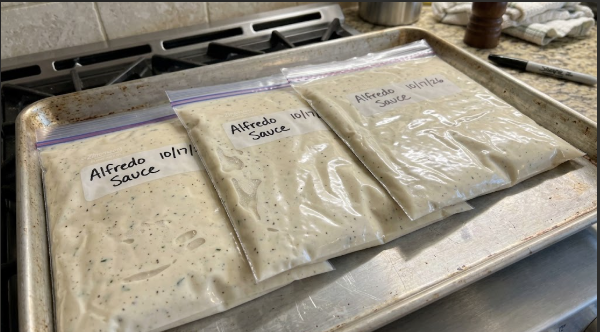
- Label and date it. Write “Alfredo,” the date, and the portion size.
- Freeze it flat. Lay bags flat on a baking sheet until solid, then stack them like books. Flat bags thaw much faster.
- Keep the freezer at 0°F (-18°C). The USDA notes that food stored constantly at 0°F stays safe indefinitely, though quality drops over time. That’s from its freezing and food safety page .
🔥 Pitmaster Tip
Freeze the sauce in an ice cube tray or a silicone freezer tray. Once the cubes are solid, pop them into a freezer bag. You get single-serving portions, and they melt into a pan quickly with no thawing needed. Two to three cubes make a nice sauce for one plate of pasta.
⚠️ Common Mistake
Freezing hot or warm sauce straight from the pot. It warms up everything around it in the freezer and creates big ice crystals. It also keeps the sauce in the danger zone too long. Always cool and chill first.
How Long Does Alfredo Sauce Last in the Freezer?
For safety, a freezer at 0°F (-18°C) keeps food safe for a long time. For quality, though, I’d use frozen Alfredo within 2 to 3 months. After that, the flavor dulls and the texture gets worse. That quality window is a practical guideline, not a USDA rule for this exact sauce .
Here’s a quick reference:
| Storage Method | Temperature | Best-Quality Window | Notes |
| Refrigerator (homemade or opened jar) | 40°F (4°C) or below | 3-4 days | USDA guidance for cooked leftovers; for opened jars, follow the label |
| Freezer (airtight) | 0°F (-18°C) | 2-3 months | Safe longer, but texture declines |
| Counter | Room temp | Max 2 hours | 1 hour if above 90°F (32°C) |
Check the FoodSafety.gov cold food storage chart for the official refrigerator and freezer timelines.
How to Thaw Alfredo Sauce Safely
This is the part most people get wrong. Thawing method matters for both safety and texture. The USDA lists three safe ways to thaw food: in the refrigerator, in cold water, and in the microwave. It also warns against thawing on the counter. You’ll find that in its safe defrosting methods guide .
Method 1: Thaw in the Refrigerator (Best)
This is the gentlest option, and it gives the smoothest sauce.
- Move the frozen sauce from the freezer to the fridge.
- Place it on a plate or in a bowl in case of leaks.
- Wait about 8-12 hours for a 2-cup portion. A flat bag may thaw in 4-6 hours.
These times are practical estimates, since they depend on your fridge and the thickness of the portion. Plan ahead and thaw overnight. Once thawed, use the sauce within 1-2 days.
Method 2: Thaw in Cold Water (Faster)
Use this when you forgot to plan ahead.
- Seal the sauce in a leak-proof bag.
- Submerge the bag in a bowl of cold tap water.
- Change the water every 30 minutes so it stays cold.
- Expect about 30-60 minutes for a small, flat portion.
Cook and use the sauce right away after thawing this way. Don’t put it back in the freezer without heating it first.
Method 3: Thaw in the Microwave (Fastest)
- Move the sauce to a microwave-safe bowl.
- Use the defrost setting or 30% power.
- Stir every 30 seconds so it thaws evenly.
- Stop while a few icy bits remain, then finish gently on the stove.
The USDA says food thawed in the microwave should be cooked right away. If your microwave runs hot, check our picks for the best over-the-range microwave models, which often have better defrost controls.
Don’t Thaw on the Counter
Leaving the sauce out at room temperature lets bacteria grow in the outer layers while the center stays frozen. Dairy-based sauces are especially risky. If you’re short on time, use the cold water method instead.
How to Reheat Frozen Alfredo Sauce Without It Breaking
Reheating is where you rescue the texture. Go slow.
Stovetop Method (Best)
- Add the thawed sauce to a saucepan or skillet over low heat. A heavy-bottomed pan works best, and our best stockpot roundup has solid options for bigger batches.
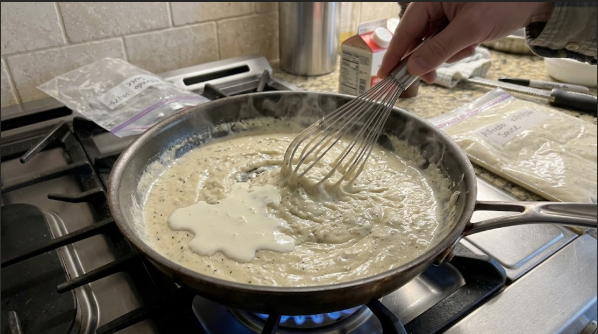
- Whisk constantly as it warms.
- Add 1-2 tablespoons of heavy cream or whole milk per cup of sauce.
- Keep the heat low. Don’t let it boil, since high heat can make the sauce split again.
- Heat until the sauce reaches 165°F (74°C), the USDA’s recommended temperature for reheating leftovers.
- If it looks too thick, add another splash of cream. If it’s too thin, simmer gently for a minute or two.
A nonstick pan makes whisking easier and keeps the sauce from scorching. If you’re shopping for one, see our Henckels Capri Granitium pans review, and our guide on using nonstick pans on an electric stove if you have a flat-top range.
Double Boiler Method (Gentlest)
If your sauce splits easily, set a heatproof bowl over a pot of barely simmering water. The indirect heat is hard to overdo. Whisk until smooth and hot.
Microwave Method (Quick, but Careful)
Heat in 30-second bursts at 50% power, stirring each time. Add a splash of cream, stir well, and check that it hits 165°F (74°C). It’s fine for a single serving, but the stovetop gives you more control.
How to Fix Separated or Grainy Alfredo Sauce
Even careful cooks end up with a sauce that splits. Here’s how to repair it.
If the sauce looks oily:
- Take the pan off the heat.
- Whisk in 1-2 tablespoons of warm cream or milk, one spoonful at a time.
- Keep whisking until it turns glossy again.
If the sauce looks grainy:
- Use an immersion blender for 10-15 seconds, or whisk hard.
- Add a bit more cream to loosen it.
- Stir in a small handful of freshly grated Parmesan off the heat. Fresh cheese helps the texture, and pre-shredded cheese often has anti-caking coating that makes the sauce gritty.
If the sauce is too thin:
- Simmer it gently for 2-3 minutes.
- Or whisk in a small cornstarch slurry (1 teaspoon cornstarch mixed with 1 tablespoon cold water) and heat briefly.
If it’s too thick:
- Whisk in cream or a little warm pasta water, a tablespoon at a time.
Our guide to thickening Alfredo sauce has more detail on stabilizing it. The FSIS guidance doesn’t cover texture fixes, so these are practical kitchen tips.
⚠️ Common Mistake
Cranking up the heat to “speed things up.” Boiling a thawed cream sauce is the fastest way to turn it greasy and grainy. Low and slow always wins.
Can You Freeze Alfredo Sauce With Pasta?
You can, but I don’t recommend it if you have a choice. Pasta absorbs liquid from the sauce as it sits and freezes, and it turns soft and mushy once reheated.
If you must freeze a finished dish:
- Undercook the pasta by 1-2 minutes before mixing.
- Cool the dish fast and portion it into airtight containers.
- Reheat in a covered pan with a splash of cream or milk, stirring gently.
- Heat to 165°F (74°C) all the way through.
A better plan is to freeze the sauce alone and cook fresh pasta when you’re ready. It takes about 10 minutes and the texture is much better.
Can You Freeze Chicken Alfredo?
Yes, though the same pasta rules apply. Chicken Alfredo with the pasta left out freezes much better. Freeze the sauce and cooked, sliced chicken separately, or together without noodles. Grilled or smoked chicken adds great flavor, and a little smoked bacon on top is a nice touch. See our bacon on a pellet grill method for crisp, smoky pieces to crumble on top.
Can You Refreeze Alfredo Sauce?
Sometimes. The answer depends on how you thawed it.
According to the USDA, food thawed in the refrigerator can be refrozen without cooking it first, though you may lose some quality. Food thawed by the cold water method or in the microwave should be cooked before you refreeze it.
For Alfredo, I’d skip refreezing. The texture gets worse with each freeze and thaw cycle. Freeze small portions from the start so you only thaw what you’ll use.
Also avoid reheating the same sauce again and again. Reheat only what you plan to eat, and discard anything that’s been sitting out too long.
Food Safety Notes
Cream sauces are made from dairy, so keep the following in mind:
- Follow the 2-hour rule. Don’t leave Alfredo out longer than 2 hours (1 hour above 90°F / 32°C), per the USDA’s danger zone guidance .
- Keep the fridge at 40°F (4°C) or below. Keep the freezer at 0°F (-18°C).
- Reheat to 165°F (74°C). Use an instant-read thermometer rather than guessing.
- Use fridge-thawed sauce within 1-2 days. Cooked leftovers in the fridge are generally best within 3-4 days.
- When in doubt, throw it out. If the sauce smells sour, looks moldy, or has been left out too long, discard it.
- Freezing doesn’t kill bacteria. It only pauses their growth, so start with fresh, properly handled sauce.
Tips for Making Alfredo Sauce That Freezes Better
If you know you’ll freeze some of the batch, build it for the freezer:
- Use heavy cream. Higher fat means a more stable sauce.
- Add a small roux. About 1 tablespoon each of butter and flour per cup of cream helps bind the sauce.
- Grate your own cheese. Freshly grated Parmigiano-Reggiano melts smoother than pre-shredded.
- Go easy on the cheese. You can stir in extra fresh cheese after reheating for a smoother finish.
- Cook it a little thicker. You can always thin it later.
- Cool it fast. A shallow container in the fridge beats a deep pot on the counter.
- Keep portions small. Smaller portions freeze and thaw more evenly.
Pair the finished sauce with a hearty main for a full meal. It’s also great as a base when you’re cooking for a crowd, much like our what to serve with stuffed peppers ideas for easy weeknight dinners.
Quick Reference Chart: Freeze, Thaw, Reheat
| Step | What to Do | Target |
| Cool | Shallow container, then fridge | Under 2 hours to cool; 40°F (4°C) |
| Portion | 1-2 cups per bag or container | ~0.5-1 lb (0.25-0.45 kg) |
| Freeze | Flat bags, 1 inch (2.5 cm) headspace | 0°F (-18°C) |
| Use by | For best quality | 2-3 months |
| Thaw | Fridge overnight (best) | 8-12 hours |
| Reheat | Low heat, whisk, add cream | 165°F (74°C) |
FAQ
1. Does Alfredo sauce separate when frozen?
It can. Freezing breaks the emulsion of fat and water, so thawed sauce may look oily or grainy. Thaw it in the fridge, reheat on low heat, and whisk in a splash of cream. Most batches come back smooth in a minute or two.
2. How long can you freeze Alfredo sauce?
For best quality, use it within 2-3 months. A freezer held at 0°F (-18°C) keeps food safe much longer, according to the USDA, but flavor and texture decline over time. Label each bag with the date so you can use the oldest first.
3. How do you thaw frozen Alfredo sauce?
The best way is overnight in the refrigerator. For faster results, seal it in a bag and submerge it in cold water, changing the water every 30 minutes. You can also use the microwave’s defrost setting. Never thaw it on the counter.
4. Can you freeze jarred Alfredo sauce?
Yes. Transfer leftover sauce from the glass jar into a freezer-safe bag or container, leaving about 1 inch (2.5 cm) of headspace. Don’t freeze it in the glass jar, since it can crack as the sauce expands. Thaw and reheat gently.
5. Can you freeze Alfredo sauce with pasta?
You can, but the noodles turn soft once reheated. Freezing the sauce alone gives a better result. If you do freeze it with pasta, slightly undercook the noodles and reheat to 165°F (74°C) with a splash of cream.
6. How do you fix separated Alfredo sauce?
Remove it from the heat and whisk in warm cream or milk, one tablespoon at a time. An immersion blender can smooth stubborn grains. Reheat on low and don’t let it boil. Stirring in fresh grated Parmesan off the heat also helps.
Conclusion
So, can you freeze Alfredo sauce? Yes, and it works well when you do it right. Cool it fast, portion it small, freeze it flat at 0°F (-18°C), and use it within 2-3 months for the best flavor.
The real secret is the thaw and reheat. Thaw overnight in the fridge, warm it slowly with a splash of cream, and whisk until glossy. Heat it to 165°F (74°C) before serving. Do that, and freezing Alfredo sauce becomes an easy way to cut down on waste and weeknight cooking.
Laura Smith

I'm Laura, I like all the kind of delicious grilled foods which makes me hungry all the time I see them. That's why I built this blog to share with you all of my Grilling experiences, recipes, and all the tips about foods that I've learned from food experts.