
Good gingerbread cookies should smell like a holiday kitchen and bend a little before they break. This recipe gives you a dough that rolls cleanly, holds sharp cutter edges, and bakes up soft in the center with lightly crisp edges. You only need basic pantry ingredients and about 45 minutes of hands-on time, plus chilling.
Most failures with gingerbread cookies come from three things: too much flour, no chilling, or too much time in the oven. This guide fixes all three with exact weights, temperatures, and visual cues. You also get oven, pellet grill, and charcoal options for bakers who want to use their outdoor cooker.
Quick Answer
Mix 3 cups (375 g) flour with ginger, cinnamon, and cloves. Cream 3/4 cup butter with brown sugar, then add egg and 1/2 cup molasses. Chill 2 hours. Roll 1/4 inch (6 mm) thick. Bake gingerbread cookies at 350°F (175°C) for 9-11 minutes until edges are set and centers look matte.
Why This Gingerbread Cookies Recipe Works
Gingerbread cookies get their flavor from molasses and warm spices, and their texture from how you handle the dough. This recipe leans on a few simple choices that pay off every time.
- Brown sugar plus molasses. Both hold moisture, which keeps the cookies soft for days instead of snappy and dry.
- A measured spice blend. Ground ginger leads, with cinnamon for sweetness and a little clove for depth. It tastes warm, not harsh.
- Baking soda for a gentle lift. Molasses is acidic, so baking soda reacts with it and gives a tender crumb without puffing the shape out of recognition.
- A long chill. Cold dough means the butter stays firm in the oven, so your gingerbread men keep their arms and legs.
The dough is also forgiving. It handles rerolling well, takes icing nicely, and tastes better on day two once the spices settle in. That makes it a good choice when you are baking ahead for a cookie swap or a gift tin.
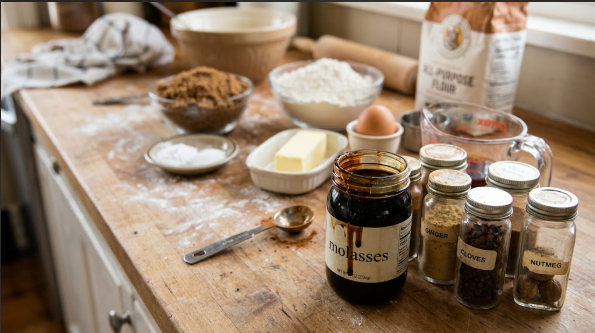
Ingredients and Equipment
Makes about 24 cookies using a 3-inch (7.5 cm) cutter.
| Ingredient | Amount | Notes |
| All-purpose flour | 3 cups (375 g) | Spoon and level, or weigh it |
| Baking soda | 1 tsp | Make sure it is fresh |
| Ground ginger | 2 tsp | The main flavor |
| Ground cinnamon | 1 1/2 tsp | |
| Ground cloves | 1/2 tsp | |
| Ground nutmeg | 1/4 tsp | Freshly grated is best |
| Fine salt | 1/2 tsp | |
| Unsalted butter | 3/4 cup (6 oz / 0.375 lb / 170 g), softened | Cool room temperature |
| Packed light or dark brown sugar | 3/4 cup (150 g) | Dark gives a deeper flavor |
| Unsulphured molasses | 1/2 cup (about 170 g) | Not blackstrap |
| Large egg | 1 | Room temperature |
| Vanilla extract | 1 tsp |
Equipment:
- Stand mixer or hand mixer with a large bowl
- Rolling pin, ideally with thickness guides
- Gingerbread cookie cutters
- Two rimmed baking sheets lined with parchment or silicone mats
- Wire cooling rack
- Plastic wrap for chilling the dough
Substitutions that work:
- Butter: Use unsalted so you control the salt. If you only have salted butter, cut the added salt in half.
- Molasses: Unsulphured molasses has a clean, mellow flavor. Blackstrap is too bitter. Dark corn syrup or golden syrup will bake, but the taste is milder.
- Flour: A 1:1 gluten-free baking blend can work, though the dough will be more delicate.
- Egg: A flax egg (1 tbsp ground flax plus 3 tbsp water) can stand in for a vegan version. For more plant-based baking ideas, browse our vegan desserts.
Choosing and Prepping Your Ingredients
Spices are the flavor engine here, so check their age. Ground spices lose punch after a year or two in the pantry. If your ginger smells faint, buy a fresh jar. It makes a noticeable difference.
Measure flour carefully. Scooping straight from the bag can pack in an extra 1/2 cup (60 g), and that is the number one reason gingerbread cookies turn out dry. Fluff the flour, spoon it into the cup, and level it with a knife. A kitchen scale is even better. Target 375 g.
Molasses is sticky, so coat your measuring cup with a quick spray of cooking oil or measure it by weight straight into the mixer bowl. It pours out cleanly that way.
Let the butter and egg sit on the counter for 30-45 minutes. The butter should dent when pressed but not look shiny or greasy. Butter that is too warm makes the cookies spread.
Do not plan to taste the raw dough. It contains raw egg and raw flour. The FDA advises against eating raw dough or batter because of the risk of illness.
Step-by-Step Instructions
- Whisk the dry ingredients. In a medium bowl, whisk the flour, baking soda, ginger, cinnamon, cloves, nutmeg, and salt until evenly mixed. This spreads the spices so there are no bitter pockets.
- Cream the butter and sugar. In a large bowl, beat the butter and brown sugar for 2-3 minutes on medium speed until fluffy and pale brown.
- Add the wet ingredients. Beat in the egg, then the molasses and vanilla. The mixture may look slightly curdled. That is fine.
- Add the flour. On low speed, mix in the dry ingredients in two or three additions, just until no dry streaks remain. Stop as soon as it comes together.
- Divide and chill. The dough will be soft and sticky. Split it into two discs about 1 inch (2.5 cm) thick, wrap each in plastic, and refrigerate for at least 2 hours, or up to 2 days.
- Preheat. Heat the oven to 350°F (175°C) with a rack in the center. Line two baking sheets with parchment.
- Roll the dough. Lightly flour a work surface. Roll one disc to 1/4 inch (6 mm) thick. Keep the other disc in the refrigerator.
- Cut and place. Cut shapes and use a thin spatula to move them to the baking sheet, spacing them 1 1/2 inches (4 cm) apart. Gather scraps and reroll once.
- Chill the cutouts (optional but helpful). Put the filled tray in the freezer for 10 minutes if your kitchen is warm. This sharpens the edges.
- Bake. Bake for 9-11 minutes, rotating the pan halfway through. Pull them when the edges are set and the centers look matte and slightly puffed.
- Cool in stages. Rest on the pan for 5 minutes, then move to a wire rack. They firm up as they cool.
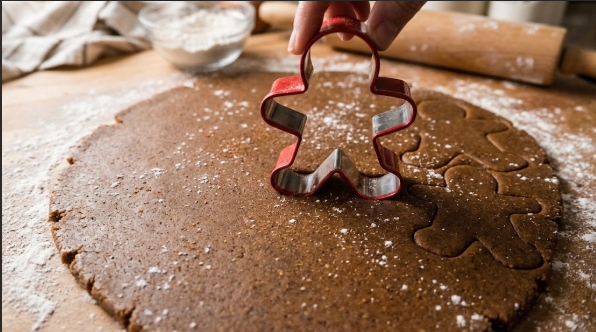
Pitmaster Tip: Roll the dough between two sheets of parchment. You need little or no extra flour, so the dough stays tender, and you can slide the whole sheet onto a tray to chill. Extra flour on the surface is the quickest way to end up with a dry, pale cookie.
Common Mistake: Baking until the cookies look “done” in the oven. Gingerbread cookies firm up a lot while cooling on the tray. If they look crisp and dry the moment you pull them, they will be rock hard by the time they cool. Take them out when the centers look set but still soft to a gentle touch.
Time and Temperature Table
| Stage | Temp | Time | Look for |
| Cream butter and sugar | n/a | 2-3 min | Pale, fluffy |
| Chill dough | Refrigerator (40°F / 4°C or colder) | 2 hr minimum | Firm, rollable |
| Optional tray freeze | Freezer | 10 min | Cold, firm shapes |
| Bake soft cookies, 1/4 inch (6 mm) | 350°F (175°C) | 9-10 min | Set edges, matte centers |
| Bake crisper cookies, 1/8 inch (3 mm) | 350°F (175°C) | 8-9 min | Edges lightly darker |
| Bake thick cookies, 3/8 inch (10 mm) | 350°F (175°C) | 11-13 min | Puffed, set at the edges |
| Cool on pan | Room temp | 5 min | Cookies lift easily |
| Cool on rack | Room temp | 30-45 min | Fully cool before icing |
How to Tell When Gingerbread Cookies Are Done
Dark dough hides browning, so you cannot judge by color. Instead, watch the edges and the surface.
- Edges: They should be dry and firm, not shiny or wet-looking.
- Centers: The surface should look matte, with no glossy sheen. It may crack very slightly near the middle.
- Feel: Touch the center gently with a finger. It should feel soft but not leave a deep dent.
- Smell: A strong, toasted spice smell usually signals about a minute left.
Because the dough contains egg, you want it fully baked. The USDA lists 160°F (71°C) as the safe minimum internal temperature for egg dishes]. A properly baked cookie with set edges and a matte center has been through enough heat. If you want proof, an instant-read thermometer in a thicker cookie will confirm it.
Resting, Decorating, and Serving
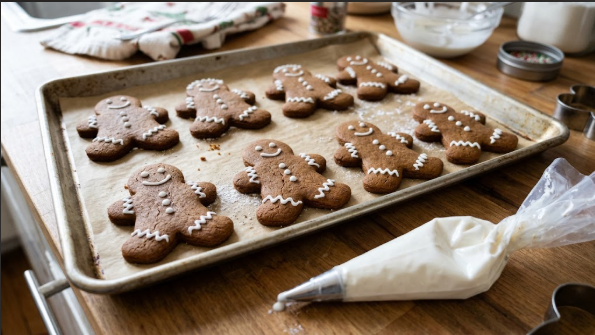
Cool the gingerbread cookies completely before decorating, or the icing will melt and slide. That takes about 30-45 minutes on a rack.
Simple royal icing: Beat 2 cups (240 g) powdered sugar with 1 1/2 tbsp meringue powder and 3-4 tbsp warm water for about 3 minutes, until stiff peaks form. Thin it with water a few drops at a time for flooding. Cover the bowl with a damp towel, since icing crusts quickly.
Easier options:
- A quick glaze of powdered sugar and milk, drizzled over the tops
- Melted white or dark chocolate, dipped on one end
- A dusting of powdered sugar for a rustic look
- Candy buttons and mini chocolate chips pressed in before baking
Let royal icing dry for 4-6 hours, or overnight, before stacking or packing. The icing should be hard to the touch with no tacky patches.
What to Serve With Gingerbread Cookies
Gingerbread cookies pair well with drinks and with other desserts on a cookie table.
- Drinks: Hot coffee, black tea, chai, hot cocoa, or cold milk
- Cookie tray companions: A classic chocolate cookie balances the spice. Try our best chocolate chip cookies or this simple chocolate chip cookie recipe
- With dessert: Crumble a cookie over vanilla ice cream, or serve alongside baked apples
- Gift tins: Layer with parchment and tuck in a mix of shapes
For more sweets to round out the holiday table, see our easy dessert recipes.
Storing, Freezing, and Reheating Leftovers
Room temperature: Store undecorated cookies in an airtight container, layered with parchment, for up to 5 days. A slice of bread in the container helps keep them soft, though the bread needs replacing every other day. Cookies with royal icing should dry fully first.
Refrigerator: Cookies without perishable fillings do not need refrigeration. If you add a cream cheese frosting, refrigerate them. The USDA advises that leftovers should go in the refrigerator within 2 hours
Freezing the dough: Wrap each disc tightly in plastic, then place in a freezer bag. Freeze for up to 3 months and thaw overnight in the refrigerator.The USDA notes food stays safe indefinitely at 0°F (-18°C) though quality drops with time.
Freezing baked cookies: Freeze undecorated cookies in a single layer on a tray, then transfer to a container with parchment between layers. Thaw uncovered at room temperature for about 30 minutes.
Refreshing stale cookies: Warm them in a 300°F (150°C) oven for 3-4 minutes. They soften slightly and smell freshly baked again.
Variations: Oven, Pellet Grill, Charcoal, and More
Oven (the baseline). Everything above was tested for a standard home oven at 350°F (175°C). Use the center rack and rotate the pan halfway.
Pellet grill. Set the grill to 350°F (175°C), close the lid, and let it preheat for 15 minutes. Put the cookies on a parchment-lined baking sheet or a preheated pizza stone, and keep the sheet off direct heat if your model has a flame zone. Use a mild pellet such as apple or cherry for a light smoke, since strong woods overpower the spices. Bake for 9-11 minutes, checking early, as pellet grills have hot spots
Charcoal kettle. Set up indirect heat, with coals on one side and the tray on the other, aiming for about 350°F (175°C) at the grate. Rotate the tray halfway through because the side facing the coals bakes faster. Place a second sheet pan under the cookie sheet to shield the bottoms from scorching.
Ninja Woodfire or other outdoor ovens. Use the bake setting if your model has one and follow its manual. Small chambers run hot, so start checking at 7 minutes.
Air fryer. Bake small batches at 325°F (165°C) for 6-8 minutes on parchment. Airflow dries cookies quickly, so keep the shapes small. For more ideas, see our easy air fryer recipes.
Other twists:
- Soft molasses drops: Skip the rolling and cutting. Scoop 1-tbsp balls, roll in sugar, and bake at 350°F (175°C) for 10-12 minutes.
- Extra spicy: Add 1/2 tsp black pepper and 1/2 tsp ground cardamom.
- Orange gingerbread: Add 1 tsp finely grated orange zest to the butter and sugar.
- Gingerbread house dough: This recipe is meant for eating. House walls need a stiffer dough with less leavening, so use a dedicated structural recipe.
Troubleshooting Your Gingerbread Cookies
| Problem | Likely cause | Fix |
| Cookies are hard | Overbaked, too much flour, rolled too thin | Pull at set edges, weigh flour, roll 1/4 inch (6 mm) |
| Cookies spread | Dough too warm, or butter too soft | Chill dough, freeze cutouts for 10 minutes |
| Dough is too sticky | Warm dough or humid kitchen | Chill longer, roll between parchment |
| Dough cracks when rolled | Dough too cold | Rest at room temp for 5-10 minutes |
| Cookies lose shape | Too much leavening or warm dough | Measure baking soda exactly, chill the tray |
| Flavor is flat | Old spices | Replace ground spices older than a year |
| Bitter taste | Blackstrap molasses | Use unsulphured molasses |
| Icing runs off | Cookies still warm | Cool fully and use stiffer icing |
| Bottoms are dark | Dark pan or low rack | Use light-colored pans, center rack |
If your gingerbread cookies still turn out hard, the first suspects are always the flour amount and the bake time. Weigh the flour and pull the tray 1 minute earlier.
Recipe Card: Gingerbread Cookies
Yield: About 24 cookies (3-inch / 7.5 cm)
Prep time: 30 minutes
Chill time: 2 hours
Cook time: 9-11 minutes per batch
Total time: About 3 hours
Oven temp: 350°F (175°C)
Ingredients:
- 3 cups (375 g) all-purpose flour
- 1 tsp baking soda
- 2 tsp ground ginger
- 1 1/2 tsp ground cinnamon
- 1/2 tsp ground cloves
- 1/4 tsp ground nutmeg
- 1/2 tsp fine salt
- 3/4 cup (6 oz / 170 g) unsalted butter, softened
- 3/4 cup (150 g) packed brown sugar
- 1/2 cup (about 170 g) unsulphured molasses
- 1 large egg
- 1 tsp vanilla extract
Steps:
- Whisk the flour, baking soda, spices, and salt.
- Beat the butter and sugar until fluffy, then add the egg, molasses, and vanilla.
- Mix in the dry ingredients until just combined.
- Divide into two discs, wrap, and chill for 2 hours.
- Roll to 1/4 inch (6 mm) and cut shapes.
- Bake at 350°F (175°C) for 9-11 minutes.
- Cool on the pan for 5 minutes, then on a rack until fully cool.
- Decorate once cool.
Frequently Asked Questions
Do you have to chill gingerbread cookie dough?
Yes. Chilling firms the butter and lets the flour absorb moisture, so the dough rolls cleanly and holds its shape. Warm dough spreads in the oven and gets sticky on the counter. Chill for at least 2 hours, or up to 2 days.
What kind of molasses is best for gingerbread cookies?
Use unsulphured molasses, labeled “original” or “mild.” It adds rich, sweet flavor without bitterness. Blackstrap molasses is far more intense and slightly bitter, which can make gingerbread cookies taste harsh unless used in a very small amount.
Why are my gingerbread cookies hard?
Hard cookies usually come from too much flour, rolling too thin, or baking too long. Weigh the flour at 375 g, roll to 1/4 inch (6 mm), and pull the tray when the edges are set and the center still looks soft.
How do you keep gingerbread cookies soft?
Store them in an airtight container as soon as they are fully cool. Layer with parchment and add a slice of bread to the container if you like. Do not overbake, since the softness you get on day one depends on pulling them early.
Can you freeze gingerbread cookie dough?
Yes. Wrap each disc tightly in plastic, put it in a freezer bag, and freeze for up to 3 months. Thaw overnight in the refrigerator, then let it sit at room temperature for 5-10 minutes before rolling so it does not crack.
Can you bake gingerbread cookies on a pellet grill?
Yes. Preheat to 350°F (175°C), use a parchment-lined sheet or a pizza stone, and choose mild pellets like apple. Check at 8 minutes because hot spots vary. The cookies pick up a faint smoky note that pairs well with the spices.
Conclusion
A good batch of gingerbread cookies comes down to simple habits. Weigh the flour, use unsulphured molasses and fresh spices, chill the dough, and pull the tray while the centers still look soft. Those four steps give you cookies that taste like the holidays and stay soft for days.
Make the dough ahead, bake whenever you have an hour, and decorate on a quiet afternoon. If you want to try the pellet grill or charcoal method, start with a small test tray. Once you have this gingerbread cookies recipe down, change the spices, the shapes, and the icing to make it yours.
Laura Smith

I'm Laura, I like all the kind of delicious grilled foods which makes me hungry all the time I see them. That's why I built this blog to share with you all of my Grilling experiences, recipes, and all the tips about foods that I've learned from food experts.