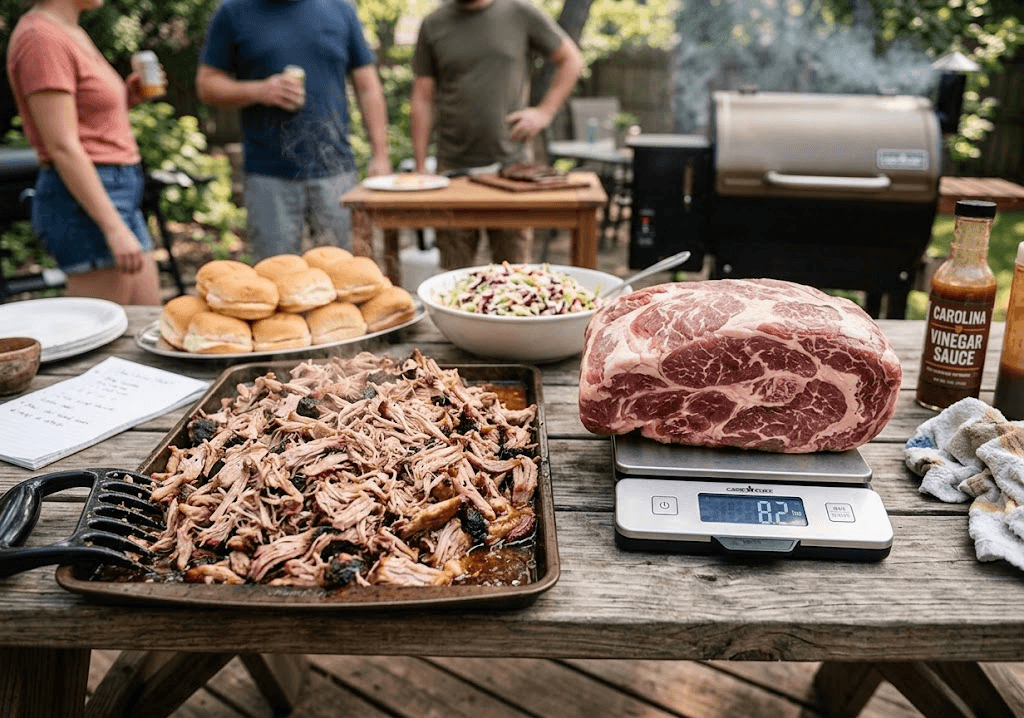
You’ve got a guest list, a smoker, and a plan for pulled pork. The only question left is how much meat to buy. Getting how much pork shoulder per person right keeps you from running out of food or eating pulled pork for two weeks.
The tricky part is that pork shoulder loses nearly half its weight on the smoker. The number on the package isn’t the number on the plate. This guide gives you the math, a chart for 4 to 50 guests, and the adjustments that matter for real parties.
Quick Answer
Plan on about ½ pound (225 g) of cooked pulled pork per person. That means buying roughly 1 pound (0.45 kg) of raw bone-in pork shoulder per guest, or about ¾ pound (0.35 kg) if it’s boneless. Add 25% for big eaters, light side dishes, or leftovers.
How Much Pork Shoulder per Person: The Quick Math
Start with the cooked portion, then work backward to the raw weight you’ll buy.
A standard serving of pulled pork on a sandwich is about ½ pound (225 g) of cooked meat. That fills a bun without turning into a pile. If pulled pork is the star of a plate with only a couple of sides, bump it to ¾ pound (340 g).
Pork shoulder shrinks a lot as it cooks. Fat renders out, moisture evaporates, and a bone-in cut loses the bone’s weight too. A common rule of thumb is that a bone-in shoulder gives you about 50-60% of its raw weight as finished pulled pork. Boneless shoulder usually lands a bit higher, around 60-65%, because there’s no bone.
Here is the formula:
Raw weight to buy = (guests × cooked portion) ÷ yield
For 10 guests at ½ lb each on a bone-in butt at 55% yield: (10 × 0.5) ÷ 0.55 = about 9 lb (4.1 kg). That’s why “1 pound raw per person” works so well as a shortcut for bone-in shoulder.
Why raw weight and cooked weight differ so much
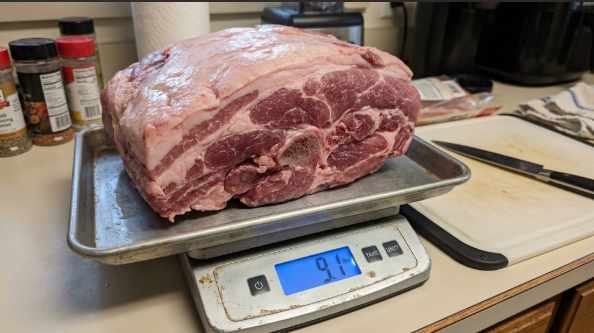
A bone-in Boston butt is heavy with fat, connective tissue, and the blade bone. All of that either renders, breaks down, or gets pulled out and discarded. The outer bark also dries and shrinks.
A raw 8 lb (3.6 kg) butt usually finishes at roughly 4-5 lb (1.8-2.3 kg) of shredded meat. Trimmed fat, the bone, and moisture loss account for the rest. If you plan around the raw weight alone, you’ll come up short.
How Much Pork Shoulder per Person for Different Crowds
Use this chart as your starting point. It assumes ½ lb (225 g) of cooked pulled pork per person, with yields of about 55% for bone-in and 62% for boneless.
| Guests | Cooked pulled pork | Raw bone-in shoulder | Raw boneless shoulder |
| 4 | 2 lb (0.9 kg) | 4 lb (1.8 kg) | 3.2 lb (1.5 kg) |
| 6 | 3 lb (1.4 kg) | 5.5-6 lb (2.5-2.7 kg) | 4.8 lb (2.2 kg) |
| 8 | 4 lb (1.8 kg) | 7.5 lb (3.4 kg) | 6.5 lb (2.9 kg) |
| 10 | 5 lb (2.3 kg) | 9-10 lb (4.1-4.5 kg) | 8 lb (3.6 kg) |
| 12 | 6 lb (2.7 kg) | 11-12 lb (5.0-5.4 kg) | 10 lb (4.5 kg) |
| 15 | 7.5 lb (3.4 kg) | 14 lb (6.4 kg) | 12 lb (5.4 kg) |
| 20 | 10 lb (4.5 kg) | 18-20 lb (8.2-9.1 kg) | 16 lb (7.3 kg) |
| 25 | 12.5 lb (5.7 kg) | 23 lb (10.4 kg) | 20 lb (9.1 kg) |
| 30 | 15 lb (6.8 kg) | 27-28 lb (12.2-12.7 kg) | 24 lb (10.9 kg) |
| 50 | 25 lb (11.3 kg) | 45 lb (20.4 kg) | 40 lb (18.1 kg) |
Round up to the next whole shoulder when you’re between sizes. Most bone-in butts at the store run 6-10 lb (2.7-4.5 kg), so for 20 guests you’d typically buy two 9-10 lb (4.1-4.5 kg) butts. Pulled pork is also forgiving, because leftovers keep well and reheat easily.
Adjusting for appetite and menu
The ½ lb number assumes a typical mixed crowd. Change it based on who’s coming and what else is on the table.
| Situation | Cooked portion per person | Raw bone-in per person |
| Kids and light eaters | ¼ lb (115 g) | about 0.45 lb (0.2 kg) |
| Sliders, or lots of sides | ⅓ lb (150 g) | about 0.6 lb (0.27 kg) |
| Standard sandwich | ½ lb (225 g) | about 0.9-1 lb (0.4-0.45 kg) |
| Pulled pork as the main plate, few sides | ¾ lb (340 g) | about 1.4 lb (0.63 kg) |
| Big eaters, football game, second helpings | ¾-1 lb (340-450 g) | about 1.4-1.8 lb (0.63-0.8 kg) |
If the menu also includes ribs, chicken, or brisket, drop your portion to ⅓ lb (150 g) per person. People eat smaller servings of each meat when there’s variety. If pulled pork is the only protein, stay at ½ lb or higher.
Step-by-Step: How to Calculate Your Pork Shoulder Order
Follow these five steps and you won’t need a calculator app.
- Count your guests. Count kids as half portions, and add one or two extra people if the guest list is a moving target.
- Pick a cooked portion. Use ½ lb (225 g) for sandwiches, ⅓ lb (150 g) for sliders or multi-meat menus, and ¾ lb (340 g) for plates.
- Multiply to get total cooked weight. Ten guests × ½ lb = 5 lb (2.3 kg) cooked.
- Divide by the yield. Use 0.55 for bone-in or 0.62 for boneless. Five pounds ÷ 0.55 = about 9 lb (4.1 kg) raw.
- Add a cushion. Add 10% for a big crowd, or 25% if you want planned leftovers.
🔥 Pitmaster Tip: Weigh the shoulder at the store, but also check the weight after trimming. If you remove a thick fat cap, you may lose 0.5-1 lb (0.2-0.45 kg) before the meat ever touches the smoker. For a tight headcount, buy a half pound more than your math says.
Bone-In vs. Boneless: Which Gives You More Pulled Pork?
Bone-in shoulder costs less per pound, and the bone helps the meat cook evenly and stay moist. You pay for that bone by weight, though, and it can be 5-8% of the raw weight. When the blade bone slides out clean at the end, that’s a good sign the meat is done.
Boneless shoulder is easier to trim, season, and portion. It usually costs more per pound but has a higher yield. It can also cook a little faster because there’s no bone to heat through.
For party math, a simple rule works: buy about 1 lb (0.45 kg) per person for bone-in, and about ¾ lb (0.35 kg) per person for boneless. Both give you enough for a standard sandwich serving with a small cushion.
Boston butt vs. picnic shoulder
“Pork shoulder” covers two cuts. The Boston butt comes from the upper shoulder and is well marbled, which makes it the favorite for pulled pork. The picnic shoulder comes from the lower shoulder, has more skin and connective tissue, and tends to yield a bit less usable meat.
Buy Boston butt when you can. If the label just says “pork shoulder,” ask the butcher which part it is. The yield numbers in this guide assume Boston butt. A picnic cut may need about 10% more raw weight.
Choosing and Preparing the Right Size Shoulder
Cooking two 8 lb (3.6 kg) shoulders is easier than cooking one 16 lb (7.3 kg) piece, which doesn’t exist at most stores anyway. Smaller pieces also finish at more predictable times. Multiple shoulders cook side by side without adding much time, as long as they aren’t touching and air can move around each one.
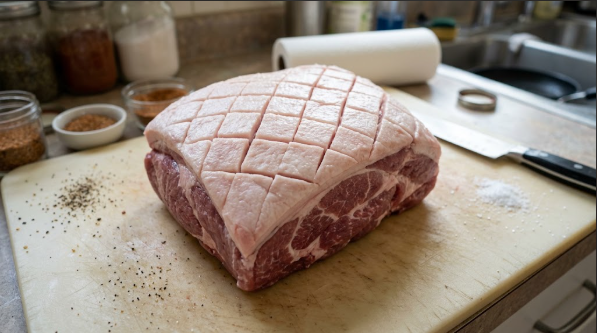
Look for a shoulder with good marbling, a fat cap about ¼ inch (6 mm) thick, and a pink-to-red color without gray patches. A thin fat cap helps the bark form, and a very thick one just melts away. Trim any fat thicker than about ½ inch (1.3 cm), because seasoning can’t get through it.
A sharp blade makes trimming easier and safer. Our guide to the best knives for cutting meat covers boning and slicing knives worth owning.
How Cooking Method Affects Your Yield
Your cooking method changes how much finished meat you get, so it’s worth knowing the basics before you commit to a number.
Low and slow wins. A smoker at 225-250°F (107-121°C) gives the best texture and renders the fat gradually. Hotter cooks finish faster but can dry the meat and lower your yield.
Hold time matters. Meat that sits in a warm cooler for hours loses little moisture if it’s wrapped. Meat left uncovered on a counter dries out and gives you less to serve.
Wrapping helps the yield. Wrapping in butcher paper or foil once the bark is set, at roughly 165°F (74°C), reduces evaporative loss. The bark softens a little, but you keep more juice.
Here are the typical numbers for a standard Boston butt.
| Stage | Smoker temp | Meat internal temp | Typical time |
| Smoke | 225-250°F (107-121°C) | 40°F → 150°F (4°C → 65°C) | 4-6 hours |
| The stall | 225-250°F (107-121°C) | 150-170°F (65-77°C) | 2-4 hours |
| Wrap (optional) | 225-250°F (107-121°C) | about 165°F (74°C) | At bark set |
| Finish | 225-250°F (107-121°C) | 195-205°F (90-96°C) | Until probe-tender |
| Rest | Wrapped, in a cooler | Hold above 140°F (60°C) | 1-2 hours |
As a rough guide, plan on 1-1.5 hours per pound at 250°F (121°C) and 1.5-2 hours per pound at 225°F (107°C). Every shoulder runs differently, so cook to feel and temperature, not the clock.
Fuel and equipment
Pellet grills hold temperature on their own, which helps beginners hit steady numbers. If you’re shopping, our best pellet grills for beginners roundup is a good place to start. Hickory, oak, and apple are classic wood choices, and cherry adds color.
Offset smokers take more attention but reward you with great bark. If you cook on one, our guide to lump charcoal in an offset smoker explains fuel and airflow. On a budget, see the best affordable offset smoker picks.
Whichever cooker you use, you need a good fire first. If you’re newer to charcoal, read how to start a grill before the big day.
How to Tell When Pork Shoulder Is Done
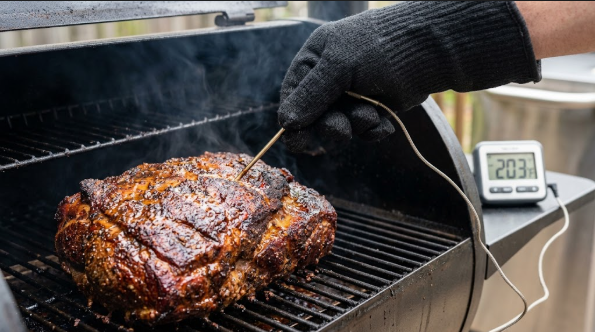
Pulled pork is done by feel, not by a single number. Pull the shoulder when the internal temperature reads 195-205°F (90-96°C) in several spots. At that range the collagen has melted into gelatin, and the meat shreds easily.
Use the probe test. An instant-read thermometer should slide in with almost no resistance, like pushing into soft butter. If the probe catches or feels tight, give it another 30-45 minutes and test again.
For a bone-in cut, the blade bone should wiggle loose and pull out clean. The bark should be dark mahogany, firm to the touch, and slightly crackly when you press it.
The USDA’s safe minimum internal temperature for whole cuts of pork is 145°F (63°C) with a 3-minute rest. Pulled pork is cooked much higher than that for tenderness, so safety is never the issue. The higher pull temp is purely about texture.
⚠️ Common Mistake: Pulling the shoulder at 180°F (82°C) because it “looks done.” At that temperature the collagen is still tight, and the meat will be chewy instead of shreddable. If your pork is tough, it usually needs more time, not less.
Resting, Pulling, and Serving
Rest the shoulder for 1-2 hours before pulling. Wrap it in foil or butcher paper, then in a clean towel, and place it in a dry cooler. The meat stays hot, the juices redistribute, and your timing gets flexible, which helps when guests are late.
During the rest, keep the meat at 140°F (60°C) or above, because the danger zone is 40-140°F (4-60°C), where bacteria multiply fastest.
Pull the pork while it’s still warm. Use bear claws, forks, or clean gloved hands. Pull out the bone, any big pockets of fat, and the connective tissue strands. Then mix in the juices from the wrap, which keeps the meat moist.
Weigh the finished pulled pork if you can. That number tells you how well your estimate worked and helps you plan better next time. If you came in under ½ lb per guest, you’ll know to buy more.
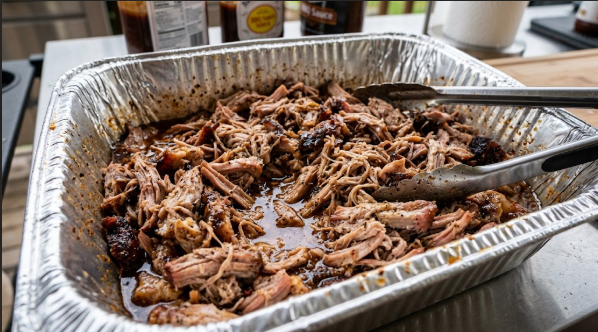
Serving ideas that stretch the meat
Some serving styles make a pound of pork go further without making guests feel shortchanged.
- Sliders use ⅓ lb (150 g) of pork and let guests try a second flavor.
- Piled sandwiches on a bun use the full ½ lb (225 g) and need coleslaw to finish them.
- Loaded baked potatoes, nachos, or tacos use ¼-⅓ lb (115-150 g) per person.
- Pulled pork plates with sides use ½-¾ lb (225-340 g).
Set out sauce on the side. A Carolina vinegar sauce, a sweet tomato sauce, and a mustard sauce cover most tastes.
What to Serve with Pulled Pork
Sides change how much meat people eat. A menu with heavy starches fills people up faster, which means you can stay near the low end of the range. A lighter menu pushes you toward the high end.
Classic pairings include:
- Creamy or vinegar coleslaw, which also goes on the sandwich
- Baked beans, mac and cheese, or potato salad
- Sweet corn bread for sopping up sauce
- Pickles, sliced onions, and grilled corn on the cob
- Slider rolls or brioche buns, about 1.5 buns per guest
Planning a full party menu? Our tips for hosting a summer BBQ party on a budget help you set quantities and costs for everything, not just the meat.
Food Safety Notes for Serving a Crowd
Large cooks bring larger food safety stakes, so a few basic rules matter.
Keep hot food hot. Hold pulled pork at 140°F (60°C) or above in a warming tray, slow cooker on warm, or insulated cooler. Don’t leave it on a buffet table without heat.
Follow the 2-hour rule. Cooked food shouldn’t sit out longer than 2 hours, or 1 hour when it’s above 90°F (32°C) outside, per USDA leftovers guidance. That’s easy to forget at an outdoor summer party.
Store leftovers quickly. Divide pulled pork into shallow containers so it cools fast. Refrigerated cooked pork keeps for 3-4 days, according to the FoodSafety.gov cold storage chart.
Reheat fully. Reheat leftovers to 165°F (74°C), as recommended in the USDA’s leftover guidance.
Planning for Leftovers
Leftover pulled pork is one of the best reasons to buy a little extra. It freezes well and turns into fast meals. Whether you want leftovers is a real planning decision, so decide it before you shop.
If you want them, add 25% to your raw weight. A 10-person party at 9-10 lb (4.1-4.5 kg) becomes 11-12 lb (5.0-5.4 kg) raw. That gives you about 2 extra pounds (0.9 kg) cooked, enough for tacos, quesadillas, or pork fried rice later in the week.
Freeze pulled pork in portions of about 1 lb (0.45 kg), with a splash of the cooking juices to prevent freezer burn. Press out the air and label the date. For best quality, use it within a few months .
To reheat, thaw it in the refrigerator overnight. Warm it gently in a covered pan with a little broth or apple juice until it reaches 165°F (74°C). Avoid blasting it in the microwave on high, which makes the edges dry.
Common Planning Mistakes
A few errors cause most “we ran out” and “we have way too much” problems.
- Counting raw weight as serving weight. This is the biggest mistake, and it leaves you about 40% short.
- Forgetting kids and seconds. Children eat less, but teens and adults often go back for a second sandwich.
- Ignoring the rest of the menu. Rich sides reduce meat portions, and a light menu increases them.
- Buying only one big piece. Two smaller shoulders cook more evenly and give you backup if one cooks slower.
- Skipping the buffer for a large crowd. Parties over 25 people tend to eat more per head than the math says, so add 10%.
Troubleshooting Yield and Texture
If your results don’t match the plan, the cause is usually one of these.
Yield was lower than expected. The shoulder may have had a thick fat cap, a large bone, or too much moisture loss from a hot, unwrapped cook. Next time, trim less aggressively, wrap at the stall, and weigh your finished meat.
The pork came out dry. It may have run too hot, or it may not have rested. Hold the shoulder wrapped in a cooler for at least an hour, then mix the juices back in when you pull it.
The pork is tough, not tender. It needs more time. Keep cooking until the probe slides in easily, even if the thermometer says 205°F (96°C).
There wasn’t enough bark. Wrapping too early softens it. Wait until the bark is dark and set before you wrap, or skip the wrap on a small cook.
Frequently Asked Questions
How much pulled pork do I need for 10 people?
Plan on 5 lb (2.3 kg) of cooked pulled pork, which means buying about 9-10 lb (4.1-4.5 kg) of raw bone-in pork shoulder. One large Boston butt or two smaller ones will do. Add a pound or two if you want leftovers or have big eaters.
How many pounds of pork shoulder for 20 people?
For 20 guests, buy about 18-20 lb (8.2-9.1 kg) of raw bone-in pork shoulder, or about 16 lb (7.3 kg) boneless. That yields roughly 10 lb (4.5 kg) cooked. Two 9-10 lb (4.1-4.5 kg) butts cook together easily on one smoker.
How much does pork shoulder shrink when smoked?
Bone-in pork shoulder typically loses 40-50% of its raw weight during cooking and trimming . That loss comes from rendered fat, evaporated moisture, and the bone. A raw 8 lb (3.6 kg) butt usually gives about 4-5 lb (1.8-2.3 kg) of pulled pork.
Is a Boston butt the same as a pork shoulder?
Not exactly. “Pork shoulder” covers two cuts: the Boston butt (upper shoulder) and the picnic (lower shoulder). Boston butt is better marbled and the standard choice for pulled pork. If the label only says “shoulder,” ask which cut it is.
How much pulled pork per person for sandwiches?
Plan on ½ lb (225 g) of cooked pork per person for a full sandwich, or ⅓ lb (150 g) for sliders. If pork is the only meat and you want seconds, go to ¾ lb (340 g). Mixed menus with other meats need less.
How long can pulled pork sit out?
Pulled pork should sit out no more than 2 hours, or 1 hour if the temperature is above 90°F (32°C). Keep it at 140°F (60°C) or hotter during service. Refrigerate leftovers promptly in shallow containers.
Final Thoughts on How Much Pork Shoulder per Person
The simple answer to how much pork shoulder per person is about ½ lb (225 g) cooked, or about 1 lb (0.45 kg) of raw bone-in shoulder per guest. From there, adjust for appetites, the rest of your menu, and whether you want leftovers.
Use the chart to find your number fast, weigh your finished pork to learn your own yield, and cook to probe-tender rather than the clock. Add a cushion for big crowds, and keep everything hot until it’s served. Do that and your pulled pork will be the easy part of the party.
Laura Smith

I'm Laura, I like all the kind of delicious grilled foods which makes me hungry all the time I see them. That's why I built this blog to share with you all of my Grilling experiences, recipes, and all the tips about foods that I've learned from food experts.