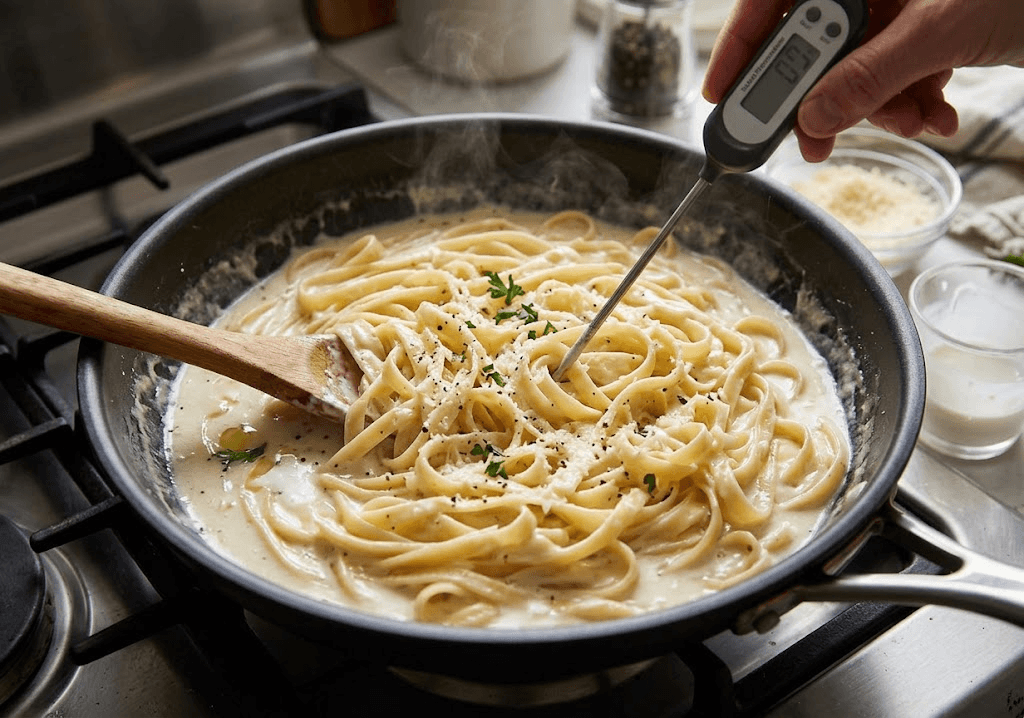
Leftover Alfredo is one of the hardest dishes to bring back to life. The sauce is butter, cream, and cheese held together in a delicate emulsion, and too much heat makes it break into oil and clumps. The good news is that learning how to reheat Alfredo comes down to three things: low heat, a little extra liquid, and constant stirring.
This guide covers the stovetop, microwave, oven, and even the grill. You’ll get exact temperatures, times, a fix for sauce that has already split, and the food safety rules for leftovers.
Quick Answer: To reheat Alfredo, warm it in a saucepan or skillet over low heat with 1-2 tablespoons of milk or cream per serving. Stir constantly for 5-8 minutes until it reaches 165°F (74°C) and turns smooth. Avoid high heat, which makes the sauce separate. The microwave works at 50% power with stirring.
What Alfredo Is and Why It’s So Hard to Reheat
Classic American-style Alfredo is a simple sauce: butter, heavy cream, and grated Parmesan. Some cooks add garlic, a little flour, or cream cheese. The sauce looks smooth because fat, water, and cheese proteins are suspended together in what cooks call an emulsion.
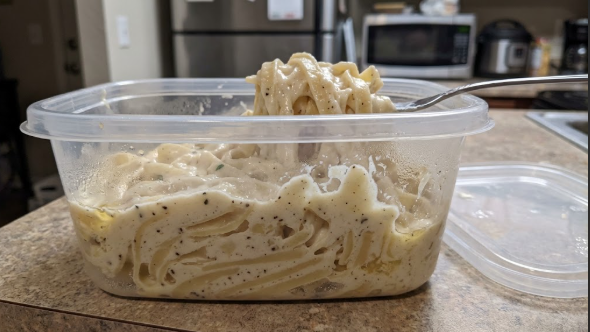
Cold temperatures and time change that structure. In the fridge, the butterfat and cream firm up, and the sauce turns into a thick, pasty block. The noodles also keep soaking up liquid, so leftover pasta often looks dry and clumped the next day.
When you reheat Alfredo too fast, the emulsion breaks. The fat leaks out as an oily layer, and the cheese proteins tighten into little grainy bits. That is why microwaved Alfredo so often looks greasy with a rubbery texture.
Everything in this guide is built around protecting that emulsion. Gentle heat, added moisture, and movement are the whole game.
Why Reheated Alfredo Separates
Three things cause most failures:
- Heat that is too high. Fat melts and escapes the sauce when the temperature climbs quickly, especially above a gentle simmer.
- Not enough liquid. Leftover sauce has lost water to the noodles and to evaporation, so there is less to hold the fat in place.
- No stirring. Hot spots form at the bottom of the pan or the edges of the bowl, and those spots break first.
Once you know the causes, the fixes are easy. Each method below handles all three.
What You Need
You don’t need special gear, but the right tools make the process easier.
Basic equipment:
- A wide nonstick skillet or a medium saucepan
- A wooden spoon, silicone spatula, or whisk
- A microwave-safe bowl with a loose lid or plate for covering
- A baking dish and foil for oven reheating
- An instant-read thermometer
- A small measuring cup or spoon for the liquid
A wide pan beats a deep one because it spreads the sauce thin and heats it evenly. If you cook on an electric range, our guide on using nonstick pans on an electric stove covers what to watch for. If you are shopping for a reliable skillet, our Henckels Capri Granitium pan review is a good place to start.
Liquids to add back:
| Liquid | Best for | Amount per serving |
| Whole milk | Everyday reheating | 1-2 tbsp |
| Heavy cream | Richest, most restaurant-like result | 1-2 tbsp |
| Half-and-half | Middle ground | 1-2 tbsp |
| Pasta water (reserved) | Loosening without adding fat | 1-3 tbsp |
| Chicken broth | Lighter, but can thin flavor | 1-2 tbsp |
A serving here means roughly 1.5 cups (about 10 oz or 280 g) of sauced pasta. Start with the smaller amount, since you can always add more.
Optional finishers: A small pat of butter, a pinch of freshly grated Parmesan, a grind of black pepper, and a tiny bit of garlic powder bring flavor back to a sauce that has dulled in the fridge.
Before You Start: Check That the Leftovers Are Safe
Reheating cannot fix food that was stored poorly, so check first. The USDA says to refrigerate perishable food within two hours, or within one hour if the room is above 90°F (32°C). According to USDA FSIS, leftovers are best used within 3 to 4 days, and the fridge should be at 40°F (4°C) or below.
If your Alfredo sat out on the counter through dinner and a movie, throw it away. If it smells sour, looks slimy, or has been in the fridge for more than four days, throw it away too. A cream sauce is a very friendly place for bacteria to grow.
Pitmaster Tip: Cool leftovers fast. Spread Alfredo into a shallow container instead of a deep tub, so it chills in the fridge quickly. Store the sauce and pasta together if it’s already mixed, but keep any cooked chicken or shrimp in the same container so everything shares the same timeline.
How to Reheat Alfredo: Four Methods
Each method below suits a different situation. The stovetop is the best all-around way to reheat Alfredo, the oven is best for big batches, and the microwave is fastest when you have no time.
Method 1: Stovetop (Best Quality)
This is the method to use when you want your reheated Alfredo to taste almost fresh. It gives you the most control, and you can see exactly what the sauce is doing.
- Take the chill off. Let the container sit on the counter for 10-15 minutes. Don’t leave it longer than 30 minutes, since you are heading toward the danger zone.
- Add liquid to the pan first. Pour 1-2 tablespoons of milk or cream per serving into a cold skillet, then add the Alfredo. This protects the sauce from hot metal.
- Turn the burner to low. Use low or medium-low heat. You want the sauce barely warm at first, with no sizzling.
- Stir gently and often. Use a spatula or wooden spoon and fold the pasta from the outside of the pan toward the middle. Break up cold clumps as they soften.
- Add more liquid if needed. If the sauce looks thick or pasty after 2-3 minutes, add another splash. Add it a teaspoon at a time near the end.
- Heat to 165°F (74°C). Check the center with an instant-read thermometer. It usually takes 5-8 minutes for a serving or two, and 10-12 minutes for a larger batch.
- Finish and serve. Stir in a small pat of butter or a spoonful of grated Parmesan, then taste for salt and pepper. Serve right away.

If you’re warming just the sauce without pasta, a saucepan works well. A heavy-bottomed pot, such as the ones in our best stockpot roundup, holds heat evenly and cuts down on scorching.
Method 2: Double Boiler (Gentlest Heat)
A double boiler is the safest way to avoid breaking a delicate sauce, so it suits sauce-only leftovers.
- Add about 1 inch (2.5 cm) of water to a saucepan and bring it to a bare simmer.
- Set a heatproof bowl on top so it doesn’t touch the water.
- Add the sauce and 1 tablespoon of milk per cup.
- Whisk steadily for 6-10 minutes until it is smooth and steaming.
- Check that it reaches 165°F (74°C), then pour it over freshly boiled pasta.
This takes longer, but the steam heat is very soft. It is also a great way to rescue a sauce that is already a little grainy.
Method 3: Microwave (Fastest)
The microwave is the method most likely to wreck Alfredo, but you can make it work with the right settings. The secret is lower power and several short bursts.
- Use a microwave-safe bowl. Spread the pasta out instead of piling it in a mound.
- Add liquid. Stir in 1-2 tablespoons of milk or cream per serving.
- Cover loosely. Use a vented lid or a plate to hold in steam and prevent splatters.
- Set power to 50%. If your microwave doesn’t have power levels, use the defrost setting.
- Heat in 60-second bursts. Stir thoroughly after each one, scraping the edges.
- Check the temperature. A single serving normally takes 2 to 3 minutes total. The center should hit 165°F (74°C).
- Let it stand for 1 minute. The USDA notes that standing time helps microwaved food finish heating evenly
Common Mistake: Running the microwave on full power for 2 minutes straight. That melts the fat out of the sauce and leaves you with greasy noodles. Short bursts at 50% power with stirring in between are the difference between creamy and broken.
If you are thinking of upgrading your microwave, see our guide to the best over-the-range microwaves.
Method 4: Oven (Best for Big Batches)
If you’re reheating Alfredo for a crowd, or the leftovers are in a baked casserole with chicken and broccoli, the oven is your friend. It heats gently and evenly.
- Preheat the oven to 350°F (175°C).
- Transfer the Alfredo to a baking dish and stir in 2-3 tablespoons of milk per 2 servings.
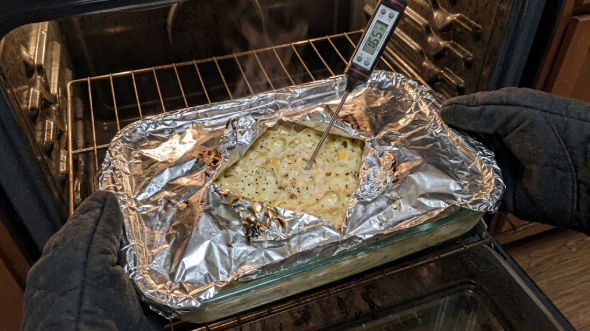
- Cover tightly with foil. This traps steam and keeps the surface from drying out.
- Bake 20-30 minutes, stirring once halfway through.
- Check that the center reaches 165°F (74°C).
- Uncover for the last 3-5 minutes if you want a lightly golden top. Add a sprinkle of Parmesan first if you like.
A toaster oven handles small portions the same way, and it heats up faster. Our best toaster oven guide lists options that hold their temperature well.

Bonus: Reheating Alfredo on the Grill or Pellet Grill
If you’re already cooking outside, you can warm a big tray of Alfredo without heating up the kitchen.
- Set your grill or pellet grill to 300°F (150°C) for indirect heat.
- Put the Alfredo in a disposable aluminum pan, add milk, and cover with foil.
- Place it on the cooler side of the grill for 20-30 minutes, stirring once or twice.
- Verify it reaches 165°F (74°C) before serving.
A pellet grill adds a faint smoky flavor, which is wonderful with chicken Alfredo. If you want to go further, top it with crisp bacon from our bacon on the pellet grill recipe.
Time and Temperature Chart
| Method | Heat setting | Added liquid | Time (1-2 servings) | Target temp |
| Stovetop skillet | Low to medium-low | 1-2 tbsp per serving | 5-8 min | 165°F (74°C) |
| Double boiler (sauce only) | Bare simmer below bowl | 1 tbsp per cup | 6-10 min | 165°F (74°C) |
| Microwave | 50% power | 1-2 tbsp per serving | 2-3 min in 60-sec bursts | 165°F (74°C) |
| Oven, covered | 350°F (175°C) | 2-3 tbsp per 2 servings | 20-30 min | 165°F (74°C) |
| Grill / pellet grill | 300°F (150°C), indirect | 2-3 tbsp per 2 servings | 20-30 min | 165°F (74°C) |
Times are for refrigerated leftovers. Larger batches take longer, so rely on your thermometer, not the clock. The USDA’s safe minimum temperature guidance says leftovers and casseroles should reach 165°F (74°C).
How to Tell When Reheated Alfredo Is Done
Your eyes and spoon will tell you a lot before the thermometer does. Properly reheated Alfredo looks glossy and smooth, and it coats the back of a spoon in a thin, even layer. The noodles should slide apart easily instead of sticking in a clump.
Steam should be rising from the center of the dish, and the sauce should have the same thickness as the day you made it. If the sauce still looks pasty, add a little more liquid and keep stirring. If it looks thin and watery, let it simmer very gently for a minute or two, or see our guide on how to thicken Alfredo sauce.
Always confirm the temperature with a thermometer. Pasta in the middle of a thick pile can still be lukewarm even when the edges are bubbling.
Reheating Alfredo With Add-Ins
Many people’s leftovers include chicken, shrimp, or vegetables. Each one needs a few small adjustments.
- Chicken: Grilled or sliced chicken can dry out quickly. Warm the pasta first, then add the chicken for the last 2 minutes so it only heats through.
- Shrimp: Shrimp turns rubbery with extra cooking. Add it at the very end and heat only until warm, about 1-2 minutes.
- Broccoli and vegetables: Vegetables usually soften more. Stir them in near the end so they don’t turn mushy.
- Sausage or bacon: These are already cooked and hold up well. Add them with the pasta.
Whatever you add, the entire dish still needs to reach 165°F (74°C) in the center.
How to Fix Alfredo That Has Already Separated
Even careful cooks sometimes end up with an oily, grainy mess. Don’t toss it yet. Most broken Alfredo can be saved.
- Take the pan off the heat right away. Continued heat makes the break worse.
- Add a splash of cold liquid. Stir in 1-2 tablespoons of cold milk or cream. The temperature drop helps the fat re-combine.
- Whisk hard. Use a whisk to stir vigorously for 30-60 seconds. You’re rebuilding the emulsion by force.
- Try a slurry for stubborn cases. Whisk 1 teaspoon of cornstarch with 1 tablespoon of cold milk, stir it in, and warm the pan very gently for 1-2 minutes.
- Blend if needed. If the sauce is grainy, a quick pulse with an immersion blender can smooth it. Make sure the pot is deep enough to prevent splatter.
- Add a little cheese at the end. A spoonful of freshly grated Parmesan can help thicken and tie things together.
Fixes work best on mild separation. If the sauce is extremely greasy or very curdled, scoop off the excess oil with a spoon and use the steps above on what remains.
Pro Tips for Better Reheated Alfredo
- Reheat only what you’ll eat. Every trip through heating and cooling lowers quality and adds food safety risk. Portion leftovers into single servings before they go in the fridge.
- Store sauce and pasta separately when possible. Noodles absorb sauce overnight. Separate storage gives you better texture the next day, and you can reheat the sauce gently on its own and toss it with fresh or briefly boiled noodles.
- Freshen noodles in hot water. If the pasta looks dry, dunk it in boiling water for 10-15 seconds, drain it well, then add it to the warmed sauce.
- Use a little extra cheese, not extra heat. Fresh Parmesan adds flavor and body, and it hides the dullness that comes from refrigeration.
- Don’t boil it. A boiling sauce will break. If you see big bubbles, lower the heat or lift the pan off the burner for a moment.
- Season at the end. Cold storage dulls flavor, so taste after reheating and adjust salt, pepper, and garlic.
- Wide pans beat deep pots. More surface area means faster, more even heating with less stirring.
Pitmaster Tip: Keep a small jar or cup of the starchy water from boiling pasta in the fridge on cooking day. A tablespoon or two of this starchy liquid loosens leftover sauce and helps it cling to noodles better than plain milk. Use it within the same 3-4 day window as the leftovers.
Common Mistakes and Fixes
| Mistake | What happens | Fix |
| Cranking the heat to “speed things up” | Sauce splits into oil and curds | Use low heat and stir; patience pays off |
| Microwaving at full power | Rubbery noodles, greasy pools | Use 50% power in short bursts |
| Adding no liquid | Pasty, dry, clumpy sauce | Add 1-2 tbsp milk or cream per serving |
| Walking away from the stove | Scorched bottom, uneven heat | Stir every 30-60 seconds |
| Skipping the thermometer | Cold center or overheated edges | Check for 165°F (74°C) in the middle |
| Reheating more than once | Quality and safety both drop | Warm only the portion you plan to eat |
| Using pre-shredded cheese to “fix” it | Grainy texture from anti-caking agents | Grate fresh Parmesan from a wedge |
Food Safety Notes
Cream-based sauces are among the foods most sensitive to temperature abuse. Follow these rules every time:
- Refrigerate quickly. Get leftovers into the fridge within 2 hours of cooking, or within 1 hour when the temperature is above 90°F (32°C). The USDA calls the 40°F to 140°F range the “danger zone” , where bacteria multiply fastest.
- Use within 3-4 days. Label the container with the date. After that, it’s not worth the risk.
- Reheat to 165°F (74°C). This is the USDA’s recommended temperature for leftovers, and you should measure it with a thermometer.
- Reheat only once. Cooling and warming repeatedly gives bacteria more chances to grow. Heat just what you’ll eat.
- Freeze for longer storage. Food kept at 0°F (-18°C) stays safe indefinitely, though quality declines over time. Thaw Alfredo in the refrigerator, not on the counter, and expect some texture changes since cream sauces can turn grainy after freezing.
- Don’t taste-test your way to safety. Sauce can smell and look fine while carrying bacteria. When in doubt, throw it out.
People who are pregnant, older adults, young children, and anyone with a weakened immune system should be especially careful with leftovers. Following the time and temperature rules above matters even more for them.
FAQ
Can you reheat Alfredo sauce?
Yes. Use low heat on the stove, add 1-2 tablespoons of milk or cream per serving, and stir constantly. Heat it to 165°F (74°C). Reheated Alfredo works best when warmed gently and eaten right away, since high heat or too little liquid can make it separate.
How do you reheat Alfredo without it separating?
Keep the heat low, add a splash of milk or cream, and stir often. Never let the sauce boil. A double boiler is the gentlest option. If it starts to split, pull it off the heat and whisk in a spoonful of cold milk.
Can you reheat Alfredo in the microwave?
Yes, with care. Use a covered microwave-safe bowl, add a splash of milk, and heat at 50% power in 60-second bursts, stirring each time. Check that the center hits 165°F (74°C). Full power often leaves the sauce oily and the noodles tough.
How long does leftover Alfredo last in the fridge?
Leftover Alfredo keeps about 3 to 4 days in an airtight container at 40°F (4°C) or below, according to USDA guidance. Refrigerate it within 2 hours of cooking. If it smells sour, looks slimy, or has passed four days, throw it away.
Can you reheat Alfredo twice?
It’s best not to. Each round of cooling and heating gives bacteria more chances to grow and lowers the quality of the sauce. Portion leftovers into single servings so you only warm what you will eat, and discard anything left after reheating.
What can I add to Alfredo when reheating it?
Add 1-2 tablespoons of milk, cream, or reserved pasta water per serving. Finish with a small pat of butter or freshly grated Parmesan to restore richness. A pinch of garlic powder and black pepper helps revive flavor that dulls in the fridge.
Conclusion
Learning how to reheat Alfredo is mostly about restraint. Low heat, a splash of milk or cream, and steady stirring keep the emulsion intact, so the sauce comes back silky instead of greasy. Use a thermometer to hit 165°F (74°C), and you’ll have leftovers that are both safe and delicious.
Choose the stovetop for the best texture, the microwave at 50% power when you’re short on time, and the oven or grill for big batches. If a sauce does break, take it off the heat, whisk in cold liquid, and rescue it. Now that you know how to reheat Alfredo the right way, yesterday’s pasta can taste nearly as good as the night you made it.
Laura Smith

I'm Laura, I like all the kind of delicious grilled foods which makes me hungry all the time I see them. That's why I built this blog to share with you all of my Grilling experiences, recipes, and all the tips about foods that I've learned from food experts.