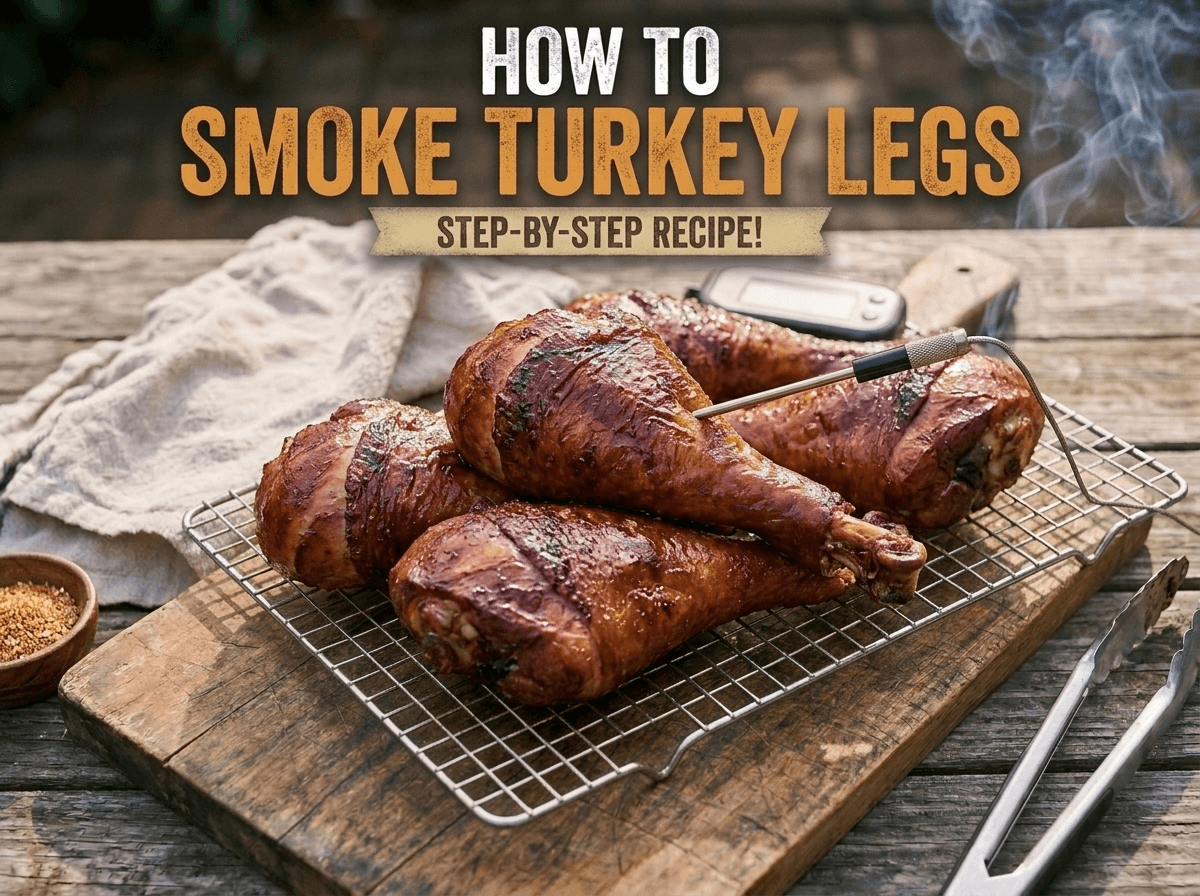
Smoked turkey legs are the fairground favorite you can make in your own backyard, with better meat and no line. The dark meat is forgiving and inexpensive, and a few hours of smoke turn a plain drumstick into a mahogany, caveman-sized meal. This smoked turkey legs: step-by-step recipe covers a simple brine, a smoky rub, a 275°F (135°C) cook, and the exact temperatures to look for.
Turkey legs are full of connective tissue, so they need steady moderate heat and more time than a breast. Cook them to the right internal temperature and the tough tendons melt into rich, juicy meat. You can get tender meat and crisp skin on a pellet grill, an offset, or a charcoal grill.
Quick Answer
For smoked turkey legs, set your smoker to 275°F (135°C) and cook about 2½–3½ hours, until the thickest part reads 180–190°F (82–88°C) for tender meat. USDA’s safe minimum is 165°F (74°C). Brine them overnight, pat dry, season, smoke with apple or cherry wood, and rest 15 minutes before serving.
Why This Smoked Turkey Legs Step-by-Step Recipe Works
Three steps do most of the work: brining, drying, and a finishing blast of heat.
- Brining pushes salt and moisture into the meat, so the legs stay juicy even though they cook past the safe minimum.
- Drying the skin in the fridge before smoking is what gives you a bite-through finish instead of a rubbery one.
- A moderate smoker temperature of 275°F (135°C) renders fat and softens the tendons without drying out the meat.
Cooking to 180–190°F (82–88°C) instead of stopping at 165°F (74°C) is the other secret. At 165°F the meat is safe, but the collagen around the bone is still tight and chewy. A little more heat and time turns it silky.
If you also want a lighter cut for the same cook, see our notes on turkey breast at 250.
Ingredients and Equipment
For the legs:
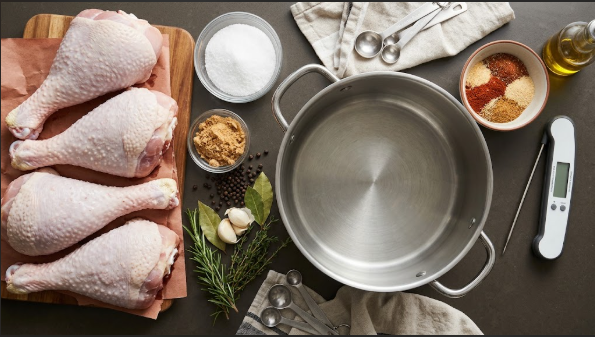
- 4 turkey legs, 1–1.5 lb (0.45–0.7 kg) each, about 5 lb (2.3 kg) total
- 2 tbsp olive or avocado oil, as a binder
For the brine (makes about 1 gallon / 3.8 L):
- 1 gallon (3.8 L) cold water
- 3.5 oz (100 g) kosher salt (weigh it, because kosher salt brands differ a lot by volume)
- ½ cup (100 g) brown sugar
- 4 smashed garlic cloves, 2 bay leaves, and 1 tbsp black peppercorns
For the rub:
- 2 tbsp brown sugar
- 1 tbsp smoked paprika
- 2 tsp each garlic powder and onion powder
- 1 tsp black pepper, 1 tsp mustard powder
- ½ tsp cayenne (optional)
- 1 tsp aluminum-free baking powder (optional, for crisper skin)
Optional glaze: 3 tbsp melted butter, 2 tbsp honey, 2 tbsp BBQ sauce.
Wood: Apple and cherry give a mild sweetness and a deep red-brown color. Pecan and hickory are stronger and good for a classic BBQ taste. Go easy on mesquite, which can taste harsh on poultry.
Equipment:
- Smoker or grill with a lid
- Instant-read thermometer and, ideally, a leave-in probe
- Large stockpot, food-safe bucket, or brining bags
- Wire rack and sheet pan
- Paper towels
Substitutions:
- Skip the brine and dry-brine instead, using salt equal to about 1% of the meat weight (about 0.16 oz / 4.5 g per lb), then rest uncovered in the fridge overnight.
- Use pellets, chunks, or chips. Pellets are easiest on a pellet grill, and chunks last longer in an offset.
- Swap the brown sugar for maple syrup in the brine.
A large pot makes brining easy, and our guide to the best stockpot covers sizes that fit four legs and still fit in a fridge. If you’re still shopping for a cooker, our roundup of pellet grills for beginners is a good place to start.
Choosing and Prepping the Turkey Legs
Buying and Thawing
Look for legs that are plump, pink, and intact, with skin that has no big tears. Buy matching sizes so they finish at the same time. Avoid packages with a lot of liquid in the tray.
If your legs are frozen, thaw them completely before smoking. USDA says to thaw meat and poultry completely before smoking and never to thaw on the counter. Use the refrigerator at 40°F (4°C) or below, which USDA’s safe thawing guidance lists at about 24 hours per 4–5 lb for a whole turkey. A single leg is much smaller, so plan on 1–2 days in the fridge.
Trimming
Pat each leg dry and trim any loose flaps of skin or stray feathers. Leave the skin on, since it protects the meat and becomes the best part. Check the end of the drumstick for tendons that stick out, which can burn.
Brining
Stir the salt and sugar into the water until fully dissolved, then add the garlic, bay leaves, and peppercorns. Make sure the brine is cold before it touches the meat. Submerge the legs, weigh them down so they stay under, and refrigerate for 8–12 hours.
Keep the container at 40°F (4°C) or below. USDA’s danger zone guidance says bacteria grow fastest between 40°F and 140°F, and raw poultry should never sit out for more than 2 hours. Don’t brine longer than 16 hours, or the meat turns salty and ham-like. Throw the used brine away.
Drying
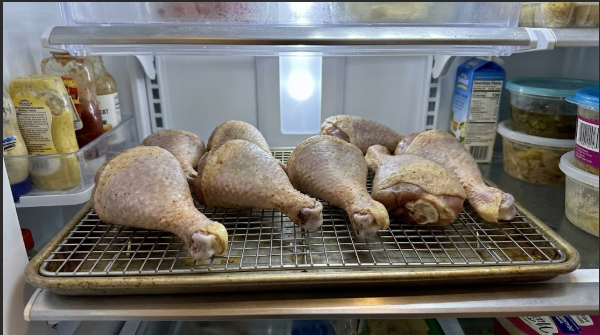
Remove the legs from the brine, rinse briefly, and pat them very dry with paper towels. Set them on a wire rack over a sheet pan and leave them uncovered in the fridge for 2–4 hours, or overnight if you have time. The skin should feel tacky and look matte, not wet.
Seasoning
Rub each leg with a thin layer of oil, then coat all over with the rub, working under the loose skin where you can. If you used a brine, skip extra salt in the rub. The baking powder helps the skin dry out and brown, so use it lightly and don’t overdo it.
Smoked Turkey Legs: Step-by-Step Instructions
- Set up the smoker. Preheat to 275°F (135°C) with apple or cherry wood. Let the smoke settle to thin, clean blue smoke before the food goes on.
- Probe the legs. Insert a thermometer into the thickest part of the drumstick, away from the bone. Use one leg as your tester.
- Load the smoker. Place the legs on the grate with space between them, meaty ends toward the heat if your cooker has hot spots.
- Smoke undisturbed for 1½ hours. Keep the lid closed. Opening it drops the heat and slows the cook.
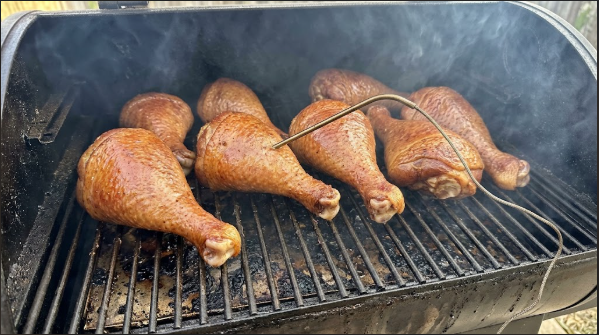
- Check at about 2 hours. The skin should be deep golden brown, and the meat should be passing 165°F (74°C).
- Crisp the skin (optional). Raise the cooker to 325–350°F (163–177°C) for the final 20–30 minutes. For a glaze, brush it on during the last 10–15 minutes.
- Pull at 180–190°F (82–88°C). Test in a couple of spots. The first leg to hit 180°F is your cue to start checking the others.
- Rest 15–20 minutes. Set the legs on a rack and tent loosely with foil. Don’t wrap them tightly or the skin will steam and soften.
- Serve. Eat the legs whole, or pull and slice the meat.
Smoke time on a cold or windy day can run longer, so rely on the thermometer instead of the clock.
Pitmaster Tip: Start checking temperature at the 2-hour mark. If the skin is getting dark but the meat isn’t up to temperature, loosely tent the legs with foil for 20–30 minutes. That slows browning while the inside catches up.
Common Mistake: Pulling the legs at 165°F (74°C) because “that’s the safe number.” It is safe, but the meat will be chewy near the bone. Keep going to 180–190°F (82–88°C), as long as the meat isn’t drying out.
Time and Temperature Table
| Cooker Temp | Estimated Time (1–1.5 lb legs) | Skin Result | Notes |
| 225°F (107°C) | 4–5 hours | Soft, needs a finishing blast | Most smoke flavor |
| 250°F (121°C) | 3½–4½ hours | Soft to medium | Good for pellet grills |
| 275°F (135°C) | 2½–3½ hours | Good | My default |
| 300°F (149°C) | 2–3 hours | Crispest | Less smoke time |
| 325°F (163°C) oven | 1¾–2¼ hours | Good | Backup, no smoke |
| Milestone | Temperature |
| USDA minimum safe temperature | 165°F (74°C) |
| Pitmaster pull temperature | 180–190°F (82–88°C) |
| Rest time | 15–20 minutes |
Times are estimates, because leg size, weather, and cooker all change them. USDA lists 165°F (74°C) as the safe minimum for all poultry, measured with a food thermometer. The higher pull range is for tenderness, not safety.
How to Tell When Smoked Turkey Legs Are Done
Start with the thermometer, and then confirm by look and feel:
- Color: The skin is deep mahogany and taut, not pale or wet.
- Probe feel: The tip slides into the thickest part with little resistance.
- Bone end: The meat pulls back from the end of the drumstick, exposing about ½ inch (1.3 cm) of bone.
- Juices: Juices run clear, not pink.
- Wiggle test: The drumstick moves loosely in the joint.
If it reads 180°F (82°C) but still feels tight, give it another 15–20 minutes and check again. A tough leg usually just needs more time.
Resting, Slicing, and Serving
Rest the legs for 15–20 minutes before eating so the juices settle back into the meat. If you cut in right away, those juices run onto the plate.
For a fair-style meal, serve the legs whole and eat them by hand. For a plated dinner, run a sharp knife along the bone and slice the meat across the grain. Our list of the best knives for cutting meat covers blades that handle poultry well.
For a holiday plate, see our Thanksgiving smoker recipes for ideas on timing multiple dishes in one cook.
What to Serve With Smoked Turkey Legs
Smoked turkey legs pair with classic BBQ and holiday sides:
- Breads: cornbread, dinner rolls, or biscuits. Try our Redstone corn bread recipe.
- Starches: mashed potatoes, baked beans, mac and cheese, or roasted potatoes.
- Vegetables: collard greens, green beans, corn on the cob, or coleslaw.
- Sauces: BBQ sauce, honey mustard, or a simple pan gravy.
- Dessert: a slice of smoked pecan pie keeps the smoky theme going.
For a casual cookout, set out a pot of beans, slaw, and rolls and let people grab a leg.
Storing, Freezing, and Reheating Leftovers
Cool and refrigerate leftovers fast. USDA says to refrigerate smoked meat and poultry within 2 hours of taking it off the smoker. Pull the meat off the bone first, or at least cut it into smaller pieces, so it chills quickly.
Store in airtight containers. Michigan State University Extension, following USDA guidance, says leftovers keep 3–4 days in the fridge or 3–4 months in the freezer. Freeze in meal-size portions and thaw in the fridge.
Reheat to 165°F (74°C) as measured with a thermometer, which matches the same MSU Extension guidance. A covered dish in a 325°F (163°C) oven with a splash of broth keeps the meat moist. Reheat the skin uncovered for the last few minutes to crisp it again.
Use leftover meat in soup, tacos, or sandwiches, and save the bones for stock.
Variations: Pellet Grill, Offset, Charcoal, and Oven Backup
Pellet grill (easiest): Set the grill to 275°F (135°C) and use apple or cherry pellets. Follow the steps above as written. A pellet grill holds temperature well, which makes it a good fit for beginners.
Offset smoker: Burn well-seasoned split wood in the firebox and keep the chamber near 275°F (135°C). Watch for hot spots near the firebox and rotate the legs. For fuel tips, see lump charcoal in an offset smoker, or look at some affordable offset smokers if you’re in the market.
Charcoal kettle (Weber): Set up two-zone heat, with coals on one side and the legs on the other, and add a wood chunk or two. Hold the lid vents to keep 275°F (135°C). Not sure how to light the coals? Here’s how to start a grill.
Electric smoker or Ninja Woodfire: Follow the same temperature and time, and use the built-in wood tray. Electric units tend to give lighter smoke and softer skin, so use the crisping step at the end.
Oven backup: Roast at 325°F (163°C) on a rack for about 1¾–2¼ hours, until the meat hits 180–190°F (82–88°C)]. Add smoked paprika to the rub for a hint of smoke flavor. You won’t get real smoke, but you’ll still get tender meat.
Troubleshooting
- Rubbery skin: The skin wasn’t dry, or the cooker was too cool. Dry the legs uncovered in the fridge, and finish at 325–350°F (163–177°C).
- Meat is tough near the bone: The legs came off too early. Cook them to 180–190°F (82–88°C) and test again.
- Too salty: The brine was too strong or went too long. Weigh the salt, limit brining to 8–12 hours, and skip extra salt in the rub.
- Dry meat: The cooker ran too hot or the legs were pulled too late. Use a probe and pull as soon as the legs reach the target range.
- Bitter smoke taste: Dirty smoke from smoldering wood. Wait for thin blue smoke and use less wood.
- Skin too dark: Too much sugar or too much heat. Tent with foil and lower the cooker temperature.
- Uneven cooking: Hot spots in the cooker. Rotate the legs halfway and group similar sizes together.
Smoked Turkey Legs: Step-by-Step Recipe Card
Servings: 4 legs | Prep: 30 minutes active, plus 8–12 hours brine and 2–4 hours drying | Cook: 2½–3½ hours at 275°F (135°C) | Pull temp: 180–190°F (82–88°C) | Rest: 15–20 minutes
Ingredients: 4 turkey legs (about 5 lb / 2.3 kg), 1 gallon (3.8 L) water, 3.5 oz (100 g) kosher salt, ½ cup (100 g) brown sugar, garlic, bay leaves, peppercorns, 2 tbsp oil, rub (brown sugar, smoked paprika, garlic powder, onion powder, black pepper, mustard powder)
Quick steps:
- Thaw legs fully in the fridge, then brine 8–12 hours at 40°F (4°C) or below.
- Rinse, pat dry, and air-dry on a rack in the fridge for 2–4 hours.
- Oil, season, and preheat the smoker to 275°F (135°C) with apple or cherry wood.
- Smoke 2½–3½ hours, probing the thickest part away from bone.
- Optional: raise to 325–350°F (163–177°C) for the last 20–30 minutes to crisp the skin.
- Pull at 180–190°F (82–88°C), rest 15–20 minutes, and serve.
FAQ
How long do you smoke turkey legs at 275°F?
Most 1–1.5 lb (0.45–0.7 kg) legs take about 2½–3½ hours at 275°F (135°C). Use the internal temperature, not the clock. Pull them when the thickest part reads 180–190°F (82–88°C), and let them rest 15–20 minutes before serving.
What temperature should smoked turkey legs be?
USDA’s minimum safe temperature for poultry is 165°F (74°C). For tender, pull-off-the-bone meat, most pitmasters take turkey legs to 180–190°F (82–88°C). Measure in the thickest part, away from the bone, with an instant-read or leave-in probe.
Do you need to brine turkey legs?
You don’t have to, but brining makes a big difference. It keeps the meat juicy and seasons it through. A wet brine for 8–12 hours works well, and a dry brine overnight is a simpler option. Both need cold storage at 40°F (4°C) or below.
Can you smoke frozen turkey legs?
No. Thaw them completely in the refrigerator first. Smokers cook at low temperatures, and frozen meat takes too long to reach a safe temperature, giving bacteria time to grow. Plan on 1–2 days in the fridge for individual legs.
How do you get crispy skin on smoked turkey legs?
Dry the skin well after brining, ideally uncovered in the fridge for 2–4 hours. Use a thin coat of oil and a light dusting of baking powder. Then smoke at 275°F (135°C) and raise the heat to 325–350°F (163–177°C) for the last 20–30 minutes.
How long do smoked turkey legs last in the fridge?
Stored in airtight containers at 40°F (4°C) or below, leftover smoked turkey legs keep 3–4 days. Refrigerate them within 2 hours of cooking. For longer storage, freeze portions for 3–4 months and reheat to 165°F (74°C) before serving.
Conclusion
This smoked turkey legs: step-by-step recipe comes down to a few habits: brine them, dry the skin, cook at 275°F (135°C), and pull at 180–190°F (82–88°C) instead of the bare 165°F (74°C) minimum. Add a short blast of higher heat at the end for crisp skin, and rest the legs before you dig in. Once you’ve done it once, try different woods, a spicier rub, or a sticky glaze. You’ll have a smoked turkey leg that beats anything from a fair stand.
Laura Smith

I'm Laura, I like all the kind of delicious grilled foods which makes me hungry all the time I see them. That's why I built this blog to share with you all of my Grilling experiences, recipes, and all the tips about foods that I've learned from food experts.