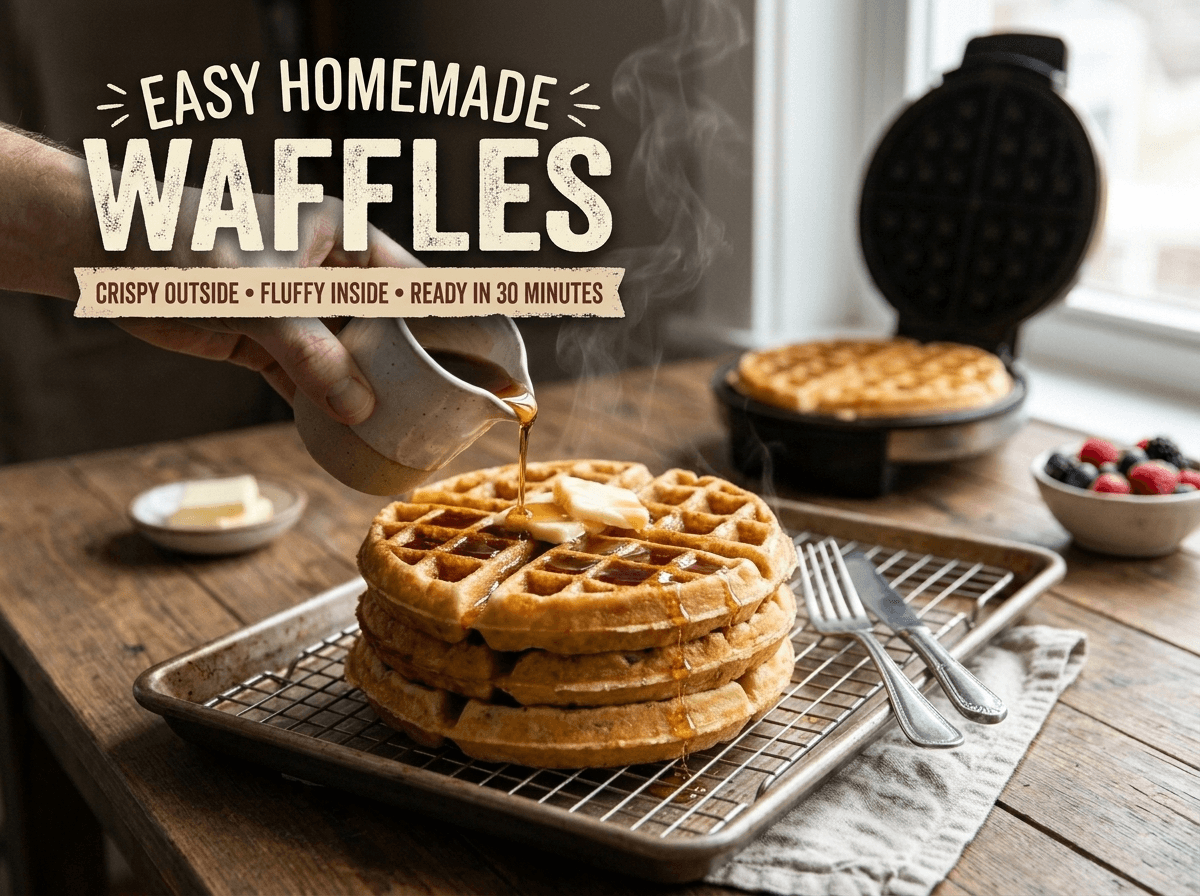
This waffle recipe makes golden waffles with a crisp shell and a light, airy middle. It uses pantry basics, one bowl for the dry mix, and a trick with whipped egg whites that gives you lift without any fancy gear. If you own a waffle iron and a whisk, you are ready.
I built it for beginner home cooks who have had floppy, pale, or stuck-on waffles before. Every step has a temperature, a time, and a visual cue, so you know what “done” looks like. The batter also holds up well for freezing, which makes weekday breakfasts easy.
If you also love flipping flapjacks on the weekend, our fluffy pancake recipe uses a similar batter idea with a few key differences we will cover below.
Quick Answer: What Is the Best Basic Waffle Recipe?
Whisk 2 cups (250 g) flour, baking powder, sugar, and salt. Mix in milk, melted butter, egg yolks, and vanilla. Fold in whipped egg whites. Cook in a waffle iron preheated to medium-high, about 400°F (205°C), for 4-5 minutes, until deep golden and steam slows. Total time: 30 minutes.
Why This Waffle Recipe Works
A great waffle needs two things that seem to fight each other: a crisp outside and a tender inside. Most recipes get one or the other. This one gets both by controlling three things.
- Melted butter and a little sugar. Fat helps the outside crisp and brown. The small amount of sugar speeds browning without making the waffle sweet like cake.
- Whipped egg whites. Beating the whites to soft peaks traps air. When that air hits the hot iron, it expands and leaves you with a light, open crumb.
- A gentle mix. Stirring until just combined keeps gluten short. Overmixing makes waffles chewy and tough.
- A hot, well-greased iron. Heat sets the surface fast, so the waffle crisps before the inside dries out.
One more thing worth knowing: waffle batter is richer and a bit thinner than pancake batter. Pancakes can rely on a griddle, but waffles need extra fat so they release cleanly and crisp. If you want to compare, try our buttermilk pancakes side by side with this batter.
Ingredients and Equipment for This Waffle Recipe
This makes about 6 standard waffles, which serves 4 to 6 people. Quantities fit most 7 to 8 inch (18-20 cm) round or square irons.
Ingredients
- 2 cups (250 g) all-purpose flour
- 2 tablespoons (25 g) granulated sugar
- 1 tablespoon baking powder
- 1/2 teaspoon fine salt
- 2 large eggs, separated
- 1 3/4 cups (420 ml) whole milk, room temperature
- 1/2 cup (113 g, 1 stick) unsalted butter, melted and slightly cooled
- 1 teaspoon vanilla extract
- Cooking spray or extra melted butter for the iron
Equipment
- Waffle iron (classic or Belgian-style)
- Large mixing bowl and a second clean, dry bowl for the whites
- Whisk or hand mixer
- Rubber spatula
- Ladle or 1/2-cup (120 ml) measuring cup
- Baking sheet and wire rack
- Instant-read thermometer (for reheating leftovers)
Easy Substitutions
- Milk: Use buttermilk for tang. Swap 1 3/4 cups for milk, and reduce baking powder to 2 teaspoons, then add 1/2 teaspoon baking soda.
- Butter: Neutral oil such as canola or vegetable works in a 1:1 swap by volume. You lose a little flavor but gain extra crispness.
- Flour: Replace up to 1/2 cup of the flour with whole wheat for a nuttier waffle.
- Sugar: Reduce to 1 tablespoon if you plan to serve with syrup or fruit.
- Gluten-free: A 1:1 gluten-free baking blend works. Let the batter rest 10 minutes so it thickens.
- Dairy-free: Use unsweetened oat or soy milk and a vegan butter stick. Our vegan breakfast ideas go deeper on plant-based swaps.
Prepping Your Batter and Waffle Iron
Good prep takes about 10 minutes and prevents most waffle problems.
Bring the cold ingredients up. Take the eggs and milk out of the fridge 20-30 minutes before you start. Cold milk can re-solidify melted butter into little clumps. Room-temperature liquids blend smoothly.
Separate the eggs carefully. Even a drop of yolk in the whites will keep them from whipping to peaks. Crack each egg over a small cup, move the yolk between shell halves, and drop the whites into the clean bowl. Use a glass or metal bowl, never plastic, which can hold grease.
Preheat the iron fully. Most irons have a light that signals ready, but that light often turns on early. Wait 2-3 extra minutes after the light so the plates are properly hot. Aim for about 400°F (205°C) if your iron has a dial, or medium-high if it has a simple setting.
Warm your oven. Set it to 200°F (95°C) and place a wire rack on a baking sheet inside. Finished waffles go on the rack in a single layer so they stay crisp while you cook the rest.
Never taste raw batter. The CDC advises against eating raw flour and dough, because raw flour and raw eggs can carry germs that cook off only with heat. Wash your hands, bowls, and utensils after handling batter.
Pitmaster Tip: Lightly grease the iron before the first waffle only if your iron is not nonstick. For nonstick irons, brush a thin layer of melted butter on the plates once, then skip it. Too much grease creates greasy, uneven spots.
Step-by-Step Waffle Recipe Instructions
Total time is about 30 minutes, plus cooking time per batch. Read all the steps first.
- Preheat. Turn on the waffle iron and set the oven to 200°F (95°C) with the wire rack inside.
- Mix the dry ingredients. In a large bowl, whisk the flour, sugar, baking powder, and salt for 20 seconds. This spreads the baking powder evenly so every waffle rises the same.
- Mix the wet ingredients. In a second bowl, whisk the egg yolks, milk, melted butter, and vanilla until smooth. The butter should be warm, not hot, or it will scramble the yolks.
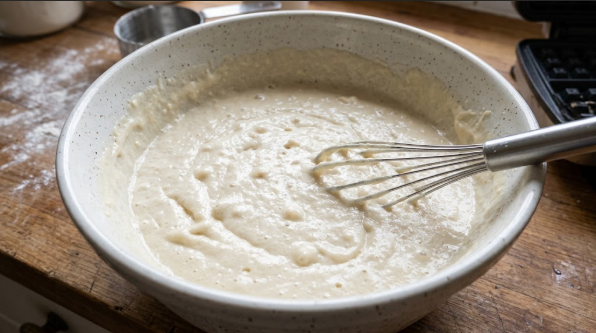
- Combine. Pour the wet mixture into the dry. Stir with a spatula just until you no longer see dry flour. A few small lumps are good. The batter will look thick and pourable, like heavy cream.
- Whip the whites. In the clean bowl, beat the egg whites with a whisk or hand mixer for 2-3 minutes, until soft peaks form. When you lift the whisk, the peak should droop slightly at the tip. Stiff, dry peaks are harder to fold in.
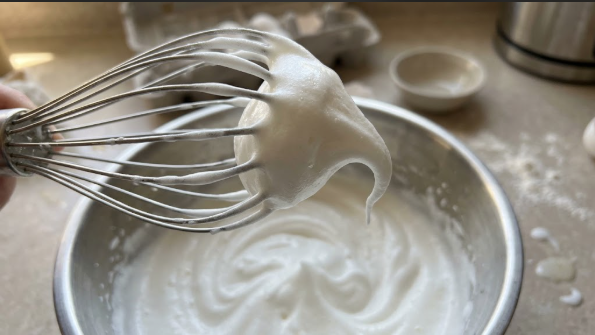
- Fold gently. Add about a third of the whites to the batter and stir to lighten it. Then fold in the rest with a spatula, scooping from the bottom and turning over. Stop when you see only a few white streaks. Do not stir hard, because you want to keep the air.
- Pour. Spoon or ladle batter into the center of the iron. For a standard round iron, use about 1/2 cup (120 ml). For a Belgian iron, use about 3/4 cup (180 ml). Spread it gently toward the edges, but leave 1/2 inch (1.3 cm) free so it does not spill when you close the lid.
- Cook. Close the lid and cook for 4-5 minutes. Watch the steam. At first, thick steam pours from the sides. When it slows to a thin wisp, the waffle is close to done.
- Check the color. Open the lid gently. If it resists, wait another 30 seconds because it is probably not set. The waffle should lift cleanly and look deep golden brown.
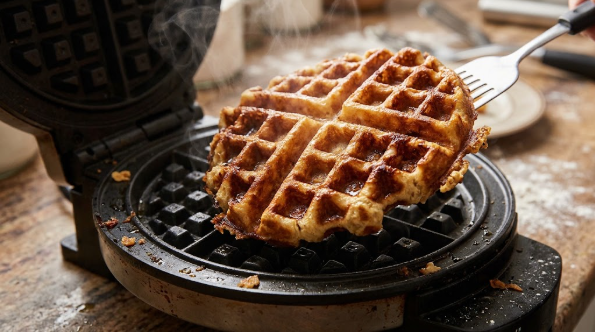
- Hold and repeat. Move the finished waffle to the oven rack. Do not stack them or they will steam and go soft. Cook the remaining batter the same way, regreasing only if needed.
- Serve right away. Top while hot with butter and warm syrup, or see the serving ideas below.
Common Mistake: Opening the iron too early. Lifting the lid before the steam slows tears the waffle in half and leaves half stuck on each plate. Be patient, and if it resists, give it 30 more seconds.
Waffle Time and Temperature Table
| Stage | Setting | Time | What to look for |
| Rest eggs and milk | Counter | 20-30 minutes | No longer fridge-cold |
| Preheat waffle iron | About 400°F (205°C) | 5-8 minutes | Ready light on, plus 2 extra minutes |
| Whip egg whites | Medium-high speed | 2-3 minutes | Soft, drooping peaks |
| Cook classic waffle | Medium-high | 4-5 minutes | Steam slows to a thin wisp |
| Cook Belgian waffle | Medium-high | 5-6 minutes | Deep golden, lifts cleanly |
| Keep warm | Oven at 200°F (95°C) | Up to 30 minutes | Single layer on a wire rack |
| Reheat leftovers | Toaster or oven | 2-3 minutes / 5-8 minutes | Hot and crisp |
| Safe reheat temp | 165°F (74°C) | At serving | Check center with a thermometer |
How to Tell When Your Waffle Is Done
The best clue is steam. When the iron is full, steam pours out. As moisture cooks off, the steam slows to a thin, steady wisp, and that is your signal.
The second clue is color and release. A finished waffle is deep golden, with darker ridge tops. When you lift the lid, it comes up without resistance. If you feel a tug, it needs more time.
The third clue is feel. Use a fork to lift the edge. A done waffle feels firm and a little springy at the center, and the crust makes a light crackle when you tap it. A pale, floppy waffle is underdone.
Different irons cook differently. Cheap irons often run cooler, so expect closer to 6 minutes. Your first waffle is your test waffle, so use it to dial in time for the rest of the batch.
Resting, Serving, and Toppings
Waffles do not need a long rest, but they do need air. Steam gets trapped between waffle and plate, and soft crusts follow. Place hot waffles on a wire rack for 1-2 minutes before plating if you can.
Serve each one hot with a pat of butter and warm maple syrup. Warming the syrup in the microwave for 20-30 seconds keeps the waffle from cooling off the moment you pour.
Here are topping ideas that work:
- Fresh berries and whipped cream
- Sliced bananas with chopped pecans
- Peanut butter and honey
- Fried chicken for a sweet-and-savory plate
- Warm cinnamon apples
- A scoop of vanilla ice cream for dessert waffles
For a showstopper, try the caramelized fruit idea from our Blackstone bananas foster and spoon it over a hot waffle.
What to Serve with Waffles
A plate of waffles is better with something savory next to it. Crispy bacon, breakfast sausage, and scrambled eggs balance the sweetness. Hash browns add a second crunchy texture.
If you want something lighter, serve waffles with fresh fruit and plain Greek yogurt. Our healthy breakfast ideas have more ways to build a balanced plate.
Planning a brunch? Waffles pair nicely with a few other easy dishes you can make at the same time. Browse our list of easy breakfast recipes for ideas that fit around the iron.
Storing, Freezing, and Reheating Waffles
This waffle recipe makes a few extra on purpose. Cooked waffles freeze very well, so you can have homemade breakfasts on busy mornings.
Refrigerating
Cool waffles completely on a wire rack first. Trapped heat makes them soggy. Then store in an airtight container or zip bag with parchment between layers. Follow USDA leftovers guidance: refrigerate within 2 hours and use within 3 to 4 days.
Freezing
Freeze waffles in a single layer on a baking sheet for 1-2 hours until firm. Then move them to a freezer bag, press out the air, and label the date. For best quality, the same USDA page says frozen leftovers are best used within 3 to 4 months. Freezing at 0°F (-18°C) keeps food safe, and quality is what slowly drops, as explained in USDA’s freezing guide.
Frozen waffles are a handy base for busy mornings. If you want more grab-and-go ideas, see our quick breakfast ideas.
Reheating
- Toaster: Pop a frozen waffle straight in on a medium setting for 2-3 minutes. This is the crispest method.
- Oven: Place on a rack at 350°F (175°C) for 5-8 minutes.
- Microwave: Works in a pinch, about 30-45 seconds, but the waffle will be soft rather than crisp.
USDA says to reheat leftovers to 165°F (74°C). Check the center of a thicker waffle with a thermometer if you are serving anyone who is more at risk from foodborne illness.
Waffle Recipe Variations
Once you have the base down, there are plenty of ways to change it up.
Buttermilk Waffles
Use 1 3/4 cups buttermilk instead of milk, reduce baking powder to 2 teaspoons, and add 1/2 teaspoon baking soda. You get a tangy, extra-tender waffle.
Whole Wheat Waffles
Replace 1/2 cup of the flour with whole wheat flour. Add 1 extra tablespoon of milk since whole grains absorb more liquid.
Chocolate Chip or Blueberry Waffles
Sprinkle 1/3 cup mini chocolate chips or fresh blueberries over the batter after pouring it onto the iron, not into the bowl. This keeps them from burning on the plates or staining the batter.
Savory Cheddar and Herb Waffles
Cut the sugar to 1 teaspoon, then add 1/2 cup shredded cheddar and 2 tablespoons chopped chives to the batter. Serve with fried eggs or use them as a sandwich base.
Low-Carb Option
For a lower-carb breakfast, check out our keto breakfast ideas. Standard flour-based waffles are not low-carb, so use a dedicated keto recipe instead.
Cast Iron Waffle Iron on the Grill or Stovetop
A cast iron stovetop waffle iron works over a gas burner or on a grill side burner. Heat both sides for 3-4 minutes, grease well, pour in the batter, and flip once halfway. Cook times run longer, usually 6-8 minutes total. Cast iron holds heat well, so keep the flame at medium.
Oven Backup
No waffle iron? Pour the batter into a greased 9×13-inch (23×33 cm) pan and bake at 400°F (205°C) for 20-25 minutes. You will not get the grid pattern, but you will get a crisp-edged waffle cake.
Troubleshooting Your Waffle Recipe
Even good recipes hit snags. Here are common problems and fixes.
| Problem | Likely cause | Fix |
| Waffles stick to the iron | Not enough grease or iron not hot | Preheat fully and brush plates lightly with butter |
| Pale and soft | Iron too cool or cooked too short | Raise heat, add 1 minute, and wait for steam to slow |
| Soggy after cooking | Stacked on a plate | Cool on a wire rack or hold in a 200°F (95°C) oven |
| Chewy or tough | Overmixed batter | Mix only until the flour disappears |
| Dense, flat waffles | Whites deflated or old baking powder | Fold gently and replace baking powder every 6 months |
| Batter leaks out | Too much batter in the iron | Use less and leave a border around the edges |
| Burnt outside, raw middle | Heat too high | Lower the setting and extend the time slightly |
| Waffles tear when lifted | Opened too early | Wait for steam to slow, then lift |
If your iron uses a dial, a good starting point for most models is medium-high. If the first waffle is too dark, drop the heat one notch and test again.
Waffle Recipe Card
Yield: About 6 waffles (serves 4-6) Prep time: 15 minutes Cook time: 4-5 minutes per waffle Total time: About 40 minutes with all batches Iron temperature: About 400°F (205°C), or medium-high Keep warm: Oven at 200°F (95°C) Reheat safely: 165°F (74°C)
Ingredients: 2 cups (250 g) flour, 2 tbsp (25 g) sugar, 1 tbsp baking powder, 1/2 tsp salt, 2 eggs separated, 1 3/4 cups (420 ml) milk, 1/2 cup (113 g) melted butter, 1 tsp vanilla, cooking spray.
Short steps:
- Preheat iron and oven to 200°F (95°C).
- Whisk dry ingredients.
- Whisk yolks, milk, butter, and vanilla.
- Combine until just mixed.
- Whip whites to soft peaks.
- Fold whites into batter.
- Pour into the hot iron, leaving a small border.
- Cook 4-5 minutes until steam slows.
- Hold on a rack in the oven.
- Serve hot with butter and syrup.
Waffle Recipe FAQ
Why are my waffles soggy instead of crispy?
Soggy waffles usually come from trapped steam or an iron that is not hot enough. Preheat fully, wait for steam to slow before opening, and place finished waffles on a wire rack, not a plate. Stacking them traps moisture and softens the crust.
Should waffle batter be thick or thin?
Waffle batter should be thicker than crepe batter and thinner than cake batter. It should pour slowly from a ladle, like heavy cream. If it is too thick, add milk one tablespoon at a time. If it is too thin, add a tablespoon of flour.
Can I make waffle batter ahead of time?
Yes, partly. You can mix the dry ingredients and the wet ingredients separately the night before and refrigerate the wet mix. Combine and whip the whites just before cooking. Batter with baking powder loses lift after a few hours, so do not mix everything early.
Can I freeze homemade waffles?
Yes. Cool them fully, freeze in a single layer until firm, then bag them. Use within about 3 to 4 months for best quality, per USDA guidance on leftovers. Reheat straight from the freezer in a toaster or oven until hot and crisp.
Do I need to separate the eggs for waffles?
No, but it helps. Whipped whites give a lighter, crispier waffle. If you skip it, add the whole eggs to the wet mix. The waffles will be a bit denser but still good. Never skip the baking powder either way.
What is the difference between waffle batter and pancake batter?
Waffle batter has more fat, often from butter or oil, so it crisps and releases from the iron. Pancake batter is leaner and thicker so it holds up on a flat griddle. Lean batter plus a flat griddle suits pancakes, while rich batter plus a ridged iron suits waffles.
Conclusion: Make This Waffle Recipe Your Go-To
A great waffle recipe comes down to a few habits: warm ingredients, a hot iron, gently folded whites, and patience until the steam slows. Hold the finished waffles on a rack in a 200°F (95°C) oven, and every plate comes out crisp.
Once you have the base down, try the buttermilk, whole wheat, or savory variations. Freeze extras so breakfast is ready for a busy week. If you are in the mood for something flatter, our classic pancake recipe is a good next stop.
Laura Smith

I'm Laura, I like all the kind of delicious grilled foods which makes me hungry all the time I see them. That's why I built this blog to share with you all of my Grilling experiences, recipes, and all the tips about foods that I've learned from food experts.