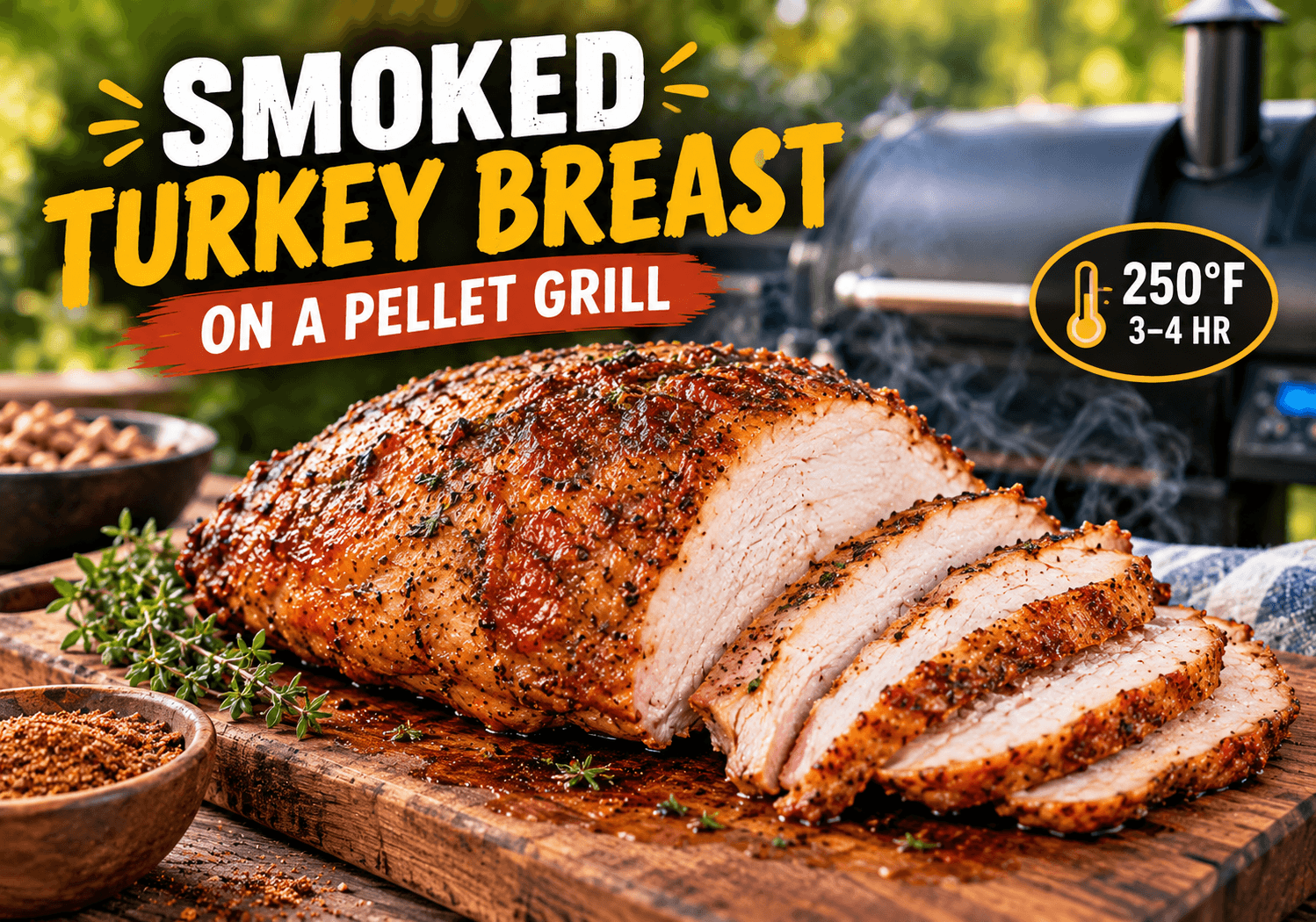
Cooking a turkey breast at 250°F on a pellet grill gives you tender, smoky white meat without the fuss of a whole bird. A bone-in breast feeds a crowd, finishes in an afternoon, and takes well to a simple dry brine and butter rub.
The challenge with turkey breast is that it’s lean. It goes from juicy to dry in a few degrees. A steady 250°F (121°C), a leave-in thermometer, and a short rest solve that problem. This guide covers the full method, including times by weight, wood choices, and fixes for rubbery skin.
Quick Answer
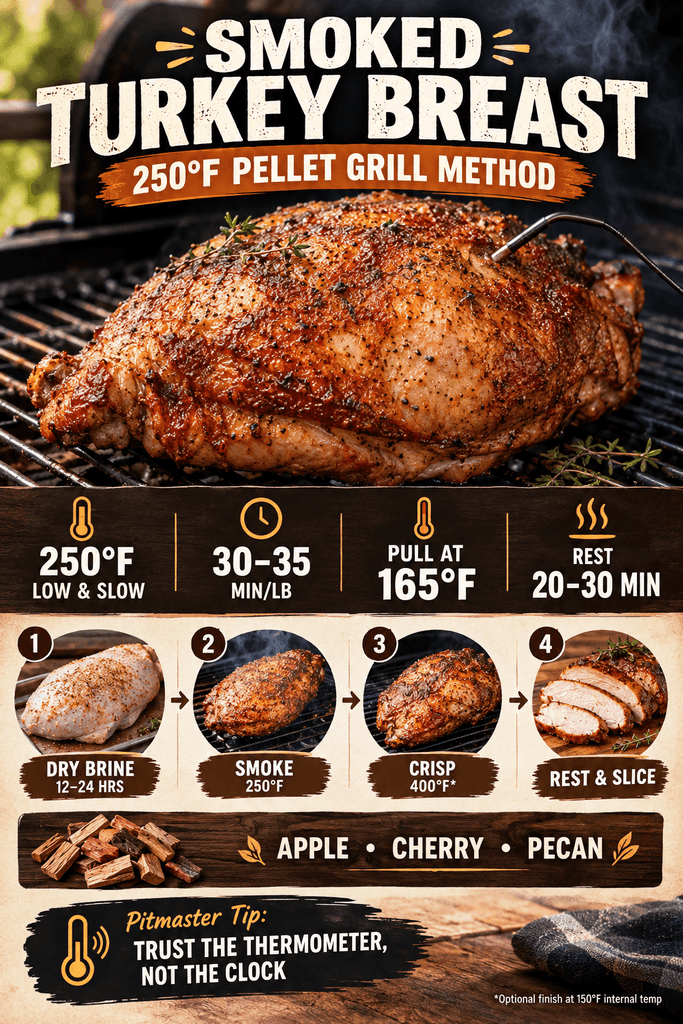
Smoke a bone-in turkey breast at 250°F (121°C) on a pellet grill for about 30–35 minutes per pound, or roughly 3–4 hours for a 6–7 lb (2.7–3.2 kg) breast. Pull it when the thickest part reads 165°F (74°C), the USDA minimum. Rest it 20–30 minutes before slicing.
Why Smoke Turkey Breast at 250°F
A pellet grill holds a steady temperature, and 250°F is a sweet spot for poultry. It’s hot enough to cook the bird safely and low enough to take on real wood smoke. The USDA’s smoking guidance says to keep the smoker between 225 and 300°F throughout the cook, so 250°F sits well inside that range.
Here is why this temperature works for turkey breast:
- Even cooking: Lower heat cooks the breast gradually, so the outer layer doesn’t dry out before the center is done.
- Smoke flavor: Smoke absorbs better at low temperatures than at 350°F or higher.
- A bigger window: At 250°F, the gap between perfect and overcooked is wider than in a hot oven.
- Easy timing: Cook time is predictable, about 30–35 minutes per pound, so you can plan dinner.
The trade-off is the skin. At 250°F the skin stays soft and pale. If you want crisp skin, you’ll use a short high-heat finish, which this recipe includes.
If you like low-and-slow cooking, you already know the rhythm from ribs on a pellet grill. Turkey breast uses the same steady-temperature idea in a much shorter window.
Ingredients and Equipment
This recipe serves 6 to 8 people and uses one bone-in, skin-on turkey breast.
Ingredients
Turkey and dry brine
- 1 bone-in, skin-on turkey breast, 6–7 lb (2.7–3.2 kg), fully thawed
- About 22 g kosher salt: roughly 1¼ tablespoons Morton or 2½ tablespoons Diamond Crystal.
Butter and rub
- 4 tablespoons (57 g) unsalted butter, softened
- 2 tablespoons (30 ml) olive oil
- 1 tablespoon smoked paprika
- 2 teaspoons garlic powder
- 2 teaspoons onion powder
- 1 teaspoon black pepper
- 1 teaspoon dried thyme
- 1 teaspoon brown sugar (optional, adds color)
For the pan (optional)
- 1 cup (240 ml) chicken broth, plus a sliced onion, to catch drippings for gravy
Equipment
- A pellet grill of any brand: Traeger, Pit Boss, Camp Chef, Z Grills, Recteq, or Weber SmokeFire. If you’re still choosing one, see our guide to the best pellet grills for beginners.
- Apple, cherry, or pecan pellets
- Leave-in probe thermometer, plus an instant-read thermometer to double-check
- Rimmed sheet pan or foil pan with a small wire rack
- Paper towels and foil
- A sharp slicing knife and a cutting board
Smart Substitutions
| If you don’t have… | Use this instead |
|---|---|
| Bone-in breast | A boneless breast, 3–4 lb (1.4–1.8 kg). It cooks faster, so check the temperature earlier. |
| Fresh thyme | Dried thyme, or poultry seasoning. |
| Smoked paprika | Regular paprika. You’ll lose a little smoky color. |
| Butter | Mayonnaise or more olive oil under and over the skin. |
| Apple pellets | Cherry, pecan, or maple pellets. |
Pitmaster Tip: Use a leave-in probe thermometer with an alarm. Set it to 150°F (66°C) as a reminder, then check the breast every 10 minutes after that. You won’t have to open the lid constantly, and you won’t miss the target.
Choosing and Prepping the Turkey Breast
Bone-in vs. boneless: Bone-in breasts cook more evenly and stay juicier. Boneless breasts cook faster and slice easily, but they dry out sooner. For a smoked turkey breast, bone-in is the better choice.
Fresh or frozen: Either works. If the breast is frozen, thaw it completely first. Penn State Extension says to thaw a turkey in the refrigerator, allowing about 24 hours for every 4–5 pounds. A 6–7 lb (2.7–3.2 kg) breast takes about 1½ to 2 days.
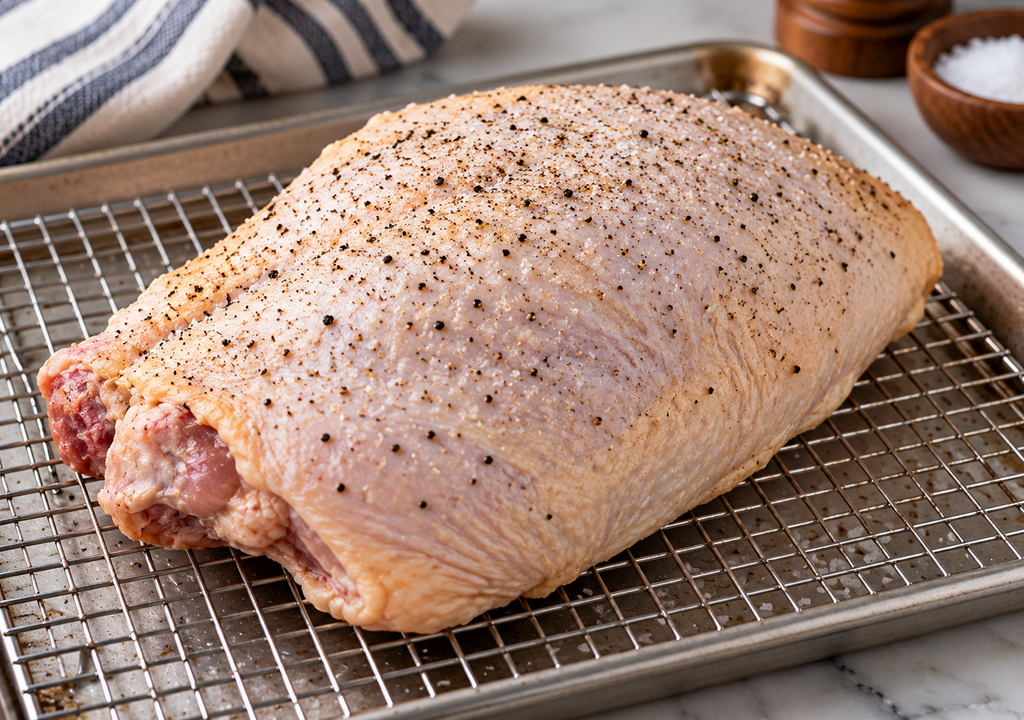
Dry brine: A dry brine is just salt rubbed on and left to sit. It seasons the meat all the way through and helps it hold moisture. Pat the breast dry, sprinkle the salt evenly over the skin and the underside, and refrigerate it uncovered on a rack for 12–24 hours. The skin dries out in the fridge, which helps it brown later.
Trim: Cut away loose flaps of skin and excess fat at the edges. Leave the skin on the breast itself.
A Quick Food Safety Note
USDA says all poultry must reach a safe minimum internal temperature of 165°F. Check the temperature in more than one spot, and keep the thermometer away from bone. USDA’s turkey guidance points to the innermost part of the thigh, the innermost part of the wing, and the thickest part of the breast. For a breast-only cook, use the thickest part of the breast and a second spot as a double-check.
How to Smoke Turkey Breast at 250°F: Step-by-Step
Active time is about 30 minutes. Plan for 3 to 4 hours on the grill, plus a 20–30 minute rest.
- Brine the night before. Season the breast with the salt, set it on a rack over a tray, and refrigerate it uncovered for 12–24 hours.
- Take it out of the fridge. About 30 minutes before cooking, remove the breast and pat it dry with paper towels. Dry skin takes smoke and color better.
- Preheat to 250°F (121°C). Fill the hopper with apple, cherry, or pecan pellets. Close the lid and let the grill settle for 15 minutes. If you need a refresher on startup, see our guide on how to start a grill.
- Add the butter. Mix the softened butter with the thyme and half of the garlic powder. Gently loosen the skin over the breast with your fingers and spread the butter underneath.
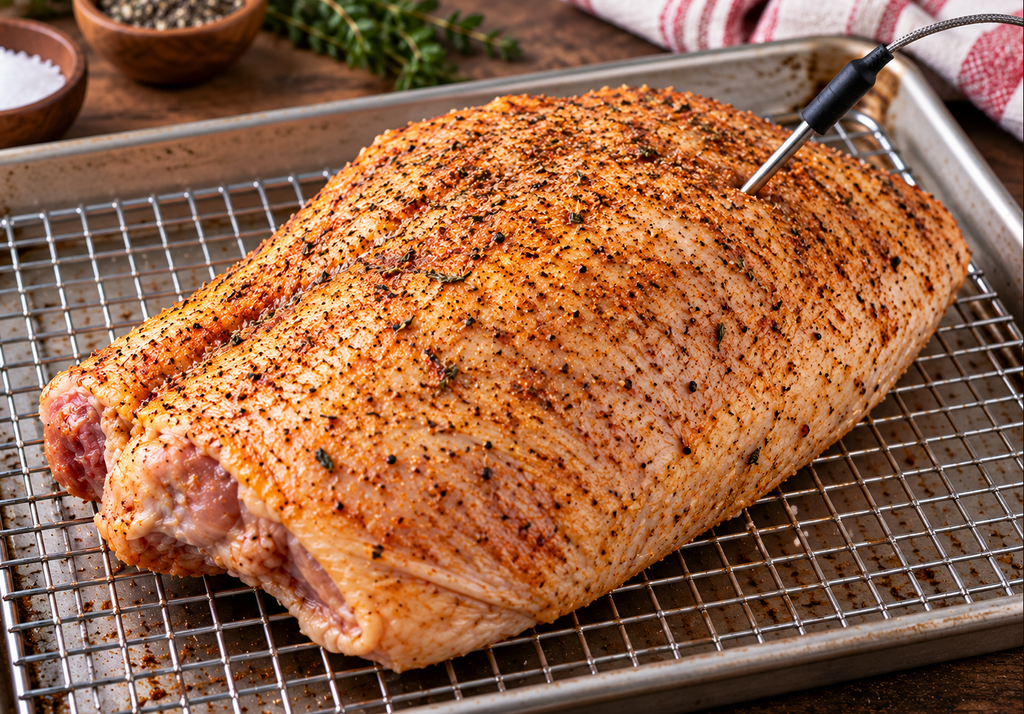
- Season the outside. Rub the skin with olive oil. Mix the paprika, remaining garlic powder, onion powder, black pepper, and brown sugar, then coat the breast evenly.
- Set up the pan. Place the breast, skin side up, on the wire rack in the foil pan. If you want gravy drippings, pour in the broth and add the onion. Don’t let the liquid touch the skin.
- Insert the probe. Push the leave-in probe into the thickest part of the breast from the side. The tip should sit in the center of the meat and not touch the bone.
- Smoke with the lid closed. Cook at 250°F (121°C) for about 2 hours without opening the lid. Then start checking the temperature every 10–15 minutes.
- Optional crisp finish. When the breast reads 150°F (66°C), raise the grill to 400°F (204°C). This takes 10–20 minutes to finish and crisps the skin.
- Pull at 165°F (74°C). Check the thickest part of the breast and one more spot. Move the breast to a cutting board.
- Rest and slice. Tent the breast loosely with foil and rest it for 20–30 minutes before carving.
[PHOTO: The seasoned turkey breast on the rack, skin side up, with the probe inserted in the thickest part before it goes on the grill.]
Common Mistake: Cooking by the clock instead of the thermometer. A timer is a guide, not a doneness test. Turkey breast is lean, so a 10-degree overshoot can dry it out. Trust a thermometer in the thickest part of the breast and don’t open the lid more than you need to.
Turkey Breast at 250°F Time and Temperature Table
These are starting points. Pellet grills run a little differently, and a breast straight from the fridge cooks more slowly than one that has sat out for 30 minutes.
Time at 250°F by Weight
| Breast size | Estimated time at 250°F (121°C) |
|---|---|
| Bone-in, 4 lb (1.8 kg) | 2–2½ hours |
| Bone-in, 6 lb (2.7 kg) | 3–3½ hours |
| Bone-in, 7 lb (3.2 kg) | 3½–4 hours |
| Bone-in, 8 lb (3.6 kg) | 4–4½ hours |
| Boneless, 3 lb (1.4 kg) | 1¾–2¼ hours |
| Boneless, 4 lb (1.8 kg) | 2¼–2¾ hours |
Grill Temperature vs. Time (6–7 lb Bone-In Breast)
| Grill temp | Estimated time | Result |
|---|---|---|
| 225°F (107°C) | 3½–4½ hours | Most smoke, softest skin |
| 250°F (121°C) | 3–4 hours | Best balance of smoke and tenderness |
| 275°F (135°C) | 2½–3¼ hours | Slightly firmer skin, less smoke |
| 300°F (149°C) | 2–2¾ hours | Faster, lighter smoke |
| 325°F (163°C) | 1¾–2½ hours | Browns skin, minimal smoke |
Pull Temp vs. the USDA Minimum
The USDA safe minimum for poultry is 165°F (74°C). For turkey breast, that is also the best pull temperature. Unlike thighs, which stay tender up to about 175°F (79°C), lean breast meat gets dry past 170°F. Pull the breast at 165°F (74°C) in the thickest part.
How to Tell When Smoked Turkey Breast Is Done
The thermometer is the main test. These other signs help you confirm it.
- Temperature: 165°F (74°C) in the thickest part of the breast, confirmed in a second spot.
- Juices: When you poke the meat, the juices should run clear to pale gold, not pink.
- Skin: Golden to deep mahogany, depending on whether you did the high-heat finish.
- Feel: The meat should feel firm but springy, not rock hard.
Smoke can leave a pink tinge in the outer meat even when it’s fully cooked. Go by the thermometer, not the color.
Resting, Slicing, and Serving
Tent the breast loosely with foil and rest it for 20–30 minutes. This allows the juices to settle back into the meat instead of running onto the board. Carryover heat can raise the temperature a few degrees.
To carve a bone-in breast, run a knife along one side of the breastbone and peel the meat away in one piece. Slice it across the grain into 1/2-inch (1.3 cm) slices. A long, sharp blade makes clean slices without tearing the skin. Our roundup of the best knives for cutting meat can help you pick one.
If you used the broth pan, strain the drippings into a saucepan. Whisk in 1 tablespoon of flour mixed with 2 tablespoons of cold water, then simmer for 3–5 minutes to make a quick gravy.
What to Serve With Smoked Turkey Breast
Turkey is mild, so it pairs with almost anything. These sides work well:
- Starches: Mashed potatoes, roasted sweet potatoes, stuffing, or buttery rolls.
- Cornbread: A pan of warm cornbread suits smoked meat. Try our Redstone corn bread recipe.
- Vegetables: Green beans, roasted Brussels sprouts, glazed carrots, or creamed corn.
- Sauces: Pan gravy, cranberry sauce, or a spoonful of Dijon mustard.
- Dessert: Finish a smoked meal with smoked pecan pie, baked on the same grill after the turkey rests.
Planning a bigger gathering? Our tips for hosting a BBQ party can help with the rest of the menu.
Storing, Freezing, and Reheating Leftovers
Cooked turkey keeps well, and sliced breast makes great sandwiches. Follow USDA guidance to keep it safe.
Refrigerate quickly. USDA’s smoking guidance says to refrigerate meat and poultry within 2 hours of taking it off the smoker. Cut it into smaller portions and store it in shallow, covered containers.
Use within 4 days. The same USDA publication says to eat refrigerated leftovers within 4 days or freeze them. Penn State Extension also says refrigerated turkey leftovers keep for up to 4 days.
Freeze. Wrap slices tightly or place them in freezer bags with a splash of broth. Penn State Extension says frozen leftovers stay safe for up to 6 months, though quality is best sooner.
Reheat. USDA says to reheat leftovers to 165°F (74°C). Warm slices covered in a 300°F (149°C) oven with a splash of broth for 10–15 minutes. Cover them so the meat stays moist.
Variations: Bacon, Offset, Charcoal, and Oven
Once you’ve got the basics of turkey breast at 250°F, try these changes.
Bacon-Wrapped Turkey Breast
Wrap the breast with 8–10 slices of thick-cut bacon, overlapping slightly. Smoke at 250°F (121°C) as usual. Expect the cook to run 15–30 minutes longer, and don’t count the bacon as a doneness test. For more on bacon temperatures, see our guide to bacon on a pellet grill.
Maple-Bourbon Glaze
Mix 3 tablespoons maple syrup with 1 tablespoon bourbon and 1 tablespoon melted butter. Brush it on in the last 20 minutes of cooking. Sugar burns, so skip the glaze if you plan a 400°F (204°C) finish.
Cajun Turkey Breast
Swap the rub for 2 tablespoons of Cajun seasoning and 1 teaspoon cayenne. Use pecan or cherry pellets.
Choosing the Wood Pellets
| Wood | Flavor | Best for |
|---|---|---|
| Apple | Mild, slightly sweet | The safe, all-purpose choice |
| Cherry | Fruity, adds a deep mahogany color | Nicely colored skin |
| Pecan | Nutty, rich | A classic with poultry |
| Maple | Gentle, sweet | Maple-bourbon glaze versions |
| Oak | Medium, balanced | Blends, used lightly |
| Hickory | Strong, savory | Blends only, since it can overpower breast meat |
| Mesquite | Very strong | Not recommended for turkey breast |
Charcoal Grill or Offset Smoker
On a charcoal kettle, build a two-zone fire and aim for 250°F (121°C) on the cool side. Add one or two small chunks of apple or cherry wood, and set the breast over the cool side with the thermometer in place. Refill coals as needed.
On an offset smoker, keep the breast away from the firebox and hold a steady 250°F (121°C). Using lump charcoal in an offset smoker helps produce cleaner heat. If you’re shopping for a smoker, see our picks for the best affordable offset smoker.
Oven Backup
No grill today? Roast the breast at 325°F (163°C) for 1¾–2¼ hours, until the thickest part reads 165°F (74°C). Use smoked paprika in the rub for a hint of smoke.
Troubleshooting Turkey Breast at 250°F
| Problem | Likely cause | Fix |
|---|---|---|
| Rubbery, pale skin | Low heat and moisture on the skin | Dry brine uncovered, pat dry, and finish at 400°F (204°C) |
| Dry breast meat | Overcooked, or no rest | Pull at 165°F (74°C); rest 20–30 minutes |
| Cook seems to stall | Evaporative cooling around 140–150°F | Keep the lid closed and be patient, or raise the grill to 275°F (135°C) |
| Too smoky or bitter | Strong wood or too long in heavy smoke | Use apple, cherry, or pecan; avoid mesquite |
| Uneven cooking | Hot spots or thin end of the breast | Rotate the pan halfway through; tuck thin edges under |
| Breast reads fine but still looks pink | Smoke can tint the meat | Verify with a thermometer in two spots |
| Skin burned during the glaze | Sugar in the glaze | Add glaze late, or skip it with a 400°F (204°C) finish |
| Pellets burned unevenly | Damp pellets | Keep pellets in a dry container |
Keep your cooker protected between cookouts. A cover helps keep moisture out of the hopper and cook chamber. Our picks for heavy-duty grill covers can help.
Recipe Card: Smoked Turkey Breast at 250°F
Prep time: 20 minutes (plus 12–24 hours dry brine) Preheat time: 15 minutes Cook time: 3–4 hours at 250°F (121°C) for a 6–7 lb (2.7–3.2 kg) bone-in breast Rest time: 20–30 minutes Servings: 6–8 Cooker temp: 250°F (121°C) Pull temp: 165°F (74°C) in the thickest part of the breast Wood: Apple, cherry, or pecan pellets
Ingredients
- 1 bone-in turkey breast, 6–7 lb (2.7–3.2 kg)
- About 22 g kosher salt (dry brine)
- 4 tablespoons (57 g) butter, softened
- 2 tablespoons olive oil
- 1 tablespoon smoked paprika
- 2 teaspoons each garlic powder and onion powder
- 1 teaspoon each black pepper and dried thyme
Quick steps
- Dry brine the breast for 12–24 hours, uncovered in the refrigerator.
- Preheat the pellet grill to 250°F (121°C) with apple, cherry, or pecan pellets.
- Spread butter under the skin; coat the outside with oil and rub.
- Insert a probe in the thickest part and place the breast on a rack in a pan.
- Smoke for about 2 hours, then check every 10–15 minutes.
- Optional: at 150°F (66°C), raise the grill to 400°F (204°C) to crisp the skin.
- Pull at 165°F (74°C), tent with foil, and rest 20–30 minutes.
FAQ: Turkey Breast at 250°F
How long does turkey breast take at 250°F?
A 6–7 lb (2.7–3.2 kg) bone-in turkey breast takes about 3–4 hours at 250°F (121°C), or roughly 30–35 minutes per pound. Boneless breasts cook faster. Always go by temperature, not time: the thickest part of the breast must read 165°F (74°C). Start checking about 45 minutes before you expect it to finish.
Is 250°F a good temperature for turkey breast?
Yes. 250°F (121°C) is a good low-and-slow temperature that adds smoke and keeps lean breast meat tender. USDA’s smoking guidance says to keep the smoker between 225°F and 300°F (107–149°C). The tradeoff is soft skin, so many cooks finish the breast at 400°F (204°C) for the last 10–15 minutes.
What internal temp should smoked turkey breast be?
Pull the turkey breast when the thickest part reads 165°F (74°C). That is the USDA safe minimum for poultry. Check two or three spots without touching bone. Rest it for 20–30 minutes under loose foil. Carryover heat may add a few degrees, so don’t wait for 175°F like you would for dark meat.
What is the best wood for smoked turkey breast?
Apple, cherry, and pecan give turkey breast a mild, slightly sweet smoke that won’t overpower the lean meat. Maple is gentle too. Hickory and oak work best in a blend or used lightly. Skip mesquite, because a long cook at 250°F can turn its strong smoke bitter on white meat.
Should you brine a turkey breast before smoking?
A dry brine is the easiest option. Rub the breast with salt and refrigerate it uncovered for 12–24 hours. The salt seasons the meat and helps it hold moisture, and the dry skin crisps better. A wet brine also works, but it adds water, which can make the skin rubbery on a pellet grill.
How long do smoked turkey breast leftovers last?
Refrigerate leftovers within two hours of taking the turkey off the grill. USDA smoking guidance says to eat them within four days or freeze them. Penn State Extension says frozen turkey stays safe for up to six months. Reheat leftovers to 165°F (74°C) before serving.
Conclusion
Smoking a turkey breast at 250°F is one of the easiest ways to get juicy, flavorful white meat from a pellet grill. Dry brine it overnight, keep the grill steady, and pull the breast at 165°F (74°C) in the thickest part.
Remember the keys: a leave-in probe, a gentle wood like apple or cherry, and a 20–30 minute rest. Once you’ve cooked a turkey breast at 250°F a time or two, you can experiment with bacon wraps, glazes, and high-heat finishes. Slice it thin, spoon on the drippings, and enjoy.
Laura Smith

I'm Laura, I like all the kind of delicious grilled foods which makes me hungry all the time I see them. That's why I built this blog to share with you all of my Grilling experiences, recipes, and all the tips about foods that I've learned from food experts.