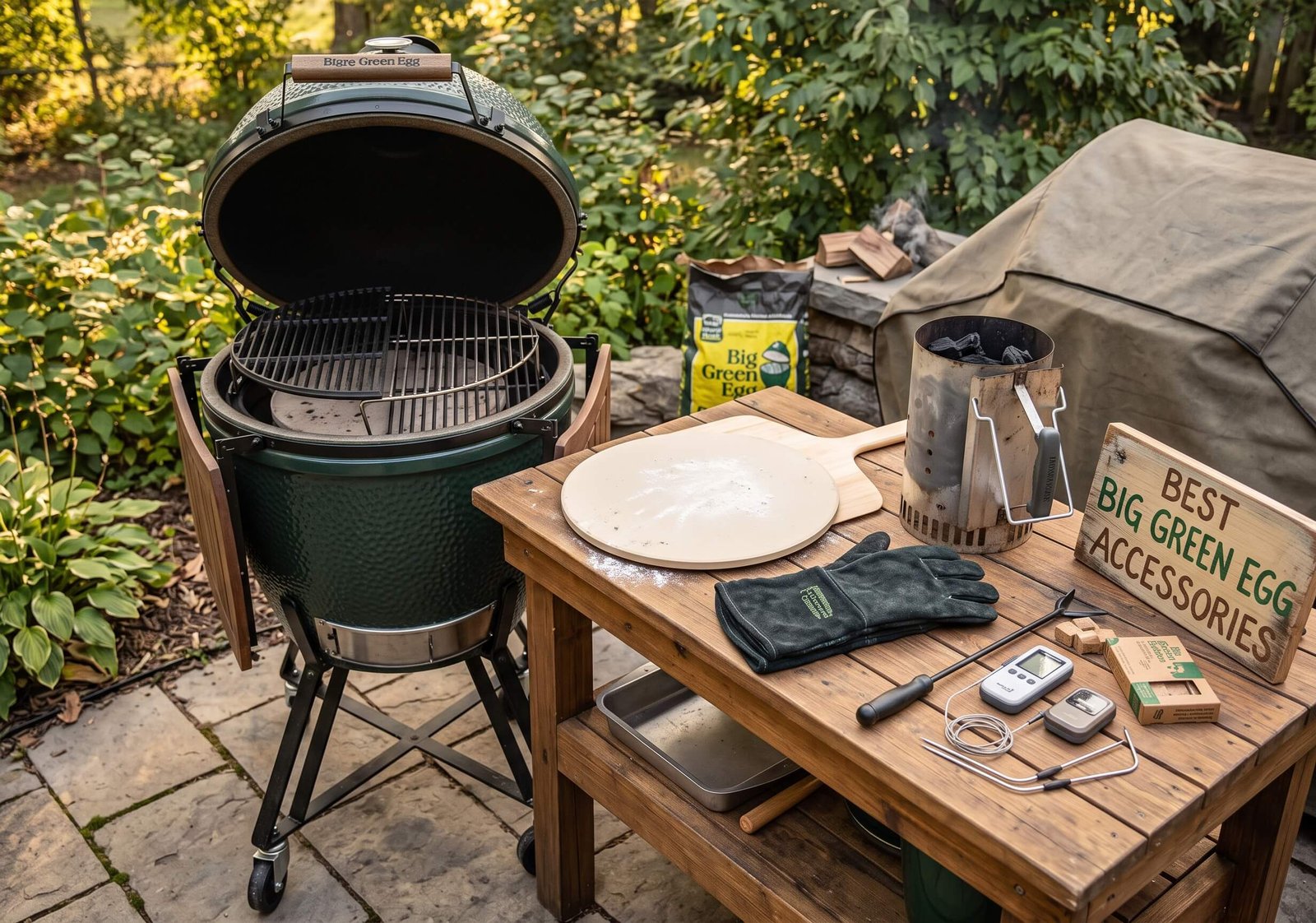
You just bought a ceramic cooker that can sear a steak at 700°F (371°C) and hold 250°F (121°C) for a 12-hour brisket. Now you need the right gear to make that happen. This guide covers the best Big Green Egg accessories, from the one item every owner needs on day one to upgrades worth saving for.
Big Green Egg accessories can add up fast, so we sorted them by how much they change your cooking. Some are essential. Others are nice extras. Here is how to tell the difference.
Quick Answer
The best Big Green Egg accessories start with a ConvEGGtor for indirect cooking, a reliable thermometer, and a chimney starter. Upgrade to the EGGspander System for more cooking space, then add a cast iron grid and baking stone as your recipes grow.
The Best Big Green Egg Accessories at a Glance
| Accessory | Key Function | Best For | Price Range |
| ConvEGGtor (plate setter) | Blocks direct heat for indirect cooking | Every owner; low and slow cooks | Mid [VERIFY] |
| EGGspander System (5-piece) | Adds multi-level cooking space | Cooking for crowds; upgrade pick | About 200-350 by size [VERIFY] |
| Instant-read thermometer | Checks internal food temperature fast | Beginners; budget pick | Under $50 [VERIFY] |
| Wireless leave-in thermometer or controller | Tracks pit and meat temps remotely | Long cooks; overnight smoking | 50-300+ [VERIFY] |
| Cast iron cooking grid | Deep sear marks and high heat retention | Steak, burgers, chops | Mid-high [VERIFY] |
| Baking stone | Even heat for pizza and bread | Pizza night; baking | Low-mid [VERIFY] |
| Chimney starter and fire starters | Lights lump charcoal fast and clean | Everyone | Under $30 [VERIFY] |
| Ash tool and ash pan | Clears airflow between cooks | Every owner | Under $40 [VERIFY] |
| EGGmitt and heat-resistant gloves | Protects hands from hot ceramic and grids | Every owner | Under $50 [VERIFY] |
Top pick: ConvEGGtor. Budget pick: a good instant-read thermometer. Upgrade pick: EGGspander System.
Why the Right Accessories Matter on a Ceramic Cooker
A Big Green Egg is a kamado, meaning a thick ceramic cooker that holds heat for hours. Out of the box, it grills well. It does not smoke well or bake well until you add a few key parts.
The reason is simple. Charcoal sits right under the cooking grid, so food gets direct heat by default. For brisket, ribs, or a whole chicken, you need to block that heat and turn the Egg into an oven. That is where accessories come in.
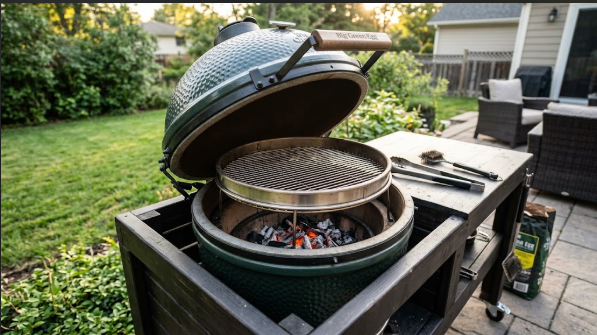
The good news is that you do not need everything at once. Most cooks get great results with three or four items and add more as they try new recipes.
1. Big Green Egg ConvEGGtor (Plate Setter)
Who it’s for
Every owner who wants to smoke, roast, or bake. If you buy only one accessory, buy this one.
Key features
The ConvEGGtor is a ceramic plate that sits between the fire and the cooking grid. It creates indirect heat, so the Egg works like a charcoal-fired convection oven. Manufacturer information describes it as the way to turn your EGG into an outdoor oven for low and slow cooking, and retailers note the newer shape has smaller side openings for more even heat across the grid.
Set the ConvEGGtor in with its feet up (legs pointing up) and place your grid on top. Add a drip pan for pork butts, turkey breast, or anything fatty.
Pros
- Opens up smoking, roasting, and baking
- Protects food from scorching on long cooks
- Works with drip pans to catch fat and make cleanup easier
Cons
- Adds heat-up time because the ceramic needs to soak
- You must remove it to switch to direct searing
- Sizes differ by Egg, so match your model exactly
Pitmaster Tip: When you smoke, bring the Egg to temperature with the ConvEGGtor already inside. Dropping a cold plate into a hot Egg can cause thermal shock and cracking risk. Add wood chunks early so you get clean, thin smoke instead of white billows.
For a deeper look at running charcoal low and steady, our guide to lump charcoal in an offset smoker covers fuel choices that carry over to ceramic cookers too.
2. EGGspander System (Upgrade Pick)
Who it’s for
Cooks who feed families or crowds, or anyone who wants to cook different foods at different heat levels at the same time.
Key features
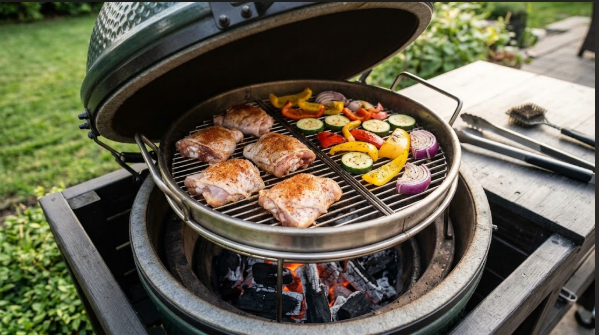
The 5-piece EGGspander Kit includes a ConvEGGtor basket, a multi-level rack, two stainless steel half grids, and a lower “cowboy style” rack. Official product listings say it supports multi-level direct and indirect setups and raised-grid cooking. The elevated sliding rack provides about 6.5 in (16 cm) of clearance, and the XL kit is listed at about 15 lb (6.8 kg) [VERIFY].
The basket also makes the ConvEGGtor easier to lift in and out. That matters when you want to add wood or switch from smoking to searing mid-cook.
Pros
- Much more usable cooking area
- Direct and indirect zones in the same cook
- Easier plate setter handling
Cons
- Costly compared to basic accessories
- Takes practice to learn the layouts
- Several pieces to clean and store
Common Mistake: Overloading the upper rack so airflow gets blocked. Leave gaps between food so hot air moves around. A packed rack cooks unevenly and can push your dome temperature higher than you intended.
[PHOTO: EGGspander basket with two half grids installed, one side holding chicken thighs and the other holding vegetables]
3. Instant-Read Thermometer (Budget Pick)
Who it’s for
Every beginner. It is the cheapest way to stop guessing and start cooking to temperature.
Key features
Look for a fast reading time, a thin probe tip, and a backlit display. You use it to spot-check chicken, steaks, and roasts in seconds.
Food safety is where this tool earns its keep. Cook poultry to 165°F (74°C), the USDA’s safe minimum internal temperature for all poultry. The same chart lists 145°F (63°C) with a 3-minute rest for whole cuts of beef, pork, and lamb, and 160°F (71°C) for ground meats.
Pros
- Low cost, high impact
- Works for every cook, not just smoking
- Catches undercooked food fast
Cons
- Does not monitor temperature while the lid is closed
- Cheap models can drift out of accuracy over time
Test it in a glass of ice water. It should read 32°F (0°C). If it is off by a few degrees, check the manual for calibration.
4. Wireless Leave-In Thermometer or Temperature Controller
Who it’s for
Anyone running long cooks like brisket or pork butt, and anyone who does not want to babysit the vents all night.
Key features
A leave-in probe sits in the meat while the lid stays closed, and a second probe can track grid temperature. A wireless unit sends readings to your phone. Big Green Egg also sells a Wi-Fi temperature controller called the EGG Genius, which uses a fan to hold a set temperature [VERIFY current specs and Egg size compatibility in the manual].
Here are real-world numbers that matter on a kamado:
- Brisket: hold the grid near 250°F (121°C) and pull at 200-205°F (93-96°C) when the probe slides in like soft butter
- Pork butt for pulling: about 195-203°F (90-95°C)
- USDA minimum for these whole cuts is still 145°F (63°C), but those tougher cuts need much higher temps to turn tender
Pros
- Lets you sleep through overnight cooks
- Helps you learn how your vents behave
- Alarms prevent overshooting
Cons
- Controllers add cost and require power
- Wireless range depends on thick ceramic and your setup
- Probes need replacing eventually
Pitmaster Tip: Move the Egg’s vent settings in small steps. A ceramic cooker reacts slowly, so a tiny vent change can take 10-15 minutes to show. Overcorrecting is the number one reason beginners swing 50°F (28°C) in either direction.
5. Cast Iron Cooking Grid
Who it’s for
Steak lovers, burger fans, and anyone chasing deep sear marks and crust.
Key features
Cast iron holds a lot of heat and transfers it to the food well. Big Green Egg lists a cast iron searing grid as one of the half-moon surfaces you can drop into the EGGspander setup. You can also buy full-size cast iron grids for some Egg sizes [VERIFY availability for your Egg size].
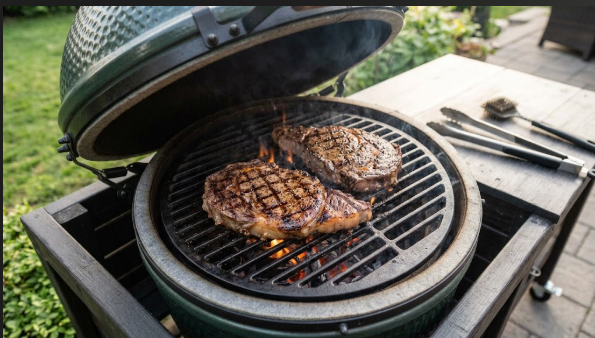
For a thick ribeye, run the Egg around 600-700°F (316-371°C). Sear 2 minutes per side, then rest the steak 5 minutes. Pull steaks around 125-130°F (52-54°C) for medium-rare, and know that this is below the USDA’s 145°F (63°C) minimum, so it is a personal choice.
Pros
- Excellent sear and heat retention
- Works well with the high heat a ceramic cooker can reach
- Great for burgers, chops, and thick steaks
Cons
- Heavy to handle
- Needs seasoning with oil and regular care to avoid rust
- Slow to heat up
6. Baking Stone
Who it’s for
Anyone who wants wood-fired pizza, flatbread, or crusty bread from their Egg.
Key features
A ceramic baking stone sits on top of the ConvEGGtor and absorbs the heat from below. That keeps the bottom of a pizza from burning while the top bakes in the dome heat. Official product pages describe pairing the ConvEGGtor and baking stone for pizza.
A good starting point is 550-600°F (288-316°C) at the stone, with the pizza cooking in about 5-8 minutes. Let the stone heat for at least 30 minutes so it is fully hot before the pizza goes on.
Pros
- Turns your Egg into a pizza oven
- Also works for cookies, bread, and pies
- Cheap compared to most upgrades
Cons
- Can crack from sudden temperature changes
- Adds one more heavy piece to store
- Pizza peel and parchment needed for easy loading
If you also want a dessert out of the same cook, try our smoked pecan pie idea once your baking setup is dialed in.
7. Chimney Starter and Fire Starters
Who it’s for
Everyone. A good lighting method saves time and protects flavor.
Key features
A chimney starter lights a full load of lump charcoal in 15-20 minutes without lighter fluid. Lighter fluid can leave an off flavor in the ceramic, so skip it. Natural fire starter cubes or an electric starter are cleaner options.
Our how to start a grill guide walks through chimney basics step by step, and the same ideas apply to your Egg. For the Egg itself, light only a small patch of charcoal for low and slow cooks. A big fire is harder to bring down than a small one is to bring up.
Pros
- No chemical taste
- Fast and repeatable lighting
- Low cost
Cons
- Chimney starters get very hot, so you need a safe place to set them
- Electric starters need a nearby outlet
Common Mistake: Opening the dome fast on a hot Egg. Fresh air can cause a flashback, a sudden burst of flame. Lift the lid an inch or two (a few centimeters), pause, then open fully. This is often called “burping” the Egg.
8. Ash Tool and Ash Pan
Who it’s for
Every owner. Ash blocks airflow, and airflow is how you control temperature.
Key features
A long-handled ash tool stirs the charcoal and pulls ash out through the bottom vent. Clean out ash before each long cook. Clogged holes in the fire grate make temperatures hard to hold and can cause the fire to struggle.
Wait until the Egg is fully cool before you clear ash. Once the cooker is cold, scoop the ash into a metal container.
Pros
- Improves airflow and temperature control
- Simple, cheap, and durable
- Makes reloading unburned charcoal easy
Cons
- Not exciting, so people skip it
- Short tools put your hands too close to the heat
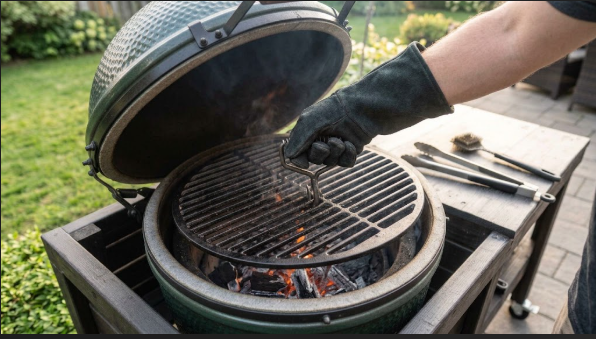
9. EGGmitt and Heat-Resistant Gloves
Who it’s for
Anyone handling hot grids, ConvEGGtors, or baking stones.
Key features
Ceramic and iron stay hot long after the flames die down. A long-cuff heat-resistant mitt gives you a better grip on the grid and protects your wrists. Look for gloves rated for high heat and check the maker’s rating [VERIFY].
For carving after the cook, a sharp blade matters just as much. See our picks for the best knives for cutting meat before you slice that first brisket.
Pros
- Prevents burns
- Makes moving hot parts safer
- Useful across all your outdoor cooking
Cons
- Wet gloves transfer heat quickly, so keep them dry
- Bulky models can reduce dexterity
Bonus: Protecting Your Egg with a Cover and Nest
A cover keeps rain, pollen, and bugs out of the Egg. A nest or table holds the ceramic body at a safe working height and helps with stability. Many owners add both after the first few months.
If you are comparing covers, read our guide to the best heavy-duty grill covers. Always let the Egg cool fully before covering it, and check your manual for placement and clearance rules [VERIFY].
How to Choose the Best Big Green Egg Accessories
Use this checklist before you buy:
- Match the size. Accessories are made for Small, Medium, Large, and XL Eggs. A Large grid is about 18 in (46 cm) wide and an XL is about 24 in (61 cm) [VERIFY], so check your model first.
- Buy for the food you cook. Smoking brisket calls for a ConvEGGtor and a leave-in probe. Steak nights call for a cast iron grid.
- Start with safety and control. Gloves, an ash tool, and a thermometer come before extras.
- Think in layers. Add the plate setter first, then the EGGspander, then specialty items.
- Check materials. Stainless steel resists rust. Cast iron needs seasoning. Ceramic can crack if shocked.
- Read the manual. Official manufacturer manuals are the final word on fit and use.
- Watch your budget. Official branded parts cost more, but many third-party items fit well. Confirm fit before buying.
Beginner Shopping Order
| Step | Buy This | Why |
| 1 | ConvEGGtor | Unlocks indirect cooking |
| 2 | Instant-read thermometer | Safe, accurate cooking |
| 3 | Chimney starter | Clean lighting |
| 4 | Gloves and ash tool | Safety and airflow |
| 5 | Leave-in probe | Long cooks |
| 6 | EGGspander System | More space and flexibility |
| 7 | Cast iron grid and baking stone | New recipe styles |
How We Picked These Best Big Green Egg Accessories
We built this list around what each accessory does, how often a typical cook will use it, and what manufacturers say about fit and function. We did not run lab tests, and we do not claim hands-on scores here.
Here are the criteria:
- Impact: Does it change what you can cook?
- Safety: Does it help you hit safe temperatures or avoid burns?
- Versatility: Can it work for several foods?
- Value: Is the benefit worth the cost for a beginner?
- Fit: Is it designed for kamado-style ceramic cookers?
We pulled specs from official Big Green Egg product pages and flagged anything we could not confirm with [VERIFY]. Prices are shown as ranges because retailers and promotions change often.
Cooking Examples That Use These Accessories
Here is how the gear comes together in real cooks:
| Food | Setup | Cooker Temp | Pull Temp |
| Brisket | ConvEGGtor, drip pan, leave-in probe | 250°F (121°C) | 200-205°F (93-96°C) |
| Pork butt (8 lb / 3.6 kg) | ConvEGGtor, drip pan | 250°F (121°C) | 195-203°F (90-95°C) |
| Whole chicken (4 lb / 1.8 kg) | ConvEGGtor | 350-375°F (177-190°C) | 165°F (74°C) in thickest part |
| Ribeye (1.5 in / 3.8 cm) | Cast iron grid, direct | 600-700°F (316-371°C) | 125-130°F (52-54°C) for medium-rare |
| Pizza | ConvEGGtor and baking stone | 550-600°F (288-316°C) | Crust golden, 5-8 minutes |
For a holiday bird, the indirect setup works much like the one in our turkey breast at 250 walkthrough. If you want pork ribs, compare the technique with our ribs on a pellet grill guide and adjust for the ceramic cooker’s moisture and heat retention.
Care and Maintenance Tips
A few habits keep your Egg and gear lasting for years:
- Let everything cool fully before cleaning or covering.
- Do not use water on hot ceramic or stones. Thermal shock can crack them.
- Season cast iron grids with a thin coat of high-heat oil, and dry them right after cleaning.
- Scrape stainless grids with a brush while they are still warm.
- Clean out ash before every long cook so air can flow.
- Check the gasket (the felt seal around the dome) for wear and replace it when it frays.
- Store small parts dry. Moisture and ash together can cause corrosion on metal pieces.
For a longer burn, a “clean burn” session now and then can help remove built-up grease residue. Run the Egg hot for a short time with the vents open, then let it cool. Follow your manual for any burn-off guidance [VERIFY].
Big Green Egg vs Other Grills: Do You Need All This?
Compared with a pellet grill, a Big Green Egg is more hands-on. If you are still weighing the two, our list of the best pellet grills for beginners shows what a set-and-forget cooker looks like. A pellet grill needs fewer accessories. An Egg rewards you with high-heat searing, strong fuel efficiency, and a wider range of cooking styles, but the right gear matters more.
The takeaway: start small. A ConvEGGtor, a thermometer, a chimney starter, and gloves will carry you through your first season.
FAQ
What accessories do I need for a Big Green Egg?
Start with a ConvEGGtor, an instant-read thermometer, a chimney starter, an ash tool, and heat-resistant gloves. Those five cover smoking, searing, safe cooking, and cleanup. Add the EGGspander, cast iron grid, and baking stone once you know what you cook most.
Is the ConvEGGtor necessary?
Yes, if you want to smoke, roast, or bake. It blocks direct heat and creates indirect cooking, which is how you cook brisket, pork butt, and whole chickens without burning the bottom. For steaks and burgers over direct heat, you can remove it.
Is the EGGspander worth it?
It is worth it if you cook for several people or like to run different zones at once. The multi-level racks add real cooking space. If you cook for one or two and mostly use one setup, the basic ConvEGGtor setup may be enough.
What is the best thermometer for a Big Green Egg?
You need two: a fast instant-read for spot checks and a leave-in probe for long cooks. Pick units rated for high heat with a clear display. A wireless model with alarms helps overnight smokes, since opening the dome loses heat.
Can you use a pizza stone on a Big Green Egg?
Yes. Place the baking stone on the ConvEGGtor, preheat for at least 30 minutes, and bake around 550-600°F (288-316°C). Heat the stone slowly with the Egg to avoid cracking. Use a peel and parchment to load the pizza.
Do you need a cover for a Big Green Egg?
A cover is optional but smart. It keeps rain, dust, and pollen out of the dome and vents. Let the Egg cool completely first. Moisture trapped under a cover on a warm cooker can lead to mildew, so check the dome seal and airflow.
Conclusion
The best Big Green Egg accessories are the ones that match how you cook. Start with a ConvEGGtor for indirect cooking, an instant-read thermometer for safe and accurate results, and a chimney starter, gloves, and ash tool for easier daily use.
Once those basics feel natural, add the EGGspander for space, a leave-in probe for long cooks, and a cast iron grid or baking stone for steak and pizza. Building your kit in stages saves money and helps you learn what you really use. For holiday menus, our Thanksgiving smoker recipes are a good next stop once your Egg is set up.
Laura Smith

I'm Laura, I like all the kind of delicious grilled foods which makes me hungry all the time I see them. That's why I built this blog to share with you all of my Grilling experiences, recipes, and all the tips about foods that I've learned from food experts.