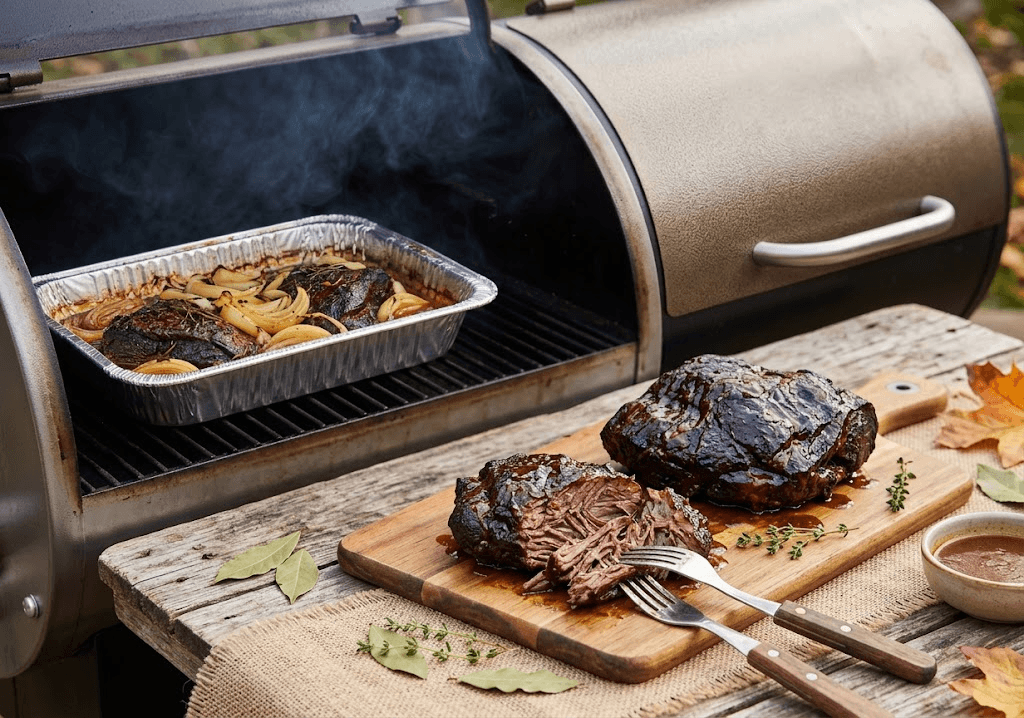
Beef cheeks are one of the best deals in the butcher case. They’re cheap, packed with flavor, and they turn almost silky when you cook them slowly. Cooking beef cheeks on a pellet grill gives you smoky bark on the outside and juicy, shreddable meat on the inside.
This guide walks you through the whole process. You’ll learn how to trim the cheeks, season them, smoke them, braise them, and rest them. You’ll also get exact temperatures, times, and fixes for the problems that trip up most first-timers.
Quick Answer
Smoke trimmed beef cheeks at 250°F (121°C) for about 3 hours until dark bark forms. Then braise them covered in a foil pan with beef broth until they probe tender at 200–205°F (93–96°C), about 3 more hours. Rest 30–60 minutes. Total time is roughly 6–7 hours. The USDA minimum is 145°F (63°C).
What Are Beef Cheeks, and Why Do They Work So Well on a Pellet Grill?
Beef cheeks are the facial muscles of the cow. They work hard all day, chewing, so they are lean, dense, and loaded with collagen. Straight off the grill at a normal steak temperature, they are very tough.
Low, steady heat changes that. Between roughly 160°F and 205°F (71–96°C), the collagen melts into gelatin. That gelatin is what makes the meat feel rich and sticky instead of dry.
A pellet grill is a great tool for this job. It holds a steady temperature for hours, feeds clean wood smoke, and needs far less babysitting than an offset smoker. If you’re still shopping for a cooker, our guide to the best pellet grills for beginners covers models that hold temperature well.
Compared to a chuck roast or brisket, cheeks are smaller and more forgiving. They cook faster than a full brisket, and the finished meat shreds easily for tacos, sandwiches, or a plate with mashed potatoes.
Why This Recipe Works
- Two-stage cooking. The open smoke stage builds bark and flavor. The covered braise stage melts the collagen and keeps the meat moist.
- A simple, salt-forward rub. Cheeks are rich, so you don’t need a long ingredient list. Salt, pepper, paprika, garlic, and onion do the job.
- Temperature, not time. You’ll cook to probe tenderness, not to a clock. That is the only reliable way to handle connective tissue.
- A built-in sauce. The braising liquid becomes a rich jus you can spoon over the meat.
If you’ve made ribs on a pellet grill, the rhythm will feel familiar: smoke first, wrap or cover second, then rest.
Ingredients and Equipment
Servings: 6–8 | Beef cheeks: about 4 lb (1.8 kg) untrimmed, which trims down to about 3 lb (1.4 kg)
For the cheeks and rub
- 4 beef cheeks (about 1 lb / 0.45 kg each)
- 2 tbsp yellow mustard or olive oil (as a binder)
- 2 tbsp kosher salt
- 1 tbsp coarse black pepper
- 1 tbsp smoked paprika
- 2 tsp garlic powder
- 2 tsp onion powder
- 1 tsp chili powder (optional)
For the braise
- 2 cups (475 ml) low-sodium beef broth
- ½ cup (120 ml) dry red wine (optional; use more broth instead)
- 2 tbsp tomato paste
- 1 tbsp Worcestershire sauce
- 1 yellow onion, thickly sliced
- 4 garlic cloves, smashed
- 2 bay leaves
- 4 thyme sprigs (or 1 tsp dried)
Equipment
- Pellet grill
- Oak, hickory, pecan, or a blend of oak and cherry pellets
- Sharp boning knife or trimming knife
- Disposable foil pan (half-size, deep) plus heavy-duty foil
- Instant-read thermometer
- Small cooler and a couple of old towels for resting
Substitutions
- No tomato paste? See our list of tomato paste substitutes. Ketchup or tomato sauce works in a pinch.
- No chili powder or want more heat? A chili paste substitution like cayenne or crushed red pepper works in the rub or braise.
- No wine? Replace it with extra beef broth and a splash of apple cider vinegar.
- No pellet smoke flavor you like? Mild woods like pecan and cherry are safer than mesquite, which can turn bitter over a long cook.
Pitmaster Tip: Oak is the safest all-around choice for beef cheeks. Hickory adds a stronger, bacon-like punch. Mix in a handful of cherry pellets if you want a deeper mahogany color on the bark.
Choosing and Prepping the Meat
Where to find beef cheeks
Ask the meat counter at a good grocery store or a local butcher. Mexican markets often carry them as cachete de res. Many stores keep them in the back, so asking helps. If they’re frozen, thaw them in the refrigerator for 24–48 hours, following USDA safe thawing guidance .
Trimming
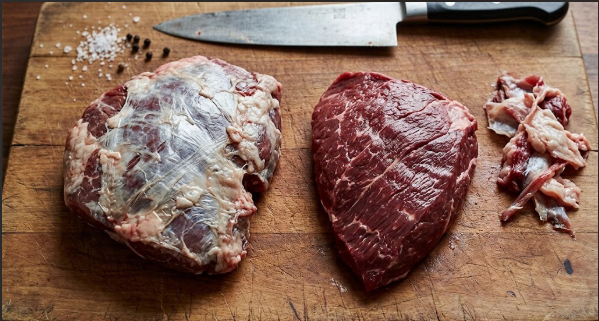
Cheeks usually have a thick layer of silver skin and hard fat on one side. This doesn’t melt the way marbling does, so remove most of it. Slide a sharp knife under the silver skin, angle the blade up, and pull the skin away in strips.
Leave a thin layer of fat, about ¼ inch (6 mm). A good boning knife makes this much easier; see our picks for the best knives for cutting meat.
Dry brine and seasoning
Pat the cheeks dry. Coat them with a thin layer of mustard or oil. This does not add mustard flavor; it just helps the rub stick.
Mix the salt, pepper, paprika, garlic powder, onion powder, and chili powder. Coat every side generously. Place the cheeks on a rack or plate, uncovered, in the refrigerator for at least 1 hour, or up to 12 hours. The salt pulls moisture out and then back in, which seasons the meat deeper.
Step-by-Step Instructions
- Preheat the pellet grill to 250°F (121°C). Let it run for 15 minutes so the temperature settles. Fill the hopper with oak or your chosen blend.
- Take the cheeks out of the fridge 20–30 minutes before cooking. Insert a probe into the thickest cheek if you use a leave-in thermometer.
- Place the cheeks directly on the grate, spaced about an inch apart. Close the lid.
- Smoke for 2½ to 3 hours. Don’t open the lid for the first 90 minutes. You want a deep reddish-brown bark that doesn’t smear when you touch it. The internal temperature should reach about 165–170°F (74–77°C).
- Build the braise. While the cheeks smoke, scatter the sliced onion, garlic, bay leaves, and thyme in the foil pan. Whisk the tomato paste and Worcestershire into the broth and wine, then pour it into the pan.
- Move the cheeks into the pan, nestling them into the liquid. The liquid should come about halfway up the meat. Cover the pan tightly with heavy-duty foil.
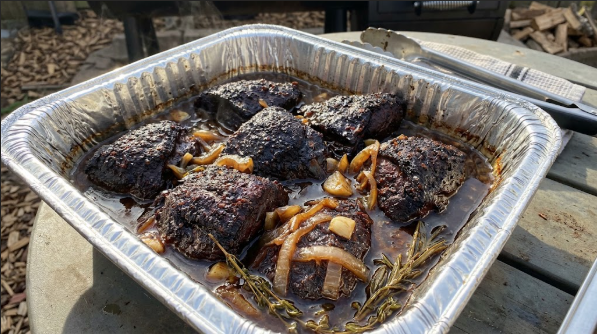
- Return the pan to the grill at 250°F (121°C). Cook for another 2½ to 3½ hours.
- Start probing at the 2-hour mark. Slide an instant-read thermometer into the thickest part. You want 200–205°F (93–96°C) and a probe that slides in with almost no resistance, like warm butter.
- Rest in the pan. Pull the pan off, keep it covered, wrap it in towels, and place it in a dry cooler for 30–60 minutes.
- Make the jus. Strain the liquid into a saucepan, skim off the fat, and simmer for 10–15 minutes until it coats a spoon.
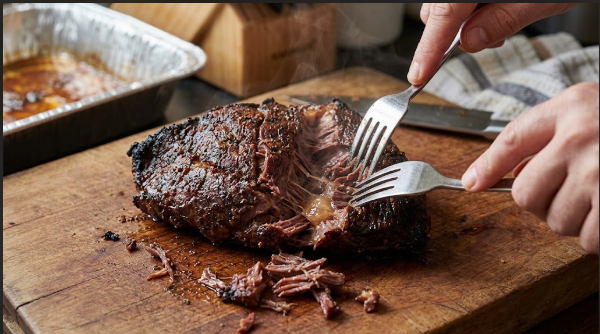
Common Mistake: Pulling the cheeks at 190°F because “the temperature looks right.” Cheeks often need to hit 200–205°F before the collagen is fully melted. If the probe still feels tight, put the pan back on for another 20–30 minutes and check again.
Time and Temperature Table
| Stage | Grill temp | Target internal temp | Approx. time |
| Dry brine (fridge) | n/a | n/a | 1–12 hours |
| Smoke, uncovered | 250°F (121°C) | 165–170°F (74–77°C) | 2½–3 hours |
| Braise, covered | 250°F (121°C) | 200–205°F (93–96°C) | 2½–3½ hours |
| Rest in cooler | n/a | stays above 140°F (60°C) | 30–60 minutes |
| Total cook time | about 6–7 hours |
Cook times vary with the size of the cheeks, how often you open the lid, and weather. Treat every number here as a guide and let the probe make the final call.
How to Tell When Beef Cheeks Are Done
Finished cheeks look dark and glossy, and they slump slightly when you lift them. Poke one with a fork. It should pull apart with almost no pressure.
For safety, the USDA’s safe minimum internal temperature for whole cuts of beef is 145°F (63°C) with a 3-minute rest. Beef cheeks cooked to tenderness will be far above that, usually 200–205°F (93–96°C). That higher number is a pitmaster pull temp for texture, not a safety requirement.
If the meat feels rubbery, it isn’t done. It is not overcooked. Give it more time covered in the braising liquid.
Resting, Slicing, and Serving
Resting matters. Cheeks lose a lot of juice if you shred them right off the grill. A 30–60 minute rest in a cooler lets the gelatin settle and the fibers relax.
Pull the meat out of the pan and trim off any leftover chunks of fat. You can serve in large pieces, shred with forks, or slice against the grain into thick pieces. Spoon the warm jus over the top.
For a barbacoa-style plate, shred the cheeks, toss with a little jus, and pile into warm tortillas with chopped onion, cilantro, and lime.
What to Serve With Smoked Beef Cheeks
Rich meat wants simple, bright, or creamy sides. Here are the combinations we like:
- Creamy starches: mashed potatoes, cheesy grits, or polenta soak up the jus.
- Cornbread: try our skillet-style cornbread recipe for something sweet and crumbly.
- Something sharp: quick pickled red onions or a vinegar slaw cut through the richness.
- Vegetables: roasted carrots, charred broccolini, or grilled corn.
- Tacos: warm corn tortillas, salsa verde, sliced radishes, and lime wedges.
Storing, Freezing, and Reheating Leftovers
Get the leftovers into the fridge within 2 hours of cooking, or within 1 hour if it’s over 90°F (32°C) outside, as USDA food safety guidance recommends.
- Refrigerate: Store in shallow containers with some jus. Use within 3–4 days.
- Freeze: Portion the meat with jus into freezer bags and press out the air. Frozen food stays safe indefinitely at 0°F (-18°C), but flavor and texture are best within 2–3 months.
- Thaw: Move to the refrigerator overnight. Don’t thaw on the counter.
- Reheat: Warm gently in a covered pan or in a 300°F (149°C) oven with extra jus until it reaches 165°F (74°C).
Adding jus before you freeze is the trick. It keeps the meat from drying out when you reheat it.
Variations: Pellet Grill, Offset, Charcoal, and Oven Backup
Pellet grill (the base recipe)
Everything above. Smoke at 250°F (121°C), braise covered, rest.
Offset smoker
Run the firebox at 250–275°F (121–135°C) using split oak. Expect to tend the fire every 30–45 minutes. If you’re new to this style of cooking, our piece on lump charcoal in an offset smoker explains fuel management.
Charcoal kettle or drum
Set up for indirect heat with a water pan and a few wood chunks. Hold the vents steady near 250°F (121°C). It’s fussier than a pellet grill, but it works.
Oven backup
No grill? Sear the seasoned cheeks in a Dutch oven, add the braising liquid, cover, and cook at 300°F (149°C) for 3½–4½ hours. You won’t get smoke, but you’ll get tender meat. If you like oven braising and roasting, our oven roast beef guide covers similar low-heat technique.
Faster finish
Smoke for 2 hours, then move the cheeks and braising liquid to a slow cooker (6–8 hours on low) or pressure cooker (about 75 minutes at high pressure). You’ll lose some bark, but save grill time.
Troubleshooting: Common Problems and Fixes
| Problem | Likely cause | Fix |
| Meat is tough or rubbery | Not cooked long enough; collagen hasn’t melted | Re-cover and cook another 20–30 minutes; probe again |
| Bark is soft or mushy | Braising stage started too early or foil trapped steam | Smoke until bark is set; uncover the last 15 minutes if needed |
| Too salty | Salty broth or heavy rub plus reduced jus | Use low-sodium broth; dilute jus with water or unsalted stock |
| Dry or stringy | Too little liquid or overcooked past tender | Keep liquid halfway up; rest in jus; reheat with extra jus |
| Bitter smoke flavor | Heavy woods like mesquite, or dirty burn pot | Switch to oak or pecan; clean the burn pot before long cooks |
| Stall at 150–170°F | Evaporative cooling | Be patient, or move to the braise stage |
| Uneven doneness | Cheeks of different thickness | Pull the smaller ones sooner; test each cheek |
For a classic braised beef comparison, our pot roast recipe shows how a similar cut behaves when cooked in liquid the whole time.
Recipe Card: Smoked Beef Cheeks
Servings: 6–8 Prep time: 30 minutes (plus 1–12 hours dry brine) Cook time: 5½–6½ hours Total time: about 6–7 hours Grill temp: 250°F (121°C) Pull temp: 200–205°F (93–96°C) and probe tender USDA minimum safe temp: 145°F (63°C) with 3-minute rest
Ingredients: 4 beef cheeks (about 4 lb / 1.8 kg), mustard or oil, kosher salt, black pepper, smoked paprika, garlic powder, onion powder, chili powder, beef broth, red wine (optional), tomato paste, Worcestershire, onion, garlic, bay leaves, thyme.
Short steps:
- Trim silver skin. Bind and season. Dry brine 1–12 hours.
- Smoke at 250°F (121°C) for 2½–3 hours until bark sets.
- Move to a foil pan with onion, garlic, broth, wine, tomato paste, and herbs. Cover tightly.
- Cook another 2½–3½ hours until 200–205°F (93–96°C) and probe tender.
- Rest 30–60 minutes. Strain and reduce the jus. Serve.
FAQ: Beef Cheeks on a Pellet Grill
How long do you smoke beef cheeks?
Plan for about 6–7 hours total at 250°F (121°C). That’s roughly 3 hours smoking uncovered, then 3 hours covered with liquid. Size and weather change the timing, so go by probe tenderness at 200–205°F (93–96°C) rather than the clock.
What temperature do you smoke beef cheeks at?
250°F (121°C) is a reliable choice. It’s low enough to melt collagen without drying the meat, and fast enough to finish in a day. You can go as low as 225°F (107°C) for a longer cook, or up to 275°F (135°C) to save time.
Do you have to wrap or braise beef cheeks?
Yes, for the best results. Cheeks are lean and tough, so they need moisture to finish tender. Smoking them uncovered the whole time usually leaves them dry. Covering them in a foil pan with broth keeps the meat juicy and creates a sauce.
What internal temperature are beef cheeks done?
Pull them at 200–205°F (93–96°C) when a probe slides in with almost no resistance. The USDA safe minimum for beef is 145°F (63°C), but cheeks won’t be tender at that temperature. The higher number is for texture, not safety.
What wood pellets are best for beef cheeks?
Oak is the most dependable. Hickory gives a stronger flavor, and pecan or cherry add mild sweetness and color. Use mesquite sparingly because it can taste bitter over a long cook. A blend of oak and cherry is a safe starting point.
Can you freeze and reheat smoked beef cheeks?
Yes. Freeze the shredded or sliced meat with some jus in airtight bags for 2–3 months of best quality. Thaw in the refrigerator, then reheat gently in a covered pan or oven with extra jus until it reaches 165°F (74°C).
Conclusion
Cooking beef cheeks on a pellet grill rewards patience. Trim well, season with salt, smoke until the bark sets, braise until the probe slides in like butter, and rest before serving. Those four habits matter more than any fancy ingredient.
Once you’ve done it once, the process feels easy, and you’ll have a cheap cut that eats like something far more expensive. Fire up the grill this weekend, and let us know how your beef cheeks turned out.
Laura Smith

I'm Laura, I like all the kind of delicious grilled foods which makes me hungry all the time I see them. That's why I built this blog to share with you all of my Grilling experiences, recipes, and all the tips about foods that I've learned from food experts.