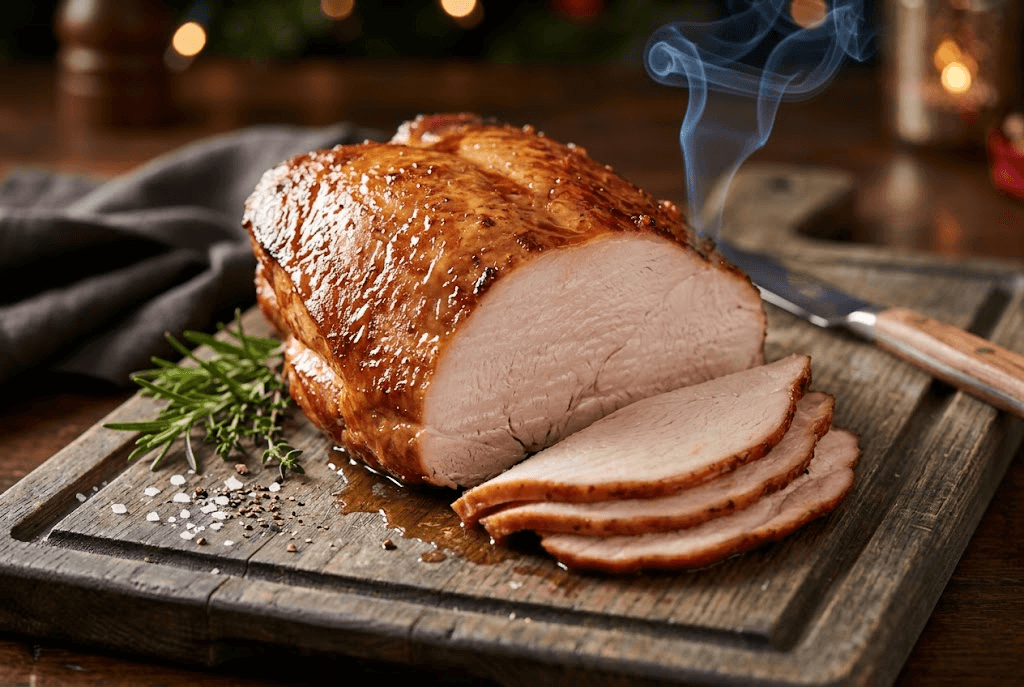
Smoking a turkey breast in an electric smoker is the easiest way to get a juicy, smoky holiday bird without babysitting a fire. You set the temperature, add a little wood, and let the heating element do the steady work. A breast is lean, so it rewards a good dry brine and a thermometer more than any fancy trick.
This guide walks you through the whole process for a bone-in, skin-on breast. You’ll get exact temperatures, real cook times, and the visual cues that tell you it’s done. If you’re planning a full holiday menu, our Thanksgiving smoker recipes round-up pairs well with this one.
Quick Answer
Smoke a 6-7 lb (2.7-3.2 kg) bone-in turkey breast in an electric smoker at 275°F (135°C) with apple or pecan wood for about 2½-3½ hours. Pull it at 160°F (71°C), rest 20-30 minutes until it reaches the USDA’s 165°F (74°C) safe minimum, then slice.
Why This Turkey Breast Recipe Works
Electric smokers hold temperature better than most cookers because a thermostat controls the heating element. That steady heat is ideal for lean poultry, which dries out fast when temperatures swing. You don’t have to feed a fire, so you can focus on the bird.
The weak spot is skin. Electric smokers run humid and produce very little bark, so skin often turns rubbery at low temperatures. This recipe fixes that three ways: an uncovered dry brine in the fridge, a pinch of baking powder in the rub, and a cook temperature of 275°F (135°C) instead of 225°F (107°C).
Smoke flavor is the other piece. Electric units make a mild, clean smoke, and poultry absorbs it quickly. A small amount of wood is plenty, and more usually just makes the meat bitter.
Ingredients and Equipment
For a 6-7 lb (2.7-3.2 kg) bone-in, skin-on turkey breast (serves 6-8):
- 1 bone-in turkey breast, 6-7 lb (2.7-3.2 kg)
- 2 tablespoons kosher salt (Diamond Crystal; use about half as much of fine table salt)
- 1 teaspoon aluminum-free baking powder
- 1 tablespoon smoked paprika
- 2 teaspoons garlic powder
- 2 teaspoons onion powder
- 1 teaspoon black pepper
- 1 teaspoon dried thyme
- 1 teaspoon brown sugar
- ½ teaspoon cayenne (optional)
- 4 tablespoons (½ stick) unsalted butter, softened
- 1-2 cups apple juice or water for the water pan
- 2-3 handfuls (about 2 cups) wood chips: apple, cherry, or pecan
Equipment:
- Electric smoker (Masterbuilt, Bradley, Char-Broil, Cuisinart, or similar)
- Instant-read thermometer and, ideally, a leave-in probe
- Wire rack and rimmed sheet pan for the fridge
- Foil pan to catch drippings
- Paper towels, kitchen twine (optional)
- A sharp slicing knife (see our guide to the best knives for cutting meat)
Substitutions:
- Wood: Hickory is stronger, so use half as much. Mesquite is usually too harsh for turkey.
- Butter: Olive oil works, but you lose some of the richness and browning.
- Rub: Any poultry seasoning works if you keep the salt amount the same.
- Water pan liquid: Plain water is fine. Apple juice adds only a faint aroma.
Choosing and Prepping the Turkey Breast
Pick the Right Breast
Choose a bone-in, skin-on breast when you can. The bones slow the cooking in the thickest part, and the skin protects the meat. Boneless breasts cook faster and can be great, but they dry out more easily, so watch the thermometer closely.
Size matters for timing. A 6-7 lb (2.7-3.2 kg) breast fits most electric smokers and feeds a family. Anything over 8 lb (3.6 kg) takes noticeably longer and may crowd smaller units.
Check the label for “enhanced” or “contains up to 8% solution.” Those breasts are pre-salted, so skip the dry brine or cut the salt in half.
Thaw Safely
If your breast is frozen, thaw it in the refrigerator, never on the counter. The USDA’s safe thawing methods say a refrigerator thaw takes about 24 hours for every 4-5 lb (1.8-2.3 kg). A 7 lb (3.2 kg) breast needs about two full days.
Dry Brine (12-24 Hours)
Pat the breast completely dry with paper towels. Skip rinsing it, since the USDA explains that washing poultry spreads bacteria around your kitchen.
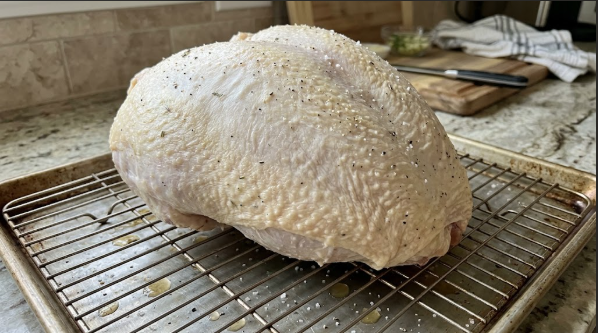
Mix the kosher salt and baking powder, then rub it over the skin and under the skin where you can reach. Set the breast skin-side up on a wire rack over a sheet pan. Leave it uncovered in the fridge at or below 40°F (4°C) for 12-24 hours. The air dries the skin, which is the secret to a crisp finish.
Pitmaster Tip: If you prefer a wet brine, use about ¼ cup of Diamond Crystal kosher salt per quart of water for 4-6 hours, then dry the skin well and air-dry it in the fridge for a few hours. A big stockpot or food-safe bucket works, and everything must stay under 40°F (4°C). Honestly, the dry brine is easier and gives better skin.
Season and Butter
An hour before smoking, take the breast out of the fridge. Mix the paprika, garlic powder, onion powder, pepper, thyme, brown sugar, and cayenne. Gently loosen the skin with your fingers, spread the softened butter under it, and rub the spice mix over the top.
Don’t add more salt now. The dry brine already seasoned the meat.
Step-by-Step: Smoking Turkey Breast in an Electric Smoker
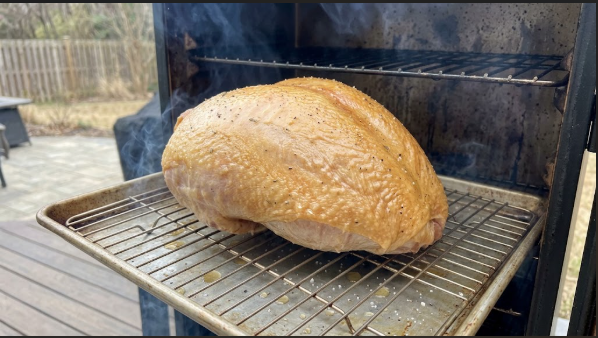
- Preheat the smoker to 275°F (135°C). Fill the water pan with apple juice or water, then let the unit heat for 20-30 minutes. A preheated smoker keeps cook times accurate.
- Add wood. Put a handful of chips in the chip tray. Wait for thin, pale blue smoke before adding the meat. Thick white smoke tastes bitter.
- Set up the probe. Insert a leave-in thermometer into the thickest part of the breast, away from the bone. Bone gives a falsely high reading.
- Place the turkey on the rack. Set the breast skin-side up in the center of the smoker. Put a foil pan on the lower rack to catch drippings if your layout allows it.
- Smoke for 2½-3½ hours. Add a second small handful of chips after about 45 minutes. Stop adding wood after the first 90 minutes, because the meat takes on most of its smoke early.
- Check at the 2-hour mark. Open the door briefly, since every opening drops temperature. The skin should be golden, and the internal temperature should be around 135-145°F (57-63°C).
- Pull at 160°F (71°C). Measure in the thickest part of the breast. Lift it onto a clean tray or cutting board.
- Rest 20-30 minutes. Tent loosely with foil. The temperature will climb to 165°F (74°C) as it rests. This is carryover cooking ; confirm with a thermometer that it reaches the USDA’s minimum.
Common Mistake: Smoking by time instead of temperature. Smokers vary, breast sizes vary, and a cold turkey cooks slower. Treat the clock as a rough guide and let your thermometer make the call.
Time and Temperature Table
These are real-world estimates. Your smoker, the breast shape, and weather all change the numbers.
| Breast Weight | Smoker Temp | Estimated Time | Pull Temp | Final Safe Temp |
| 4-5 lb (1.8-2.3 kg) | 275°F (135°C) | 1¾-2½ hours | 160°F (71°C) | 165°F (74°C) |
| 6-7 lb (2.7-3.2 kg) | 275°F (135°C) | 2½-3½ hours | 160°F (71°C) | 165°F (74°C) |
| 8 lb (3.6 kg) | 275°F (135°C) | 3-4 hours | 160°F (71°C) | 165°F (74°C) |
| 6-7 lb (2.7-3.2 kg) | 250°F (121°C) | 3-4 hours | 160°F (71°C) | 165°F (74°C) |
| 6-7 lb (2.7-3.2 kg) | 225°F (107°C) | 3½-4½ hours | 160°F (71°C) | 165°F (74°C) |
If you want to see how a low-and-slow approach compares on another cooker, read our guide to turkey breast at 250°F. Lower temperatures give more smoke time, but the skin will be softer.
How to Tell When Smoked Turkey Breast Is Done
Temperature is the only reliable test. The USDA’s safe minimum internal temperature for poultry is 165°F (74°C). Pitmasters often pull breast at 160°F (71°C) because carryover heat during the rest brings it up to 165°F (74°C). If it hasn’t reached 165°F (74°C) after resting, put it back in the smoker.
Beyond the thermometer, look for these signs:
- Skin: Deep golden to mahogany, tight, and slightly crisp at the edges.
- Juices: Clear to pale yellow when you poke the thickest part. Pink juices mean it needs more time.
- Feel: The meat should spring back lightly when pressed, not feel soft or mushy.
- Color: A pink ring just under the surface is normal. Smoke reacts with the meat and leaves a harmless pink tinge, even when fully cooked.
Check two or three spots with an instant-read thermometer. Always measure the thickest part and avoid touching the bone.
Resting, Slicing, and Serving
Resting matters as much as smoking. During the rest, juices move back through the meat instead of running onto your board. Cut too early and you’ll watch the moisture pool and the slices turn dry.
Let it sit 20-30 minutes under a loose foil tent. Don’t wrap it tightly, because trapped steam softens the skin you worked to crisp.
To carve, cut along one side of the breastbone to remove the whole breast half. Slice that half against the grain into ½-inch (1.3 cm) slices. Repeat on the other side. Save the bones for stock.
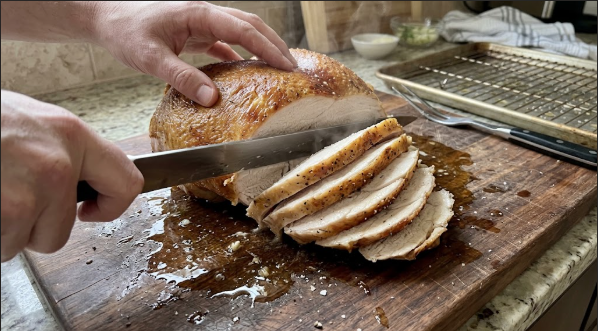
Spoon any pan drippings over the slices, or turn them into gravy. A splash of warm stock over the platter keeps the meat moist at the table.
What to Serve With Smoked Turkey Breast
Smoked turkey pairs well with sides that are rich, bright, or both:
- Mashed potatoes or garlic-herb roasted potatoes
- Green bean casserole or roasted Brussels sprouts
- Cranberry sauce or a tart apple slaw
- Stuffing cooked in a casserole dish
- Warm corn bread with honey butter
- Mac and cheese for a crowd
For dessert, a smoked pecan pie keeps the smoky theme going without being heavy.
Storing, Freezing, and Reheating Leftovers
Cool the meat quickly. The USDA recommends refrigerating cooked poultry within two hours, or within one hour if the air temperature is above 90°F (32°C), according to its leftovers and food safety guidance .
Refrigerator: Store sliced turkey in shallow airtight containers for 3-4 days at 40°F (4°C) or below.
Freezer: Wrap in portions with as little air as possible. Frozen turkey stays safe indefinitely at 0°F (-18°C), but quality is best within 2-6 months .
Reheating: Warm leftovers to 165°F (74°C). Add a splash of broth, cover with foil, and reheat in a 325°F (163°C) oven or a covered skillet. Slices reheat better than a whole chunk, and microwaving dries them out fast.
Variations: Other Cookers and Backup Plans
Pellet grill: Set it to 275°F (135°C) and use apple or pecan pellets. Cook times are almost identical. Our guide to the best pellet grills for beginners can help if you’re shopping.
Offset or charcoal smoker: Hold 275°F (135°C) with a steady fire and a few chunks of fruit wood. These cookers give more smoke flavor, but they need more attention. See our tips on using lump charcoal in an offset smoker.
Oven backup: If weather or equipment fails, finish the breast in a 325°F (163°C) oven until it reaches 160°F (71°C). You’ll miss some smoke flavor, but the dry-brined, buttered breast stays juicy.
Boneless breast: Cut the time by about 25-30%. Tie it with twine for even thickness, and start checking temperature at 1½ hours.
Smoke-then-crisp: Smoke at 225-250°F (107-121°C) until about 140°F (60°C), then raise the heat to 325-350°F (163-177°C) to finish the skin. This gives more smoke flavor and still crisps the skin, but your smoker must reach those temperatures.
Troubleshooting Common Problems
The skin is rubbery. The most likely cause is low smoker temperature or a damp surface. Next time, dry brine uncovered, use baking powder, and cook at 275°F (135°C). To rescue it now, put the rested breast under a hot broiler for 2-3 minutes, watching closely.
The meat is dry. You probably overcooked it or skipped the rest. Pull at 160°F (71°C), and make sure your thermometer is accurate by testing it in ice water (it should read 32°F, or 0°C).
The smoke tastes bitter or acrid. Too much wood or thick white smoke is the usual culprit. Use small amounts and wait for thin blue smoke. Clean old resin from the chip tray and vents.
The temperature won’t hold. Cold weather, wind, or frequent door openings all cause swings. Shield the smoker from wind and avoid peeking. In cold weather, a smoker blanket made for your model can help.
The breast is cooking unevenly. Hot spots are common. Rotate the pan halfway through, and keep the thickest part toward the heat source.
It’s taking forever. A stall can happen when moisture evaporates from the surface. Raise the temperature to 300°F (149°C) and keep going. It’s safe as long as the smoker stays above 225°F (107°C).
Recipe Card: Smoked Turkey Breast in an Electric Smoker
| Servings | 6-8 |
| Prep time | 20 minutes (plus 12-24 hours dry brine) |
| Smoke time | 2½-3½ hours at 275°F (135°C) |
| Rest time | 20-30 minutes |
| Total time | About 4 hours active, plus brine |
| Pull temp / safe temp | 160°F (71°C) / 165°F (74°C) |
Ingredients: 6-7 lb (2.7-3.2 kg) bone-in turkey breast, 2 tbsp kosher salt, 1 tsp baking powder, 1 tbsp smoked paprika, 2 tsp garlic powder, 2 tsp onion powder, 1 tsp black pepper, 1 tsp dried thyme, 1 tsp brown sugar, 4 tbsp softened butter, apple or pecan chips.
Short steps:
- Dry brine uncovered in the fridge for 12-24 hours.
- Rub butter under the skin and season the outside.
- Preheat the smoker to 275°F (135°C) and add wood.
- Smoke skin-side up until the thickest part hits 160°F (71°C).
- Rest under foil 20-30 minutes and confirm 165°F (74°C).
- Slice against the grain and serve.
FAQ: Turkey Breast in an Electric Smoker
How long does it take to smoke a turkey breast in an electric smoker?
At 275°F (135°C), a 6-7 lb (2.7-3.2 kg) bone-in breast takes about 2½-3½ hours. Lower temperatures add time, and a 225°F (107°C) cook can run 4½ hours. Always go by internal temperature rather than the clock, since each smoker and breast behaves a little differently.
What internal temperature is smoked turkey breast done?
The USDA’s safe minimum is 165°F (74°C). Many cooks pull the breast at 160°F (71°C) and let carryover heat finish the job during a 20-30 minute rest. Confirm it reaches 165°F (74°C) before carving.
Should I brine turkey breast before smoking?
Yes. A dry brine with kosher salt for 12-24 hours seasons the meat deeply, helps it hold moisture, and dries the skin for better crispness. A wet brine also works but makes the skin harder to crisp. Skip brining if the label says the breast is pre-salted or enhanced.
Do I need water in my electric smoker?
Most electric smokers include a water pan, and using it helps stabilize temperature and add humidity. Plain water works fine. Some cooks skip it for crisper skin, which is reasonable at 275°F (135°C). Check your manufacturer’s manual for your model’s recommended use.
What wood is best for smoked turkey breast?
Apple, cherry, and pecan are the best choices because they give gentle, slightly sweet smoke that suits poultry. Maple is another mild option. Hickory works in small amounts. Skip mesquite, which tends to taste harsh on lean turkey meat.
Can I smoke a frozen turkey breast?
Thaw it first. Cooking from frozen keeps the meat in the temperature danger zone for too long in a low-heat smoker, and it cooks unevenly. Thaw in the refrigerator, about 24 hours per 4-5 lb (1.8-2.3 kg), following USDA thawing guidance .
Conclusion
Smoking a turkey breast in an electric smoker comes down to a few habits: dry brine early, hold 275°F (135°C), use a light hand with the wood, and trust your thermometer. Pull at 160°F (71°C), rest until it reaches 165°F (74°C), and slice against the grain.
Once you’ve done it once, the process is simple enough to repeat for holidays or Sunday dinner. Try it with apple wood first, then experiment with pecan or cherry on your next cook.
Laura Smith

I'm Laura, I like all the kind of delicious grilled foods which makes me hungry all the time I see them. That's why I built this blog to share with you all of my Grilling experiences, recipes, and all the tips about foods that I've learned from food experts.