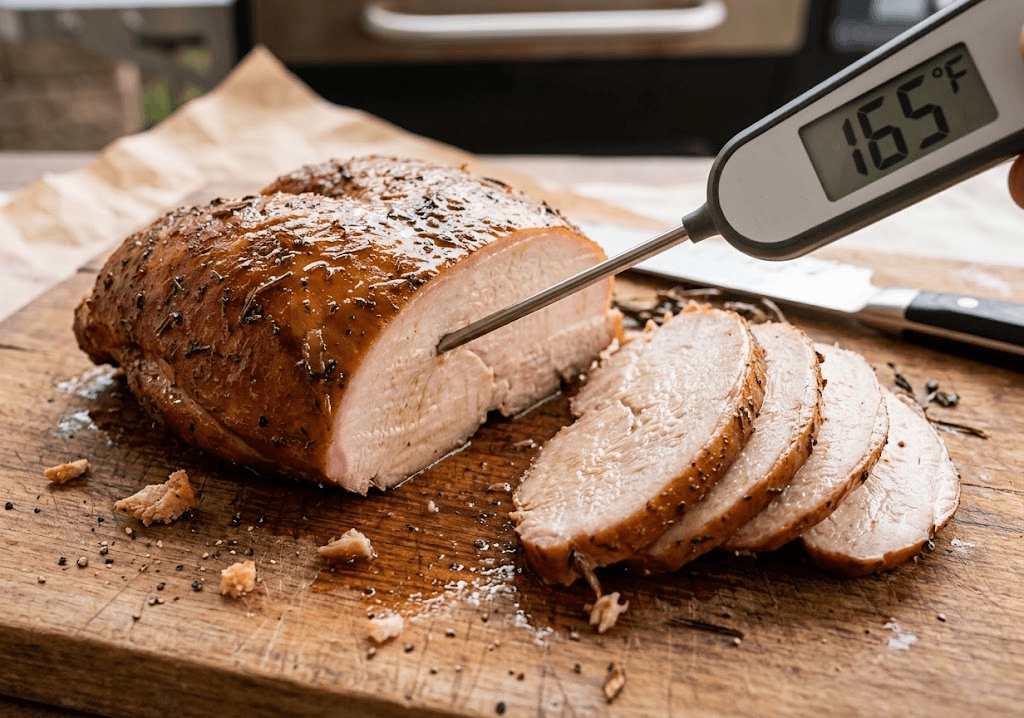
Turkey breast is lean, mild, and easy to ruin. A few degrees too low is a food safety problem, and a few degrees too high gives you dry, stringy slices. This turkey breast internal temperature guide shows you exactly where to probe, when to pull, and how to rest the meat so it stays moist.
The short version is that the USDA’s safe minimum is 165°F (74°C). The longer version covers carryover cooking, thermometer placement, smoker and oven settings, and what to do when the numbers don’t match what you see.
Use this on a smoker, pellet grill, kettle, or oven. The temperature targets stay the same on every cooker.
⚡ Quick Answer
Cook turkey breast until the thickest part reads 165°F (74°C), the USDA’s safe minimum. Many cooks pull at 160°F (71°C) and let carryover heat finish the job during a 20-minute rest. Probe the thickest part, away from bone. Use an instant-read thermometer, not color or timers.
What Internal Temperature Means and Why It Matters
Internal temperature is the heat at the center of the meat. It is the only reliable way to know if turkey is both safe to eat and properly cooked.
Color is a poor guide. Smoked turkey can stay pink from the smoke ring even when fully cooked. Roasted turkey can look done at the surface while the center is still under 150°F (66°C).
The USDA’s safe minimum internal temperature for poultry is 165°F . That number applies to turkey breast, whole turkey, ground turkey, and leftovers you reheat.
There is also a quality side. Turkey breast has very little fat, so it dries out quickly once it passes about 170°F (77°C). The goal is a narrow window: hit 165°F, and don’t go much beyond it.
Why breast meat is trickier than dark meat
Breast and thigh are different meats that want different temperatures. Thighs and legs have more connective tissue and fat, so they taste better at 175 to 180°F (79 to 82°C). Breast meat is tender at 165°F and turns dry past that.
That’s the main problem with roasting a whole bird. By the time the thighs are ready, the breast has often passed its peak. Cooking a turkey breast on its own removes that conflict, and it’s why many backyard cooks prefer it. For a full cook-through, see our turkey breast at 250°F walkthrough.
What You Need to Check Turkey Breast Temperature
You don’t need much gear, but you do need the right gear.
- Instant-read digital thermometer: Gives a reading in 2 to 4 seconds. Use it to spot-check in several places.
- Leave-in probe thermometer (optional): Alerts you as the breast approaches your target without opening the lid.
- A bowl of ice water: For calibrating your thermometer.
- Foil and a rimmed pan or cutting board: For resting and catching juices.
- A sharp carving knife: Good slicing preserves moisture. A quality knife for cutting meat makes clean slices.
Calibrate your thermometer first
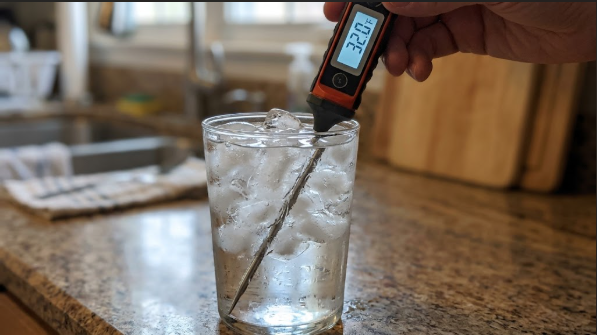
An inaccurate thermometer undermines everything else. Fill a glass with ice, add cold water, and stir for 30 seconds. Insert the probe without touching the glass. It should read 32°F (0°C).
If it’s off by a few degrees, adjust it per the manufacturer’s manual if possible, or mentally correct for the difference. The USDA has guidance on kitchen thermometers . Check it again before big cooks like Thanksgiving.
How to Check Turkey Breast Temperature: Step-by-Step
Where you put the probe matters as much as the number it shows.
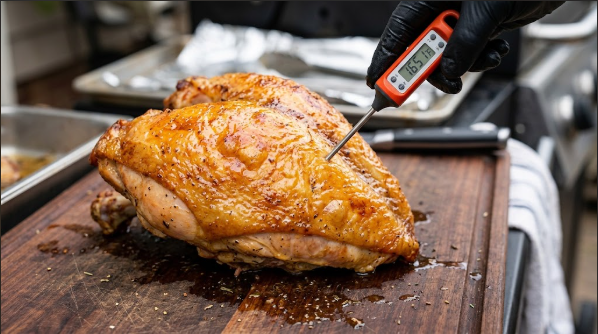
- Pick the thickest part of the breast. On a bone-in breast, that’s usually the center of the meatiest lobe. On a boneless roast, it’s the middle.
- Insert from the side or the top at a slight angle. Push the tip in until it reaches the center. The sensing zone is typically in the last half inch (1.25 cm) of the probe, so make sure it’s fully in.
- Stay away from bone. Bone conducts heat differently and reads hotter. Keep the tip about ½ inch (1.25 cm) from it.
- Avoid fat pockets, the pan, and the skin surface. These can give false readings.
- Wait for the reading to stabilize. Give it a few seconds before you trust the number.
- Check a second spot. Probe the opposite end or another thick area. Use the lowest reading as your guide.
For a whole turkey, FSIS recommends checking the innermost part of the thigh, wing, and thickest part of the breast]. For a breast alone, the thickest part is the main spot.
🔥 Pitmaster Tip: Start probing about 30 minutes before you expect the turkey to be done. Opening the lid or oven door constantly drops the cooker temperature and adds cook time. A leave-in probe lets you watch the number climb without lifting the lid.
Turkey Breast Doneness: Temperature Chart
Use this table as a quick reference. The USDA minimum is the number you must reach for safety. The other columns are about texture.
| Stage | Temp | What It Looks and Feels Like |
| Still cooking | Below 150°F (66°C) | Pale, wobbly, firm only at the surface |
| Approaching done | 150–159°F (66–71°C) | Skin starts to set; juices run pinkish |
| Pitmaster pull temp | 160°F (71°C) | Rises to about 165°F (74°C) during rest |
| USDA safe minimum | 165°F (74°C) | Meat is opaque white, juices run clear |
| Edge of dry | 170–175°F (77–79°C) | Firmer, slightly tighter slices |
| Overcooked | 180°F+ (82°C+) | Dry, stringy, crumbly |
The 160°F pull and carryover cooking
Carryover cooking means the meat keeps heating after you take it off the cooker. The hot outer layers pass heat inward as the breast rests. A turkey breast pulled at 160°F typically climbs about 3 to 5 degrees.
That’s why many pitmasters pull a few degrees early. It works, but only if you verify. Check the temperature again after 10 to 15 minutes of resting and confirm it reaches 165°F (74°C).
If you’re new to this, there’s no shame in simply pulling at 165°F. You’ll still get a juicy result as long as the cooker temperature was moderate and you rest the meat afterward.
⚠️ Common Mistake: Pulling at exactly 160°F and carving immediately without rechecking. If the temperature doesn’t climb to 165°F, you’ve served undercooked poultry. Always confirm the final number during the rest.
Cooking Times and Temperatures by Cooker
Time is only an estimate. The thermometer decides when it’s done. These ranges are for a typical bone-in turkey breast around 6 to 7 lb (2.7 to 3.2 kg) and are rough guides.
| Cooker | Cooker Temp | Approx. Time | Pull Temp |
| Smoker / pellet grill | 250°F (121°C) | 2.5–3.5 hours | 160–165°F (71–74°C) |
| Smoker / pellet grill (hot and fast) | 325°F (163°C) | 1.5–2.25 hours | 160–165°F (71–74°C) |
| Oven | 325°F (163°C) | 1.5–2.25 hours | 160–165°F (71–74°C) |
| Kettle (indirect) | 300–325°F (149–163°C) | 1.5–2.5 hours | 160–165°F (71–74°C) |
| Boneless roast, oven | 350°F (177°C) | 1–1.5 hours (3 lb / 1.4 kg) | 160–165°F (71–74°C) |
Lower temperatures take longer but give more smoke flavor and a gentler cook. Higher temperatures crisp the skin better and shorten the time.
A note on smoke and wood
Light fruit woods like apple, cherry, and pecan suit turkey well. Hickory can be heavy-handed on mild poultry, so use it sparingly. If you want a pellet grill that makes this easy, see our guide to the best pellet grills for beginners.
Prepping the Turkey Breast for Even Cooking
Temperature accuracy starts before the cook. A little prep makes the numbers more predictable.
Thaw safely and fully
A partly frozen breast cooks unevenly. The outside hits 165°F while the center is still cold. USDA lists three safe thawing methods: refrigerator, cold water, and microwave. In the fridge, allow roughly 24 hours for every 4 to 5 lb (1.8 to 2.3 kg) .
Bring it to a stable starting point
Let the breast sit out for no more than 30 minutes while the cooker heats. Don’t leave it out longer. Poultry shouldn’t spend more than 2 hours total in the temperature “danger zone” between 40°F and 140°F (4°C and 60°C) .
Season or brine
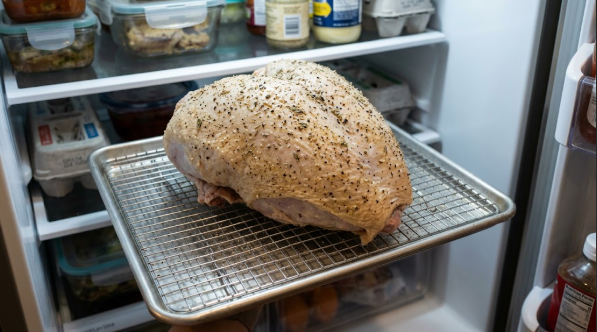
A dry brine of kosher salt (about 1 tsp per lb / 2 tsp per kg), plus pepper and garlic powder, applied 12 to 24 hours ahead helps the meat hold moisture. A wet brine works too but adds water and can make the skin soggy.
Pat the skin dry before cooking. Dry skin crisps better, and a thin coat of oil or butter helps browning.
Using the Temperature During the Cook
Here’s how to use the numbers from start to finish.
- Preheat the cooker to your chosen temperature. Confirm with a second thermometer at grate level if you can.
- Insert a leave-in probe into the thickest part before the breast goes on, if your thermometer supports it.
- Cook with the lid closed. Resist peeking. Every lid lift costs a few minutes.
- Start spot-checking about 30 minutes before the estimated finish.
- Pull the turkey at 160°F (71°C) if you plan to rest and recheck, or at 165°F (74°C) if you want to play it safe.
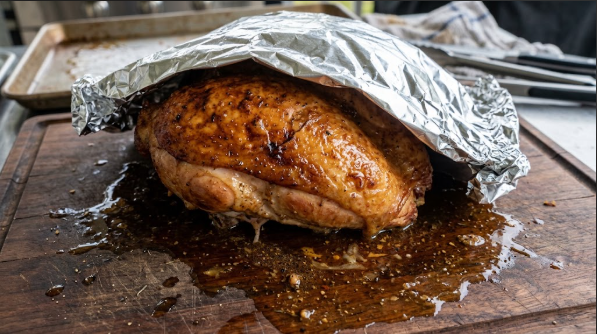
- Tent loosely with foil and rest for 15 to 30 minutes.
- Recheck the temperature in a second spot before carving. It should read 165°F (74°C) or higher.
- Slice against the grain into ½-inch (1.25 cm) pieces.
Your pull temperature also depends on the cooker. A hot oven at 350°F (177°C) has more carryover than a smoker at 225°F (107°C), so the gap between pull and final temp can be wider on hotter cooks.
What if the skin is done before the meat?
If the skin is deep brown at 140°F (60°C), tent the breast loosely with foil and keep cooking. Foil slows surface browning without blocking heat entirely. Turn the heat down 25°F (14°C) if needed.
What if the meat is done before dinner?
Wrap the turkey in foil, then in a towel, and place it in a dry cooler. It will hold above 140°F (60°C) for up to an hour or two. Check with your thermometer. Don’t let it drift into the danger zone.
Resting, Slicing, and Serving
Resting lets the juices settle back into the meat. If you cut early, they spill onto the board and the slices dry out.
For a breast of 6 to 7 lb (2.7 to 3.2 kg), rest 15 to 30 minutes. For smaller boneless roasts, 10 to 15 minutes is plenty. The meat will stay hot enough, especially under foil.
When it’s time to carve, remove the breast from the bone first on bone-in cuts. Run your knife along the rib cage and lift the whole lobe off. Then cut across the grain in even slices.
What to serve with turkey breast
- Classic sides: Mashed potatoes, gravy, green beans, and stuffing
- Fresh sides: Roasted Brussels sprouts, cranberry relish, or a crisp salad
- Sandwiches: Slice leftovers for lunch; try chicken salad sandwich sides as inspiration for pairings
If you’re planning a full holiday meal, browse our Thanksgiving smoker recipes for ideas on sides and timing.
Pro Tips for Juicier Turkey Breast
- Cook breast-side up and shield the skin if it browns fast.
- Use a rack so heat circulates around the meat.
- Keep the cooker steady. Big temperature swings produce uneven results.
- Choose a bone-in breast when you can. Bone slows cooking slightly and adds forgiveness.
- Check several spots. Turkey breasts are uneven, so the thick side may lag behind the thin side.
- Slice just before serving. A whole breast holds heat and moisture better than slices.
- Save the drippings. They make a good gravy base once cooked to a safe temperature.
Variations by Cooker
Pellet grill or smoker
Set the cooker to 250°F (121°C) for a smoky, tender result, or 325°F (163°C) for crisper skin. Fruitwood pellets are mild and pleasant on poultry.
Offset or charcoal smoker
Keep the firebox temperature steady. If you’re using lump charcoal, read our tips on lump charcoal in an offset smoker. Hold the cooking chamber near 250 to 275°F (121 to 135°C) and use a small split of apple or cherry for flavor.
Kettle or gas grill
Set up two zones with the fire on one side and the turkey on the other. Close the lid and adjust the vents (or burners) to hold 300 to 325°F (149 to 163°C). If you’re new to lighting a grill, here’s a refresher on how to start a grill.
Oven backup
Roast on a rack in a pan at 325°F (163°C). Add ½ inch (1.25 cm) of water or broth to the pan to keep the drippings from burning. If you cook turkey a lot indoors, a rotisserie oven is another option for even browning.
Common Mistakes and How to Fix Them
| Problem | Cause | Fix |
| Dry, stringy slices | Cooked well past 170°F | Pull earlier; rest and recheck |
| Still pink at 165°F | Smoke chemistry or cure-like color | If thermometer confirms 165°F and juices run clear, it’s fine |
| Undercooked center | Thermometer in wrong spot or partly frozen meat | Re-probe thickest part; thaw fully next time |
| Skin is rubbery | Wet skin or low heat | Pat dry; finish at 400°F (204°C) for 10 minutes |
| Temperature stalls | Evaporative cooling | Keep cooking; raise cooker temp 25°F (14°C) if needed |
| Uneven doneness | Thick and thin ends | Check several spots; tent thin end with foil |
⚠️ Common Mistake: Trusting the pop-up timer that comes in some turkeys. These are often set to pop at a higher temperature and can be unreliable. Rely on your own thermometer instead.
About pink meat at 165°F
Smoked turkey often has a pink tint near the surface from the smoke. A properly measured 165°F (74°C) reading is what counts. Pink without a safe reading is a problem. Pink with 165°F or more in several spots is typically normal.
Food Safety Notes
- Use a thermometer every time. Appearance alone can’t confirm that poultry is safe.
- Reach 165°F (74°C) in the thickest part. This applies to bone-in and boneless turkey breast.
- Keep raw and cooked separate. Use a clean plate and clean tongs after cooking.
- Wash hands and surfaces with hot, soapy water after handling raw turkey.
- Chill leftovers promptly. Refrigerate within 2 hours. Leftovers keep for 3 to 4 days in the fridge].
- Reheat to 165°F (74°C) before serving again.
- Smoking safely: Keep smoker temperature at or above 225°F (107°C), according to FSIS smoking guidance .
Storing and freezing leftovers
Slice or shred leftovers and store them in shallow airtight containers so they cool fast. Freeze in portions with a splash of broth to prevent freezer burn. Cooked poultry is best used within a few months in the freezer. Thaw in the refrigerator.
FAQ
What temperature should turkey breast be when done?
Turkey breast is done at 165°F (74°C) in the thickest part, according to the USDA. Many cooks pull at 160°F (71°C) and let carryover heat finish it during rest. Always recheck with an instant-read thermometer before slicing to confirm it hit 165°F.
Is 165°F safe for turkey breast?
Yes. The USDA lists 165°F (74°C) as the safe minimum internal temperature for all poultry, including turkey breast. At that temperature, harmful bacteria such as Salmonella are destroyed. Measure in the thickest part, away from the bone, and check a second spot.
Should I pull turkey breast at 160°F?
You can, as long as the temperature climbs to 165°F (74°C) during a 15 to 30 minute rest. Verify with your thermometer before serving. If you’re not sure, pull at 165°F. You’ll still get juicy meat if the cooker temperature was moderate.
Where do you put the thermometer in a turkey breast?
Insert it into the thickest part of the breast at a slight angle, with the tip reaching the center. Keep it away from bone, fat, and the pan. Check a second spot too, and trust the lowest reading.
How long should turkey breast rest?
Rest a bone-in turkey breast for 15 to 30 minutes under loose foil. Smaller boneless roasts need 10 to 15 minutes. Resting lets juices redistribute, so slices stay moist. The internal temperature will rise a few degrees while it rests.
Why is my turkey breast still pink at 165°F?
Smoke, brining, and cooking method can leave a pink tint even in fully cooked turkey. If your thermometer reads 165°F (74°C) in several spots and the juices run clear, the meat is safe. Pink with a low reading means keep cooking.
Conclusion
A good turkey breast internal temperature guide comes down to a few simple rules. Probe the thickest part, aim for 165°F (74°C), and rest the meat before slicing. If you pull early at 160°F, always verify the final temperature.
Calibrate your thermometer, check more than one spot, and trust the number instead of the color or a timer. Do that, and you’ll serve safe, juicy turkey on any cooker, any day of the year.
Laura Smith

I'm Laura, I like all the kind of delicious grilled foods which makes me hungry all the time I see them. That's why I built this blog to share with you all of my Grilling experiences, recipes, and all the tips about foods that I've learned from food experts.