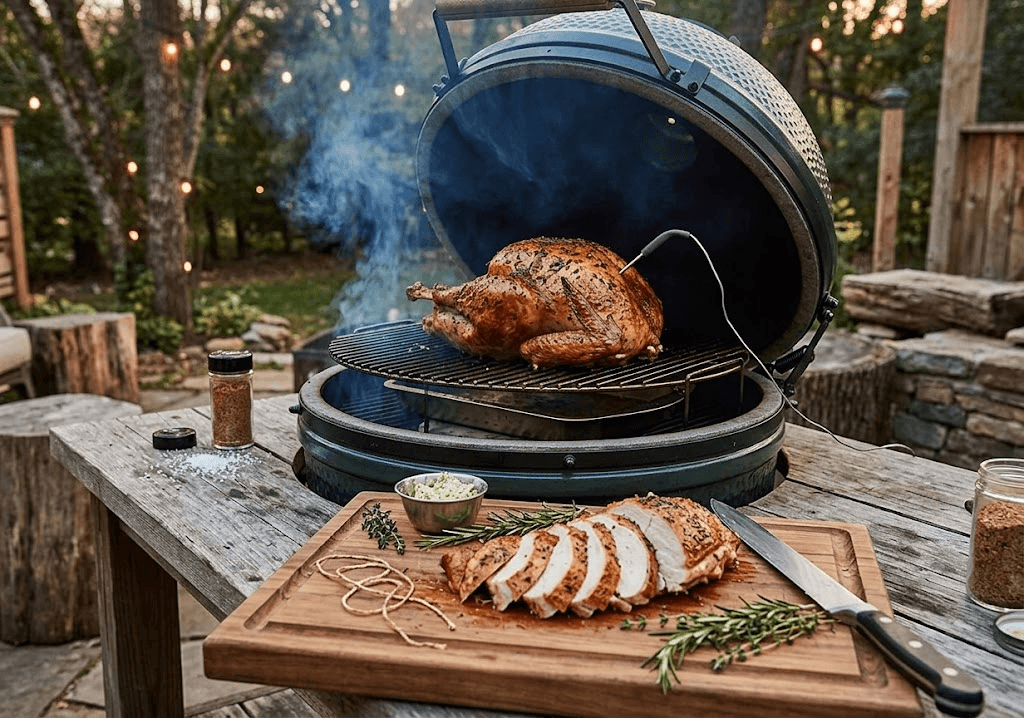
A turkey breast on a kamado grill is one of the easiest ways to get a smoked bird with golden skin and juicy white meat. The thick ceramic walls hold steady heat and lock in moisture, which is exactly what lean turkey breast needs. You get all the holiday-style flavor without cooking a whole 18-pound turkey.
This recipe uses a bone-in breast, a simple overnight dry brine, and a 325°F (163°C) indirect cook. It works on a Big Green Egg, a Kamado Joe, an Akorn, or any other ceramic or kamado-style cooker. Total cook time is about 2 to 2½ hours, plus a rest.
If your kamado is new to you, our guide on how to start a grill covers fire basics that apply to charcoal cookers of every type.
Quick Answer: Turkey Breast on a Kamado Grill
Turkey breast on a kamado grill: Cook a 6-7 lb (2.7-3.2 kg) bone-in breast at 325°F (163°C) with the heat deflector in place. Pull it when the thickest part reads 165°F (74°C), about 2-2½ hours. Dry-brine overnight, rest 20-30 minutes, then slice against the grain.
Why This Turkey Breast on a Kamado Grill Works
Turkey breast is lean, so there is little room between juicy and dry. A kamado gives you tools that most grills can’t match.
- Steady heat. Thick ceramic holds a set temperature for hours with very little fuel and few adjustments. Fewer swings in temperature means more even cooking.
- Moist cooking environment. The tight seal and small vents keep moisture in the cooker, so the surface of the meat doesn’t dry out as fast as it does in a drafty smoker.
- Real wood-fired flavor. Lump charcoal plus a few chunks of fruit wood gives mild smoke that suits turkey without overpowering it.
- Crispy skin without a rotisserie. At 325°F, the skin renders and browns while the meat cooks slowly. A cooler setting like 250°F makes rubbery skin, so this recipe runs a little hotter.
Add an overnight dry brine and a butter rub under the skin, and you have a breast that slices cleanly and stays moist.
Ingredients and Equipment
Serves 8-10 (6-7 lb / 2.7-3.2 kg bone-in breast)
The turkey and dry brine
- 1 bone-in, skin-on turkey breast, 6-7 lb (2.7-3.2 kg), fully thawed
- 2 tablespoons Diamond Crystal kosher salt (or 1 tablespoon Morton kosher salt)
- 1 teaspoon black pepper
- 1 teaspoon baking powder (optional, for extra-crisp skin; make sure it is baking powder, not baking soda)
The herb butter
- 4 tablespoons (57 g) unsalted butter, softened
- 3 garlic cloves, minced
- 1 tablespoon fresh thyme leaves, chopped
- 1 tablespoon fresh sage, chopped
- 1 teaspoon lemon zest
The rub
- 1 tablespoon smoked paprika
- 1 teaspoon garlic powder
- 1 teaspoon onion powder
- 1 teaspoon brown sugar
- 2 tablespoons olive oil, to bind the rub
Fuel and wood
- Natural lump charcoal, enough to fill the firebox just above the air holes
- 2-3 small chunks of apple, cherry, or pecan wood
Equipment
- Kamado grill (Big Green Egg, Kamado Joe, Akorn, or similar)
- Ceramic heat deflector or plate setter
- Disposable aluminum pan or a roasting pan for drippings
- Instant-read thermometer
- Dual-probe leave-in thermometer (strongly recommended)
- Chimney starter or electric starter
- A sharp slicing knife (see our guide to the best knives for cutting meat)
Substitutions
- Boneless breast: Use a 3-4 lb (1.4-1.8 kg) boneless, skin-on roast, tied with kitchen twine so it cooks evenly.
- No fresh herbs: Use 1 teaspoon each of dried thyme and dried sage.
- Dairy-free: Swap the butter for olive oil mixed with the herbs.
- No heat deflector: You can use a pizza stone on the grate, with the drip pan on top. It is less ideal, but it works for indirect heat.
Choosing and Prepping the Turkey Breast
Buy the right cut. Look for a bone-in, skin-on whole breast. Bone-in cooks more gently, and the skin protects the meat and gives you crisp edges. Check the label for “enhanced with a solution” or “contains up to 8% broth.” Those birds are pre-salted, so cut the dry brine salt in half.
Thaw it safely. If your breast is frozen, thaw it in the refrigerator. The USDA says to plan about 24 hours for every 4-5 pounds of turkey in the fridge (USDA FSIS safe thawing guidance). A 7-lb breast needs a day and a half to two days. Never thaw on the counter.
Dry brine overnight. A dry brine is just salt on the surface. It pulls moisture out, dissolves into it, and gets reabsorbed, so the meat is seasoned deeper and holds more juice.
- Pat the turkey completely dry with paper towels.
- Mix the salt, pepper, and baking powder in a small bowl.
- Rub the mixture over the skin and into the meat side. Get some under the skin where you can.
- Set the turkey on a rack over a sheet pan, skin side up, and refrigerate it uncovered for 12-24 hours.
The uncovered rest dries the skin, and dry skin is what crisps on the grill.
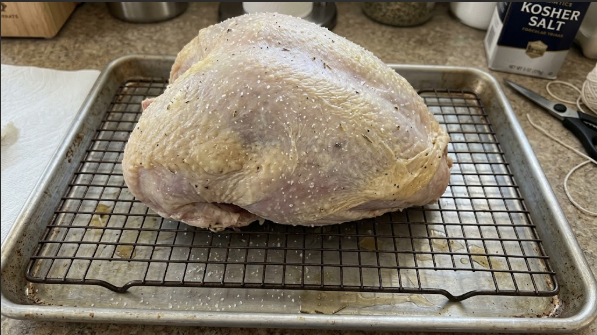
Season before the cook. An hour before you light the grill, take the turkey out of the refrigerator. Mix the herb butter ingredients. Gently slide your fingers between the skin and the meat, and spread the butter under the skin. Rub the outside with olive oil, then dust on the rub.
Best Wood and Charcoal for Turkey Breast on a Kamado Grill
Turkey is mild, so choose gentle smoke. Kamados use so little fuel that even a small amount of wood goes a long way.
| Wood | Flavor | Verdict |
| Apple | Light, fruity, slightly sweet | Best for beginners |
| Cherry | Mild, sweet, gives deep mahogany color | Great for skin color |
| Pecan | Nutty, rich, medium | Top all-rounder |
| Hickory | Strong, bacon-like | Use only 1 small chunk, or blend |
| Oak | Balanced, classic | Solid choice |
| Mesquite | Harsh, very strong | Skip it for turkey |
Use real lump charcoal, not briquettes with lighter fluid or additives. Lump burns clean and hot and leaves little ash. Our guide on lump charcoal in an offset smoker explains why clean-burning fuel matters, and the same idea applies to your kamado.
Use 2-3 fist-size chunks of wood, buried in the charcoal rather than piled on top. Wood that sits on top burns off early. Buried chunks smolder through the whole cook.
How to Cook Turkey Breast on a Kamado Grill (Step by Step)
Time: Prep 30 minutes (plus 12-24 hours brine) | Fire setup 30 minutes | Cook 2-2½ hours | Rest 20-30 minutes
- Clean out the old ash. Remove ash from the firebox and clear the air holes. Blocked airflow is the top cause of a kamado that won’t hold temperature.
- Load the firebox. Fill it with lump charcoal to just above the air holes. Bury 2-3 chunks of wood throughout the pile.
- Light the fire. Light the charcoal in 2-3 spots near the center. Leave the lid open for about 10 minutes, until you see small flames and ashing coals.
- Set the vents and close the lid. Open the bottom vent about ½ inch (1.3 cm) and set the top vent (the daisy wheel) about halfway open. Close the lid. Use these as a starting point, then adjust to hold your target.
- Stabilize at 325°F (163°C). Creep up on your temperature from below. A kamado holds heat so well that it is hard to bring it back down once it overshoots. It usually takes 20-30 minutes. Once you pass about 250°F (121°C), start closing the vents slowly toward your final setting.
- Install the heat deflector. Add the deflector and set your drip pan on top. Add a cup of water or broth to the pan if you like. Let the cooker “heat soak” for 15 minutes so the ceramic stabilizes.
- Place the turkey. Put the breast on the grate, skin side up, directly over the drip pan. Insert the probe into the thickest part of the breast, away from the bone. Close the lid.
- Leave it alone. Don’t open the lid for the first hour. Each peek drops the temperature and dries the surface. Check your thermometer instead.
- Check temperature at 1½ hours. Use an instant-read thermometer in a few places in the thickest part of the breast. The breast is done when the thickest area reads 165°F (74°C) and the juices run clear.
- Tent if the skin gets too dark. If the skin is deep brown before the meat is ready, loosely cover the breast with foil. Leave the foil off if the color looks good.
- Pull and rest. Move the breast to a cutting board or tray. Rest, uncovered or loosely tented, for 20-30 minutes before slicing.
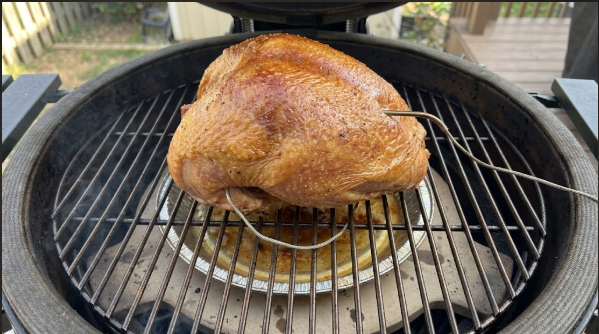
Pitmaster Tip: Trust the grate-level temperature, not just the dome thermometer. Dome thermometers can read 25°F (14°C) or more off, and a cheap one can drift. A dual-probe leave-in thermometer with one probe clipped at grate level and one in the turkey tells you exactly what the meat is seeing.
Common Mistake: Opening the lid too early and too often. On a kamado, each time you lift the lid at high temperature, fresh oxygen rushes in. This can cause a flash of flame and a temperature spike. Open the dome slowly, just a crack, for a second or two before lifting it all the way. Better yet, avoid opening it at all until the first check.
Time and Temperature Table
| Stage | Cooker Temp | Time | Target |
| Dry brine | Refrigerator | 12-24 hours | Skin dry and tight |
| Fire setup | Rising to 325°F (163°C) | 20-30 minutes | Thin blue smoke |
| Heat soak | 325°F (163°C) | 15 minutes | Stable dome and grate temp |
| Cook bone-in breast, 6-7 lb (2.7-3.2 kg) | 325°F (163°C) | 2-2½ hours | 165°F (74°C) in thickest part |
| Cook boneless breast, 3-4 lb (1.4-1.8 kg) | 325°F (163°C) | 1-1½ hours | 165°F (74°C) |
| Rest | Room temp, loosely tented | 20-30 minutes | Juices settle |
These are estimates. Every kamado runs a little differently, and breasts vary in thickness, so cook to temperature, not to the clock.
Food safety note: The USDA’s safe minimum internal temperature for all poultry is 165°F (74°C) (USDA safe minimum internal temperature chart ). Many cooks pull breast a few degrees early and let carryover cooking finish the job. If you want to be safe and simple, pull at 165°F in the thickest spot and confirm with a second reading.
How to Tell When Turkey Breast on a Kamado Grill Is Done
The thermometer is your final answer, but your eyes and hands give good hints along the way.
- Skin: Deep golden to mahogany brown, dry to the touch, with a slight crackle. Rubbery or pale skin means it needs more time or a hotter cooker.
- Juices: When you pierce the thickest part, the juices should run clear, not pink or red.
- Feel: The breast should feel firm but springy when pressed, not squishy.
- Temperature: Check at least two spots in the thickest part, avoiding bone. All readings should be at least 165°F (74°C).
- Color near the bone: Meat close to the bone can stay slightly pink even when fully cooked. Trust the thermometer, not the color.
Resting, Slicing, and Serving
Resting matters. If you cut the turkey right off the grill, a lot of the juice runs onto the board. Wait 20-30 minutes and it stays in the meat.
How to carve a bone-in breast
- Run your knife along one side of the breastbone, following the ribs.
- Peel the whole half-breast off the bone in one piece.
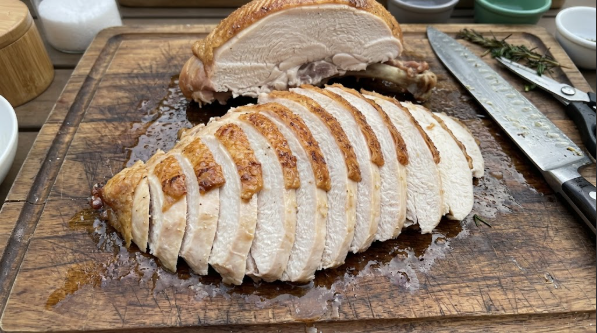
- Lay it flat on the board and slice across the grain into ½-inch (1.3 cm) slices.
- Repeat on the other side.
Slicing across the grain makes each slice tender instead of stringy. A long, sharp slicer helps. If you cook on the grill often, our guide to the best butcher knives is a good place to find a knife that fits the job.
Make a quick pan sauce. Pour the drippings from the pan into a small saucepan. Skim most of the fat, add ½ cup (120 ml) chicken broth, and simmer for 5 minutes. Season with salt, pepper, and a squeeze of lemon.
What to Serve With Turkey Breast on a Kamado Grill
The smoky, buttery flavor goes with classic holiday sides and lighter weeknight picks.
- Cornbread: A sweet-and-savory partner. Try our Redstone corn bread recipe.
- Mashed potatoes and gravy: Use the pan drippings for the gravy.
- Roasted vegetables: Carrots, Brussels sprouts, and green beans.
- Stuffing or dressing: Bake it in the oven while the turkey rests.
- Cranberry sauce: The tart sweetness balances the smoke.
- Crisp salad: A bright salad with vinegar cuts through the richness.
Cooking for a holiday crowd? Our roundup of Thanksgiving smoker recipes helps you plan a whole smoked menu.
Storing, Freezing, and Reheating Leftovers
Refrigerate quickly. Get leftovers into the refrigerator within 2 hours of cooking. The USDA calls the range from 40°F to 140°F the “danger zone,” where bacteria grow fastest (USDA FSIS danger zone guidance ).
- Slice or pull the meat off the bone and store it in shallow, airtight containers.
- Keep leftover turkey in the refrigerator for 3-4 days, per USDA leftovers guidance.
Freezing
- Wrap portions tightly in freezer bags with the air pressed out.
- Frozen turkey stays safe indefinitely at 0°F (-18°C). For best taste and texture, eat it within 2-3 months.
- Thaw in the refrigerator, not on the counter.
Reheating
- Reheat to 165°F (74°C) in all parts.
- Add a splash of broth or a little butter to slices, cover, and warm gently in a 300°F (149°C) oven, or in a covered skillet on low.
- Avoid high heat, which dries out lean white meat fast.
Variations: Pellet Grill, Offset, Kettle, and Oven
Kamado Joe or Big Green Egg differences
Both cook the same way. The Big Green Egg uses a ConvEGGtor as the heat deflector, and the Kamado Joe uses a Divide & Conquer system or a ceramic deflector. If you have the Divide & Conquer, use the half-moon deflector on the lower rack and the cooking grate above. Smaller kamados may fit only a 4-5 lb (1.8-2.3 kg) breast, so check clearance with the lid.
Pellet grill
Set it to 325°F (163°C) and cook the same way. Pellet grills give a bit less moisture retention, so keep the cook uncovered and check the skin closely. See our best pellet grills for beginners if you are shopping.
Offset smoker
Run the firebox at 300-325°F (149-163°C) with a clean-burning fire. Expect to tend the fire every 30-45 minutes and rotate the breast once if one side runs hotter.
Weber kettle
Bank lit coals on one side, put the pan on the other, and place the turkey over the pan. Hold the vents about one-third open and add a few fresh coals every 45 minutes.
Oven backup
Roast at 325°F (163°C) on a rack in a roasting pan until the breast reaches 165°F (74°C), about 2-2½ hours. It won’t have smoke, but the dry brine and herb butter still work. Add ½ teaspoon of smoked paprika to the rub for a hint of smoky flavor.
Troubleshooting Turkey Breast on a Kamado Grill
| Problem | Likely Cause | Fix |
| Rubbery skin | Cook temp too low, or skin was damp | Dry-brine uncovered overnight; cook at 325°F (163°C) or higher; add baking powder to the brine |
| Dry meat | Overcooked, or lean/enhanced bird | Pull at 165°F (74°C); rest 20 minutes; use butter under the skin |
| Bitter or sooty smoke | Dirty smoke from too much wood or a smoldering fire | Use only 2-3 chunks; wait for thin blue smoke before loading the turkey |
| Temperature overshoots | Vents opened too far, too early | Creep up on the target; keep vents mostly closed once near it |
| Temperature won’t hold | Clogged air holes or old ash | Clean the firebox before each cook; make sure the lid gasket seals |
| Skin burns before meat is done | Hot spots or too much sugar in the rub | Tent loosely with foil; keep sugar low; move the pan closer to the center |
| Uneven cooking | Thick and thin parts of the breast | Rotate the pan halfway; make sure the probe sits in the thickest part |
| Meat is bland inside | Not enough salt or too short a brine | Brine at least 12 hours; season under the skin |
Recipe Card: Turkey Breast on a Kamado Grill
Servings: 8-10 | Prep: 30 minutes (plus 12-24 hours dry brine) | Cook: 2-2½ hours | Rest: 20-30 minutes
Cooker: Kamado at 325°F (163°C), indirect | Wood: Apple, cherry, or pecan | Pull temp: 165°F (74°C)
Ingredients: 6-7 lb (2.7-3.2 kg) bone-in turkey breast, 2 tbsp Diamond Crystal kosher salt (or 1 tbsp Morton), 1 tsp black pepper, 1 tsp baking powder (optional), 4 tbsp (57 g) softened butter, 3 minced garlic cloves, 1 tbsp each fresh thyme and sage, 1 tsp lemon zest, 1 tbsp smoked paprika, 1 tsp each garlic powder and onion powder, 1 tsp brown sugar, 2 tbsp olive oil, lump charcoal, and 2-3 chunks of fruit wood.
Short steps:
- Thaw fully. Pat dry. Dry-brine uncovered in the fridge 12-24 hours.
- Mix herb butter. Spread under the skin. Oil the outside and apply the rub.
- Light the kamado and stabilize at 325°F (163°C). Add the deflector and a drip pan.
- Cook skin side up with a probe in the thickest part for 2-2½ hours.
- Pull at 165°F (74°C). Rest 20-30 minutes.
- Carve off the bone and slice across the grain.
FAQ: Turkey Breast on a Kamado Grill
What temperature do you cook turkey breast on a kamado?
Cook at 325°F (163°C) with the heat deflector in place. This temperature browns the skin while the meat cooks gently. Lower temperatures like 250°F work, but the skin can turn rubbery. Pull the breast when the thickest part reaches 165°F (74°C).
How long does turkey breast take on a kamado grill?
A 6-7 lb (2.7-3.2 kg) bone-in breast takes about 2 to 2½ hours at 325°F (163°C). A boneless 3-4 lb (1.4-1.8 kg) roast takes 1 to 1½ hours. Always cook to internal temperature, because breast size and weather change the time.
Should I brine a turkey breast before smoking?
Yes, a dry brine helps a lot. Salt the turkey and refrigerate it uncovered for 12-24 hours. It seasons the meat deeper, helps it hold juice, and dries the skin so it crisps. Cut the salt in half if the breast is already enhanced.
What wood is best for smoking turkey breast?
Apple, cherry, and pecan are the best choices because they give mild, slightly sweet smoke. Hickory works in small amounts or blended with fruit wood. Skip mesquite, which can taste harsh on lean poultry. Use only 2-3 small chunks in a kamado.
How do you get crispy skin on a smoked turkey breast?
Dry the skin well. Dry-brine uncovered overnight, add a little baking powder to the salt, and cook at 325°F (163°C) or hotter. Avoid basting during the cook, since wet skin turns soft. Pat the skin dry before applying the oil and rub.
What internal temperature should turkey breast be?
The USDA’s safe minimum internal temperature for poultry is 165°F (74°C). Measure in the thickest part of the breast, away from the bone. Check at least two spots with an instant-read thermometer before you pull it off the grill.
Conclusion
Turkey breast on a kamado grill is a reliable way to get juicy meat, crisp skin, and gentle smoke flavor without cooking a whole bird. Dry-brine it overnight, hold the cooker at 325°F, keep the smoke thin and clean, and pull at 165°F. Then give it a proper rest before carving.
Once you have cooked turkey breast on a kamado grill one time, you can try new herbs, a different wood, or a glaze in the last 20 minutes. If you also want to compare a lower-temperature method, read our guide to cooking turkey breast at 250°F, and keep your cover in good shape between cooks with a heavy-duty grill cover.
Laura Smith

I'm Laura, I like all the kind of delicious grilled foods which makes me hungry all the time I see them. That's why I built this blog to share with you all of my Grilling experiences, recipes, and all the tips about foods that I've learned from food experts.