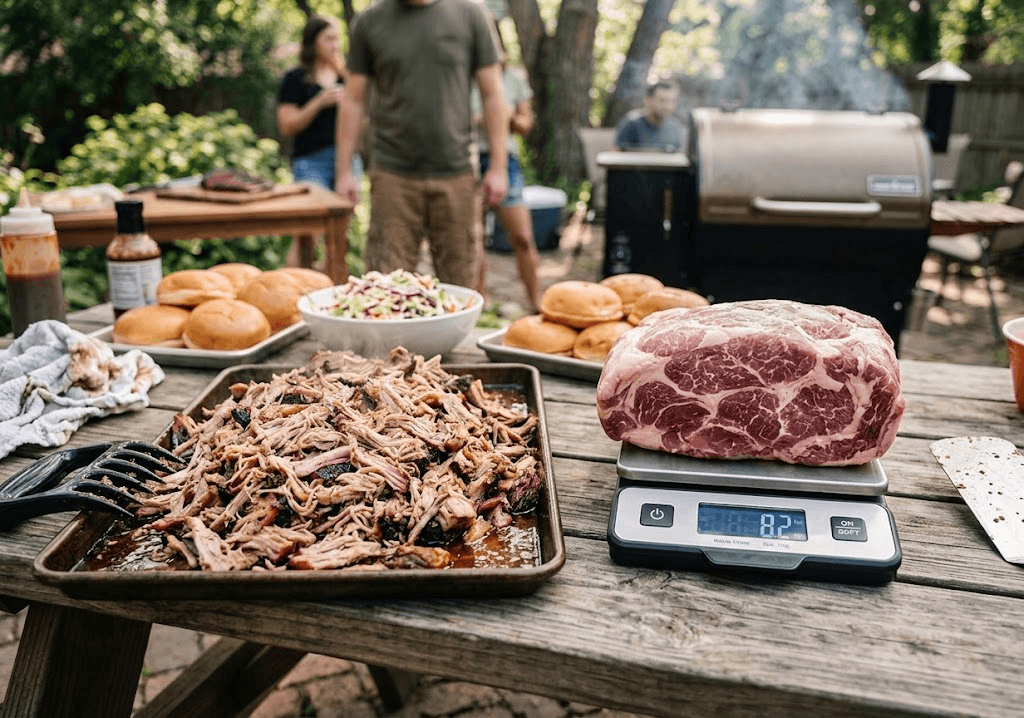
The short rule for how much pork butt per person is 1/2 lb (0.23 kg) of raw, bone-in pork butt for a sandwich crowd. Plan on 3/4 lb (0.34 kg) per person if guests are hungry, sides are light, or you want leftovers. Those numbers account for the weight that melts away on the smoker.
Pork butt loses a lot of weight in the cooker, and the bone is dead weight too. That is why a 10 lb (4.5 kg) butt does not feed 10 people the way you might think. This guide gives you exact numbers, a table for common party sizes, and the cook times you need so dinner is ready when guests are.
Quick Answer: Buy 1/2 lb (0.23 kg) of raw bone-in pork butt per person for sandwiches, or 3/4 lb (0.34 kg) for plates and leftovers. For boneless, buy about 1/3 to 1/2 lb (0.15-0.23 kg). A 6-8 lb (2.7-3.6 kg) butt usually feeds 10-14 people.
Why Pork Butt Weight Changes So Much
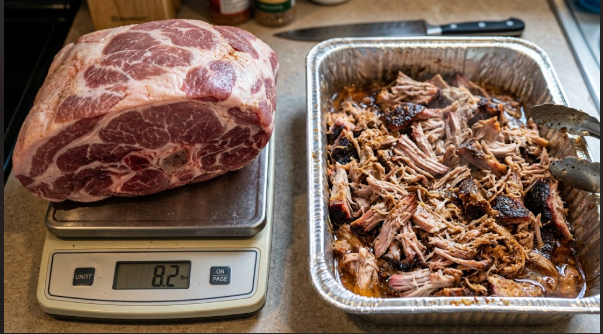
A raw pork butt and a pan of pulled pork are very different weights. Three things take weight away: the bone, the fat, and moisture lost during a long cook. Understanding each one helps you buy the right size.
The bone. A bone-in butt carries a bone that can account for a small but real share of its weight. When you buy boneless, you pay more per pound but get more edible meat per pound.
The fat. Butts have a thick fat cap and seams of fat inside. Some melts into the meat and some gets trimmed or pulled away after the cook.
The moisture. Over 10 to 14 hours, the meat loses water and rendered fat. As a rough rule of thumb, cooked, pulled meat ends up around 50-60% of the raw weight.
Is Pork Butt the Same as Pork Shoulder?
Pork butt and pork shoulder come from the same area of the pig, the upper front leg and shoulder. The butt, also sold as Boston butt, is the upper portion and has more even marbling. The lower portion is called the picnic shoulder and has a bit less fat and more skin and bone.
Both work for pulled pork, but the butt is the favorite because it stays juicy. The per-person math in this guide applies to either cut, though picnic shoulders may yield slightly less because of the extra skin and bone.
How Much Pork Butt per Person: The Basic Numbers
Start with how you plan to serve the meat. A sandwich uses less than a full plate.
Serving Size by Meal Type
- Sandwich on a bun: about 4 oz (113 g) of cooked pulled pork per person
- Plate with two or three sides: about 5-6 oz (140-170 g) cooked
- Plate as the main event, big eaters: about 8 oz (227 g) cooked
- Appetizer or slider bar: about 2-3 oz (57-85 g) cooked per person
Now work backward to a raw weight. If cooked yield is about 50-60%, you need roughly 2 lb (0.9 kg) raw to get about 1 lb (0.45 kg) cooked. That gives these buying rules:
| Cut | Raw weight per person (sandwiches) | Raw weight per person (plates, leftovers) |
| Bone-in pork butt | 1/2 lb (0.23 kg) | 3/4 lb (0.34 kg) |
| Boneless pork butt | 1/3 lb (0.15 kg) | 1/2 lb (0.23 kg) |
Boneless costs more per pound but gives more meat per pound, so the totals often come out close. Compare the price per cooked pound, not the price per raw pound.
Pitmaster Tip: Always round up. Leftover pulled pork freezes well and makes great tacos, nachos, and breakfast hash. Running out of meat in front of guests is a far bigger problem than having an extra pound in the freezer.
How Much Pork Butt Do I Need? Party Size Chart
This table uses bone-in butt and rounds to easy numbers. Use the lower column for sandwiches with plenty of sides, and the higher column for plates or hungry crowds.
| Guests | Raw bone-in weight (1/2 lb each) | Raw bone-in weight (3/4 lb each) | Typical butts to buy |
| 4 | 2 lb (0.9 kg) | 3 lb (1.4 kg) | 1 small (3-4 lb / 1.4-1.8 kg) |
| 8 | 4 lb (1.8 kg) | 6 lb (2.7 kg) | 1 (6-8 lb / 2.7-3.6 kg) |
| 12 | 6 lb (2.7 kg) | 9 lb (4.1 kg) | 1 large (8-10 lb / 3.6-4.5 kg) |
| 20 | 10 lb (4.5 kg) | 15 lb (6.8 kg) | 2 (8 lb each) |
| 30 | 15 lb (6.8 kg) | 22.5 lb (10.2 kg) | 2-3 |
| 50 | 25 lb (11.3 kg) | 37.5 lb (17 kg) | 4-5 |
Typical pork butts weigh somewhere around 6-10 lb (2.7-4.5 kg) at the store, though packs vary. For a very small group, ask the meat counter to cut a butt in half so you do not have to cook a giant piece.
How Much Pork Butt for 10, 20, and 50 People
For a gathering of 10, plan on 5 lb (2.3 kg) raw for sandwiches, or 7.5 lb (3.4 kg) for plates. One 8 lb (3.6 kg) butt covers it with a little left over. For 20 people, buy two 8 lb (3.6 kg) butts for sandwiches. That is 16 lb (7.3 kg) raw, which is a comfortable margin over the 10 lb (4.5 kg) minimum.
For 50 people, plan on 25-30 lb (11-14 kg) raw. Cook four or five butts together if your cooker has the space, and start the day before. If you are throwing a big event on a tight budget, our tips for hosting a summer BBQ on a budget show where to save money.
Adjusting for Your Crowd
The chart is a starting point. Real parties are messier. Adjust the numbers with these questions.
- Are there kids? Count children under 10 as half an adult.
- Are there big eaters or teenagers? Count each as 1.25 adults.
- Is pulled pork the only meat? Use the higher number. If you also serve ribs, chicken, or sausage, you can use the lower number or even less.
- Are there lots of sides? A table with beans, slaw, mac and cheese, and cornbread lets people eat less meat. Try our cornbread recipe as an easy side.
- Do you want leftovers? Add 25% on top. Pulled pork reheats well.
- Is it a long event? A party where people graze for hours uses more food than a single sit-down meal.
If you are also making ribs for the same event, read how to cook ribs on a pellet grill so both meats finish at the right time.
Bone-In vs. Boneless Pork Butt
Both cuts work, but they behave a little differently on the smoker.
Bone-In Pork Butt
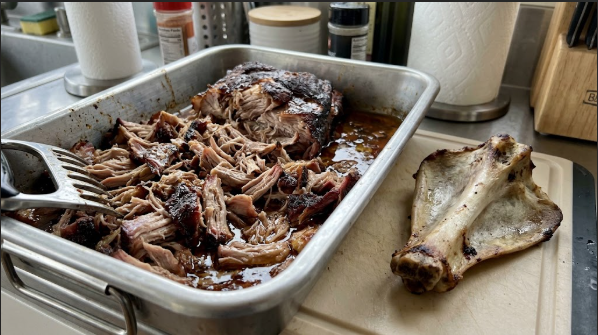
Bone-in is the traditional choice. The bone helps the meat cook evenly, and when it is done, the blade bone slides out clean. That clean pull is one of the best doneness signs. It is usually cheaper per pound, but you lose some weight to the bone.
Boneless Pork Butt
Boneless is easier to season, trim, and slice, and it fits in smaller cookers. Some butchers tie or net boneless butts, which can make for uneven shapes. It costs more per pound, so calculate cost per cooked pound before you decide.
For most home cooks, bone-in is the best value. Choose boneless only if you want convenience or are cooking for a small group.
How Long Does It Take to Smoke a Pork Butt?
Plan ahead, because pork butt takes a long time. A general rule is 1.5 to 2 hours per pound at 225-250°F (107-121°C). An 8 lb (3.6 kg) butt can take 12-16 hours, so many cooks start late at night or very early in the morning.
| Raw weight | Cooker temp | Estimated cook time | Rest in cooler |
| 4 lb (1.8 kg) | 250°F (121°C) | 6-8 hours | 1 hour |
| 6 lb (2.7 kg) | 250°F (121°C) | 9-12 hours | 1-2 hours |
| 8 lb (3.6 kg) | 250°F (121°C) | 12-16 hours | 1-2 hours |
| 10 lb (4.5 kg) | 250°F (121°C) | 15-18 hours | 2 hours |
Use these as planning guides only. Every butt cooks differently, and the stall can add hours. Cook to temperature and feel, not the clock. Cooking two butts side by side does not double the time, but a crowded cooker can slow down.
The Stall
Around 150-170°F (65-77°C) internal, the temperature stops rising for what can be hours. This is the stall, caused by moisture evaporating from the surface. Do not panic or crank up the heat.
Many cooks wrap the butt in butcher paper or foil at about 165°F (74°C) to push through the stall. Wrapping shortens the cook and keeps the meat moist, though it softens the bark. [PHOTO: A pork butt wrapped in pink butcher paper on the smoker]
How to Cook Pork Butt: Simple Method
This method works on a pellet grill, offset smoker, or charcoal smoker. It is the same whether you are feeding six or sixty.
- Trim lightly. Leave about 1/4 inch (6 mm) of fat on the cap. Remove any thick, hard pieces. A sharp knife helps; see our picks for the best knives for cutting meat.
- Season. Coat with a thin layer of yellow mustard or oil, then apply your rub on all sides. For a big butt, use about 1/4 cup (60 ml) of rub per 8 lb (3.6 kg). Let it sit 1 hour or overnight in the fridge.
- Heat the cooker. Set it to 225-250°F (107-121°C). Hickory, oak, apple, and cherry are all good wood choices. New to pellet cooking? Check our list of the best pellet grills for beginners.
- Smoke fat side up. Place the butt on the grate with a probe thermometer in the thickest part, away from the bone.
- Spritz if you like. After about 3 hours, spray with apple juice or water every hour or so if the surface looks dry.
- Wrap at about 165°F (74°C). When the bark is dark and set, wrap in butcher paper or foil. Return to the cooker.
- Pull at 195-205°F (90-96°C). The probe should slide in with almost no resistance, like pushing into soft butter. The bone should wiggle loose.
- Rest 1-2 hours. Wrap in towels and hold in a dry cooler. This is the step that makes the meat juicy.
- Shred and serve. Pull the meat apart with claws or forks, discard the fat and bone, and mix the juices back in.
The USDA’s safe minimum internal temperature for fresh pork is 145°F (63°C) with a three-minute rest . Pulled pork is cooked far past that, to 195-205°F (90-96°C), because the connective tissue needs the extra heat to break down and become tender.
Common Mistake: Pulling the butt too early because it hit 180°F (82°C). At that point it is safe but tough and will not shred. Wait for probe tenderness, not just a number.
How to Tell When It Is Done
- The probe slides in with almost no resistance.
- The bone wiggles and slides out clean.
- The bark is dark mahogany and holds together.
- The meat jiggles when you move the pan.
Other Cookers and Oven Backup
If you do not have a smoker, you can still make good pulled pork. On a charcoal setup, our guide to using lump charcoal in an offset smoker covers fire management. In an oven, roast at 275°F (135°C) in a covered pan for about 1 hour per pound, until it hits 195-205°F (90-96°C). You will miss the smoke, but the texture is excellent.
Shopping for the Right Pork Butt
A better butt starts at the store. Look for these signs:
- Good marbling. Thin white lines of fat running through the meat mean a juicier result.
- Pink to light red color. Avoid meat that is gray or has dark spots.
- A fat cap about 1/4 to 1/2 inch (6-12 mm) thick.
- Tight packaging with little liquid. Excess liquid can mean older meat.
- Weight that fits your cooker. Check the grate size before you buy.
If your store sells only large packs, ask the butcher to split one. A good cutting knife also makes trimming easier. Our best butcher knives guide has options.
Cost: Is It Cheaper to Buy Extra?
Pork butt is one of the cheapest cuts to feed a crowd. Because it is inexpensive per pound, an extra butt costs less than ordering takeout trays. Prices change often, so check your local store.
A simple way to compare options is cost per cooked pound. Divide the raw price per pound by the cooked yield. Bone-in at about 50% yield costs twice its raw price per cooked pound, while boneless at about 60% yield costs about 1.7 times its raw price.
Here is how that plays out. Say bone-in costs $2.00 per lb and boneless costs $3.00 per lb (example numbers only, not real prices). Bone-in works out to $4.00 per cooked pound. Boneless works out to $5.00 per cooked pound. Bone-in still wins on price, but the gap is smaller than the sticker suggests. That is how you compare the two cuts honestly.
A Worked Example: Feeding 24 People
Say you are hosting a backyard party for 24 guests. Six of them are kids, and you are serving pulled pork sandwiches with slaw, beans, and cornbread.
- Count adults and kids. That is 18 adults plus 6 kids. Count kids as half, so you are feeding 21 adult portions.
- Pick the serving size. Sandwiches with plenty of sides means 1/2 lb (0.23 kg) raw bone-in per portion.
- Do the math. 21 portions times 1/2 lb is 10.5 lb (4.8 kg) raw.
- Add a cushion. Add 25% for seconds and leftovers. That brings you to about 13 lb (5.9 kg).
- Choose butts. Two 7 lb (3.2 kg) butts gives you 14 lb (6.4 kg) raw, which fits the plan.
- Plan the cook. At 250°F (121°C), two 7 lb butts need about 10-14 hours. Start the evening before, rest them 2 hours, and shred an hour before serving.
You should end up with roughly 7-8 lb (3.2-3.6 kg) of cooked, pulled pork. That is about 5 oz (140 g) per adult portion, which is generous for a sandwich.
Food Safety: Holding, Serving, and Leftovers
Pulled pork feeds a crowd for hours, so food safety matters. Do not leave it on the counter all afternoon.
- Two-hour rule. Refrigerate cooked food within 2 hours, or within 1 hour if it is above 90°F (32°C) outside. This follows USDA guidance on leftovers.
- Keep it hot. Hold pulled pork at 140°F (60°C) or above on a slow cooker set to warm or in a covered chafing dish.
- Store in shallow containers. Shallow pans cool faster in the fridge.
- Refrigerator life. Use leftovers within 3-4 days.
- Freezing. Freeze portions in airtight bags with the juices. Frozen food stays safe indefinitely at 0°F (-18°C), though quality drops over time.
- Reheat to 165°F (74°C). Add a splash of broth or apple juice to keep it moist.
Related Tips for Serving a Crowd
- Serve from a slow cooker. It keeps the meat warm and moist.
- Offer two sauces. A vinegar sauce and a sweet tomato sauce cover most tastes.
- Set up a sandwich bar. Buns, slaw, pickles, and sauces let people build their own.
- Count the buns. Plan on 1.5 buns per adult.
- Reserve juices. Keep the drippings from the pan and stir some back into the shredded meat.
- Plan the timeline. Smoke the night before, rest and hold the next day, and reheat gently before the party.
Frequently Asked Questions
How much pork butt do I need for 10 people?
For 10 people, buy about 5 lb (2.3 kg) of raw bone-in pork butt for sandwiches, or 7.5 lb (3.4 kg) for plates. One 8 lb (3.6 kg) butt covers either plan with a little extra for leftovers.
How many pounds of pork butt feed 20 people?
Plan on 10 lb (4.5 kg) raw for sandwiches and 15 lb (6.8 kg) for plates. In practice, buy two 8 lb (3.6 kg) butts. They cook side by side and give you a safe margin for seconds and leftovers.
How much does a pork butt shrink when smoked?
A pork butt typically loses around 40-50% of its raw weight from the bone, trimmed fat, and moisture. An 8 lb (3.6 kg) butt often gives about 4-5 lb (1.8-2.3 kg) of pulled pork.
How long does pulled pork last in the fridge?
Store pulled pork in sealed containers and eat it within 3-4 days, following USDA leftover guidance. Refrigerate within 2 hours of cooking. For longer storage, freeze it in portions and reheat to 165°F (74°C).
Is bone-in or boneless pork butt better?
Bone-in is cheaper per pound and gives a clean doneness signal when the bone slides out. Boneless is easier to trim and gives more meat per pound. For most cooks, bone-in is the best value for a crowd.
Can you freeze pulled pork?
Yes. Cool it quickly, pack it with some juices in airtight bags, and freeze flat for fast thawing. Keep it at 0°F (-18°C), thaw in the fridge, and reheat to 165°F (74°C) before serving. Quality is best within a few months.
Conclusion
Knowing how much pork butt per person takes the stress out of party planning. Use 1/2 lb (0.23 kg) of raw bone-in meat per person for sandwiches, 3/4 lb (0.34 kg) for plates, and add extra if you want leftovers. Boneless runs closer to 1/3 to 1/2 lb (0.15-0.23 kg).
Start the cook early, wrap at the stall, pull at 195-205°F (90-96°C), and rest the meat well. Write down your numbers after the party so next time is even easier. Before you shop, count your guests and use the chart above.
Laura Smith

I'm Laura, I like all the kind of delicious grilled foods which makes me hungry all the time I see them. That's why I built this blog to share with you all of my Grilling experiences, recipes, and all the tips about foods that I've learned from food experts.