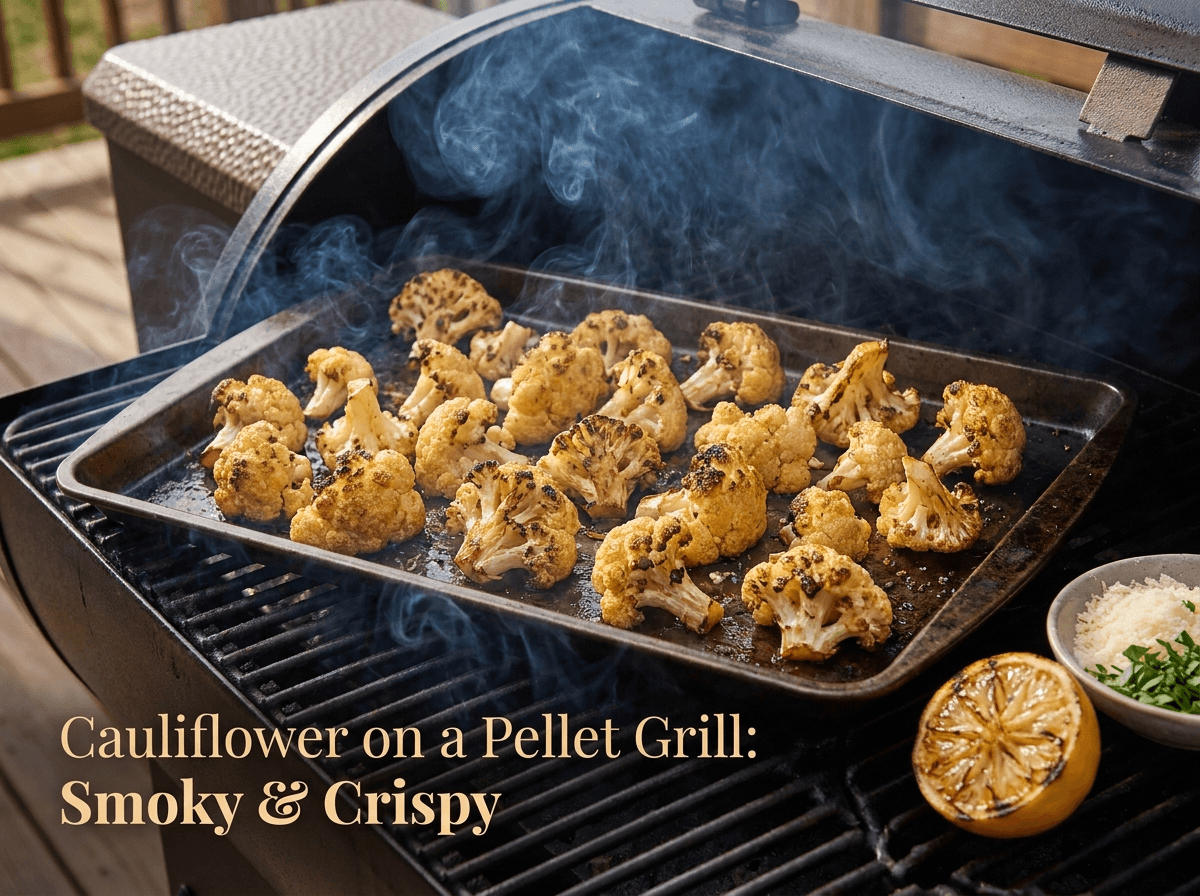
Cauliflower on a pellet grill is one of the easiest ways to turn a plain vegetable into a side dish people ask about. Its mild flavor soaks up wood smoke quickly. High heat then browns the edges until they taste sweet and nutty.
This guide covers the exact temperatures, times, and seasoning I’d use for florets, a whole head, and thick steaks. If you’re still choosing a cooker, start with our guide to the best pellet grills for beginners.
Quick Answer: Smoke cauliflower florets at 250°F (121°C) for 30 minutes, then raise the heat to 425°F (218°C) for 20–25 minutes. Total time is about 55 minutes. There is no USDA minimum temperature for vegetables, so pull it when it’s fork-tender, around 195–205°F (91–96°C).
Why Cauliflower on a Pellet Grill Works
Cauliflower is dense but mild, which makes it a good match for pellet smoke. A short, low-heat start lets the smoke stick to the surface. A hot finish then drives off moisture and browns the sugars.
Pellet grills hold steady temperatures and let you change them quickly. That two-stage method is hard to match on a gas grill or in an oven, because neither gives you smoke.
- Smoke without bitterness: 30 minutes at 250°F is enough. Longer can taste harsh on a vegetable this mild.
- Crispy edges: Finishing at 425°F caramelizes the florets instead of steaming them.
- Hands-off cooking: Once it’s on the grate, you only stir it once or twice.
- Flexible: The same method works for florets, wedges, steaks, and whole heads.
Ingredients and Equipment
Ingredients (serves 4–6):
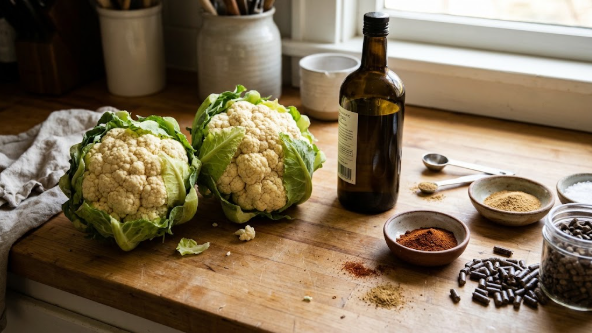
- 2 medium heads cauliflower, about 3 lb (1.4 kg) total. That yields roughly 2 lb (0.9 kg) of florets.
- 3 tablespoons avocado or olive oil
- 1 teaspoon kosher salt
- 1 teaspoon smoked paprika
- 1 teaspoon garlic powder
- ½ teaspoon onion powder
- ½ teaspoon black pepper
- ¼ teaspoon cayenne (optional)
- To finish: 2 tablespoons melted butter, ¼ cup grated Parmesan, a squeeze of lemon, chopped parsley
Substitutions:
- Oil: Avocado oil handles 425°F best. Olive oil works fine if you don’t mind a little extra smoke from the pan.
- Butter: Use olive oil or vegan butter for a dairy-free finish.
- Parmesan: Skip it, or use nutritional yeast.
- Rub: A salt-based barbecue rub works. Use about 1½ tablespoons and cut the salt.
Equipment:
- Pellet grill (any brand: Traeger, Pit Boss, Camp Chef, or Green Mountain)
- Pellets: pecan, apple, cherry, or maple. Mild fruit and nut woods suit cauliflower. Hickory is fine in a blend, but heavy mesquite overpowers it.
- A dark, rimmed sheet pan or perforated grill pan
- A sharp chef’s knife and large bowl
- Tongs and an instant-read thermometer
New to your grill? Our how to start a grill walkthrough covers startup and preheating basics.
Choosing and Prepping Your Cauliflower
Pick heads that feel heavy for their size, with tight, creamy-white florets. Skip any with brown spots or loose, spreading curds. Leaves should look green and fresh.
How to prep:
- Wash it. Rinse under running water and skip the soap, as the FDA says to wash all produce thoroughly under running water before cutting or cooking.
- Trim. Remove the leaves and cut out the core.
- Cut evenly. Aim for florets about 1½ to 2 inches wide, so they finish together.
- Dry thoroughly. Pat them with a towel. Wet florets steam instead of browning.
A good vegetable knife makes this faster. If you’re deciding between styles, see our santoku vs nakiri comparison.
No brine is needed. Cauliflower is porous, and seasoning the oil carries flavor into the crevices. Don’t boil or blanch it first. Pre-cooking adds water, and water is the enemy of crispy edges.
Pitmaster Tip: Put your empty sheet pan on the grill while it preheats. Florets that hit a hot pan start browning right away, which gives you better color and less sticking.
How to Cook Cauliflower on a Pellet Grill (Step by Step)
- Preheat to 250°F (121°C). Add pellets and let the grill come to temperature, about 10–15 minutes. Most pellet grills swing 15–25°F, so trust a second thermometer if you have one.
- Mix the seasoning. Combine the salt, paprika, garlic powder, onion powder, pepper, and cayenne in a small bowl.
- Coat the florets. Toss them in a large bowl with the oil first, then the seasoning. Oil first helps the rub stick evenly.
- Spread them out. Arrange the florets in a single layer on the pan with space between them. [PHOTO: Seasoned florets spread on a dark sheet pan before going on the grill]
- Smoke for 30 minutes at 250°F. Close the lid and leave it alone. The florets will look dull and slightly damp, which is normal at this stage.
- Stir and raise the heat. Toss the florets, then turn the grill up to 425°F (218°C). Give it 8–10 minutes to recover.
- Roast 20–25 minutes. Stir once at the halfway point. [PHOTO: Florets mid-cook with brown edges starting to form]
- Test for doneness. A fork should slide into the thickest stem with light resistance, and the edges should be deeply golden.
- Finish. Toss with melted butter, Parmesan, lemon juice, and parsley. Serve hot.
Common Mistake: Crowding the pan. Florets piled on top of each other trap steam and come out soft and pale. If everything doesn’t fit in one layer with space, use two pans or cook in two batches.
Time and Temperature Table
| Cut | Smoke Stage | Roast Stage | Total Time | Pull Cue |
| Florets (1½–2 in) | 250°F (121°C), 30 min | 425°F (218°C), 20–25 min | ~55 min | Fork-tender, browned edges |
| Wedges (1½ in thick) | 250°F (121°C), 30 min | 400°F (204°C), 30–35 min | ~1 hr 5 min | Core yields to a fork |
| Steaks (1 in thick) | None | 425°F (218°C), 10–12 min per side | ~25 min | Browned both sides, tender |
| Whole head (2–2.5 lb / 0.9–1.1 kg) | 275°F (135°C), 60 min | 400°F (204°C), 25–35 min | ~1 hr 30 min | Knife slides into the center |
These are my pitmaster guidelines based on typical pellet grill behavior. Your results will vary with weather and your grill’s temperature swings.
How to Tell When It’s Done
Time is only a starting point, because cauliflower doesn’t have a USDA minimum internal temperature the way chicken does. Use your senses and a thermometer.
- Color: Deep golden-brown on the edges and tips, with some darker spots.
- Texture: A fork or probe slides into the stem with light resistance, not mushy.
- Temperature guide: The thickest part usually reads about 195–205°F (91–96°C) when it’s tender.
- Aroma: Sweet, nutty, and lightly smoky, not sharp or sulfurous.
Raw or undercooked cauliflower tastes squeaky and a little bitter. Overcooked cauliflower falls apart and gets watery. Aim for the point where it holds its shape but yields easily.
Resting and Serving
Let the cauliflower rest 3–5 minutes on the pan. The surface firms up slightly and the steam settles. Don’t cover it, or the crispy edges will soften.
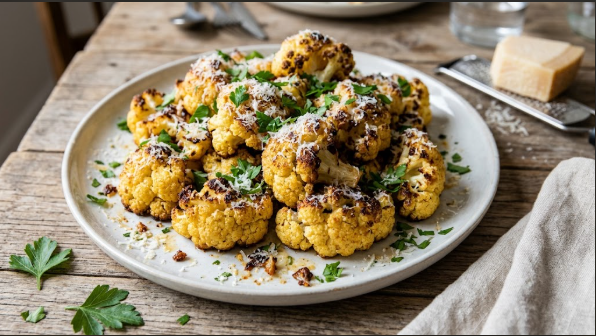
Add the finishing butter, Parmesan, and lemon while it’s still hot. Serve straight from the pan, or move it to a warm platter. For steaks, a spoonful of chimichurri or tahini sauce looks great and tastes even better.
What to Serve with Smoked Cauliflower
This side pairs with almost any smoked main. A few good matches:
- Ribs: The sweet, savory crust balances sticky sauce. Try it with our pellet grill ribs recipe.
- Poultry: It fits a lighter plate next to our turkey breast at 250°F.
- Holiday spreads: It adds a lighter option to any Thanksgiving smoker recipes menu.
- Steaks and chops: The smoky vegetable stands up to a seared crust.
- Grain bowls or tacos: Chop leftover florets into bowls, quesadillas, or tacos.
Storing, Freezing, and Reheating Leftovers
Cool leftovers quickly and refrigerate them within two hours. The USDA calls the range between 40°F and 140°F the danger zone, where bacteria grow fast.
- Refrigerator: Store in shallow containers for 3–4 days, per USDA FSIS leftovers guidance.
- Freezer: Leftovers keep their best quality for about 3–4 months at 0°F (-18°C), though the texture softens after thawing.
- Reheating: Bring leftovers to 165°F (74°C), the FSIS reheating target. For crispness, use a 425°F oven or air fryer for 8–10 minutes rather than a microwave.
Variations: Pellet Grill, Offset, Charcoal, and Oven Backup
Pellet grill steaks. Slice thick 1-inch slabs from the center of the head. Brush with oil, season, and roast at 425°F for 10–12 minutes per side. The small trimmings can go on the pan too.
Buffalo cauliflower. Smoke and roast as written, then toss with ½ cup buffalo sauce and 2 tablespoons melted butter. Return to the grill at 425°F for 5 minutes to set the sauce.
Bacon and ranch. Crumble a few slices of cooked bacon over the finished florets. Our bacon on a pellet grill guide covers cooking it the same day.
Whole smoked head. Trim the leaves, brush with oil and rub, and cook per the table. Slice into wedges at the table.
Offset or charcoal. Run the firebox at about 250°F for the smoke stage, then move the pan closer to the fire or open the vents for the hot finish. Our notes on lump charcoal in an offset smoker help with fire management.
Oven backup. Roast at 425°F for 30–35 minutes with a pinch of smoked paprika. You won’t get true smoke, but the browning will be good.
Troubleshooting Common Problems
| Problem | Likely Cause | Fix |
| Soggy, pale florets | Pan too crowded or florets wet | Use a single layer, pat dry, preheat the pan |
| Bitter or acrid smoke taste | Too much smoke time or heavy wood | Cut the smoke stage to 20–30 min; use fruit woods |
| Burnt tips, raw centers | Florets cut unevenly or heat too high | Cut uniformly; lower the finish to 400°F |
| Rub sliding off | Oil added after seasoning | Toss with oil first, then the rub |
| Mushy texture | Overcooked | Pull earlier and test with a fork |
| Bland flavor | Under-salted | Season generously and finish with lemon |
Recipe Card: Cauliflower on a Pellet Grill
Servings: 4–6 | Prep: 15 minutes | Cook: 55 minutes | Total: about 1 hour 10 minutes
Ingredients: 2 medium heads cauliflower (about 3 lb / 1.4 kg), 3 tbsp avocado oil, 1 tsp each salt, smoked paprika, and garlic powder, ½ tsp each onion powder and black pepper, 2 tbsp melted butter, ¼ cup Parmesan, lemon, and parsley.
Quick steps:
- Preheat the pellet grill to 250°F (121°C).
- Cut, wash, and dry the florets, then toss with oil and rub.
- Spread on a pan and smoke 30 minutes.
- Stir, raise to 425°F (218°C), and roast 20–25 minutes.
- Pull when fork-tender and browned, then toss with butter, Parmesan, and lemon.
FAQ
How long does cauliflower take on a pellet grill?
Florets take about 55 minutes total: 30 minutes of smoke at 250°F (121°C), then 20–25 minutes at 425°F (218°C). Steaks take about 25 minutes at 425°F. A whole head needs roughly 1 hour 30 minutes. Always check tenderness with a fork.
What temperature should I smoke cauliflower?
Start at 250°F (121°C) for smoke flavor, then finish at 400–425°F (204–218°C) for browning. Smoking at 225°F works, but the cauliflower stays pale and softer. The two-stage method gives the best balance of smoky taste and crisp edges.
Do you need to boil cauliflower before smoking it?
No. Boiling adds water, which prevents browning and makes florets soft. Raw, dry florets coated in oil roast better. If you want extra tenderness, just extend the roasting stage by 5 to 10 minutes.
What wood pellets are best for cauliflower?
Mild fruit and nut woods like apple, cherry, pecan, and maple work best. They add sweetness without overpowering the vegetable. Hickory is fine in a blend. Skip mesquite, which can taste harsh on delicate vegetables.
Can you smoke a whole head of cauliflower?
Yes. Smoke a 2–2.5 lb (0.9–1.1 kg) head at 275°F (135°C) for 60 minutes, then roast at 400°F (204°C) for 25–35 minutes. A knife should slide easily into the center. Cut it into wedges to serve.
How long do leftovers last, and can I freeze them?
Refrigerate leftovers within two hours and eat them in 3–4 days, per USDA FSIS. Freezing works for 3–4 months of best quality, though the texture softens. Reheat to 165°F (74°C), ideally in a hot oven or air fryer to bring back some crispness.
Final Thoughts on Cauliflower on a Pellet Grill
Cauliflower on a pellet grill gives you smoky flavor, crispy edges, and a tender center with very little work. Smoke briefly at 250°F, finish hot at 425°F, and judge doneness by fork-tenderness rather than the clock.
Start with the basic florets, then try steaks, a whole head, or a buffalo version once you’re comfortable. Keep the pan uncrowded and the florets dry, and you’ll get good results every time.
Laura Smith

I'm Laura, I like all the kind of delicious grilled foods which makes me hungry all the time I see them. That's why I built this blog to share with you all of my Grilling experiences, recipes, and all the tips about foods that I've learned from food experts.