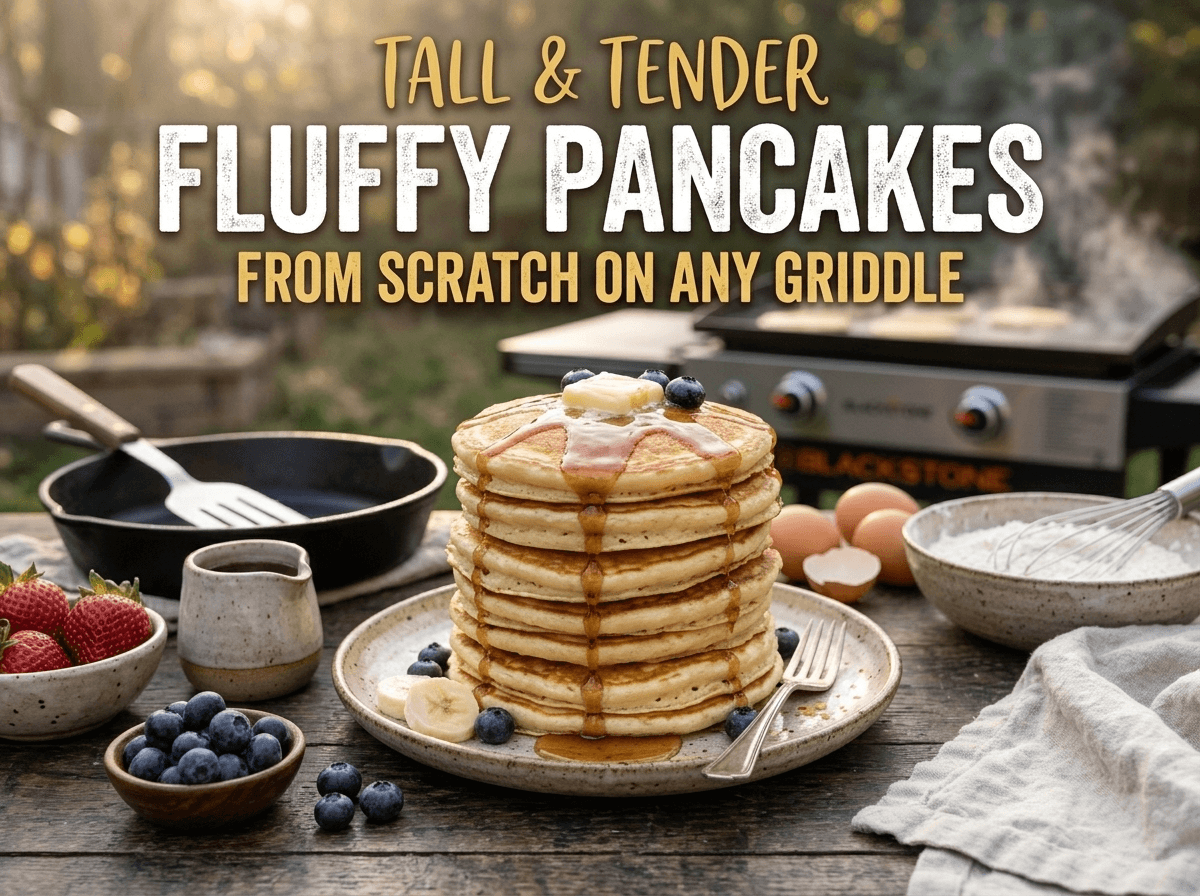
This fluffy pancake recipe makes thick, golden stacks with soft, airy centers and lightly crisp edges. It uses pantry basics, one bowl, and about 25 minutes. It works on a stovetop pan, an electric griddle, or a Blackstone out in the backyard.
Fluffy pancakes come down to three things: the right ratio of baking powder to flour, a gentle hand with the batter, and steady griddle heat. Get those right, and you don’t need special flour or fancy tricks.
Below you’ll find exact measurements, temperatures, and times. You’ll also find the common reasons pancakes go flat or rubbery, and how to fix each one.
Quick Answer: For a fluffy pancake recipe, whisk 1½ cups (190 g) flour with 3½ teaspoons baking powder, mix in milk, egg, and melted butter until just combined, and rest the batter 5 minutes. Cook on a 350–375°F (175–190°C) griddle for 2–3 minutes, flip, and cook 1–2 minutes more.
Why This Fluffy Pancake Recipe Works
Pancakes rise because baking powder releases gas bubbles when it hits liquid and heat. Your job is to trap those bubbles in the batter and cook the pancake before they escape. Every step in this recipe protects those bubbles.
- Enough leaven: 3½ teaspoons of baking powder for 1½ cups of flour gives a strong lift. Too little and the pancakes come out dense.
- Minimal mixing: Stirring the wet and dry ingredients just until the flour disappears keeps gluten weak. Strong gluten makes pancakes chewy and flat.
- A short rest: Letting the batter sit for 5 to 10 minutes gives the flour time to absorb liquid. The batter thickens, which helps pancakes stay tall in the pan.
- Melted butter: Butter adds flavor and tenderness. Cooling it slightly first keeps it from scrambling the egg.
- Steady heat: A griddle around 350–375°F (175–190°C) sets the outside as the center puffs up.
The batter is thick on purpose. It should pour slowly off a spoon and mound a little on the griddle. A thin, runny batter gives you thin, crepe-like pancakes.
Ingredients and Equipment
Makes about 8 to 10 pancakes (4 servings).
Dry ingredients:
- 1½ cups (190 g) all-purpose flour
- 3½ teaspoons baking powder (1 tablespoon plus ½ teaspoon)
- 1 tablespoon granulated sugar
- ½ teaspoon fine salt
Wet ingredients:
- 1¼ cups (300 ml) whole milk
- 1 large egg
- 3 tablespoons (42 g) unsalted butter, melted and cooled slightly
- 1 teaspoon vanilla extract
For the griddle: 1 tablespoon butter or neutral oil, plus more as needed.
Equipment: large mixing bowl, whisk, rubber spatula, ¼-cup measuring scoop, wide spatula, griddle or large pan, wire rack, and a sheet pan. An infrared thermometer is handy but not required.
Easy substitutions:
- Buttermilk pancakes: Swap the milk for 1¼ cups (300 ml) buttermilk. Reduce the baking powder to 2 teaspoons and add ½ teaspoon baking soda. The result is tangier and extra tender.
- No buttermilk: Stir 1 tablespoon of lemon juice or white vinegar into the milk. Let it sit 5 minutes.
- Dairy-free: Use unsweetened oat or soy milk and swap the butter for neutral oil. For a fully egg-free and dairy-free option, see these vegan breakfast ideas.
- Flour: Measure by weight if you can. A scoop packed straight from the bag can add 25% more flour than you want, which makes pancakes dry and heavy.
Pitmaster Tip: If you have a kitchen scale, use it. Weighing 190 g of flour is the easiest way to get the same fluffy result every time.
Prepping the Batter
Melt and cool the butter. Microwave it in 15-second bursts until just liquid. Let it sit 2 to 3 minutes. Hot butter can cook the egg when you whisk it in.
Whisk the dry ingredients. Combine the flour, baking powder, sugar, and salt in your large bowl. Whisking spreads the baking powder evenly, so you don’t get bitter pockets or uneven rise.
Combine the wet ingredients. In a second bowl or large measuring cup, whisk the milk, egg, melted butter, and vanilla. Room-temperature milk blends more smoothly. If your milk is cold from the fridge, microwave it for 20 seconds.
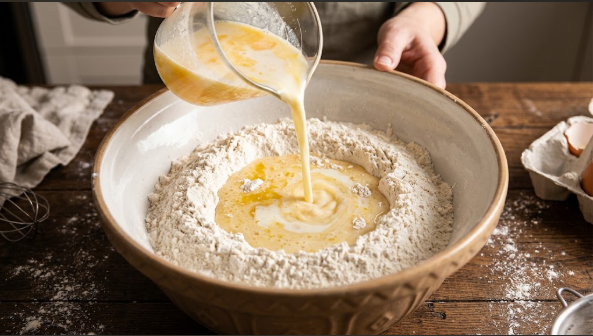
Make a well. Pour the wet mix into the dry ingredients. Don’t dump it in all at once and keep stirring, which is where overmixing starts.
Fluffy Pancake Recipe Step by Step
- Heat the griddle. Set a griddle, cast iron pan, or nonstick skillet over medium to medium-low heat. Aim for a surface temperature of 350–375°F (175–190°C). Without a thermometer, flick a few drops of water on the surface. They should dance and sizzle, then evaporate in a few seconds.
- Fold the batter. Pour the wet ingredients into the dry. Use a rubber spatula to fold gently, about 10 to 12 strokes, until you no longer see dry flour. The batter will look lumpy. That’s what you want.
- Rest the batter. Let it sit for 5 to 10 minutes. You’ll see small bubbles form on the surface. Don’t stir it again.
- Grease lightly. Brush or wipe a thin film of butter or oil on the surface. Too much fat fries the edges and makes the pancakes greasy.
- Scoop the batter. Pour or scoop ¼ cup (60 ml) of batter per pancake. Leave about 2 inches (5 cm) between pancakes so you have room to flip.
- Cook the first side. Cook for 2 to 3 minutes. Wait for bubbles to form across the surface, pop, and leave small holes. The edges should look dry and set.
- Flip once. Slide the spatula under the pancake and flip it in one quick motion. Don’t press it down. Pressing squeezes out the air.
- Cook the second side. Cook 1 to 2 minutes more, until the bottom is golden brown and the pancake feels springy in the center.
- Keep warm. Place finished pancakes on a wire rack set over a sheet pan in a 200°F (95°C) oven. Don’t stack them tightly, or steam will soften them.
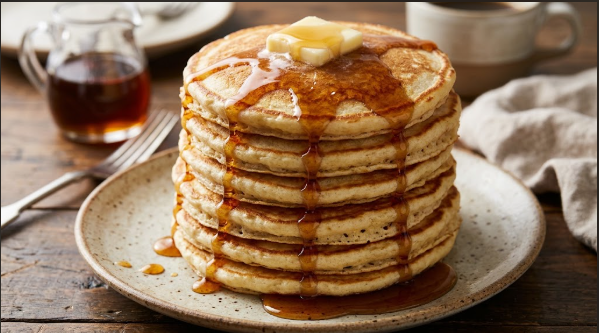
- Serve right away with warm syrup, butter, and your favorite toppings.
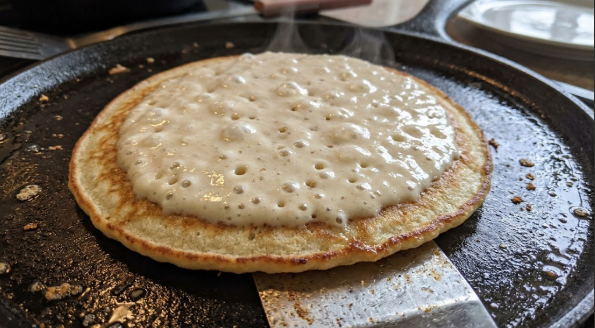
Common Mistake: Flipping too early. If the surface is still wet and shiny with only a few bubbles, the pancake isn’t ready. An early flip makes the center collapse and leaves a pale, doughy pancake.
Time and Temperature Table
| Step | Time | Temperature |
| Preheat griddle | 5–8 min | 350–375°F (175–190°C) surface |
| Rest batter | 5–10 min | Room temperature |
| Cook first side | 2–3 min | 350–375°F (175–190°C) |
| Cook second side | 1–2 min | 350–375°F (175–190°C) |
| Hold in oven | Up to 20 min | 200°F (95°C) |
| Refrigerate leftovers | 3–4 days | 40°F (4°C) or below |
| Freeze leftovers | 3–4 months | 0°F (-18°C) |
| Reheat leftovers | Until steaming hot | 165°F (74°C) |
How to Tell When Fluffy Pancakes Are Done
Watch the pancake, not the clock. The top tells you when to flip, and the bottom and sides tell you when to pull.
Ready to flip: The surface is covered with bubbles. Some bubbles have popped and left open holes. The edges look matte and set, not shiny and wet.
Ready to pull: The bottom is an even golden brown, and the sides look dry. A gentle press on the center should spring back. If your finger leaves a dent, give it another 30 seconds.
The first pancake is a test. It’s normal for the first one to be a bit off, since the griddle is still settling. If it browns too fast, lower the heat. If it takes more than 3 minutes to flip, raise it slightly.
Pancakes are cooked from a batter that contains raw flour and raw egg, so make sure none stays undercooked. The CDC says germs in raw flour and raw eggs are killed only when the food is baked or cooked, so don’t taste the batter. Cook each pancake until the center is set and no longer gooey.
Resting, Stacking, and Serving
Pancakes taste best within a few minutes of leaving the griddle. If you’re feeding a crowd, keep finished batches on a wire rack in a 200°F (95°C) oven. A rack lets air circulate underneath, so the bottoms don’t turn soggy.
Avoid covering them with foil, which traps steam. Don’t stack more than three or four in a warm oven either.
For serving, set out warm syrup so the pancakes don’t cool down. Try:
- Classic: Butter and warm maple syrup
- Fruit: Fresh blueberries, sliced strawberries, or bananas
- Sweet and nutty: Toasted pecans and a drizzle of honey
- Dessert-style: Whipped cream and chocolate chips
For a smoky twist, serve the stack with smoked butter. The mild smoke flavor melts into the pancake and works especially well with maple syrup.
What to Serve With Fluffy Pancakes
A stack of pancakes is sweet, so pair it with something salty and savory for balance.
- Eggs: Scrambled, fried, or soft-boiled eggs add protein.
- Bacon or sausage: The salt cuts through syrup. Cook it on the same griddle once the pancakes are done.
- Fresh fruit: A bowl of melon, berries, or orange slices keeps the plate from feeling too heavy.
- Yogurt parfait: Cool and creamy next to hot pancakes.
- Coffee or hot chocolate: The classic drink pairings.
If you’re planning a full spread, browse more easy breakfast recipes. For lighter mornings, these healthy breakfast ideas pair well with a smaller pancake portion.
Storing, Freezing, and Reheating Leftovers
Refrigerate. Let pancakes cool to room temperature, then store them in an airtight container or zip-top bag. According to the USDA’s leftover guidance, leftovers can be kept in the refrigerator for 3 to 4 days. Put them in the fridge within 2 hours of cooking.
Freeze. Pancakes freeze well. Lay cooled pancakes in a single layer on a sheet pan and freeze for 1 hour. Then stack them with a square of parchment paper between each one and move them to a freezer bag. USDA guidance says leftovers can be frozen for 3 to 4 months, though they may lose some quality after that.
Reheat. The USDA says to reheat leftovers to 165°F (74°C) as measured with a food thermometer. Frozen pancakes can go straight from the freezer to the toaster, oven, or microwave.
- Toaster: 1 to 2 cycles for crisp edges.
- Oven: 350°F (175°C) for 8 to 10 minutes on a sheet pan, covered with foil if they’re dry.
- Microwave: 30 to 45 seconds per 2 pancakes, under a damp paper towel.
Pancakes reheated in the microwave stay softest. The toaster gives you the crispest edge.
Variations
Buttermilk pancakes. Use the buttermilk swap in the ingredients list. Buttermilk reacts with baking soda for extra lift and a slight tang.
Blueberry pancakes. Pour the batter on the griddle first, then drop 5 or 6 blueberries on each one before flipping. This keeps the berries from sinking and staining the batter.
Chocolate chip pancakes. Sprinkle on the chips after pouring, not in the bowl. The chips melt into the top and won’t burn on the griddle.
Banana pancakes. Fold ½ cup (about 115 g) of mashed ripe banana into the wet mix and reduce the milk to 1 cup (240 ml). For something fancier, try the sauce from this Blackstone bananas foster recipe as a topping.
Whole-grain. Swap up to half the flour for whole wheat. Add 2 extra tablespoons of milk because whole wheat absorbs more liquid.
Cooking on a Blackstone or outdoor griddle. Preheat on medium-low and let the surface even out for 5 to 8 minutes. Outdoor griddles can have hot spots, so rotate pancakes if one side browns faster. If you’re picking a size, our guides to Blackstone 22 vs 28 inch and Blackstone 28 vs 36 inch can help you decide how many pancakes you can cook at once.
Cast iron or electric griddle. Cast iron holds heat well but needs a full 5 to 8 minutes of preheating. An electric griddle set to 350°F (175°C) gives the most even results for beginners.
Troubleshooting
| Problem | Likely cause | Fix |
| Pancakes are flat | Old baking powder or overmixed batter | Test baking powder in hot water. If it doesn’t fizz, replace it. Fold gently. |
| Rubbery or chewy | Too much mixing | Stir only until the flour disappears. Keep some lumps. |
| Pale and doughy inside | Flipped too early or heat too low | Wait for bubbles and set edges. Raise heat slightly. |
| Burnt outside, raw inside | Griddle too hot | Lower heat to medium-low and let the surface cool for a minute. |
| Pancakes spread thin | Batter too runny | Add 2 tablespoons of flour and rest the batter again. |
| Greasy edges | Too much oil or butter | Wipe the griddle and use a thin film only. |
| Taste of metal or soap | Too much baking powder | Measure precisely and level the spoon. |
| Uneven color | Hot spots on the griddle | Rotate pancakes and move them to different zones. |
Fluffy Pancake Recipe Card
Servings: 4 (8–10 pancakes) | Prep time: 10 minutes | Rest time: 5–10 minutes | Cook time: 15 minutes | Total time: about 30 minutes
Ingredients: 1½ cups (190 g) all-purpose flour; 3½ tsp baking powder; 1 tbsp sugar; ½ tsp salt; 1¼ cups (300 ml) whole milk; 1 large egg; 3 tbsp (42 g) melted butter; 1 tsp vanilla; butter or oil for the griddle.
Quick steps:
- Heat the griddle to 350–375°F (175–190°C).
- Whisk the dry ingredients. Whisk the wet ingredients.
- Fold together just until combined. Leave the lumps.
- Rest the batter 5–10 minutes.
- Scoop ¼ cup (60 ml) per pancake onto a lightly greased griddle.
- Cook 2–3 minutes until bubbles form and edges set. Flip once.
- Cook 1–2 minutes more until golden.
- Hold on a wire rack in a 200°F (95°C) oven. Serve warm.
Storage: Refrigerate 3–4 days. Freeze up to 3–4 months. Reheat to 165°F (74°C).
FAQ
How do you make pancakes fluffy?
Use enough baking powder, fold the batter gently, and rest it for 5 to 10 minutes. Cook on a griddle at 350–375°F (175–190°C) and flip only once. Avoid pressing the pancake down after flipping, since that squeezes out the air bubbles that make it rise.
Why are my pancakes flat?
Flat pancakes usually come from old baking powder, overmixed batter, or a runny mix. Test your baking powder in hot water, and if it doesn’t fizz, replace it. Stir only until the flour disappears, and add a spoonful of flour if the batter pours too thin.
Should pancake batter be lumpy?
Yes. A few small lumps mean you haven’t overmixed. Overmixing builds gluten, which makes pancakes tough and chewy. The lumps disappear as the batter rests and as the pancakes cook, so stop stirring as soon as you no longer see dry flour.
How long should you rest pancake batter?
Rest the batter for 5 to 10 minutes. This gives the flour time to absorb the liquid, so the batter thickens slightly and cooks up taller. You’ll see small bubbles form on top. Don’t stir again after resting, or you’ll knock out the air.
Can you freeze pancakes?
Yes. Cool them fully, freeze them in a single layer for 1 hour, then stack with parchment between each and store in a freezer bag. USDA guidance says leftovers keep best for 3 to 4 months frozen. Reheat in a toaster, oven, or microwave until steaming hot.
What temperature should a griddle be for pancakes?
Aim for a surface temperature of 350–375°F (175–190°C), which is about medium to medium-low on most stovetop pans and outdoor griddles. No thermometer? Flick a few drops of water on the surface. They should sizzle and dance, then evaporate within a few seconds.
Conclusion
A great fluffy pancake recipe is simple: measure the flour carefully, use enough baking powder, fold the batter gently, and let it rest. Cook on steady medium heat, flip once when the bubbles pop, and keep finished pancakes on a rack so they stay crisp at the edges.
Once you’ve nailed the base batter, you can add blueberries, bananas, or chocolate chips, or move the whole operation to a Blackstone for a weekend crowd. Keep the leftovers cool, reheat them to 165°F (74°C), and your next batch will be just as tall and tender.
Laura Smith

I'm Laura, I like all the kind of delicious grilled foods which makes me hungry all the time I see them. That's why I built this blog to share with you all of my Grilling experiences, recipes, and all the tips about foods that I've learned from food experts.