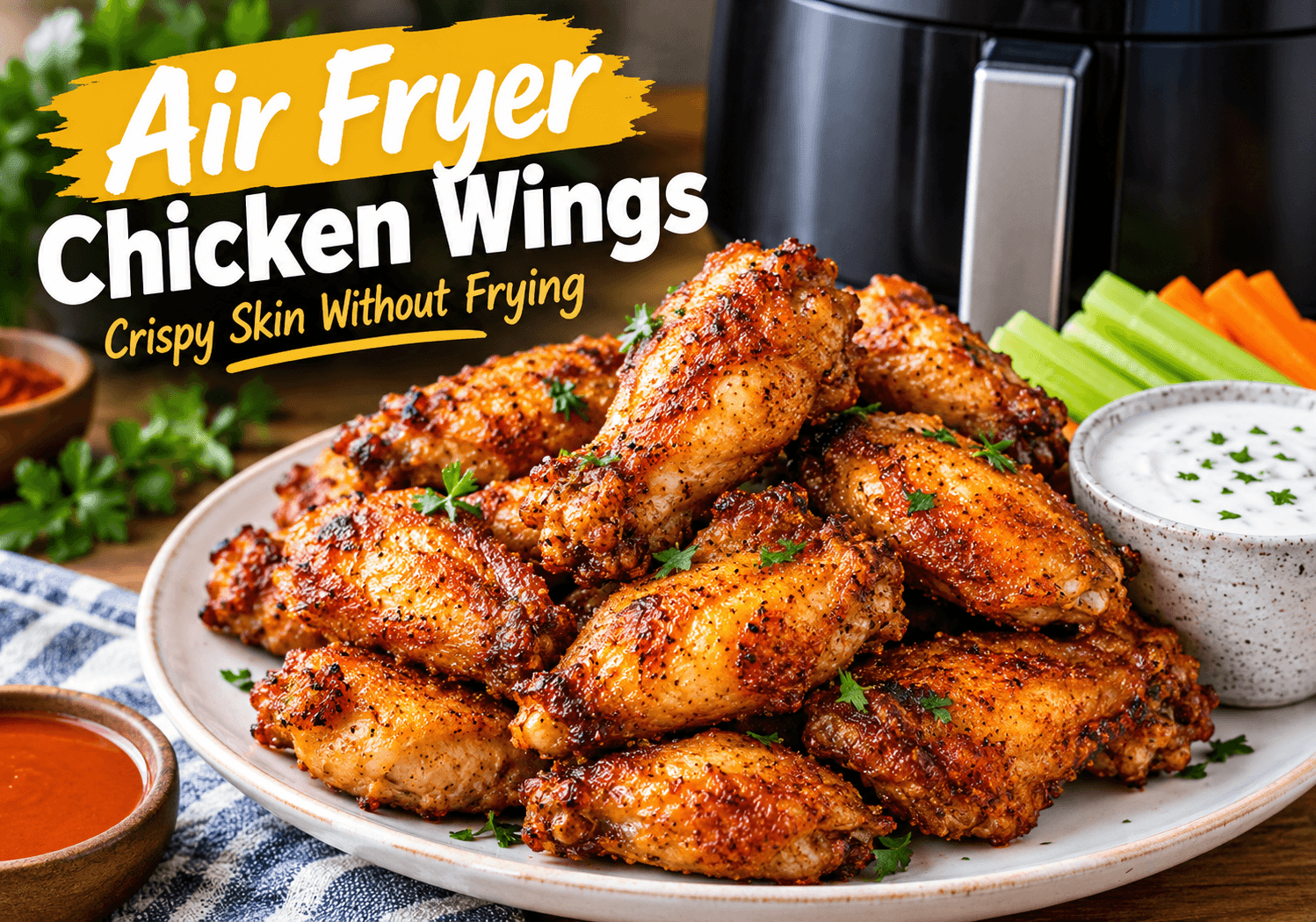
Great air fryer chicken wings have skin that crackles when you bite it, juicy meat underneath, and no pot of hot oil on the stove. The trick is not a fancy gadget. It is dry skin, a little baking powder, and enough space in the basket for hot air to move.
This recipe makes about 3 lb (1.4 kg) of wings in roughly 30 minutes of cooking time, plus a short dry-out in the fridge. For more fast weeknight ideas, browse our easy air fryer recipes.
QUICK ANSWER For crispy air fryer chicken wings, dry 3 lb (1.4 kg) of wings, toss with baking powder and salt, and cook in a single layer at 380°F (193°C) for 15 minutes. Flip, then cook at 400°F (204°C) for 12 to 15 minutes. Pull at 175°F to 185°F (79-85°C). USDA’s minimum is 165°F (74°C).
Why This Air Fryer Chicken Wings Recipe Works
An air fryer is a small, powerful convection oven. A fan pushes hot air around the food, which dries the surface and browns it fast. That is why it works so well for chicken skin.
Four details make the difference:
- Dry skin. Wet skin steams instead of crisping. We pat the wings dry and rest them uncovered in the fridge.
- Baking powder. A light coating raises the skin’s pH, which helps it brown and blister. Use aluminum-free baking powder, not baking soda.
- Two temperatures. A medium start at 380°F (193°C) renders the fat. A hotter finish at 400°F (204°C) crisps the skin.
- A single layer. Wings that touch trap steam. Cook in batches if you need to.
The wings also cook in their own fat, so you do not need extra oil. If you are watching calories, our healthy air fryer recipes have more light options.
Ingredients and Equipment for Air Fryer Chicken Wings
Ingredients (serves 4-6 as an appetizer, 3-4 as a meal)
- 3 lb (1.4 kg) chicken wings, split into flats and drumettes, tips removed
- 1½ tbsp aluminum-free baking powder (about 18 g)
- 1 tsp kosher salt
- ½ tsp black pepper
- 1 tsp garlic powder
- 1 tsp smoked paprika
- Cooking spray or 1 tbsp neutral oil (optional)
Classic Buffalo Sauce
- ½ cup (120 ml) Louisiana-style hot sauce
- 4 tbsp (57 g) unsalted butter, melted
- 1 tsp white vinegar
- ½ tsp garlic powder
Equipment
- Air fryer with a 5- to 6-quart basket (or larger)
- Wire rack and sheet pan for drying
- Paper towels
- Large mixing bowl
- Tongs
- Instant-read thermometer
Easy Substitutions
| If you don’t have… | Use this | What changes |
| Whole wings | Pre-split party wings | Saves 10 minutes of cutting |
| Baking powder | Cornstarch (1 tbsp) | Crisp, but a little less blistered |
| Hot sauce | Honey and garlic, or BBQ sauce | Sweeter, less tangy |
| Butter | Smoked butter | Adds a campfire note to buffalo sauce |
| Smoked paprika | Regular paprika | Less smoky color and flavor |
| Fresh wings | Frozen wings | Cook longer; see the frozen section below |
Choosing and Prepping Your Wings
Buy wings that look plump and pink with no gray patches. Skin should be intact, with no tears or dry spots. Packaged “party wings” are already split and trimmed, which is the easy route.
If you start with whole wings, remove the tip, which burns easily, then cut through the joint to separate the flat from the drumette. Save the tips in the freezer for stock.
Thaw frozen wings safely before prepping. The USDA lists three safe methods: the refrigerator, cold water, or the microwave. Never thaw on the counter. Poultry thawed in the fridge stays good for another one to two days before cooking.
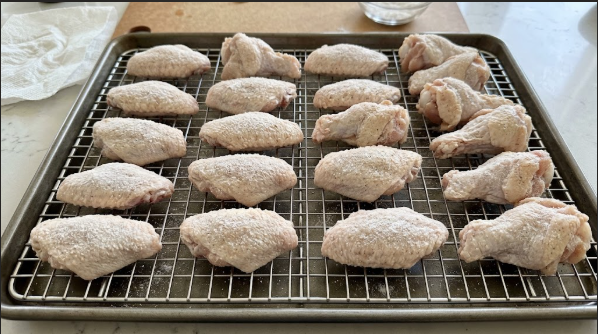
Pat every wing very dry with paper towels. Then set the wings on a wire rack over a sheet pan and refrigerate, uncovered, for 1 to 4 hours. This step dries the skin and is worth the wait.
PITMASTER TIP Season with salt and baking powder only after the wings are dry. Toss them in a big bowl until each wing is coated in a thin, even film. If you see white clumps, shake them off. Too much baking powder leaves a bitter, chalky edge.
Step-by-Step Instructions
- Dry the wings (1-4 hours, mostly hands-off). Pat dry, rack them, and refrigerate uncovered.
- Mix the coating (2 minutes). In a small bowl, stir the baking powder, salt, pepper, garlic powder, and smoked paprika.
- Toss. Put the dry wings in a large bowl. Sprinkle the mix over them and toss until lightly and evenly coated.
- Preheat (3-5 minutes). Heat the air fryer to 380°F (193°C). A hot basket starts the browning right away.
- Load the basket. Lightly spray the basket if it is sticky. Add wings in a single layer with small gaps. If they overlap, cook in two batches.
- First cook, 15 minutes at 380°F (193°C). The fat will render and the skin will turn pale gold.
- Flip. Use tongs to turn each wing over. Rotate the basket if your fryer has hot spots.
- Second cook, 12-15 minutes at 400°F (204°C). Look for deep golden color with browned, bubbled edges.
- Check the temperature. Insert a thermometer into the thickest part of a drumette, without touching bone. Pull at 175°F to 185°F (79-85°C).
- Toss with sauce. Put the hot wings in a large bowl, add sauce, and toss until coated. Serve right away.
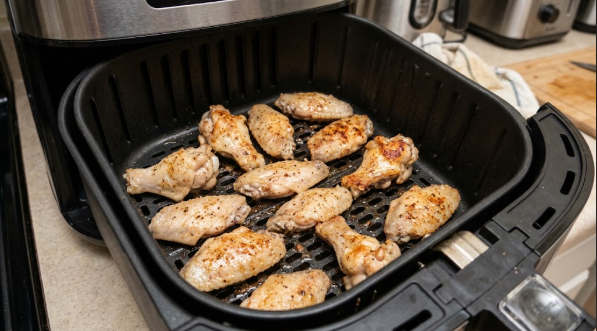
COMMON MISTAKE Overloading the basket. When wings are stacked, the middle ones steam and the skin turns rubbery. Cook two smaller batches and hold the first in a 200°F (93°C) oven on a wire rack while the second cooks.
Air Fryer Chicken Wings Time and Temperature Table
Times depend on your model and basket size.
| Wing type | First cook | Second cook | Pull temp | Total time |
| Fresh flats and drumettes | 15 min at 380°F (193°C) | 12-15 min at 400°F (204°C) | 175-185°F (79-85°C) | 27-30 min |
| Whole wings (with tip) | 18 min at 380°F (193°C) | 12-15 min at 400°F (204°C) | 175-185°F (79-85°C) | 30-33 min |
| Small party wings | 12 min at 380°F (193°C) | 10-12 min at 400°F (204°C) | 175-185°F (79-85°C) | 22-24 min |
| Frozen, uncoated | 12 min at 380°F (193°C) | 15-18 min at 400°F (204°C) | 175-185°F (79-85°C) | 27-30 min |
| Reheating leftovers | 5-8 min at 350°F (177°C) | n/a | 165°F (74°C) minimum | 5-8 min |
How to Tell When Air Fryer Chicken Wings Are Done
For safety, cook poultry to a minimum internal temperature of 165°F (74°C), the USDA’s safe minimum for all poultry, including wings. Always check with a thermometer. Color alone is not reliable.
Why pull higher? Wings have a lot of connective tissue and fat. At 165°F (74°C) they are safe but can be a little chewy near the bone. Taking them to 175°F to 185°F (79-85°C) renders more fat and gives a more tender bite. That is a quality preference, not a safety rule.
Use these signs, too:
- Skin: deep golden, dry to the touch, with small blisters.
- Sound: a light crackle when you tap a wing with tongs.
- Meat: pulls easily from the bone, and juices run clear.
- Feel: the drumette bone wiggles loosely in the meat.
Saucing, Resting, and Serving
Let the wings rest for 2 to 3 minutes before saucing. This lets the skin firm up. Then toss with sauce in a big bowl, not in the basket, so the sauce does not drip into the fryer and smoke.
Sauce only what you will eat right away. Wet sauce softens the skin within 10 to 15 minutes. If you are serving a crowd, keep some wings plain and put sauces in bowls on the side.
Here are four easy ways to finish them:
- Buffalo: whisk the hot sauce, melted butter, vinegar, and garlic powder, then toss.
- Lemon pepper: toss with 2 tbsp melted butter, 1 tbsp lemon zest, and 1 tsp cracked pepper.
- Garlic parmesan: toss with 3 tbsp melted butter, 3 minced garlic cloves, and ½ cup grated parmesan.
- Honey BBQ: warm ½ cup barbecue sauce with 2 tbsp honey, then toss.
What to Serve With Air Fryer Chicken Wings
Wings are rich and spicy, so pair them with something cool, crisp, or smoky.
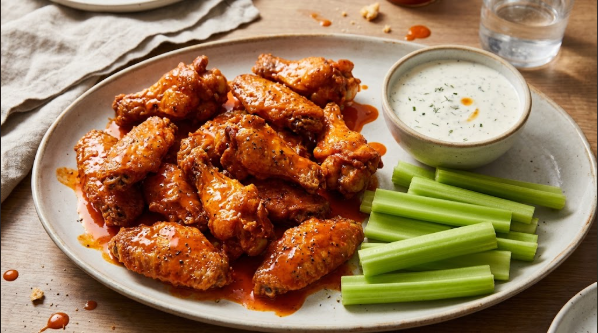
- Raw veggie sticks. Celery, cucumber, and carrot sticks cool down the heat. Grilled carrots add sweetness if you want a cooked option.
- Dips. Ranch and blue cheese are classic. A cool yogurt-and-herb dip is a lighter swap.
- Smoky sides. Brussels sprouts on a pellet grill bring char and crunch to the table.
- Grilled veggies. Grilled bell peppers add color and a mild sweetness.
- Coleslaw or corn on the cob. Both balance buffalo heat.
Storing, Freezing, and Reheating Leftovers
Timing matters at parties. Bacteria grow fastest between 40°F and 140°F (4°C and 60°C), a range the USDA calls the Danger Zone. Do not leave perishable food out for more than two hours, or one hour if it is above 90°F (32°C). For game day, keep hot wings at or above 140°F (60°C) in a warm oven or slow cooker.
Refrigerating
Refrigerate leftovers within two hours, in shallow containers. According to USDA guidance on leftovers, cooked chicken keeps for 3 to 4 days in the fridge.
Freezing
The same USDA page says leftovers can be frozen for 3 to 4 months for best quality. Freeze wings in a single layer on a tray first, then bag them. Sauced wings freeze less well because the skin turns soft.
Reheating
The air fryer is the best way to bring wings back to life. Heat at 350°F (177°C) for 5 to 8 minutes, flipping once, until the center reaches 165°F (74°C), the USDA’s recommended temperature for leftovers. From frozen, allow 10 to 14 minutes . A microwave reheats fine but leaves soft skin.
Variations: Frozen, Pellet Grill, Offset, Charcoal, and Oven
Cooking frozen wings
The USDA says it is safe to cook poultry from frozen, but it takes longer. Start with 12 minutes at 380°F (193°C), separate any stuck wings, then season and finish at 400°F (204°C) for 15 to 18 minutes. Make sure the thickest part hits at least 165°F (74°C).
Pellet grill
Set the grill to 375°F (190°C) with apple or hickory pellets. Cook the coated wings on a rack for 40 to 50 minutes, flipping once, until crisp and 175°F to 185°F (79-85°C) For another smoky poultry project, see our guide to smoked turkey legs.
Offset or charcoal
Set up indirect heat at about 375°F (190°C) with a small piece of pecan or apple wood. Cook for 40 to 45 minutes, flipping once, and finish over direct heat for 1 to 2 minutes per side for blistered skin Oven backup
Bake coated wings on a wire rack over a sheet pan at 425°F (218°C) for 45 to 50 minutes, flipping at the halfway mark. The rack lets heat reach the underside. Expect slightly less crunch than the air fryer.
Troubleshooting Air Fryer Chicken Wings
| Problem | Likely cause | Fix |
| Soggy skin | Wings were wet or basket overcrowded | Dry thoroughly and cook in a single layer |
| Pale, not browned | Temperature too low or no preheat | Preheat and finish at 400°F (204°C) |
| Bitter or chalky coating | Too much baking powder | Use 1½ tbsp per 3 lb and shake off clumps |
| Dry meat | Overcooked past 190°F (88°C) | Check at 25 minutes and pull at 185°F (85°C) |
| Burned tips | Wing tips left on | Remove tips or lower the second cook to 390°F (199°C) |
| Smoke from the fryer | Fat pooling in the drawer | Wipe the drawer between batches and skip extra oil |
| Skin stuck to basket | No spray, wings flipped too early | Spray lightly and wait until the 15-minute mark |
| Sauce slides off | Wings too hot and wet | Rest 2 minutes, then toss and serve fast |
Air Fryer Chicken Wings Recipe Card
Yield: 4-6 appetizer servings Prep time: 15 minutes (plus 1-4 hours drying) Cook time: 27-30 minutes Total time: about 45 minutes active, plus drying
Ingredients: 3 lb (1.4 kg) wings; 1½ tbsp aluminum-free baking powder; 1 tsp salt; ½ tsp pepper; 1 tsp garlic powder; 1 tsp smoked paprika; buffalo sauce (½ cup hot sauce, 4 tbsp butter, 1 tsp vinegar).
Short steps:
- Pat wings dry and chill uncovered on a rack for 1-4 hours.
- Toss with baking powder, salt, and spices.
- Preheat the air fryer to 380°F (193°C).
- Cook in a single layer for 15 minutes.
- Flip and raise to 400°F (204°C); cook 12-15 minutes.
- Check for 175-185°F (79-85°C); USDA minimum is 165°F (74°C).
- Rest 2-3 minutes, then toss in sauce.
- Refrigerate leftovers within 2 hours; reheat to 165°F (74°C).
Air Fryer Chicken Wings FAQ
How long do you cook chicken wings in an air fryer?
Fresh wings take about 27 to 30 minutes: 15 minutes at 380°F (193°C), then 12 to 15 minutes at 400°F (204°C) after flipping. Small party wings need a few minutes less. Always confirm doneness with a thermometer, since basket size and fryer model change the timing.
What temperature should air fryer chicken wings be?
Use 380°F (193°C) to start and 400°F (204°C) to finish. The first stage renders fat, and the second crisps the skin. Internally, wings must reach at least 165°F (74°C) for safety, though 175°F to 185°F (79-85°C) gives more tender, better-rendered meat.
Do you need oil for air fryer wings?
No. Wings have plenty of natural fat that renders during cooking. A light spray on the basket can prevent sticking, but oil on the wings is optional. The baking powder coating does more for crispness than oil does, as long as the wings are dried first.
Do you need to flip wings in the air fryer?
Yes, flip once at the halfway point, about 15 minutes in. Flipping browns both sides evenly and keeps the underside from sticking to the basket. If your fryer runs hotter on one side, rotate the basket at the same time.
Can you cook frozen chicken wings in an air fryer?
Yes. Cook them from frozen, but plan on extra time, about 27 to 30 minutes in total, and separate any stuck wings early. Season after the first 12 minutes so the coating sticks. Check that the thickest part reaches at least 165°F (74°C).
How do you get air fryer wings crispy?
Dry the skin well, rest the wings uncovered in the fridge for at least an hour, and coat them lightly with baking powder. Cook in a single layer, flip once, and finish at 400°F (204°C). Sauce them only right before serving so the skin stays crisp.
Final Thoughts on Air Fryer Chicken Wings
Great air fryer chicken wings come down to four habits: dry the skin, coat lightly with baking powder, give the wings room, and finish at a higher heat. Do those, and you get crackling skin and tender meat in about half an hour.
Pick a sauce, set out cool veggies and dip, and serve them hot. Save the extras for a quick air fryer reheat within 3 to 4 days.
Laura Smith

I'm Laura, I like all the kind of delicious grilled foods which makes me hungry all the time I see them. That's why I built this blog to share with you all of my Grilling experiences, recipes, and all the tips about foods that I've learned from food experts.