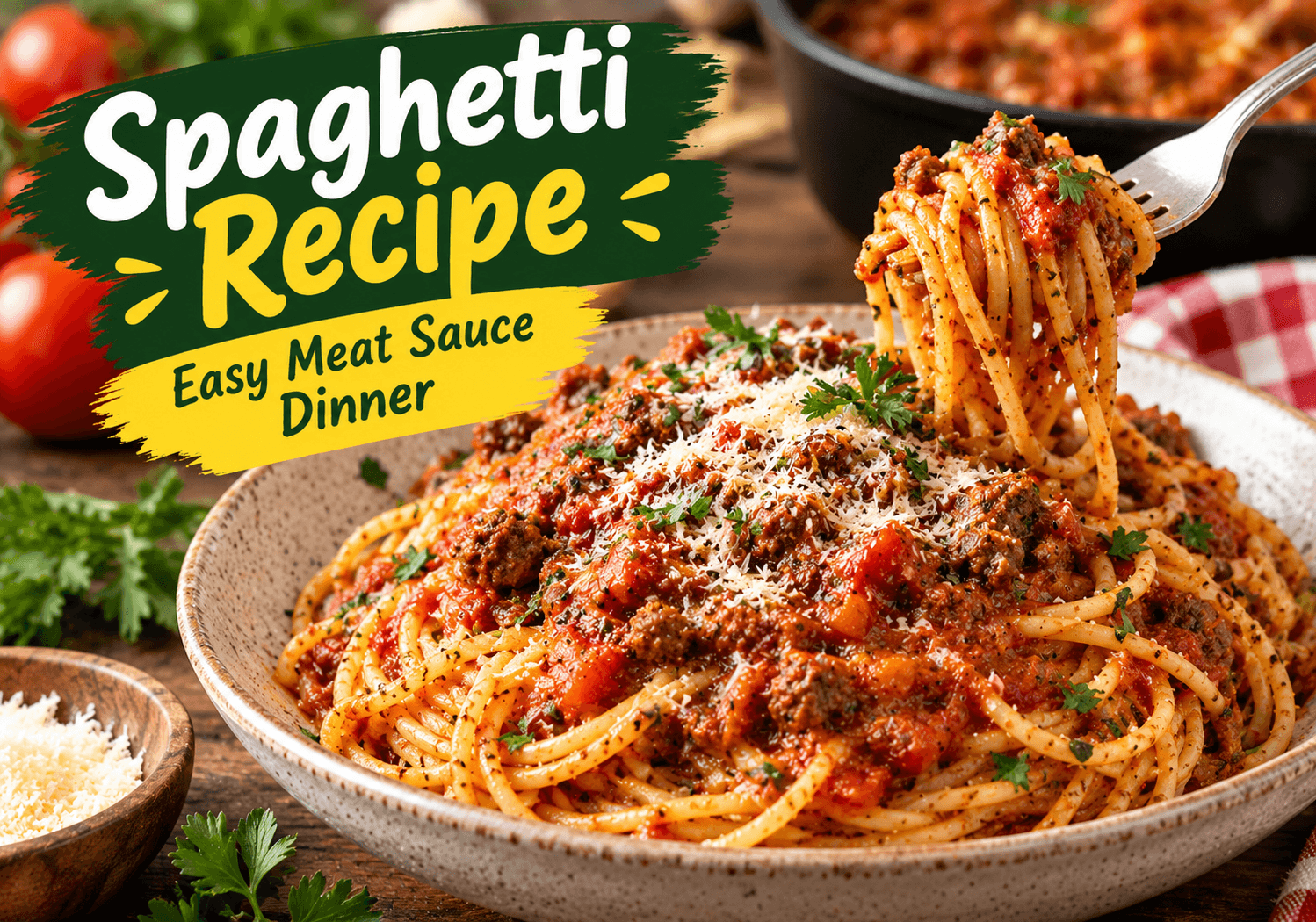
This spaghetti recipe gives you a thick, savory meat sauce and noodles that stay firm instead of mushy. It uses a short ingredient list, one pot for the sauce, and a few small steps that make a big difference: browning the beef hard, cooking the tomato paste, and finishing the pasta in the sauce. A good spaghetti recipe does not need a secret ingredient. It needs patience and the right heat.
Whether you cook on the stove, a pellet grill, or in the oven, the method stays the same: brown, build, simmer, and toss. This guide covers temps, times, substitutions, storage, and fixes. For more weeknight ideas, see our easy pasta recipes.
Quick Answer: Brown 1 lb (0.45 kg) of ground beef to 160°F (71°C), build the sauce with onion, garlic, tomato paste, and crushed tomatoes, then simmer 45 minutes on low. Boil 1 lb (0.45 kg) of spaghetti for 8-10 minutes until al dente, toss it in the sauce, and serve. Total time is about 1 hour 15 minutes.
Why This Spaghetti Recipe Works
A great pot of spaghetti and meat sauce comes down to flavor built in layers. Each step in this spaghetti recipe has a job.
- Hard browning. Beef that sits undisturbed in a hot pot develops a dark crust. That crust is flavor, and gray, steamed beef cannot match it.
- Cooked tomato paste. Two minutes in the pot turns it dark and sweet and removes the raw, tinny taste.
- A 45-minute simmer. Time thickens the sauce and blends the herbs, tomato, and beef. Rushing it gives you a thin, sharp sauce.
- Salted pasta water. Noodles season from the inside. Bland pasta is hard to fix once it is on the plate.
- Finishing in the sauce. Tossing the pasta in the pot for 1-2 minutes lets it soak up flavor. A splash of starchy pasta water helps the sauce cling.
Ingredients and Equipment for This Spaghetti Recipe
This makes 6 servings. Plan on about 2.7 oz (75 g) of dry spaghetti per person.
For the sauce
- 2 tablespoons olive oil
- 1 lb (0.45 kg) 80/20 ground beef
- 1 medium yellow onion, finely diced (about 1 cup)
- 1 medium carrot, finely grated (optional, for sweetness)
- 4 garlic cloves, minced
- 2 tablespoons tomato paste
- 1/2 cup (120 ml) dry red wine, or beef broth
- 1 can (28 oz / 1.75 lb / 0.79 kg) crushed tomatoes
- 1/2 cup (120 ml) beef broth or water
- 2 teaspoons dried oregano
- 1 teaspoon dried basil
- 1 teaspoon kosher salt, plus more to taste
- 1/2 teaspoon black pepper
- 1 bay leaf
- 1/2 teaspoon sugar, only if needed
For the pasta and finish
- 1 lb (0.45 kg) dry spaghetti
- 4 quarts (3.8 L) water
- 1 to 2 tablespoons kosher salt for the pasta water
- Freshly grated Parmesan, for serving
- Fresh basil, torn, for serving
Equipment
- 5-6 quart (5-5.5 L) Dutch oven or deep skillet
- 8-quart (7.5 L) stockpot
- Wooden spoon, tongs, and a colander
- Instant-read thermometer
- Box grater or microplane
Easy substitutions
- Meat: Swap half the beef for Italian sausage with the casings removed. For ground turkey or chicken, cook to 165°F (74°C).
- No wine: Use beef broth plus 1 teaspoon red wine vinegar.
- Tomatoes: Hand-crush a 28 oz can of whole peeled tomatoes. Fresh tomatoes work, but you need about 3 lb (1.4 kg), peeled, and a longer simmer.
- Herbs: Use 1 tablespoon of chopped fresh oregano or basil for every 1 teaspoon dried. Add fresh basil at the end.
- Pasta: Whole wheat or gluten-free spaghetti both work. Start tasting 2 minutes early, because they overcook fast.
- Cheese: Pecorino Romano gives a sharper, saltier finish than Parmesan.
Choosing and Prepping the Beef, Tomatoes, and Pasta
Choose 80/20 ground beef for the best flavor. Leaner beef, such as 90/10, works but can taste dry, so add the full 2 tablespoons of olive oil. Keep the beef cold until the moment it hits the pot.
For tomatoes, look for crushed or whole peeled tomatoes with no added sugar. The ingredient list should be short. Spaghetti with a rough, matte surface, often labeled bronze-die cut, holds sauce better than very shiny pasta.
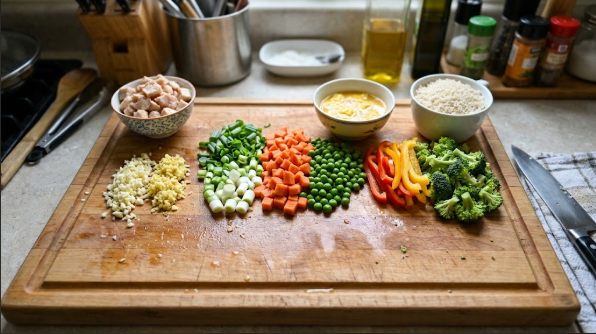
Dice the onion small, about 1/4 inch (6 mm), so it melts into the sauce. Grate the carrot on the fine side of a box grater. Mince the garlic last, so it does not dry out while you work.
Pitmaster Tip: Make the sauce a day ahead if you can. Overnight rest in the refrigerator blends the herbs and tomato, and the flavor is rounder the next day. Reheat gently on the stove and loosen it with a splash of water.
Spaghetti Recipe Step by Step
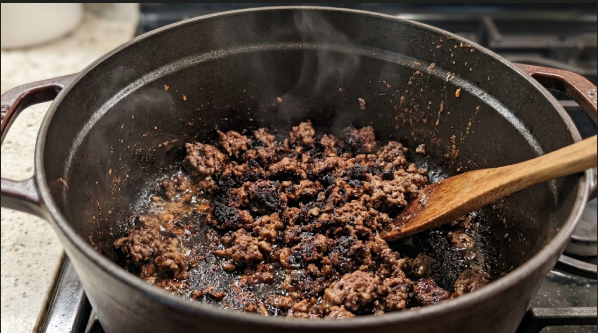
- Brown the beef. Heat the olive oil in a Dutch oven over medium-high heat. Add the beef in an even layer. Do not stir for 2-3 minutes, then break it up and cook 8-10 minutes total, until deeply browned and at least 160°F (71°C) on a thermometer. Spoon off all but 1-2 tablespoons of fat.
- Soften the vegetables. Lower the heat to medium. Add the onion, carrot, and a pinch of salt. Cook 5 minutes, stirring, until soft and translucent.
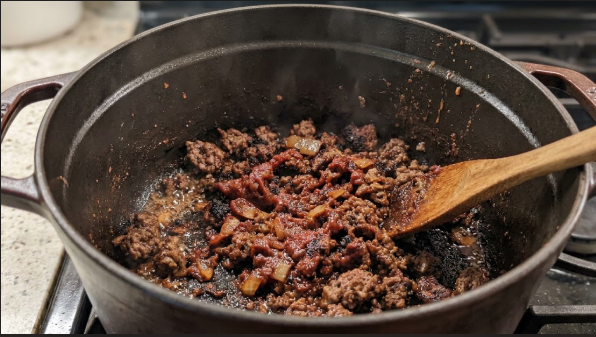
- Cook the garlic and paste. Stir in the garlic for 30-60 seconds. Add the tomato paste and cook 2 minutes, stirring, until it darkens to a brick red and sticks to the pot.
- Deglaze. Pour in the wine. Scrape up the browned bits and cook 2-3 minutes until the liquid is nearly gone.
- Add the tomatoes. Stir in the crushed tomatoes, broth, oregano, basil, salt, pepper, and bay leaf. Bring to a bubble.
- Simmer low. Reduce the heat until you see a small bubble every second or two. Partially cover. Cook 45 minutes, stirring every 10-15 minutes. Add 2-3 tablespoons of water if it gets too thick.
- Boil the pasta. About 10 minutes before the sauce is done, bring 4 quarts (3.8 L) of water to a rolling boil. Add 1-2 tablespoons of salt, then the spaghetti. Stir the first 2 minutes. Cook until 1 minute short of the package time, usually 8-10 minutes. Scoop out 1 cup (240 ml) of pasta water, then drain.
- Toss together. Remove the bay leaf. Add the pasta and 1/4 cup (60 ml) of pasta water to the sauce. Toss over medium heat 1-2 minutes, until the sauce clings to every strand.
- Rest and serve. Turn off the heat and let it sit 5 minutes. Top with Parmesan and basil.
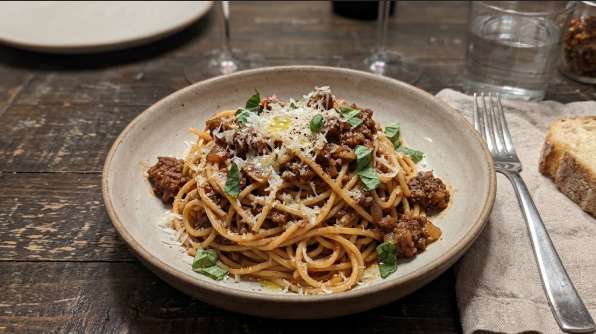
Common Mistake: Rinsing the pasta after draining. Rinsing washes away the surface starch that helps sauce stick, so the noodles end up slick and the sauce pools in the bowl. Move the pasta straight from the pot to the sauce.
Time and Temperature Table
| Step | Heat | Target | Time |
| Brown beef | Medium-high | At least 160°F (71°C), deep brown crust | 8-10 min |
| Soften onion and carrot | Medium | Soft and translucent | 5 min |
| Cook tomato paste | Medium | Dark brick red | 2 min |
| Deglaze with wine | Medium | Liquid nearly gone | 2-3 min |
| Simmer sauce | Low | Small bubble every 1-2 seconds | 45 min |
| Boil spaghetti | Rolling boil | Al dente | 8-10 min |
| Toss in sauce | Medium | Sauce clings to noodles | 1-2 min |
| Rest off heat | None | Sauce settles and thickens slightly | 5 min |
How to Tell When Your Spaghetti Is Done
Check the sauce first. Drag a spoon across the bottom of the pot. If it leaves a clear trail that fills in slowly, the sauce is thick enough. The color should be a deep red-brown, with a slight orange sheen of oil around the edges.
Taste for salt, acid, and sweetness. It should taste rich, not sharp or flat. Add salt a pinch at a time. Stir in a pinch of sugar only if the sauce tastes sour.
For the pasta, bite a strand. Al dente spaghetti is tender but firm, with a tiny pale dot in the center. It will keep softening in the hot sauce, which is why you pull it 1 minute early.
Do not judge the beef by color. The USDA warns that ground beef can look brown before it is safe, so use a thermometer. Cook ground beef to the USDA safe minimum of 160°F (71°C), and ground poultry to 165°F (74°C).
Resting, Serving, and Plating
The 5-minute rest lets the sauce settle so it does not run off the noodles. Warm the bowls in a 200°F (95°C) oven for a few minutes if you like. Hot sauce on a cold plate cools fast.
Twirl a portion with tongs and a large spoon, then set it in the bowl. Add about 1 tablespoon of grated Parmesan per serving, a few basil leaves, and a crack of black pepper. For a smoky twist, shave a little smoked cheese over the top.
What to Serve With Spaghetti and Meat Sauce
- Bread: Grilled garlic bread soaks up extra sauce. Our grilled bread method gives you crisp edges and a chewy center.
- Salad: A crisp green salad with a sharp vinaigrette cuts through the rich sauce.
- Vegetables: Charred sides add color and sweetness. Try grilled bell peppers or roasted broccoli.
- Drinks: Sparkling water with lemon, or a medium red wine such as Chianti.
Planning a full menu? Browse our dinner ideas with pasta for more combinations.
Storing, Freezing, and Reheating Leftovers
Cool leftovers in shallow containers and refrigerate within 2 hours. The USDA FSIS leftovers guidance says most leftovers keep 3 to 4 days in the refrigerator, or 3 to 4 months frozen at 0°F (-18°C). University of Illinois Extension lists the same windows.
Store the sauce and noodles separately if you can. Pasta keeps better texture that way, and the sauce freezes well on its own. Freeze sauce in 2-cup (475 ml) portions in freezer bags, laid flat so they thaw quickly.
To reheat: Leftovers should reach 165°F (74°C), per the USDA. Warm sauce on the stove over medium-low heat with a splash of water, stirring often. Dip cold noodles in boiling water for 30-60 seconds, then toss with the sauce. In the microwave, cover with a damp paper towel and heat in 60-second bursts, stirring between. The same gentle approach works in our guide to reheating alfredo.
Variations: Pellet Grill, Offset, Charcoal, Oven, and Slow Cooker
- Pellet grill: Set the grill to 300°F (150°C). Use a Dutch oven and brown the beef on the stovetop first, or on a hot cast iron pan. Simmer the sauce on the grill, partly covered, about 1 hour 15 minutes. Use mild wood like cherry or pecan. Heavy hickory can overpower tomato.
- Offset or charcoal grill: Hold a steady 300°F (150°C) and set the Dutch oven off to the side of the coals. Stir every 15 minutes and rotate the pot so one side does not scorch.
- Oven backup: After step 5, cover the Dutch oven and bake at 325°F (165°C) for about 1 hour. The even heat means less stirring and less scorching.
- Slow cooker: Brown the beef and vegetables on the stove, then move everything but the pasta to the slow cooker. Cook on low for 6-8 hours. See our easy crockpot meals for more set-and-forget dinners.
- Meatballs: Roll 1.5 inch (4 cm) beef meatballs and bake at 400°F (200°C) for about 18-20 minutes, until 160°F (71°C) inside. Simmer them in the sauce for 10 minutes.
- Meatless: Swap the beef for diced mushrooms and lentils. Our vegetarian pasta recipes have more ideas.
- Spicy: Add 1/2 teaspoon red pepper flakes with the garlic.
Troubleshooting Your Spaghetti Recipe
| Problem | Likely Cause | Fix |
| Watery sauce | Simmer too short or lid fully on | Simmer uncovered 10-15 minutes more |
| Bland sauce | Under-salted or under-browned | Salt in layers; brown the beef longer next time |
| Too sharp or sour | Acidic tomatoes | Add grated carrot or 1/2 teaspoon sugar; simmer 5 minutes |
| Greasy surface | Fat not drained | Spoon off the oil, or blot with a paper towel |
| Mushy noodles | Overcooked or sat too long | Pull 1 minute early; finish in sauce |
| Clumped noodles | Not enough water or no stirring | Use 4 quarts (3.8 L); stir the first 2 minutes |
| Sauce too thick | Over-reduced | Stir in pasta water 2 tablespoons at a time |
| Burnt bottom | Heat too high | Lower the heat; stir more often; use a heavier pot |
Recipe Card: Spaghetti Recipe With Meat Sauce
Servings: 6 | Prep: 15 minutes | Cook: 1 hour | Total: about 1 hour 15 minutes
Ingredients: 1 lb (0.45 kg) ground beef; 1 onion; 1 carrot; 4 garlic cloves; 2 tbsp tomato paste; 1/2 cup (120 ml) red wine; 28 oz (0.79 kg) crushed tomatoes; 1/2 cup (120 ml) broth; oregano, basil, bay leaf, salt, pepper; 2 tbsp olive oil; 1 lb (0.45 kg) spaghetti; Parmesan and basil.
Steps:
- Brown the beef in olive oil to at least 160°F (71°C). Drain extra fat.
- Cook the onion and carrot 5 minutes. Add the garlic, then the tomato paste for 2 minutes.
- Deglaze with wine. Add the tomatoes, broth, herbs, and bay leaf.
- Simmer on low for 45 minutes, stirring now and then.
- Boil the spaghetti in salted water until 1 minute short of the package time. Save 1 cup (240 ml) of pasta water.
- Toss the pasta in the sauce for 1-2 minutes. Rest 5 minutes and serve with Parmesan.
Spaghetti Recipe FAQ
What is the secret to a good spaghetti recipe?
Brown the beef well, cook the tomato paste until dark, simmer 45 minutes, and finish the pasta in the sauce. Those four habits build deeper flavor than any extra ingredient. Salt the pasta water well, too, because noodles season from the inside.
How long should you simmer spaghetti sauce?
Simmer meat sauce 45 minutes to 1 hour on low heat, stirring every 10-15 minutes. Less than 30 minutes tastes raw and thin. If it gets too thick, add a splash of water. Keep the bubbles slow and small so the bottom does not scorch.
How do you keep spaghetti from sticking?
Use plenty of water, about 4 quarts (3.8 L) per pound, and stir during the first 2 minutes, when noodles are sticky. Skip oil in the water, because it makes sauce slide off. Move the drained pasta straight into the sauce.
Can you freeze spaghetti sauce?
Yes. Cool it in shallow containers, then freeze. USDA FSIS says leftovers hold quality for 3 to 4 months at 0°F (-18°C). Thaw overnight in the refrigerator and reheat on the stove to 165°F (74°C). Freeze the sauce without noodles for the best texture.
Should you add sugar to spaghetti sauce?
Only a pinch, and only if the sauce tastes sharp. Good canned tomatoes and cooked tomato paste are usually sweet enough. Try grated carrot first. Start with 1/2 teaspoon, simmer 5 minutes, and taste again before adding more.
Why does my spaghetti sauce taste bland?
Bland sauce usually needs more salt, more browning, or more time. Season in layers: salt the onions, the sauce, and the pasta water. Stir in grated Parmesan or a splash of red wine vinegar at the end to wake up the flavors.
Conclusion
A great spaghetti recipe is built from simple steps done well: hard-browned beef, dark tomato paste, a steady 45-minute simmer, and pasta finished in the sauce. Hit 160°F (71°C) on the beef, pull the noodles 1 minute early, and rest the pot for 5 minutes.
Make a double batch and freeze half for busy nights. Then try the pellet grill, slow cooker, and meatball options to make this spaghetti recipe your own.
Laura Smith

I'm Laura, I like all the kind of delicious grilled foods which makes me hungry all the time I see them. That's why I built this blog to share with you all of my Grilling experiences, recipes, and all the tips about foods that I've learned from food experts.