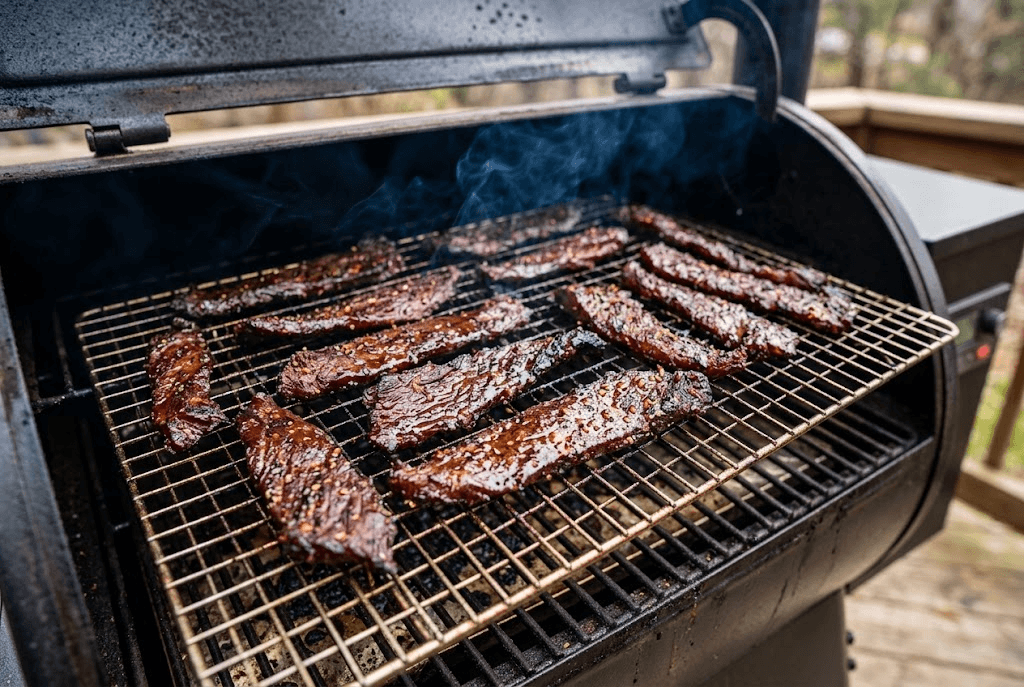
Making beef jerky on a pellet grill is one of the easiest ways to turn a cheap, lean roast into a snack that costs a fraction of store-bought bags. Your pellet grill holds a steady low temperature, feeds real wood smoke to the meat, and frees your oven. The trick is getting the strips dry and chewy without leaving them unsafe or brittle.
This guide walks through the whole process: picking the cut, slicing, a simple marinade, a two-stage cook that follows USDA guidance, doneness tests, and storage. If you can set a pellet grill to 180°F, you can make this.
Quick Answer
For beef jerky on a pellet grill, smoke marinated ¼-inch (6 mm) strips at 180°F (82°C) for 1 hour. Raise the heat so the meat reaches 160°F (71°C), the USDA’s jerky guidance. Then drop to 170°F (77°C) and dry 1.5 to 3 hours until the jerky bends and cracks without snapping.
Why Beef Jerky on a Pellet Grill Works So Well
A pellet grill is basically an outdoor convection oven that burns wood. The fan moves air around the grate, the controller holds a steady temperature, and the pellets add smoke flavor you cannot get from a dehydrator. Those three things are exactly what jerky needs.
Jerky is not really “cooked” in the way a steak is. You are slowly removing moisture while the salt, sugar, and smoke build flavor on the surface. That means the grill must run low and steady, and the air must keep moving so water can leave the meat.
Here is why beef jerky on a pellet grill is worth your time:
- Real smoke flavor. Hickory, oak, or apple pellets give jerky a depth that liquid smoke alone cannot match.
- Big batches. A standard pellet grill grate holds 3 to 5 lb (1.4 to 2.3 kg) of sliced meat on racks.
- Easy temperature control. You set 180°F or 170°F and the controller does the work.
- Low cost. Lean beef roasts are cheaper per pound than the jerky you buy in a bag.
If you are still shopping for a cooker, our guide to the best pellet grills for beginners covers models that hold low temperatures well, which matters a lot for jerky.
Ingredients and Equipment
This beef jerky on a pellet grill recipe makes about 12 to 16 oz (340 to 450 g) of finished jerky from 3 lb (1.4 kg) of raw trimmed beef. Dried jerky weighs roughly a quarter to a third of the raw meat, so plan your batch size from that.
Meat
- 3 lb (1.4 kg) beef eye of round or top round, trimmed of visible fat and silver skin
Marinade
- ½ cup (120 ml) low-sodium soy sauce
- ¼ cup (60 ml) Worcestershire sauce
- 2 tablespoons brown sugar
- 1 tablespoon coarsely ground black pepper
- 1 tablespoon smoked paprika
- 2 teaspoons garlic powder
- 2 teaspoons onion powder
- 1 teaspoon red pepper flakes (optional)
- 1 teaspoon liquid smoke (optional, since the pellets add smoke)
- ¼ cup (60 ml) water
Equipment
- Pellet grill and hardwood pellets (hickory, oak, apple, or a blend)
- Sharp slicing knife (see our picks for the best knives for cutting meat)
- Large zip-top bags or a glass dish with a lid
- Wire cooling racks that fit your grill grate, or jerky racks
- Instant-read digital thermometer
- Paper towels
- Airtight containers or a vacuum sealer
Substitutions
- Meat: Flank steak, bottom round, or sirloin tip all work. Venison works too, but it needs its own safety handling.
- Soy sauce: Use coconut aminos or tamari for a gluten-free version, and check the label.
- Sweetener: Swap brown sugar for honey or maple syrup, but use a little less, because both burn and stick faster.
- Curing salt: Some cooks add curing salt for color and extra protection during low-temperature smoking. If you use it, follow the package directions exactly.
Choosing the Best Cut for Beef Jerky on a Pellet Grill
Fat goes rancid, and rancid fat shortens shelf life. That is why lean cuts make the best jerky.
Eye of round is my first pick. It is very lean, uniform in shape, and slices into even strips. Top round is a close second and often easier to find in larger packages. Flank steak has a lot of flavor and a visible grain, but it can turn tough if sliced too thin or dried too long.
Skip well-marbled cuts like ribeye or brisket flat with a heavy fat cap. They taste great fresh, but the fat will go greasy and spoil faster in a jerky bag. If you want a fatty cut, make that rib recipe instead.
Prepping the Meat: Trim, Freeze, Slice
Good prep is 80% of good jerky. Most failures come from uneven slices and leftover fat.
- Trim all visible fat. Cut away the fat cap, the silver skin, and any thick connective tissue. Fat does not dry, so it stays soft and can spoil.
- Partially freeze the roast. Put it in the freezer for 60 to 90 minutes until firm but not rock solid. A firm roast slices cleanly.
- Slice to ¼ inch (6 mm) thick. Use a long, sharp knife. Keep every strip the same thickness so they all dry at the same rate.
- Choose your grain direction. Slice against the grain for tender, easy-to-bite jerky. Slice with the grain for a chewier, more traditional strip.
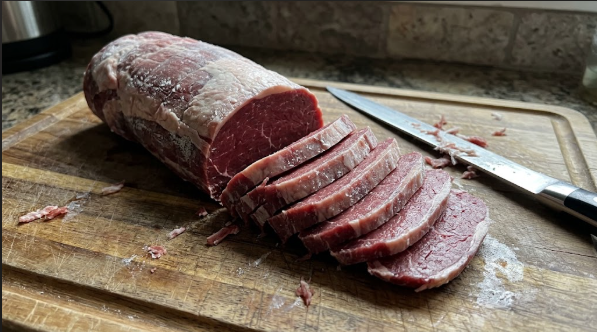
Pitmaster Tip: Slice the roast, then lay a strip flat on the board and press it with your palm. If the thickness varies by more than a pencil’s width from one end to the other, trim it. Uneven strips are the main reason half a tray is done while the other half is still soft.
The Marinade for Beef Jerky on a Pellet Grill
Whisk all the marinade ingredients in a bowl until the sugar dissolves. Put the beef strips in a large zip-top bag or glass dish, pour in the marinade, and press out the air. Turn the bag a few times to coat every piece.
Marinate in the refrigerator, never on the counter. Keep it at or below 40°F (4°C) for 8 to 24 hours. The USDA’s guidance on homemade jerky says to marinate meat in the refrigerator, and the same page says to defrost frozen meat in the fridge too.
Give the bag a flip once or twice. Eight hours gives good flavor. Twenty-four is the upper limit, because longer than that the meat can turn salty and mushy.
Common Mistake: Skipping the blotting step. If you pull wet strips out of the marinade and put them straight on the racks, the surface stays damp, smoke does not stick well, and drying takes much longer. Lay the strips on paper towels and pat both sides until they feel tacky, not dripping.
Step-by-Step: How to Make Beef Jerky on a Pellet Grill
This method uses two stages. Stage one adds smoke at a low temperature. Stage two heats the meat to the USDA’s recommended temperature, then dries it. I explain why below.
Why Two Stages?
The USDA Meat and Poultry Hotline recommends heating meat to 160°F before the dehydrating process for homemade jerky, because dry, low heat can leave harmful bacteria alive. A pellet grill running at 170°F all day does not reliably take thin strips to 160°F, so we build that step into the cook.
The Steps
- Remove the meat from the marinade. Drain it and pat the strips dry with paper towels.
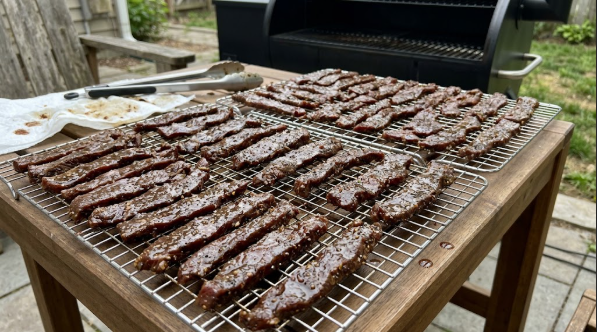
- Arrange the strips on racks. Lay them on wire racks in a single layer. Leave about ¼ inch (6 mm) between pieces so smoke and air can circulate.
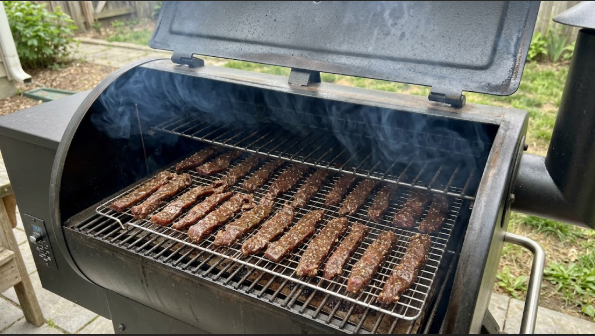
- Fire up the pellet grill. Fill the hopper with hickory, oak, or apple pellets. Set the grill to 180°F (82°C), or use the smoke setting if your grill has one. Let it run 10 minutes until the smoke looks thin and blue.
- Smoke for 1 hour at 180°F (82°C). Put the racks on the grate and close the lid. Do not open it often, because every peek drops the temperature and dumps smoke.
- Raise the temperature to 250°F (121°C). After the first hour, turn the controller up. Thin strips usually reach 160°F (71°C) in the thickest part within 20 to 40 minutes, but start checking at 15 minutes.
- Check the internal temperature. Slide an instant-read thermometer sideways into the thickest strip. Check 3 or 4 different pieces. All of them should read at least 160°F (71°C).
- Drop the grill to 170°F (77°C). Once the strips hit 160°F, lower the temperature and let the grill settle.
- Dry for 1.5 to 3 hours. Rotate the racks every 45 minutes so strips near the heat do not over-dry. Start testing for doneness at 90 minutes.
- Pull the jerky when it passes the bend test. See the doneness section below.
- Cool and condition. Let the jerky cool on racks for 30 minutes, then bag it loosely for a few hours before sealing it for storage.
Pitmaster Tip: Many cooks skip the 250°F step and run the grill at 160 to 180°F for the whole cook, and the result tastes fine. If you go that route, you are outside the USDA’s recommended procedure, so I do not recommend it for anyone serving jerky to kids, older adults, or anyone with a weakened immune system.
Time and Temperature Table for Beef Jerky on a Pellet Grill
| Stage | Grill Temp | Time | Goal |
| Preheat | 180°F (82°C) | 10 minutes | Clean, thin smoke |
| Smoke | 180°F (82°C) | 1 hour | Smoke flavor on damp, tacky surface |
| Heat to safe temp | 250°F (121°C) | 20 to 40 minutes | Meat reaches 160°F (71°C) |
| Dry | 170°F (77°C) | 1.5 to 3 hours | Remove moisture, firm texture |
| Cool | Room temperature | 30 minutes | Finish drying, check texture |
| Condition | Loose bag | 2 to 4 hours | Even out moisture |
Total time for beef jerky on a pellet grill is usually 3 to 5 hours, depending on slice thickness, humidity, and how many racks you load. Treat the times as a guide and the bend test as the final word.
Which Wood Pellets Are Best for Beef Jerky on a Pellet Grill?
Jerky sits in smoke for hours, so strong woods can turn bitter. Pick based on how smoky you like it:
- Hickory: Classic bold, savory smoke. A safe first choice.
- Oak: Medium, steady smoke that does not overpower the marinade.
- Apple or cherry: Mild and slightly sweet, with a nice reddish color on the meat.
- Mesquite: Very strong. Use it in a blend, not by itself.
A blend of hickory and apple is a reliable crowd-pleaser for beef jerky on a pellet grill. Always use food-grade cooking pellets, never heating pellets.
How to Tell When Beef Jerky on a Pellet Grill Is Done
Time is a guess. Your beef jerky on a pellet grill tells you the truth.
The bend test: Take a piece off the rack and let it cool for 5 minutes, since hot jerky always feels softer than cool jerky. Bend it 90 degrees. Done jerky bends and shows white cracks on the surface, but it does not snap in two. If it bends without any cracking, it needs more time. If it snaps cleanly, it is over-dried.
What it looks and feels like:
- Dark brown to mahogany with a dry, leathery surface
- Slightly flexible with a firm chew
- No wet, shiny, or soft spots in the middle when you tear one open
Always confirm the 160°F (71°C) pull temperature during the heat stage as well, since that is a food safety check and the bend test is a texture check. You need both.
Resting, Slicing, and Serving
Let the jerky cool on the racks for at least 30 minutes. It will firm up as it cools and the surface oils settle. Then put it in a zip-top bag, leave the bag cracked open for 2 to 4 hours, and shake it now and then. This “conditioning” step evens out moisture between thick and thin pieces.
If a piece feels too wet after conditioning, return it to the grill at 170°F for 20 minutes.
What to Serve With Beef Jerky
Beef jerky on a pellet grill is a snack, but it works well on a board or in a lunch box:
- Sharp cheddar, pepper jack, or string cheese
- Apple slices, dried cherries, or grapes
- Roasted nuts and pretzel sticks
- Pickles and pickled jalapeños
- Cold beer, iced tea, or sparkling water
Pair it with smoked bacon for a smoky snack board.
Storing, Freezing, and Reheating Leftovers
Homemade beef jerky on a pellet grill has no preservatives beyond salt and drying, so storage matters.
- Room temperature: Keep jerky in an airtight container away from heat and light. The USDA lists a limited room-temperature shelf life for home-dried jerky, usually in the range of 1 to 2 months.
- Refrigerator: Cold storage extends freshness and slows mold.Freezer: Freeze in vacuum-sealed bags for longer storage. See our related post on freezing smoked foods for general freezer handling.
The University of California’s extension guidance on home jerky also suggests that dried jerky be packaged in glass jars or heavy food storage bags, and refrigerated or frozen for longer storage.
Throw it out if: you see mold, a sour or rancid smell, or oily wet spots. Do not taste-test suspect jerky.
Reheating: Jerky is eaten as is.
Variations: Pellet Grill, Offset, Charcoal, and Oven
Pellet Grill (This Recipe)
Use the two-stage method above for beef jerky on a pellet grill, the best mix of smoke and safety.
Offset Smoker
Offset cookers make great jerky, but temperature swings are a bigger problem. Keep the firebox small and burn clean, lump-style fuel; our guide on lump charcoal in an offset smoker shows how to hold steady heat. If you are shopping, check the best affordable offset smokers.
Charcoal Kettle
Set up a two-zone fire with a small pile of coals on one side and the jerky on the cool side. Keep the vents mostly closed to hold 170 to 200°F (77 to 93°C) and add one or two wood chunks.
Oven Backup
Set the oven to 170°F (77°C) and prop the door open slightly with a wooden spoon. Lay the strips on wire racks over a foil-lined sheet pan. Heat the meat to 160°F first, then dry for 3 to 5 hours. You will not get smoke flavor, so add a teaspoon of liquid smoke to the marinade.
Troubleshooting Common Problems
| Problem | Likely Cause | Fix |
| Jerky is too dry and brittle | Strips too thin or cooked too long | Slice ¼ inch thick, start checking earlier, pull at the first white cracks |
| Jerky is still soft or wet in the middle | Strips too thick or racks overcrowded | Dry 20 to 30 more minutes, leave space between pieces |
| Jerky tastes bitter or acrid | Dirty smoke or strong wood | Wait for thin blue smoke, use milder pellets |
| Jerky is too salty | Long marinade or regular soy sauce | Use low-sodium soy, cap at 24 hours, skip extra salt |
| Jerky is greasy | Fat left on the beef | Trim closely, choose eye of round |
| Uneven drying | Hot spots on the grill | Rotate racks every 45 minutes |
| White powdery film | Salt crystals or mold | Salt feels gritty and wipes off; fuzzy spots mean mold, so discard |
| Grill temperature swings | Dirty fire pot or low pellets | Clean the fire pot, use fresh dry pellets |
Most problems with beef jerky on a pellet grill come down to slice thickness, fat, or temperature swings. If your cooker struggles to hold low temperatures, our post on holding a steady 250°F with turkey breast has pellet grill temperature tips that apply here too.
Safety Notes for Beef Jerky on a Pellet Grill
- Defrost meat in the refrigerator and marinate in the refrigerator.
- Heat the meat to 160°F (71°C) before the long dry, per the USDA. Poultry jerky needs 165°F (74°C).
- Never reuse raw marinade as a sauce unless you boil it first.
- Wash hands, knives, and cutting boards after handling raw beef.
- When in doubt, throw it out.
Recipe Card: Beef Jerky on a Pellet Grill
Servings: About 12 snack portions (12 to 16 oz / 340 to 450 g finished jerky) Prep time: 45 minutes, plus 8 to 24 hours marinating Cook time: 3 to 5 hours Pellet grill temperatures: 180°F (82°C), then 250°F (121°C), then 170°F (77°C)
Ingredients: 3 lb (1.4 kg) eye of round or top round; ½ cup low-sodium soy sauce; ¼ cup Worcestershire; 2 tbsp brown sugar; 1 tbsp black pepper; 1 tbsp smoked paprika; 2 tsp garlic powder; 2 tsp onion powder; 1 tsp red pepper flakes; ¼ cup water; 1 tsp liquid smoke (optional).
Short steps:
- Trim fat, partially freeze, slice ¼ inch (6 mm).
- Marinate in the fridge 8 to 24 hours.
- Pat dry and arrange on racks.
- Smoke at 180°F (82°C) for 1 hour.
- Raise to 250°F (121°C) until meat reads 160°F (71°C).
- Lower to 170°F (77°C) and dry 1.5 to 3 hours.
- Bend test, cool, condition, store airtight.
FAQ
What temperature should I smoke beef jerky on a pellet grill?
Start at 170 to 180°F (77 to 82°C) for smoke flavor. For safety, bring the meat to 160°F (71°C) at some point, either by raising the grill to about 250°F briefly or finishing in an oven. Then dry at 170°F until the jerky bends and cracks without snapping.
How long does it take to make beef jerky on a pellet grill?
Plan on 3 to 5 hours of grill time for ¼-inch strips, plus marinating time. Thicker strips take longer, and humid weather slows drying. Start testing at the 90-minute mark of the drying stage, and let the bend test decide, not the clock.
What is the best cut of beef for beef jerky on a pellet grill?
Eye of round is the top choice because it is very lean and slices evenly. Top round and bottom round also work well. Flank steak adds more beefy flavor but needs careful slicing. Avoid fatty cuts, since fat turns rancid and shortens storage life.
Do I need curing salt for jerky?
No, it is optional. Regular salt, the marinade, and proper drying make good jerky. Curing salt adds color and an extra margin of protection for low-temperature smoking. If you use it, measure exactly as the package says, since too much is unsafe.
Should I slice jerky with or against the grain?
Slice against the grain for a tender bite that tears easily. Slice with the grain for a chewier, stringier jerky that many people prefer. Either way, keep every strip the same thickness so the whole batch dries at the same pace.
How long does homemade beef jerky last?
Stored airtight, homemade jerky keeps for a limited time at room temperature, longer in the refrigerator, and much longer in the freezer. Check the USDA’s jerky guidance for exact times. Discard it if you see mold, off smells, or damp spots.
Conclusion
Making beef jerky on a pellet grill takes more patience than skill. Pick a lean roast, slice it evenly, marinate it cold, smoke it low, take it to 160°F, then dry it until the bend test says it is done. That order gives you smoky flavor, a good chew, and a safer finished snack.
Make the base recipe once, then play with the marinade and the pellets. Once you have run beef jerky on a pellet grill a couple of times, you will know exactly how your cooker behaves, and every batch gets easier.
Laura Smith

I'm Laura, I like all the kind of delicious grilled foods which makes me hungry all the time I see them. That's why I built this blog to share with you all of my Grilling experiences, recipes, and all the tips about foods that I've learned from food experts.