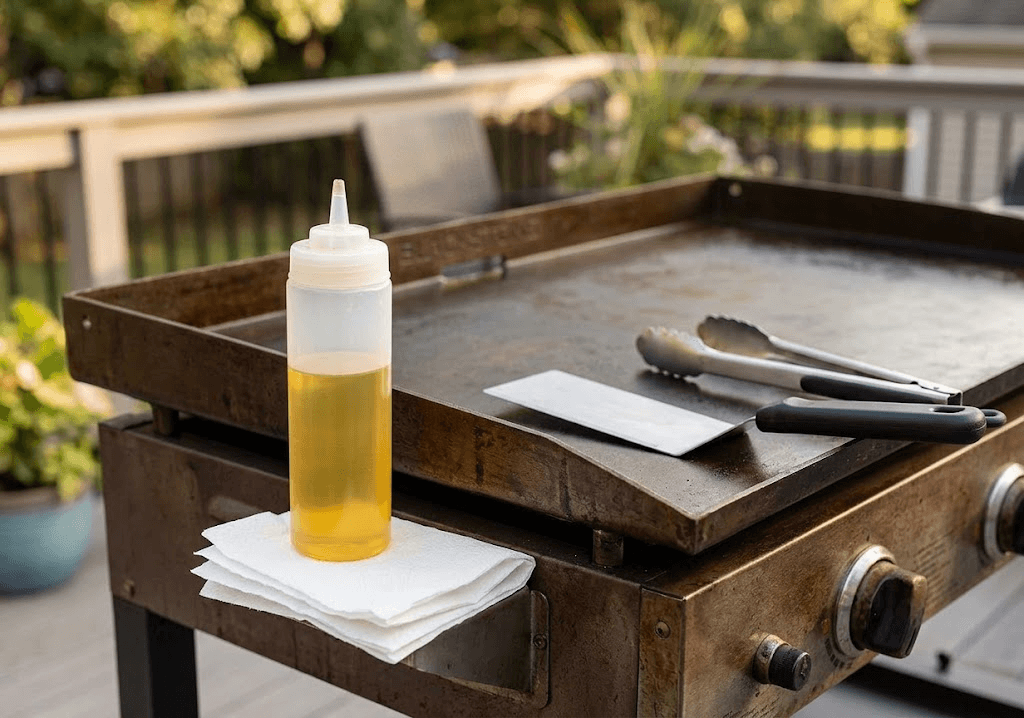
The best oil for a Blackstone griddle is a refined, high smoke point oil with a neutral taste. For most people, that means canola oil. It is cheap, easy to find, and handles the heat of a steel flat top without turning bitter or sticky.
Still, the right choice depends on what you are doing. Seasoning a brand-new griddle top, cooking smash burgers, and stir-frying hibachi rice all ask different things from your oil. This guide breaks down eight options, shows how smoke point and oil type affect your griddle, and covers the mistakes that cause sticky, flaky seasoning.
Quick Answer
Top pick: Canola oil. Budget pick: Vegetable (soybean) oil. Upgrade pick: Refined avocado oil.
The best oil for a Blackstone griddle is canola oil for most cooks. It is affordable, neutral, and handles normal griddle heat. Choose vegetable oil to save money, or refined avocado oil for the highest smoke point. Use flaxseed only for early seasoning layers, and skip butter and extra virgin olive oil.
Best Oil for a Blackstone Griddle: Quick Comparison
Smoke points vary by brand and how refined the oil is. Treat the numbers below as rough ranges and check the bottle label.
| Oil | Approx. smoke point | Best for | Flavor | Price range |
| Canola oil | ~400°F (204°C) | Everyday cooking, seasoning upkeep | Neutral | $ |
| Vegetable (soybean) oil | ~400-450°F (204-232°C) | Budget seasoning, high-volume cooking | Neutral | $ |
| Refined avocado oil | ~480-520°F (249-271°C) | Searing, high-heat cooking | Mild | $$$ |
| Refined peanut oil | ~450°F (232°C) | Hibachi, stir-fry, fried rice | Light, nutty | $$ |
| Grapeseed oil | ~400-420°F (204-216°C) | Seasoning, light-flavored dishes | Neutral | $$ |
| Flaxseed oil | ~225-385°F (107-196°C) | Initial seasoning layers only | Grassy | $$ |
| Beef tallow / lard | ~370-400°F (188-204°C) | Smash burgers, breakfast, flavor | Rich, savory | -$ |
| Griddle seasoning conditioner | Varies by product | Convenience, rust protection | Neutral | -$ |
Price ranges are relative and need a check against current store prices.
1. Canola Oil: Top Pick
Who it’s for: Almost every Blackstone owner, from beginners to people who cook on the flat top several times a week.
Canola oil hits the sweet spot of price, performance, and flavor. It stays neutral, so your pancakes will not taste like your fajitas. It also handles the typical working range of a Blackstone, which is about 350-450°F (177-232°C) on the cooking zone.
You can use it for the first seasoning layers, for cooking, and for the thin wipe-down after every cook. A gallon jug (about 7.5 lb, or 3.4 kg) lasts a long time.
Pros
- Affordable and sold everywhere
- Neutral flavor works with sweet and savory food
- Builds a decent seasoning layer when applied thin
- One bottle covers seasoning, cooking, and maintenance
Cons
- Smoke point is good but not the highest
- Gets tacky fast if you apply it too thick
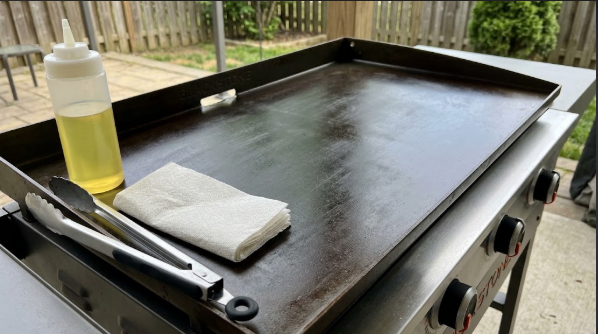
Pitmaster Tip: Put your oil in a squeeze bottle, not a pour jug. A squeeze bottle lets you draw a thin line across the griddle and spread it with a paper towel held in tongs. Thin coats are the secret to a smooth surface.
2. Vegetable Oil: Budget Pick
Who it’s for: New owners who want to season a large griddle without spending much, and anyone cooking for a crowd.
Most “vegetable oil” in the store is soybean oil. It is one of the cheapest oils you can buy and works almost the same as canola on a flat top. Its neutral taste and moderate smoke point make it a solid seasoning oil.
If you plan to run five or six thin seasoning layers on a 36-inch griddle, a budget oil keeps the cost down. Pair it with a spray bottle or squeeze bottle so you do not overdo it. The same bottle can handle smash burgers, eggs, and fried rice.
Pros
- Lowest cost per ounce
- Neutral flavor
- Easy to find in large bottles
Cons
- Blends can vary by brand
- Not as heat-tolerant as avocado oil
For a party cook, a big bottle of vegetable oil and a flat top can feed a lot of people. If you are planning one, our summer BBQ party tips show how to do it on a budget.
3. Refined Avocado Oil: Upgrade Pick
Who it’s for: Cooks who sear steaks, smash burgers, or hibachi on very hot zones and want a bigger safety margin before the oil smokes.
Refined avocado oil has one of the highest smoke points of any common cooking oil, often above 480°F (249°C). That headroom matters when you run the griddle on high for a hard sear. The flavor is mild and clean.
The downside is price. It costs several times more than canola or vegetable oil, so most people save it for cooks where heat tolerance matters. Make sure the label says “refined.” Unrefined avocado oil smokes much sooner and will not give you the same benefit.
Pros
- Very high smoke point
- Mild, clean taste
- Good for hard sears
Cons
- Expensive
- Overkill for pancakes and eggs
- Unrefined versions smoke early
4. Refined Peanut Oil: Best for Hibachi Cooking
Who it’s for: Anyone making fried rice, teppanyaki-style chicken, steak bites, or vegetable stir-fry on the griddle.
Refined peanut oil is a classic stir-fry oil because it handles high heat and adds a faint nutty note. On a Blackstone, it works well for hibachi-style meals where you move food constantly across a hot top. It is also a favorite for fried foods.
One safety note: if anyone eating your food has a peanut allergy, skip peanut oil entirely and ask their doctor about refined versus unrefined oil.Canola or avocado oil is a safe swap.
Pros
- Strong high-heat performance
- Great flavor for Asian-style cooking
- Moderately priced
Cons
- Allergy concerns
- Flavor may not suit sweet dishes
If you cook a lot of shrimp for hibachi nights, a good shrimp deveiner makes prep much faster.
5. Grapeseed Oil
Who it’s for: People who want a clean, light oil for seasoning and for delicate foods like fish, eggs, or vegetables.
Grapeseed oil is neutral, light, and has a smoke point in the same neighborhood as canola. Many griddle cooks like it for initial seasoning because it spreads thin and clean. It also does not leave a heavy aftertaste.
The tradeoff is cost. Grapeseed oil usually sells for more than canola with little real-world gain on a flat top. If you already have a bottle, use it. If not, canola does the same job for less.
Pros
- Neutral and light
- Spreads thin
- Decent heat tolerance
Cons
- More expensive than canola
- Not widely stocked in large sizes
6. Flaxseed Oil: Initial Seasoning Only
Who it’s for: Owners who want to build a hard first seasoning layer on a brand-new griddle top and are willing to work carefully.
Flaxseed oil is high in polyunsaturated fat, which means it polymerizes into a hard layer. That is why it became popular for seasoning cast iron and flat tops. Used right, it can create a slick, durable finish.
The catch is that flax can flake if applied too thick or if layers build up unevenly. Its smoke point is also low, so you need to apply very thin coats and keep heat controlled. Many cooks use flax for the first few layers and then switch to canola for ongoing upkeep. Check your owner’s manual for the manufacturer’s current recommendation.
Pros
- Builds a hard seasoning layer
- Popular for first-time seasoning
Cons
- Flakes if applied thick
- Low smoke point
- Not ideal for daily cooking
Common Mistake: Pouring flaxseed oil on like you would for cooking. Seasoning oil should be wiped on and then wiped almost all the way off. If you can see wet shine, you used too much.
7. Beef Tallow and Lard
Who it’s for: Smash burger fans, breakfast cooks, and anyone who wants rich flavor from the fat itself.
Tallow and lard add real flavor. Smash burgers cooked with a bit of beef tallow taste more beefy, and potatoes and eggs get crisp edges. Both fats are solid at room temperature, so melt them on the hot griddle before using.
Their smoke points are lower than avocado or peanut oil, so keep your burner at medium-high. They are also more variable in quality, so buy from a source you trust. For a normal wipe-down after the cook, many people still choose a liquid oil because it spreads thinner.
Pros
- Excellent flavor on beef, potatoes, and eggs
- Great for crisp edges
- Reasonable cost
Cons
- Lower smoke point
- Harder to spread thin
- Not suitable for some diets
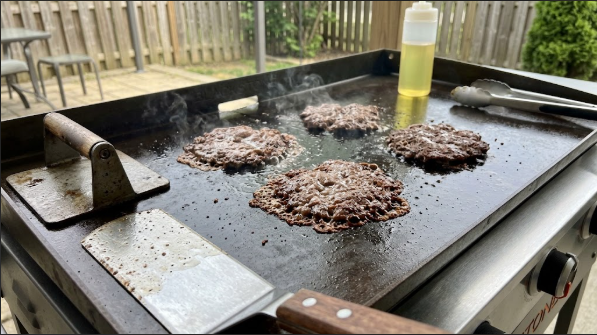
When you are portioning smash burger balls, use about 3-4 oz (0.19-0.25 lb, or 85-113 g) of ground beef per patty. Press hard for about 10 seconds, then flip after roughly 2 minutes when the edges look lacy and brown. Cook ground beef to the USDA’s safe minimum internal temperature of 160°F (71°C).
8. Griddle Seasoning Conditioner
Who it’s for: Owners who want a no-guess product for seasoning and rust protection, or who store their griddle for long stretches.
Griddle conditioners are pre-blended pastes or waxes made for flat tops and cast iron. They are designed to spread easily, build a protective film, and shield bare steel from moisture. Many people keep one in the cabinet for storage and for rescuing a dull top.
Check the label for ingredients and heat instructions, since formulas vary. A conditioner is not a replacement for cooking oil, but it is a handy extra for care.
Pros
- Easy, thin application
- Good for rust protection
- Useful before storing the griddle
Cons
- Extra product to buy
- Formulas differ by brand
- Not meant for cooking food
How to Choose the Best Oil for a Blackstone Griddle
Use this checklist when you are standing in the store aisle.
Look for these traits
- Refined, not unrefined or extra virgin. Refined oils have more heat tolerance.
- Smoke point at or above 400°F (204°C). This covers most griddle cooking.
- Neutral flavor. Your oil should not fight with the food.
- Liquid at room temperature. It spreads thinner and wipes off cleaner.
- Bottle size that fits your use. A gallon for heavy users, a pint for occasional cooks.
Oils to avoid or limit
- Extra virgin olive oil. Its smoke point is lower, and it can leave a bitter, sticky film on a hot top.
- Butter. The milk solids burn quickly. Add a pat near the end of a cook for flavor, not as your main fat.
- Aerosol cooking spray. Many contain additives that can leave residue and gum up the surface.
- Old or rancid oil. If it smells like paint or crayons, throw it away.
Pitmaster Tip: An infrared thermometer helps you stay in the right zone. For seasoning, aim for a surface of about 400-450°F (204-232°C). For eggs and pancakes, drop to about 325-350°F (163-177°C).
Match the oil to the job
| Job | Best oil choice | Surface temp |
| Initial seasoning | Flaxseed, canola, or grapeseed | 400-450°F (204-232°C) |
| Seasoning upkeep | Canola or vegetable | 350-400°F (177-204°C) |
| Smash burgers | Canola, tallow, or avocado | 400-450°F (204-232°C) |
| Hibachi fried rice | Refined peanut or avocado | 375-425°F (191-218°C) |
| Eggs and pancakes | Canola or vegetable | 325-350°F (163-177°C) |
| Fish fillets | Canola or avocado | 375-400°F (191-204°C) |
If fish is on the menu, remember it needs to reach 145°F (63°C) inside. Flat tops handle delicate fillets well, and our guide to the best pans for cooking fish offers good backup options when you want to cook indoors.
Best Oil for a Blackstone Griddle: How We Picked
We ranked each option using practical criteria that matter on a steel flat top. This article does not include lab tests or invented test results. The picks reflect general cooking behavior and widely shared griddle practice.
- Heat tolerance: Can it handle 400-450°F (204-232°C) without smoking hard?
- Flavor impact: Does it stay out of the way of the food?
- Seasoning performance: Does it form a smooth layer when applied thin?
- Cost per ounce: Can a regular user afford to use it often?
- Availability: Can you grab it at a normal grocery store?
- Ease of use: Does it spread thin and wipe clean?
Canola, vegetable, and avocado oil scored best for different reasons: balance, price, and heat. The rest earned spots for specific jobs.
Care and Maintenance: Making Your Oil Work
Choosing the best oil for a Blackstone griddle is half the job. The other half is how you apply it and care for the surface.
How to season a new Blackstone griddle
Always follow your owner’s manual first.The general method looks like this:
- Wash the top. Use warm water and mild soap to remove the factory coating, then dry it fully.
- Heat the griddle. Run all burners on medium-high for about 10-15 minutes until the steel darkens slightly.
- Apply a thin coat. Squeeze a small amount of oil on and spread it across the whole top, including the edges.
- Wipe off the excess. Use tongs and a clean paper towel. The surface should look barely damp.
- Burn it in. Let it smoke until the smoke fades, about 15-30 minutes.
- Repeat 3-5 times. Each layer gets darker and smoother.
Daily upkeep
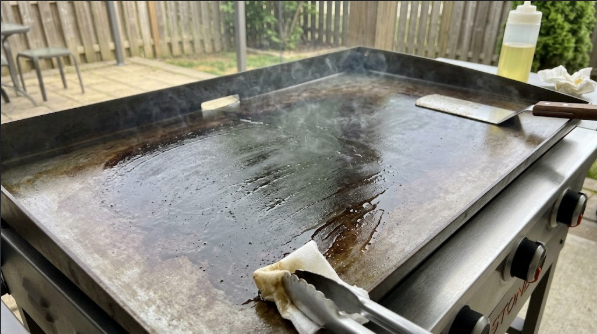
After every cook, scrape off food bits while the griddle is still warm. Wipe with a paper towel, then add a very thin film of oil. This tiny step keeps rust away and builds the seasoning over time.
If your griddle sits outside, a good cover helps a lot. Our roundup of heavy-duty grill covers can help you pick one that blocks rain and humidity.
Troubleshooting seasoning problems
| Problem | Likely cause | Fix |
| Sticky, tacky surface | Oil layer too thick | Heat on high until it stops smoking, then scrape and wipe |
| Flaking black bits | Thick layers or heavy flax use | Scrape flakes off, re-season with thin canola layers |
| Burnt smell | Old oil or too much buildup | Scrub, clean, and re-season lightly |
| Rust spots | Moisture or no oil film | Scrub rust, wash, dry, and re-season |
| Uneven color | Hot spots and uneven oil | Rotate burners and apply a thinner coat |
If the burnt-oil smell lingers on your hands or in your kitchen after a long seasoning session, these kitchen odor cures can help.
Chopping and prepping for the griddle
A flat top works best when food is cut into even pieces. For hibachi-style cooking, a sharp knife saves time. Our guide to the best knives for cutting meat covers good options for slicing steak, chicken, and more.
If you are used to cooking bacon on other cookers, the griddle is a good comparison. Our post on bacon on a pellet grill shows a different approach, while the griddle gives you crisp strips with less wait time. Keep your temperature around 325°F (163°C) so the bacon fat renders without burning.
Frequently Asked Questions
What oil do you use on a Blackstone griddle?
Most cooks use canola or vegetable oil for both seasoning and daily cooking. They are cheap, neutral, and handle typical griddle heat. For very hot searing, refined avocado oil gives you a higher smoke point. Whatever you choose, apply it in thin coats.
Can you use olive oil on a Blackstone?
You can, but it is not the best choice. Extra virgin olive oil has a lower smoke point and can leave a bitter, sticky film on a hot top. If you want olive oil flavor, add a small drizzle at the end of the cook off the heat.
Is flaxseed oil good for a Blackstone griddle?
Flaxseed oil can build a hard seasoning layer, but it flakes if applied too thick. Its smoke point is also low. Many cooks use it only for the first layers on a new top, then switch to canola for daily upkeep. Check your manual for current guidance.
Can you use butter on a Blackstone griddle?
Yes, but not as your main fat. Butter has milk solids that burn at typical griddle temperatures. Cook with a high smoke point oil, then add butter near the end for flavor on steak, eggs, or vegetables.
How often should you oil your Blackstone?
Apply a thin film of oil after every cook while the top is still warm. Do a deeper re-season whenever the surface looks dull, gray, or patchy. If you store the griddle for a long period, add a protective oil layer first.
Why is my Blackstone seasoning sticky?
Sticky seasoning almost always means the oil layer was too thick or did not burn long enough. Heat the griddle on high until it stops smoking, scrape off any gummy spots, and then apply thinner coats. Patience and thin layers fix most sticky problems.
Conclusion
Choosing the best oil for a Blackstone griddle comes down to heat tolerance, flavor, price, and the job at hand. Canola oil is the best all-around pick, vegetable oil is the budget winner, and refined avocado oil is the upgrade for hard sears. Peanut oil, tallow, and grapeseed all have their place, and flaxseed is best saved for early seasoning layers.
Whichever oil you choose, remember the real secret: thin layers, steady heat, and a quick wipe-down after every cook. Do that, and your flat top will build a dark, slick surface that gets better with every meal.
Laura Smith

I'm Laura, I like all the kind of delicious grilled foods which makes me hungry all the time I see them. That's why I built this blog to share with you all of my Grilling experiences, recipes, and all the tips about foods that I've learned from food experts.