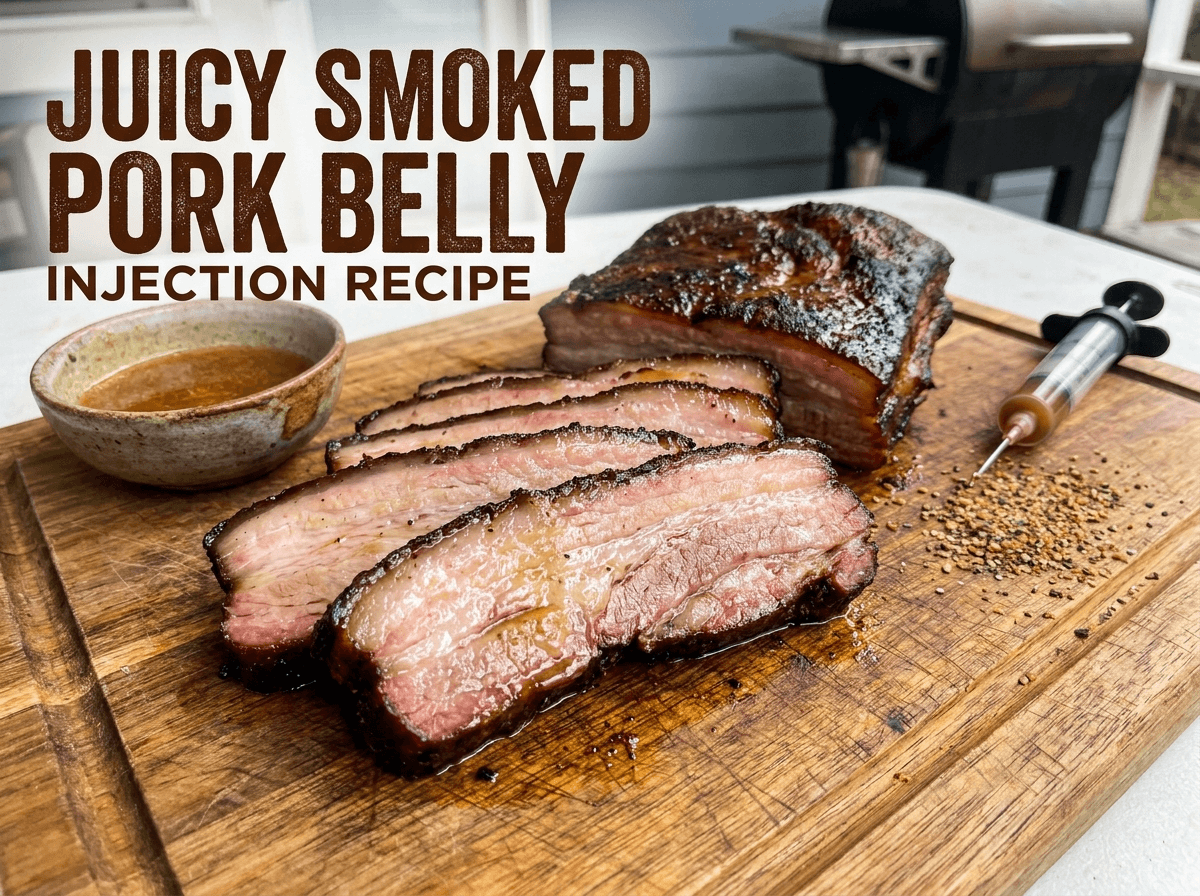
A good pork belly injection recipe does one job: it pushes flavor and moisture deep into a thick, fatty cut that seasoning on the surface can’t reach. Pork belly already has plenty of fat. But the lean layers between the fat can still turn dry and bland if you smoke them long enough.
This method fixes that. You inject a sweet-savory apple and Worcestershire liquid, rub the slab, and smoke it low and slow at 250°F (121°C). The result is tender, glossy, deeply seasoned pork belly. You can slice it or cube it into burnt ends.
If you can run a pellet grill or offset smoker for about five hours, you can make this.
Quick Answer
Pork Belly Injection Recipe at a Glance: Inject a 5 lb (2.3 kg) skinless pork belly with about 1 cup of apple juice-based marinade, rub it, and smoke at 250°F (121°C) for 4 to 5 hours. Pull it when a probe slides in like soft butter, around 195-203°F (91-95°C). Rest 30 minutes. The USDA minimum safe temperature for pork is 145°F (63°C).
Why This Pork Belly Injection Recipe Works
Pork belly is layered like a cake: fat, meat, fat, meat. The fat melts during a long smoke and bastes the meat on its own. So why inject at all?
Because the lean streaks are thin, and a rub only seasons the outside. Injecting delivers salt, sugar, and acid into the center of the slab. Salt helps the meat hold onto water. Sugar helps with color and bark. A little vinegar cuts through the richness so the finished bite doesn’t taste heavy.
Here is what you gain with this approach:
- Seasoning all the way through, not only on the crust
- Extra moisture in the lean layers during a 4 to 5 hour cook
- Balanced flavor, since the acid and sweetness offset the fat
- A forgiving cook, because injected belly handles small temperature swings better
If you have already tried smoked bacon on a pellet grill, this is the same pork belly cut, just uncured and cooked far longer.
Ingredients and Equipment
For the pork belly
- 1 skinless pork belly slab, 5 lb (2.3 kg), about 1.5 to 2 inches (4-5 cm) thick
- 2 tablespoons yellow mustard or olive oil (binder)
For the injection marinade
Makes about 1½ cups, enough for one 5 lb belly with a little left over.
- 1 cup (240 ml) apple juice
- ¼ cup (60 ml) apple cider vinegar
- 2 tablespoons Worcestershire sauce
- 2 tablespoons light brown sugar
- 2 teaspoons kosher salt
- 1 teaspoon garlic powder
- ½ teaspoon onion powder
For the rub
- 2 tablespoons light brown sugar
- 1 tablespoon smoked paprika
- 1 tablespoon kosher salt
- 2 teaspoons coarse black pepper
- 1 teaspoon garlic powder
- 1 teaspoon onion powder
- ½ teaspoon cayenne pepper (optional)
Equipment
- Pellet grill, offset smoker, or charcoal kettle set up for indirect heat
- Stainless steel meat injector with a multi-hole needle
- Instant-read thermometer plus a leave-in probe
- Wire rack or sheet pan
- Butcher paper or heavy-duty foil (for burnt ends)
- Sharp slicing knife. See our guide to the best knives for cutting meat if yours is dull.
Substitutions
| Ingredient | Swap | Notes |
| Apple juice | Pineapple juice or unsweetened apple cider | Pineapple adds tang; keep it to the same volume |
| Apple cider vinegar | White wine vinegar | Slightly sharper |
| Light brown sugar | Honey or maple syrup | Use 1 tablespoon; they are sweeter |
| Worcestershire | Soy sauce (1 tbsp) | Reduce added salt in the injection to ½ teaspoon |
| Smoked paprika | Regular paprika | Add a pinch more smoke from your wood |
Choosing and Prepping the Pork Belly
What to buy
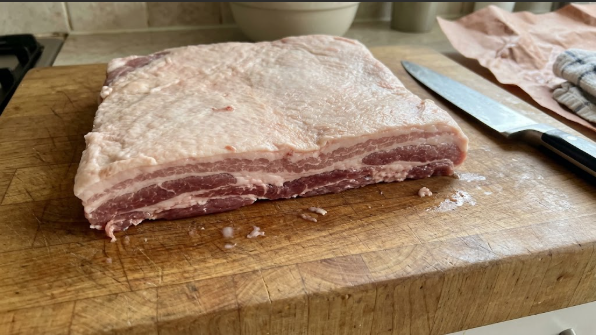
Look for a slab with even thickness and a balance of fat and meat. You want visible, distinct meat layers, not a slab that is 80% white fat. Skinless is easiest for this recipe because the rub and smoke can reach the surface directly.
If you can’t find a 5 lb (2.3 kg) slab, a 3 to 4 lb (1.4-1.8 kg) piece works. Just scale the injection down proportionally and start checking temperature earlier.
Trimming
Trim any loose, dangling bits so nothing burns. Square up the edges if the slab is ragged. Leave the fat cap in place. It is what renders and bastes the meat.
Prep timing
Plan on a total of about 6 to 7 hours:
- 15 minutes to mix the injection
- 15 minutes to inject and rub
- 30 minutes to 12 hours of rest in the fridge (optional)
- 4 to 5 hours of smoking
- 30 minutes of resting
How to Make the Injection Marinade
Whisk the apple juice, vinegar, Worcestershire, brown sugar, salt, garlic powder, and onion powder in a bowl. Stir until the sugar and salt fully dissolve. Undissolved grains clog the injector needle.
Pour the mix through a fine mesh strainer. This catches any clumps of garlic powder. Then draw the marinade into your injector.
Pitmaster Tip: Pour out about ½ cup of the marinade into a separate small bowl before you begin. Use that for any extra injecting, and discard what is left in the main bowl after you finish. Dipping the injector back into a bowl that has touched raw meat can contaminate it.
Step-by-Step Instructions
Step 1: Pat the belly dry
Place the slab on a sheet pan and pat it dry with paper towels. A dry surface lets the binder and rub stick, and it helps bark form later.
Step 2: Inject in a grid
Insert the needle straight into the thickest part of the meat. Push it in about 1 to 1.5 inches (2.5-4 cm), then slowly depress the plunger as you pull the needle back out. This leaves a thin line of marinade rather than a single pocket.
Work in a grid pattern, spacing injection points about 1 inch (2.5 cm) apart. Aim for roughly 1 cup (240 ml) total across a 5 lb (2.3 kg) belly. That works out to about 3 tablespoons per pound.
Expect some liquid to leak out of each hole. That is normal. Wipe the surface with a paper towel before you rub.
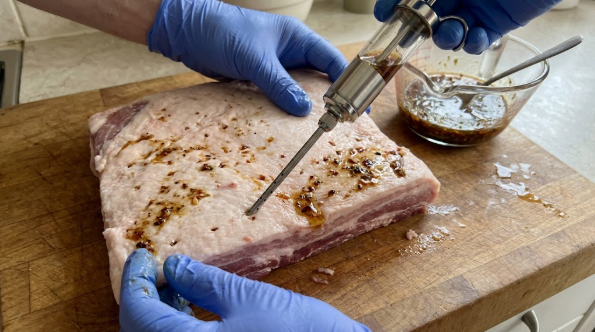
Common Mistake: Injecting too much in one spot. A big pocket of liquid steams the meat from the inside and leaves a spongy, uneven texture. Go slow, use many small injections, and stop when the slab feels plump but not swollen.
Step 3: Add the binder and rub
Brush a thin layer of mustard or olive oil over every surface. You will not taste the mustard in the finished pork belly. It just acts as glue.
Mix the rub ingredients in a small bowl. Sprinkle the rub evenly over the top, bottom, and sides, patting it in lightly. Do not rub hard, or you will push the spices off in clumps.
Step 4: Rest (optional but helpful)
Let the belly sit uncovered on a rack in the fridge for at least 30 minutes. For deeper flavor, rest it up to 12 hours. The salt in the injection and rub has time to work, and the surface dries slightly, which improves bark.
Take the belly out of the fridge while you get the smoker ready. Do not leave raw pork at room temperature for more than 2 hours, per the USDA’s guidance on the temperature danger zone].
Step 5: Set up your smoker at 250°F
Heat your smoker to 250°F (121°C). This temperature gives you enough time to render fat without drying the lean layers. Higher heat works, but you risk burning the sugar in the rub.
Wood choice: Apple, cherry, and pecan give sweet, mild smoke that suits pork belly. Hickory adds a stronger, bacon-like flavor, so use it alone sparingly or blend it with fruit wood.
If you are new to your cooker, see our picks for the best pellet grills for beginners. Prefer charcoal and offset cooking? Learn how lump charcoal behaves in an offset smoker before you start. If you are shopping, we also cover the best affordable offset smokers.
Step 6: Smoke the belly
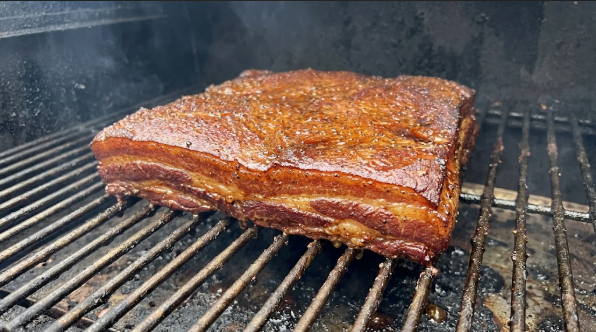
Place the belly fat side up, directly on the grate or on a wire rack set over a drip pan. Insert a leave-in probe into the thickest part of the meat, away from the edges.
Smoke for about 2.5 to 3 hours until the surface looks deep mahogany and the internal temperature reaches roughly 165-175°F (74-79°C). You may see the temperature climb slowly or stall here. That is normal.
Step 7: Decide: slices or burnt ends
At this point you can take the cook two ways.
For sliced pork belly: Keep smoking unwrapped until the internal temperature hits 195-203°F (91-95°C) and a probe slides in with almost no resistance. That is usually another 1.5 to 2 hours.
For pork belly burnt ends: Pull the belly at about 170°F (77°C) and cut it into 1.5-inch (4 cm) cubes. Place the cubes in a foil pan, toss with a few tablespoons of BBQ sauce and a drizzle of honey, and return to the smoker uncovered at 250°F (121°C) for about 60 to 90 minutes. They are done when the cubes are tender and the sauce has tightened into a sticky glaze.
Step 8: Rest
Pull the pork belly and rest it for 30 minutes, loosely tented with foil. This lets juices settle back into the meat. Slicing right away sends them onto the cutting board.
Time and Temperature Table
| Stage | Smoker Temp | Time | Target Internal Temp |
| Preheat | 250°F (121°C) | 15-20 min | n/a |
| First smoke | 250°F (121°C) | 2.5-3 hours | 165-175°F (74-79°C) |
| Finish (sliced) | 250°F (121°C) | 1.5-2 hours | 195-203°F (91-95°C) |
| Finish (burnt ends, after cubing) | 250°F (121°C) | 60-90 min | 195-203°F (91-95°C) |
| Rest | n/a | 30 min | Holds above 140°F (60°C) |
Total cook time for a 5 lb (2.3 kg) belly is typically 4 to 5 hours. Always cook to feel and temperature, not just the clock.
How to Tell When It’s Done
The USDA’s safe minimum internal temperature for pork is 145°F (63°C) with a 3-minute rest. Pork belly will be well past that by the time it tastes good.
For tenderness, use these cues instead:
- Probe feel: The thermometer should slide in like pushing into soft butter, with no tight spots. This usually happens between 195°F and 203°F (91-95°C).
- Bark: The surface should look deep reddish-brown and feel set, not wet or tacky.
- Jiggle: A cooked slab should flex and wobble slightly when you lift one end with tongs.
- Fat: The white fat layers should look translucent and soft, not opaque and waxy.
If the probe still meets resistance in some spots, give it another 20 to 30 minutes and check again.
Resting, Slicing, and Serving
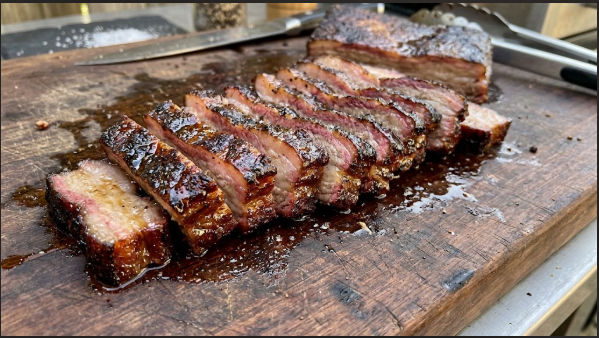
Move the rested belly to a cutting board. Slice against the grain into ½-inch (1.25 cm) pieces for sandwiches or ¾-inch (2 cm) pieces for a plate.
Use a sharp, long knife and cut with smooth strokes, not a sawing motion. A good butcher knife makes clean cuts through the bark without tearing it.
For burnt ends, serve them right out of the pan while the glaze is hot and sticky. They are also great piled on slider buns with pickles.
What to Serve With Smoked Pork Belly
Pork belly is rich, so pair it with sides that add acid, crunch, or freshness:
- Creamy coleslaw or vinegar slaw
- Pickled red onions and dill pickles
- Baked beans or smoked mac and cheese
- Cornbread or soft slider buns
- Grilled corn with lime and chili
- Simple green salad with a sharp vinaigrette
If you want a full cookout menu, our guide on how to start a grill covers the basics for getting a side dish or two going while the pork belly rests.
Storing, Freezing, and Reheating Leftovers
Cool cooked pork belly quickly and refrigerate it within 2 hours of cooking. Cooked leftovers keep for 3 to 4 days in the fridge, according to USDA FSIS leftover guidance .
To freeze: Wrap portions tightly in plastic wrap, then place in freezer bags with the air pressed out. Frozen leftovers stay safe indefinitely at 0°F (-18°C), but quality is best within 2 to 3 months .
To reheat: Warm slices or cubes in a 300°F (149°C) oven, covered with foil, until they reach 165°F (74°C), the USDA’s recommended reheat temperature for leftovers]. Add a splash of apple juice or stock to the pan to keep them moist. A skillet also works well for crisping slices.
Variations
Pellet grill
Set your pellet grill to 250°F (121°C) and use apple or cherry pellets. The cook time is identical. Use a Super Smoke setting if your model has one for extra flavor in the first hour.
Offset smoker
Keep your firebox temperature steady at 250°F (121°C) with small, frequent splits of fruit wood. Rotate the slab once halfway through if the end near the firebox is browning faster.
Charcoal kettle (indirect)
Bank your coals on one side and place the belly on the opposite side over a drip pan. Add a small chunk of apple wood. Check coals every 45 minutes and add a handful as needed to hold 250°F (121°C).
Oven backup
No smoker? Place the injected, rubbed belly on a wire rack over a sheet pan in a 275°F (135°C) oven. Cook for 3 to 4 hours until probe tender. Add ½ teaspoon of smoked paprika to the injection for a hint of smokiness. You will lose true bark, but the flavor is still excellent.
Troubleshooting
| Problem | Likely Cause | Fix |
| Dry, tough lean layers | Pulled too early or smoker too hot | Cook to probe-tender, not just a number; hold at 250°F (121°C) |
| Mushy, spongy texture | Over-injected in one spot | Use smaller, spread-out injections next time |
| Overly salty | Too much salt in injection plus rub | Cut injection salt to 1 teaspoon or reduce the rub salt |
| Burnt, bitter bark | Sugar scorched at high heat | Keep smoker at or below 275°F (135°C); wrap if bark is dark early |
| Rubbery fat | Not cooked long enough | Keep cooking until fat looks translucent and the probe slides in easily |
| Bland flavor | Injection leaked out or rub too light | Wipe the surface before rubbing; rest overnight for deeper seasoning |
If your bark darkens too early (before 3 hours), wrap the belly loosely in butcher paper and continue cooking until probe tender. Paper protects the bark better than foil.
Recipe Card: Smoked Pork Belly With Injection
Servings: 8-10 | Prep time: 30 minutes (plus optional rest) | Cook time: 4-5 hours | Rest: 30 minutes | Smoker temp: 250°F (121°C)
Ingredients:
- 5 lb (2.3 kg) skinless pork belly
- 2 tbsp mustard or oil (binder)
- Injection: 1 cup apple juice, ¼ cup apple cider vinegar, 2 tbsp Worcestershire, 2 tbsp brown sugar, 2 tsp kosher salt, 1 tsp garlic powder, ½ tsp onion powder
- Rub: 2 tbsp brown sugar, 1 tbsp smoked paprika, 1 tbsp kosher salt, 2 tsp black pepper, 1 tsp garlic powder, 1 tsp onion powder, ½ tsp cayenne
Steps:
- Mix and strain the injection.
- Pat belly dry; inject about 1 cup in a grid.
- Apply binder and rub; rest 30 minutes to 12 hours in the fridge.
- Smoke at 250°F (121°C) with apple or cherry wood.
- Cook to 165-175°F (74-79°C), about 2.5-3 hours.
- Finish to 195-203°F (91-95°C), or cube and sauce for burnt ends.
- Rest 30 minutes, slice against the grain, and serve.
FAQ
How much injection should I use per pound of pork belly?
Use about 3 tablespoons (45 ml) of injection per pound of pork belly. For a 5 lb (2.3 kg) slab, that is roughly 1 cup (240 ml). Inject in a grid with small amounts per spot so the marinade spreads evenly and the meat doesn’t turn spongy.
What should you inject pork belly with?
A sweet, savory, and slightly acidic liquid works best. This recipe uses apple juice, apple cider vinegar, Worcestershire sauce, brown sugar, salt, and garlic powder. Apple juice brings sweetness, vinegar cuts richness, and Worcestershire adds depth. Keep salt moderate so it does not overpower.
Can you inject pork belly the night before?
Yes. Injecting and rubbing the belly 12 hours ahead gives the salt time to season deeply and helps the surface dry for better bark. Keep it uncovered on a rack in the fridge at 40°F (4°C) or below, and smoke it straight from the fridge.
How long does it take to smoke pork belly at 250°F?
A 5 lb (2.3 kg) pork belly takes about 4 to 5 hours at 250°F (121°C) to reach 195-203°F (91-95°C) and turn probe tender. Burnt ends take a bit longer because of the extra saucing stage. Always judge by probe feel rather than the clock.
Do you have to wrap pork belly when smoking?
No. Unwrapped belly develops the best bark, so wrapping is optional. Wrap in butcher paper only if the bark is getting too dark before the meat is tender. For burnt ends, the cubes finish in a foil pan, which acts as a gentle wrap.
What is the safe internal temperature for pork belly?
The USDA’s minimum safe internal temperature for pork is 145°F (63°C) with a 3-minute rest. Pork belly tastes best much higher, at 195-203°F (91-95°C), because the fat and connective tissue need that heat to break down into tender, juicy meat.
Conclusion
A good pork belly injection recipe takes a naturally rich cut and makes it better. Injecting delivers seasoning and moisture to the center, the rub builds bark, and a steady 250°F (121°C) smoke does the rest. Pull it when the probe slides in like butter, rest it for 30 minutes, and slice or cube it for burnt ends.
Start with the injection amounts here, then adjust the salt, sweetness, and smoke to your taste on your next cook. Once you have made this pork belly injection recipe once, it becomes easy to repeat and tweak.
Laura Smith

I'm Laura, I like all the kind of delicious grilled foods which makes me hungry all the time I see them. That's why I built this blog to share with you all of my Grilling experiences, recipes, and all the tips about foods that I've learned from food experts.