
A good potato soup recipe should taste like potatoes, not flour paste. It should be thick enough to coat a spoon, loaded with crisp bacon, and seasoned well enough that you go back for a second bowl. This one checks all three boxes, and you only need one pot and a handful of pantry staples.
This is a stovetop soup built on Yukon Gold potatoes, a quick flour roux, and a mix of whole milk and cream. We also show you how to bring it into grill territory: pellet grill bacon, smoked butter, and a smoked cheddar topper. If you have never made potato soup before, you can still get it right on the first try. Every step below includes temperatures, times, and the look and feel of the soup at each stage.
Quick Answer: How to Make Potato Soup
Quick Answer: For this homemade potato soup recipe, cook bacon, soften onion and celery in the fat, stir in flour, add broth and 2.5 lb (1.1 kg) of cubed Yukon Gold potatoes, and simmer 15 to 20 minutes. Mash about a third, add milk and cream, and heat gently. Total time: 50 minutes. Serves 6 to 8.
Why This Potato Soup Recipe Works
Most disappointing potato soup fails in one of three ways: bland, gluey, or watery. This recipe fixes each one on purpose.
- Layered flavor. Bacon fat, onion, celery, garlic, thyme, and a pinch of smoked paprika build a savory base before the potatoes ever hit the pot.
- Natural thickening. A small amount of flour makes a roux, and mashing part of the potatoes releases starch. You get a creamy texture without blending everything into paste.
- Gentle dairy. Milk and cream go in at the end and never boil, so the soup stays smooth instead of grainy.
- Even cooking. Cutting the potatoes into 3/4-inch (2 cm) cubes means they finish at the same time and keep a little bite for the texture contrast people love in a loaded baked potato soup.
If you like a pot-style comfort meal, this belongs on the same shelf as our easy soup recipes collection.
Ingredients and Equipment
Serves: 6 to 8 | Prep: 15 minutes | Cook: 35 minutes | Total: 50 minutes
Ingredients
- 6 slices thick-cut bacon, about 6 oz (170 g), chopped
- 2 tablespoons unsalted butter (regular or smoked butter)
- 1 large yellow onion, diced (about 1.5 cups)
- 2 celery ribs, diced
- 4 garlic cloves, minced
- 3 tablespoons all-purpose flour
- 4 cups (950 ml) low-sodium chicken broth
- 2.5 lb (1.1 kg) Yukon Gold potatoes, peeled and cut into 3/4-inch (2 cm) cubes
- 1 bay leaf
- 1/2 teaspoon dried thyme
- 1/2 teaspoon smoked paprika
- 1 cup (240 ml) whole milk
- 1 cup (240 ml) heavy cream
- 1 teaspoon kosher salt, plus more to taste
- 1/2 teaspoon black pepper
- 1 cup (4 oz / 113 g) shredded sharp cheddar
Toppings: extra cheddar, sour cream, sliced chives or green onion, and the reserved bacon.
Equipment
- 5 to 6 quart (4.7 to 5.7 liter) Dutch oven or heavy soup pot
- Potato masher or immersion blender
- Wooden spoon and a whisk
- Instant-read thermometer
- Sharp chef’s knife and cutting board
Easy Substitutions
- No bacon: Use 3 tablespoons of butter or olive oil and add an extra 1/2 teaspoon of smoked paprika.
- Lighter soup: Swap the cream for another cup of whole milk. The soup will be a little less rich but still creamy.
- Dairy-free: Use full-fat coconut milk and olive oil. The flavor changes, but the texture holds up.
- Vegetarian: Use vegetable broth and skip the bacon.
- Gluten-free: Replace the flour with 2 tablespoons of cornstarch mixed with 2 tablespoons of cold water, added after the potatoes soften.
Choosing and Prepping the Potatoes and Other Ingredients
Which Potatoes Are Best
Yukon Gold potatoes are the best all-around pick. They are medium in starch, so they hold their shape when cubed yet turn creamy when mashed. Russets are starchier and break down faster, which makes a thicker soup but one that can turn gluey if you overwork it. Red potatoes stay firm and waxy and give you chunky soup with less natural creaminess.
Peel or Don’t Peel
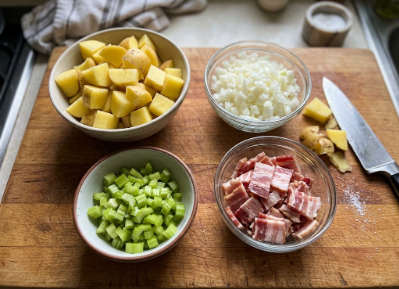
Peeling gives a smoother, classic soup. If you like a rustic bowl, scrub the Yukon Golds well and leave the thin skins on. Either way, cut every piece to the same size so they cook at the same speed.
Prep the Rest
- Bacon: Chop it while still cold. Cold bacon is much easier to cut cleanly.
- Onion and celery: Dice them small, about 1/4 inch (6 mm), so they melt into the soup.
- Dairy: Pull the milk and cream out of the refrigerator when you start cooking. Slightly less cold dairy mixes in more smoothly.
- Cheese: Shred your own cheddar from a block. Pre-shredded cheese often contains anti-caking starch that can make the soup a bit grainy.
Step-by-Step Instructions
- Cook the bacon. Add the chopped bacon to a cold Dutch oven and set the heat to medium (about 350°F / 175°C surface heat). Cook 8 to 10 minutes, stirring now and then, until the bacon is crisp and deep golden. Move it to a paper-towel-lined plate. Pour off all but 2 tablespoons of the fat.
- Sweat the vegetables. Add the butter, onion, and celery to the pot. Cook 6 to 8 minutes over medium heat, stirring often, until soft and translucent. You want no browning here. If the onion starts to darken, lower the heat.
- Add the garlic and spices. Stir in the garlic, thyme, and smoked paprika. Cook 30 seconds until fragrant, then move on before the garlic scorches.
- Make the roux. Sprinkle the flour over the vegetables and stir constantly for 2 minutes. The mixture will look like wet sand and smell lightly toasty. This cooks out the raw flour taste.
- Add the broth slowly. Pour in about 1 cup (240 ml) of broth while stirring or whisking, scraping up any browned bits on the bottom. Once it is smooth, add the rest of the broth.
- Simmer the potatoes. Add the potatoes, bay leaf, 1 teaspoon of salt, and the pepper. Bring to a boil over medium-high heat, then reduce to medium-low. Cover with the lid slightly ajar and simmer 15 to 20 minutes. The potatoes are ready when a fork slides in with no resistance and the edges start to crumble.
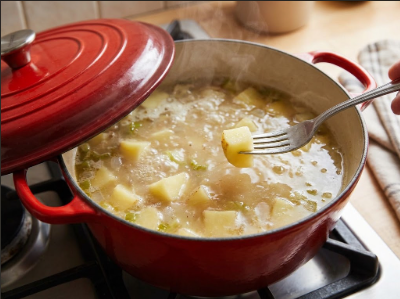
- Mash for body. Remove the bay leaf. Using a potato masher, press down 8 to 10 times, mashing roughly one-third of the potatoes against the side of the pot. The soup will go from brothy to thick and creamy while still holding chunks.
- Add the dairy. Lower the heat to low. Stir in the milk and cream and warm gently for 5 to 7 minutes. Do not let it boil. Small bubbles at the edge are fine, but a rolling boil can cause curdling.
- Add the cheese. Take the pot off the heat. Stir in the cheddar a handful at a time until melted. Taste and add salt, usually another 1/4 to 1/2 teaspoon.
- Rest and serve. Let the soup sit off the heat for 5 minutes. It thickens as it cools slightly. Ladle into bowls and top with bacon, cheese, sour cream, and chives.
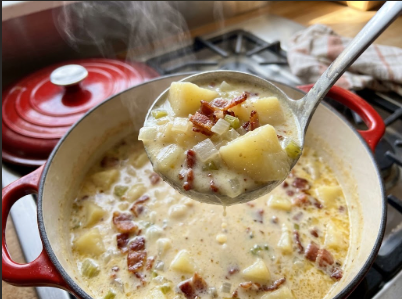
Pitmaster Tip: Do the mashing in the pot, not in a blender, and stop sooner than you think. Potato starch turns gummy when it is blended hard, especially in a high-speed blender. If you want a smoother soup, use an immersion blender and pulse 3 or 4 times, then stir and check the texture.
Common Mistake: Boiling the soup after the milk and cream go in. High heat makes dairy separate and can leave a grainy, curdled look. Keep it below a simmer, and add the cheese off the heat.
Time and Temperature Table
| Stage | Heat Level | Time | Look and Feel Cue |
| Render bacon | Medium, about 350°F (175°C) | 8 to 10 min | Crisp, deep golden, fat pooled in the pot |
| Soften onion and celery | Medium | 6 to 8 min | Soft, translucent, no browning |
| Toast the roux | Medium | 2 min | Wet-sand texture, light nutty smell |
| Simmer potatoes | Medium-low, gentle bubbles | 15 to 20 min | Fork slides in; edges crumble |
| Warm the dairy | Low | 5 to 7 min | Steaming, edge bubbles only, about 160 to 180°F (71 to 82°C) |
| Rest before serving | Off heat | 5 min | Slightly thicker, coats the spoon |
How to Tell When Potato Soup Is Done
You do not need a thermometer to know the soup is cooked, because the potatoes tell you. A fork should pass through a cube with no resistance, and the corners should look slightly soft and rounded. If you squeeze a cube against the side of the pot with a spoon, it should break apart easily.
Then check body and seasoning:
- Texture: The soup should coat the back of a spoon, and a line drawn through it with your finger should hold for a second or two.
- Thickness: If it is too thick, stir in 1/4 cup (60 ml) of milk or broth at a time. If it is too thin, mash a few more potatoes or simmer 3 to 5 minutes without the lid.
- Salt: Potato soup needs more salt than most people expect. Taste, add a pinch, and taste again.
For serving temperature, aim for 160°F (71°C) or hotter in the bowl so it is piping hot. If you are holding it for guests, keep it at 140°F (60°C) or above. The USDA says bacteria grow fastest between 40°F and 140°F, so the danger zone is worth avoiding for a big pot sitting on the counter.
Resting, Slicing, and Serving
There is no slicing in soup, but resting still matters. Five minutes off the heat lets the starch settle and the soup thicken. Skip the rest and it will look thinner than it really is.
Serve in warm bowls so the soup stays hot longer. A simple order for toppings works best:
- A small handful of shredded cheddar so it melts into the hot soup
- A spoonful of sour cream in the center
- Crumbled bacon, so it stays crisp
- Chives or sliced green onion for a fresh, sharp finish
For a grill-style finish, top the bowl with a few cubes of smoked cheese. It melts slowly and adds a gentle wood-smoke flavor.
What to Serve With Potato Soup
Potato soup is filling on its own, so choose sides that add crunch, acid, or char.
- Bread: Grilled bread with a crisp, charred edge is perfect for dipping.
- Vegetables: A side of grilled carrots adds natural sweetness. Roasted or pellet grill Brussels sprouts cut through the richness.
- Salad: A sharp green salad with a vinegar dressing balances the cream.
- Sandwiches: Half a grilled cheese sandwich turns the soup into a full dinner.
- Crackers: Oyster crackers or buttered saltines are classic for a reason.
Storing, Freezing, and Reheating Leftovers
Refrigerating
Cool the soup fast. Per the USDA, leftovers should go into shallow containers and be refrigerated within two hours (one hour if it is above 90°F / 32°C). Following FSIS leftovers guidance, most leftovers keep 3 to 4 days in a refrigerator set to 40°F (4°C) or below.
Potato soup also thickens a lot in the fridge as the starch sets. That is normal, and a splash of milk or broth fixes it.
Freezing
You can freeze potato soup, but know the trade-off. According to the USDA on freezing and food safety [VERIFY URL], food held at 0°F (-18°C) stays safe, and storage times are about quality. For best quality, plan to eat frozen soup within 3 to 4 months, per FSIS leftovers guidance.
The potatoes can turn slightly grainy and the cream can look split after thawing. To reduce this, freeze the soup before adding the cream and cheese, then stir them in after reheating. Freeze flat in zip-top freezer bags for fast thawing, and label each with the date.
Reheating
Thaw frozen soup in the refrigerator overnight. Reheat it in a pot over medium-low heat, stirring often, until it reaches 165°F (74°C), the USDA safe temperature for leftovers. Add a splash of milk or broth as needed. University of California extension guidance says to bring soups and stews to a boil, so for a cream soup, heat slowly and stir to avoid scorching. If you run it in the microwave, cover it and stir halfway through.
Cream-based soups reheat much like cream sauces, so our tips on reheating creamy sauces apply here too: low heat, frequent stirring, and a splash of liquid.
Variations: Pellet Grill, Offset, Charcoal, Oven, and Slow Cooker
Pellet Grill Version
Smoke the flavor into the ingredients before they go in the pot.
- Bacon: Set the pellet grill to 375°F (190°C) and cook the chopped or sliced bacon on a rack over a sheet pan for 18 to 25 minutes, until crisp. Hickory or apple pellets both work. Save the drippings for the pot.
- Potatoes: Toss the cubes with oil and salt and smoke-roast them at 375°F (190°C) for 25 to 35 minutes, until almost tender. Finish them in the soup for 5 minutes.
- Butter: Use smoked butter in step 2 for a deeper, campfire-style base.
Offset Smoker or Charcoal Grill
Hold the cooker at 350°F (175°C) using a clean-burning fire and a light wood such as apple or pecan. Smoke the bacon on a rack until crisp, 20 to 30 minutes. Set the Dutch oven over indirect heat and run the soup at a gentle simmer, adding a few coals to keep it steady. Keep a close eye on it, because direct heat will scorch the bottom of a roux-based soup.
Oven Backup
Start the soup on the stove through step 6. Then move the covered Dutch oven to a 350°F (175°C) oven for 25 to 30 minutes. Oven heat is even and gentle, so there is less risk of scorching. Finish with steps 7 through 10 on the stove.
Slow Cooker Version
Cook the bacon, onion, celery, garlic, and roux in a skillet, then move everything into a slow cooker with the broth, potatoes, and seasonings. Cook on low 6 to 8 hours or high 3 to 4 hours, until the potatoes are fork-tender. Mash, stir in the dairy during the last 30 minutes, and add the cheese at the end. For more set-it-and-forget-it ideas, see our easy crockpot meals.
Lighter Version
Use 2 percent milk, skip the cream, and cut the bacon to 3 slices. For more ideas, browse our healthy soup recipes.
Troubleshooting Common Potato Soup Problems
| Problem | Likely Cause | Fix |
| Soup is too thin | Too much liquid or too few mashed potatoes | Mash more potatoes, or simmer uncovered 3 to 5 minutes |
| Soup is too thick | Starch set as it cooled | Stir in milk or broth, 1/4 cup (60 ml) at a time |
| Gluey or gummy texture | Over-blending or overworking the potatoes | Mash by hand, and use short pulses with an immersion blender |
| Grainy or curdled | Boiling after adding dairy, or cold dairy added to boiling soup | Keep heat low; temper cold dairy with a little hot soup first |
| Bland | Not enough salt or acid | Add salt in small pinches, then a splash of lemon juice or vinegar |
| Raw flour taste | Roux cooked too briefly | Cook the flour at least 2 minutes before adding broth |
| Potatoes still hard | Pieces too large or heat too low | Simmer 5 to 10 more minutes; cut a test cube to check |
| Scorched bottom | Heat too high after adding flour or dairy | Do not scrape the bottom; pour the soup into a clean pot |
Potato Soup Recipe Card
Loaded Stovetop Potato Soup
Prep time: 15 minutes | Cook time: 35 minutes | Total time: 50 minutes | Serves: 6 to 8
Ingredients: 6 slices bacon (6 oz / 170 g); 2 tbsp butter; 1 diced onion; 2 diced celery ribs; 4 garlic cloves; 3 tbsp flour; 4 cups (950 ml) chicken broth; 2.5 lb (1.1 kg) Yukon Gold potatoes; 1 bay leaf; 1/2 tsp thyme; 1/2 tsp smoked paprika; 1 cup (240 ml) whole milk; 1 cup (240 ml) heavy cream; 1 tsp salt; 1/2 tsp pepper; 1 cup (113 g) cheddar.
Short steps:
- Crisp the bacon in a Dutch oven. Set aside; keep 2 tbsp fat.
- Soften onion and celery in butter, 6 to 8 minutes.
- Add garlic, thyme, and paprika for 30 seconds.
- Stir in the flour for 2 minutes.
- Whisk in the broth, then add potatoes, bay leaf, salt, and pepper.
- Simmer 15 to 20 minutes until fork-tender.
- Mash about one-third of the potatoes.
- Add milk and cream on low heat for 5 to 7 minutes. Do not boil.
- Stir in the cheese off the heat.
- Rest 5 minutes, then top with bacon, cheese, sour cream, and chives.
Keeps: 3 to 4 days in the refrigerator; reheat to 165°F (74°C).
FAQ
What potatoes are best for potato soup?
Yukon Gold potatoes are the best choice because they hold their shape when cubed yet turn creamy when mashed. Russets also work and make a thicker soup, but they break down quickly and can turn gluey. Red potatoes stay firm, so they suit a chunkier bowl with less natural creaminess.
How do you thicken potato soup?
Mash some of the cooked potatoes right in the pot, which releases starch and thickens the soup naturally. You can also start with a flour roux, as this recipe does. As a last resort, simmer the soup uncovered for a few minutes so extra liquid evaporates.
How do you keep potato soup from getting gluey?
Avoid blending the potatoes hard, since overworked starch turns gummy. Mash by hand, or pulse an immersion blender just a few times. Also use medium-starch potatoes like Yukon Golds, and stop mashing as soon as the soup looks creamy but still has visible chunks.
Can you freeze potato soup?
Yes, but the texture can change. Potatoes may turn grainy and cream may separate after thawing. For best results, freeze the soup before adding cream and cheese, then stir those in during reheating. Freeze in flat bags for up to 3 to 4 months of best quality.
How long does potato soup last in the fridge?
Potato soup keeps for 3 to 4 days in a refrigerator at 40°F (4°C) or below, according to USDA guidance on leftovers. Cool it quickly in shallow containers and refrigerate within two hours. Reheat to 165°F (74°C) before serving, stirring often.
Can you make potato soup without cream?
Yes. Replace the cream with extra whole milk, or use half-and-half for a middle path. For a lighter soup that is still thick, mash more of the potatoes or add an extra half cup of diced potato. The soup will taste slightly less rich but still creamy.
Conclusion
A great potato soup recipe comes down to a few reliable habits: build flavor in the bacon fat, use Yukon Golds, mash by hand, and keep the heat gentle once the dairy goes in. Do those four things and you get a creamy, well-seasoned pot every time, with no blender and no fuss.
Make it on the stove tonight, or take it outside and smoke the bacon and butter for a deeper, grill-style version. Either way, keep leftovers cold, reheat them to 165°F (74°C), and pair the soup with something crisp, like grilled bread. Save this potato soup recipe for the next cold evening.
Laura Smith

I'm Laura, I like all the kind of delicious grilled foods which makes me hungry all the time I see them. That's why I built this blog to share with you all of my Grilling experiences, recipes, and all the tips about foods that I've learned from food experts.