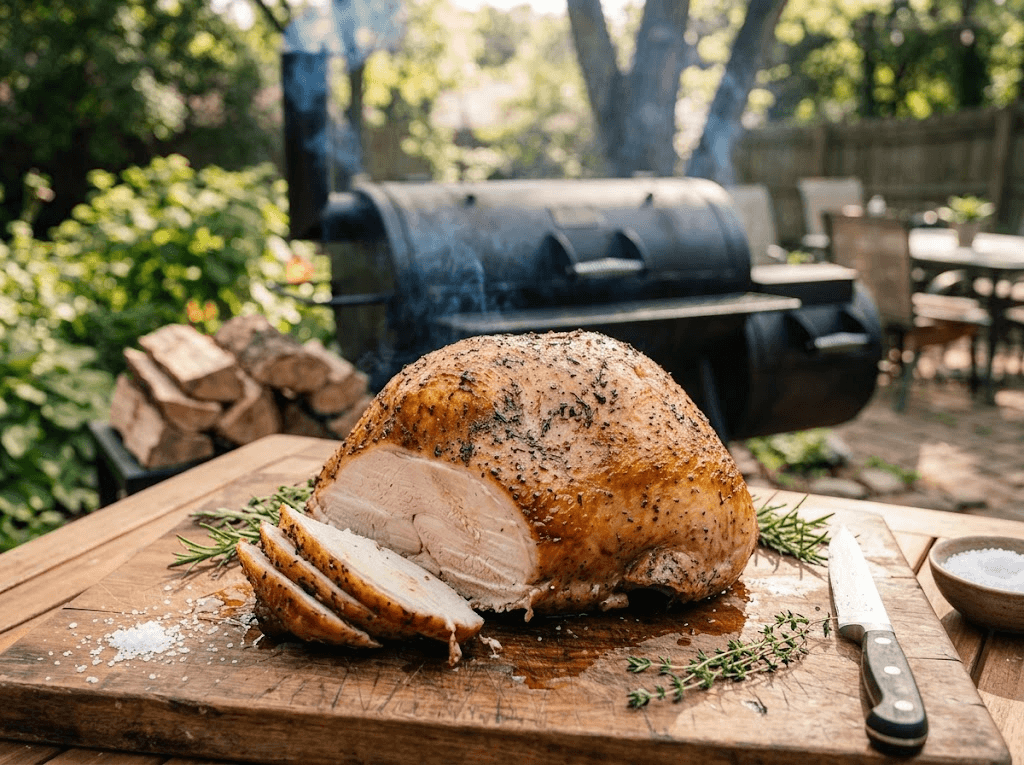
Turkey breast on an offset smoker is one of the best things you can cook over a live wood fire. You get golden, crisp skin, moist slices, and a clean smoky flavor that oven turkey can’t copy. It also cooks in about three hours, so you don’t need a whole day or a whole bird.
This recipe is made for beginners. You will learn how to dry brine, how to hold a steady 275°F (135°C) in a stick burner, how to read your thermometer, and what to do if the fire misbehaves. A breast is lean, so small mistakes show up fast, and this guide helps you avoid them.
The method works for Thanksgiving, Sunday dinner, or a batch of sandwich meat for the week. Let’s set up the cooker and get started.
Quick Answer: For turkey breast on an offset smoker, run the cook chamber at 275°F (135°C), use oak or apple splits, and smoke a 6 to 8 lb (2.7 to 3.6 kg) bone-in breast for about 2.5 to 3.5 hours. Pull at 160°F (71°C) in the thickest part and rest 20 to 30 minutes until it reads 165°F (74°C).
Why This Turkey Breast on an Offset Smoker Recipe Works
There are four things going on here, and each one fixes a common turkey problem.
A dry brine keeps the meat juicy. Salt pulls moisture out of the meat, then the meat soaks the salty liquid back in. The result is seasoned, tender meat that holds more juice during the cook. It also dries the skin, which helps it crisp.
275°F (135°C) is the sweet spot. At 225°F (107°C) the skin often turns rubbery. At 275°F, fat renders faster and the skin gets crisp while the meat stays moist. You also save about an hour.
Butter under the skin adds fat to a lean cut. Breast meat has very little fat. Soft butter placed between the skin and the meat bastes it from the inside as it cooks.
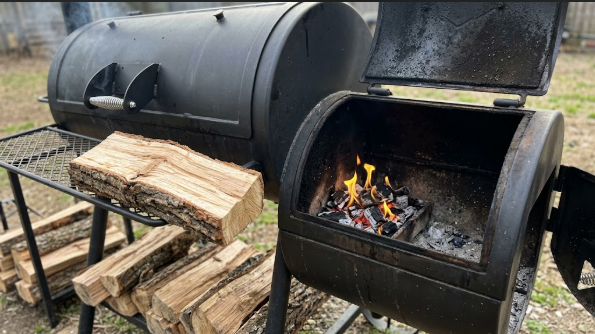
An offset smoker gives real wood flavor. A stick burner burns split logs, which makes a clean, deep smoke when the fire is hot and well fed. If you are still shopping for a cooker, see our affordable offset smoker guide.
Ingredients and Equipment
Ingredients (serves 6 to 8)
- 1 bone-in, skin-on turkey breast, 6 to 8 lb (2.7 to 3.6 kg)
- 2 tablespoons plus 1 teaspoon Diamond Crystal kosher salt for the dry brine (see the note below)
- 1 tablespoon smoked paprika
- 1 teaspoon black pepper
- 1 teaspoon garlic powder
- 1 teaspoon onion powder
- 1/2 teaspoon dried thyme
- 4 tablespoons (57 g) unsalted butter, softened
- 1 tablespoon neutral oil, such as avocado or canola
- Optional spritz: 1 cup apple juice mixed with 2 tablespoons apple cider vinegar
Salt note: Different salts weigh different amounts. Diamond Crystal is lighter than Morton. If you use Morton kosher salt, cut the amount about in half. If you use table salt, use even less.
Equipment
- Offset smoker (a stick burner or a reverse flow model)
- Chimney starter and lump charcoal or good briquettes
- Seasoned, split hardwood (oak, apple, cherry, or pecan)
- Two thermometers: one at grate level in the cook chamber, and one instant-read
- Wire rack and a rimmed baking sheet for dry brining
- Disposable foil pan for the drip tray
- Heat-proof gloves
- Spray bottle for the spritz
- A sharp carving knife (our guide to the best knives for cutting meat can help)
Which wood is best for turkey breast?
Turkey is mild, so it takes smoke fast. Pick fruit woods or a mellow hardwood and skip anything harsh.
| Wood | Flavor | Best Use |
| Oak | Medium, steady | Main fuel in an offset firebox |
| Apple | Light, sweet | Great all-purpose pairing |
| Cherry | Mild, slightly sweet | Adds a rich mahogany color |
| Pecan | Nutty, soft | Good with oak |
| Maple | Mild, sweet | Good for ham-like flavor |
| Hickory | Strong | Use only a small piece, mixed with fruitwood |
| Mesquite | Very strong | Skip it for turkey |
Substitutions
- Boneless breast: Cooks faster, usually 1.5 to 2.5 hours. Tie it for even thickness.
- No unsalted butter: Use salted butter and cut the rub salt a little.
- No apple juice: Spritz with plain water or leave the spritz out.
- No offset smoker: See the variations section for a pellet grill, charcoal kettle, and oven version.
Choosing and Prepping the Turkey Breast
Pick the right breast
Choose a bone-in, skin-on breast if you can. The bone slows heat on one side, so the meat cooks more gently and holds more juice. The skin protects the meat and gives you that crisp, golden bite.
Check the label for the words “enhanced,” “basted,” or “contains up to 8% solution.” Those birds already have salt water added. If yours does, skip the dry brine and only use a light rub without added salt .
Thaw it safely
If the breast is frozen, thaw it in the refrigerator, not on the counter. The USDA says a turkey breast needs about 24 hours in the fridge for every 4 to 5 lb (1.8 to 2.3 kg), and you can read the details in the USDA’s safe thawing guidance . A 7 lb (3.2 kg) breast should be thawed for roughly 1.5 to 2 days. Do not smoke it frozen.
Trim and dry
Pat the breast completely dry with paper towels. Trim any loose flaps of skin or long dangling fat that might burn. Leave the skin attached.
Don’t rinse the turkey. Rinsing splashes raw juices around your sink and does not make the bird safer.
Dry brine for 12 to 24 hours
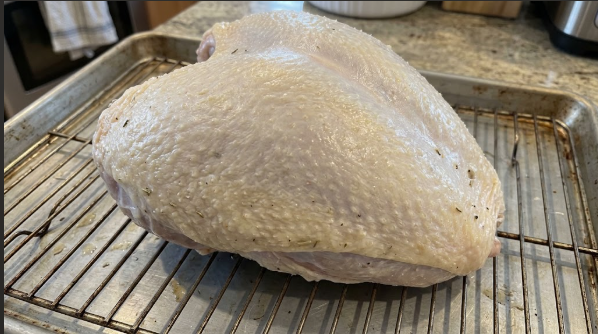
Mix the kosher salt with the paprika, pepper, garlic powder, onion powder, and thyme. Gently loosen the skin over the breast with your fingers, and rub about a third of the seasoning directly on the meat. Season the skin side and the cavity side with the rest.
Set the breast on a wire rack over a baking sheet, uncovered, in the refrigerator. Leave it for 12 to 24 hours. The skin should look dry and slightly tight, which is exactly what you want.
Pitmaster Tip: Take the breast out of the fridge 30 to 45 minutes before it goes on the smoker. Taking off some chill helps the meat cook evenly, and it won’t hurt anything as long as it stays under about 1 hour out of the fridge. Meanwhile, use that time to light your fire.
Turkey Breast on Offset Smoker: Step-by-Step Instructions
Plan about 4 hours total from first lit coal to carving. The cook itself is 2.5 to 3.5 hours.
- Light the fire. Fill a chimney starter with lump charcoal and light it. If you need help with fire lighting, read our guide on how to start a grill. Wait until the top coals are covered in gray ash, about 15 to 20 minutes.
- Build the bed. Pour the hot coals into the firebox and add two small, dry splits of oak or apple. Leave the door slightly open so the fire gets plenty of air.
- Set your target. Open the intake and let the cook chamber climb to 275°F (135°C). Read the thermometer at grate level, not the one on the lid, which can be off by 25°F or more .
- Watch the smoke. Wait for thin, pale blue smoke from the stack. Thick white smoke means the fire is starved or the wood is too wet. Give it more air and wait before loading the turkey.
- Finish the turkey. Pat the skin dry one more time. Slide softened butter under the skin in 4 to 5 spots and massage it flat. Rub the skin lightly with oil.
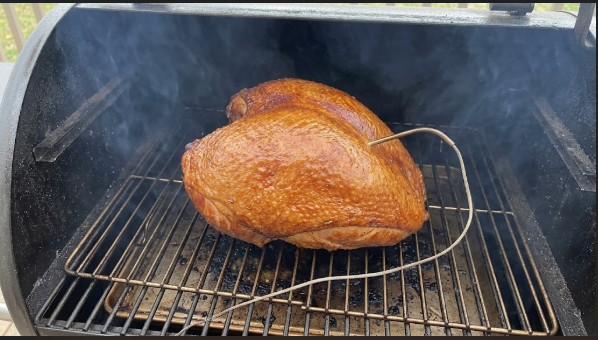
- Load the cooker. Put the breast on the far side of the cook chamber from the firebox, skin side up, with the thickest part pointing toward the heat. Put a foil drip pan under it if there is room.
- Insert the probe. Place a thermometer in the thickest part of the breast, away from the bone. Close the lid.
- Feed the fire. Add a small split every 30 to 40 minutes, preheated on top of the firebox. Small, frequent additions keep the temperature steady better than big logs.
- Rotate once. About 1 hour in, turn the pan 180 degrees so the skin cooks evenly. Do this quickly to avoid losing heat.
- Optional spritz. Mist the breast every 45 minutes with the apple juice mix, but stop in the last 45 minutes so the skin stays crisp.
- Check the color at 2 hours. The skin should be deep golden. If it is getting dark too fast, tent just the top with foil.
- Start temp checking early. At about 2 hours, check the thickest part. Check again every 15 minutes after that.
- Pull the turkey. Take it off the smoker when the thickest part reaches 160°F (71°C).
- Rest. Tent loosely with foil on a cutting board for 20 to 30 minutes, until it climbs to at least 165°F (74°C).
- Carve and serve.
Common Mistake: Cooking by the clock instead of by temperature. Every fire and every breast is different. A 7 lb (3.2 kg) breast might take 2.5 hours in one cooker and 3.5 in another. Trust your thermometer, not the timer.
Fire management tips for beginners
- Keep a clean fire. A small, hot fire with plenty of air makes better smoke than a smoldering one.
- Use dry, seasoned wood. Wet or green wood makes bitter, sooty smoke.
- Keep a backup supply of coals. Light a second chimney after about 1 hour so you always have hot coals ready.
- Open the lid only when needed. Each peek can drop the cook chamber temperature by 25 to 50°F (14 to 28°C).
If you cook with lump charcoal in your firebox, our guide to lump charcoal in an offset smoker covers how much to add and how to keep the heat steady.
Time and Temperature Table
| Breast Size | Smoker Temp | Estimated Cook Time | Pull Temp | Rest |
| 4 to 5 lb (1.8 to 2.3 kg) bone-in | 275°F (135°C) | 1.75 to 2.5 hr | 160°F (71°C) | 20 min |
| 6 to 8 lb (2.7 to 3.6 kg) bone-in | 275°F (135°C) | 2.5 to 3.5 hr | 160°F (71°C) | 20 to 30 min |
| 8 to 10 lb (3.6 to 4.5 kg) bone-in | 275°F (135°C) | 3.25 to 4.25 hr | 160°F (71°C) | 30 min |
| 2 to 3 lb (0.9 to 1.4 kg) boneless | 275°F (135°C) | 1.25 to 2 hr | 160°F (71°C) | 15 min |
Times are estimates only. Weather, wind, and fire control can change them. Always check with a thermometer.
How to Tell When Turkey Breast Is Done
Temperature is the only reliable test. Insert the instant-read thermometer into the thickest part of the breast, parallel to the bone and not touching it. Bone reads hotter than meat and can fool you.
The USDA’s safe minimum internal temperature for poultry is 165°F (74°C) . Many pitmasters pull the breast at 160°F (71°C) and let carryover heat bring it up to 165°F while it rests. Always confirm the final reading hits 165°F before you carve. If it falls short, put it back on the smoker.
Look and feel help too. The skin should be deep golden brown and slightly crisp, not wet or pale. The meat should feel firm but springy, and the juices should run clear, though color alone is not a reliable safety check.
Check a second spot on larger breasts, and always probe near the bone side where heat arrives last.
Resting, Slicing, and Serving
Resting matters as much as cooking. During the rest, juices settle back into the meat. If you slice too soon, they pour onto the board.
Tent the turkey loosely with foil so the skin stays crisp. Don’t wrap it tight, which traps steam and softens the skin. Rest it for 20 to 30 minutes.
To carve, run a sharp knife along the breastbone and peel the whole lobe off in one piece. Slice it across the grain into 1/2 inch (1.3 cm) slices. Keep the skin on each slice for the best bite.
If you carve a lot, a good knife makes it easier. See our guide to the best butcher knives for options.
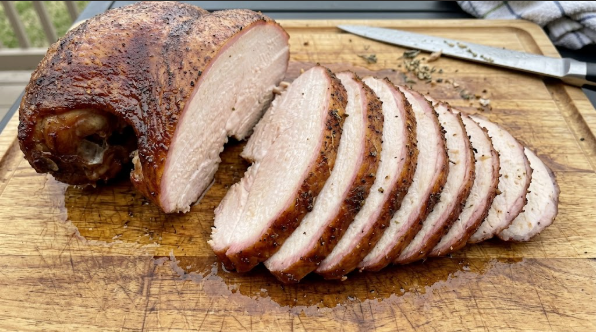
A note on pink meat: Smoked turkey can look slightly pink near the edge even when it is fully cooked. That is the smoke ring, not undercooked meat. Trust the thermometer.
What to Serve With Smoked Turkey Breast
Good sides keep the plate balanced. Smoked turkey is savory and a little rich, so you want something creamy, something sweet, and something fresh.
- Cornbread: Our cornbread recipe is soft and slightly sweet, which pairs well with smoke.
- Mashed potatoes and gravy: Use drippings from the pan for the gravy.
- Roasted vegetables: Green beans, carrots, or Brussels sprouts add color.
- Stuffing or dressing: A classic with any turkey.
- Cranberry sauce: The tart sweetness cuts through the smoke.
- Mac and cheese: Creamy and comforting.
- Coleslaw or a crisp salad: A cool, crunchy counterpoint.
For a full holiday menu, our collection of Thanksgiving smoker recipes gives you more ideas to cook alongside the turkey.
Leftover turkey makes great sandwiches, soups, and salads. Slice it thin for lunch the next day.
Storing, Freezing, and Reheating Leftovers
Get leftovers into the fridge within 2 hours of cooking. The USDA’s Danger Zone guidance warns that bacteria grow fast between 40°F and 140°F (4°C and 60°C), and one hour is the limit if it is above 90°F (32°C).
Refrigerator
Slice or pull the meat, pack it in shallow airtight containers, and keep it at 40°F (4°C) or below. The USDA’s leftover guidance says cooked poultry is good for 3 to 4 days in the fridge].
Freezer
Freeze portions in zip-top bags with the air pressed out. Frozen at 0°F (-18°C), turkey stays safe indefinitely, but quality is best within 2 to 6 months. Thaw in the fridge overnight.
Reheating
Reheat to 165°F (74°C) . Add a splash of broth to the container, cover, and warm in a 300°F (149°C) oven until it hits temperature. This keeps slices from drying out. A microwave works too, covered, in short bursts.
Variations: Pellet Grill, Charcoal, Boneless, and Oven Backup
Pellet grill
Set the grill to 275°F (135°C), use fruitwood pellets, and follow the same temperatures and times. Pellet grills hold temperature on their own, which makes this the easiest option. If you are choosing one, see our guide to the best pellet grills for beginners.
Reverse flow offset
A reverse flow smoker has a baffle that spreads heat evenly, so you can place the turkey anywhere in the chamber with less rotating. If you are curious how they work, see our post on a custom reverse flow smoker.
Charcoal kettle grill
Bank hot coals on one side, add a chunk of apple or oak, and set the turkey on the other side. Keep the vents about half open to hold 275°F (135°C). Refuel with about 10 to 12 unlit briquettes every hour.
Boneless breast
Tie the roast with butcher string so it holds an even shape. Cook at the same 275°F (135°C), start checking at 1 hour, and pull at 160°F (71°C).
Oven backup
No smoker? Roast the dry-brined breast at 325°F (163°C) on a rack until the thickest part reaches 160°F (71°C), about 1.5 to 2 hours for a 6 to 7 lb (2.7 to 3.2 kg) breast . Add a pinch of smoked paprika and serve.
Troubleshooting Common Problems
The skin is rubbery. The smoker ran too low, or the skin was wet. Dry brine uncovered, hold 275°F (135°C) or higher, and skip the spritz near the end.
The meat is dry. It was likely overcooked. Pull at 160°F (71°C), rest well, and use butter under the skin next time.
The turkey tastes bitter or sooty. The smoke was dirty. Use dry wood, keep the fire hot, and don’t let it smolder. Wait for thin blue smoke before the breast goes on.
The skin is too dark. Tent the top with foil, move the turkey farther from the firebox, or use less sugar in your rub.
The temperature swings up and down. Add smaller splits more often, and keep the intake mostly open. Preheat each new split on top of the firebox before adding it.
The breast is cooking unevenly. The side closest to the firebox runs hotter. Rotate the pan 180 degrees halfway through.
It is hitting 165°F way before 2 hours. The cook chamber ran hot. Keep checking, and lower the fire next time.
Recipe Card: Turkey Breast on an Offset Smoker
| Item | Details |
| Servings | 6 to 8 |
| Prep time | 20 minutes, plus 12 to 24 hours dry brining |
| Cook time | 2.5 to 3.5 hours at 275°F (135°C) |
| Rest time | 20 to 30 minutes |
| Wood | Oak with apple or cherry |
| Pull temp | 160°F (71°C), rest to 165°F (74°C) |
| Safe minimum temp | 165°F (74°C) |
Ingredients: 6 to 8 lb (2.7 to 3.6 kg) bone-in turkey breast, 2 tbsp plus 1 tsp Diamond Crystal kosher salt, 1 tbsp smoked paprika, 1 tsp each black pepper, garlic powder, and onion powder, 1/2 tsp dried thyme, 4 tbsp softened unsalted butter, 1 tbsp oil.
Short steps:
- Dry brine the breast uncovered in the fridge for 12 to 24 hours.
- Light the fire and bring the cook chamber to 275°F (135°C) with thin blue smoke.
- Slide butter under the skin and oil the skin.
- Smoke skin side up, away from the firebox, rotating once.
- Pull at 160°F (71°C) in the thickest part.
- Rest 20 to 30 minutes until it reads 165°F (74°C).
- Carve and serve.
FAQ
What temperature should I smoke a turkey breast at?
Smoke turkey breast at 275°F (135°C) for crisp skin and juicy meat. Lower temps like 225°F (107°C) work, but the skin often turns rubbery and the cook takes longer. Hold the temperature steady at grate level, and cook to internal temperature, not just time.
How long does it take to smoke a turkey breast?
A 6 to 8 lb (2.7 to 3.6 kg) bone-in turkey breast takes about 2.5 to 3.5 hours at 275°F (135°C). Smaller breasts take less time. Start probing at 2 hours, because fire strength and weather change timing. Pull when the thickest part reaches 160°F (71°C).
What internal temp should smoked turkey breast be?
The USDA says poultry must reach 165°F (74°C). Many cooks pull the breast at 160°F (71°C) and rest it, letting carryover heat reach 165°F. Always confirm 165°F with an instant-read thermometer in the thickest part before carving.
Do you need to brine a turkey breast before smoking?
Brining is not required, but a dry brine helps a lot. Salting the breast for 12 to 24 hours makes it juicier and more flavorful, and it dries the skin for better crisping. Skip it if the label says the turkey was already enhanced with a salt solution.
What is the best wood for smoking turkey breast?
Oak, apple, cherry, and pecan are the best picks. They give a mild, slightly sweet smoke that suits poultry. Use hickory sparingly because it is strong, and skip mesquite. In an offset, oak makes a good main fuel, with fruitwood added for flavor.
How do you get crispy skin on a smoked turkey breast?
Dry the skin well, air-dry it uncovered in the fridge, and cook at 275°F (135°C) or higher. Put butter under the skin, not on top, and oil the surface lightly. Skip spritzing near the end, and rest the turkey loosely tented, not wrapped.
Conclusion
Turkey breast on an offset smoker rewards a little planning: dry brine the night before, run a clean 275°F (135°C) fire, cook to temperature, and rest before you carve. Do that and you will get crisp skin, juicy slices, and real wood-fired flavor.
Start with a 6 to 8 lb (2.7 to 3.6 kg) bone-in breast, watch your thermometer, and keep notes on your fire and your timing. After one or two cooks, you will know your cooker well enough to make smoked turkey breast any time. For a quicker take on the same cut, see our turkey breast at 250 guide.
Laura Smith

I'm Laura, I like all the kind of delicious grilled foods which makes me hungry all the time I see them. That's why I built this blog to share with you all of my Grilling experiences, recipes, and all the tips about foods that I've learned from food experts.