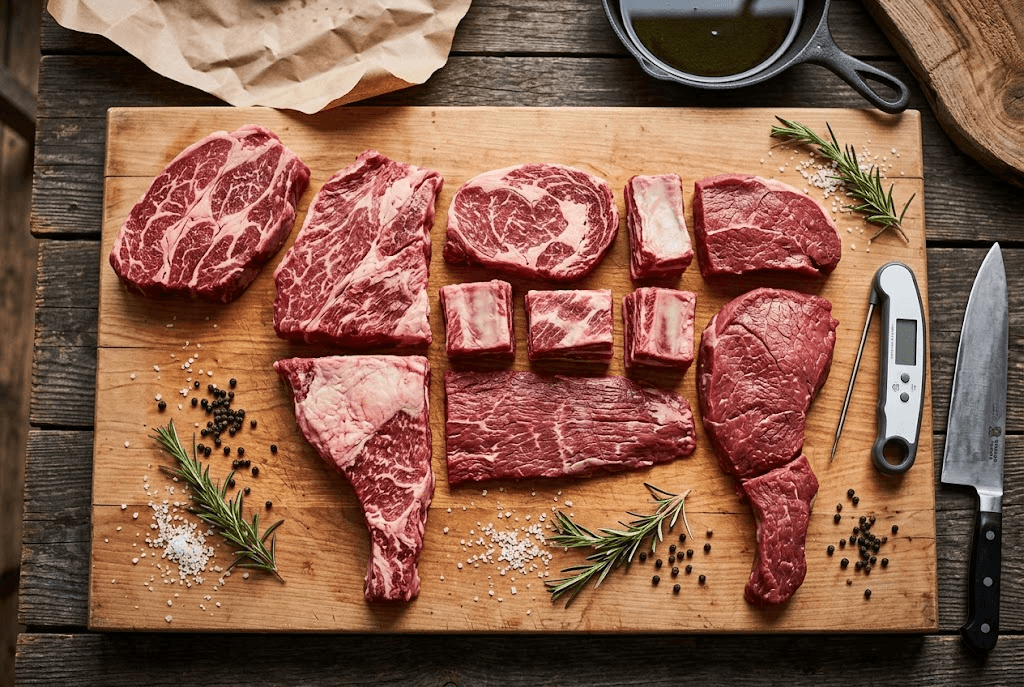
A good beef cuts chart solves the most common mistake at the butcher counter: buying the right cut and cooking it the wrong way. A ribeye and a chuck roast are both beef, but one wants a screaming-hot grill and the other wants hours of low heat.
This guide breaks beef into its primal cuts, shows what comes from each one, and matches every cut to a cooker, a method, and a pull temperature. Use it at the store, at the smoker, or when you’re deciding what to throw on the grill tonight.
Quick Answer: A beef cuts chart sorts the animal into primal cuts: chuck, rib, loin, round, brisket, plate, flank, and shank. Tender cuts from the rib and loin suit fast, dry heat like grilling. Tougher, hardworking cuts from the chuck, brisket, and round need low-and-slow smoking or braising.
Beef Cuts Chart: The 8 Primal Cuts at a Glance
USDA lists four basic primal cuts: chuck, loin, rib, and round (see USDA’s Beef From Farm to Table). Most butchers and extension programs split those out further into eight. This table uses the eight-cut version because it’s more useful at the counter.
| Primal Cut | Location | Popular Retail Cuts | Tenderness | Best Cooking Method |
| Chuck | Shoulder | Chuck roast, chuck eye, ground chuck | Tough, flavorful | Braise, smoke, slow roast |
| Rib | Upper back, mid-body | Ribeye, prime rib, rib roast | Very tender | Grill, sear, roast |
| Loin | Back, behind the rib | Strip, T-bone, porterhouse, tenderloin, sirloin, tri-tip | Tender to very tender | Grill, sear, roast |
| Round | Rear leg | Top round, eye of round, rump roast | Lean, firm | Slow roast, braise, slice thin |
| Brisket | Lower chest | Whole packer, flat, point | Tough, rich | Smoke, braise |
| Plate | Lower belly | Skirt, short ribs, plate ribs | Chewy, beefy | Grill hot, smoke, braise |
| Flank | Lower belly, rear | Flank steak | Lean, grainy | Grill hot and fast |
| Shank | Lower foreleg | Cross-cut shank, osso buco | Very tough | Braise |
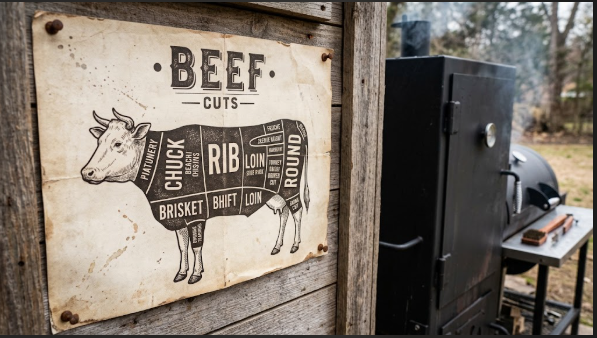
How to Read a Beef Cuts Chart
Every chart works the same way. A primal is the large section of the animal. A subprimal is a smaller piece cut from it, and a retail cut is what ends up in the case. K-State’s extension guide, Beef Processing Options for Consumers, walks through how primals and subprimals are broken down.
Tenderness follows one rule: muscles that work harder are tougher. Shoulders, legs, and chests do heavy lifting, so they carry more connective tissue. Cuts along the back, like the rib and loin, do less work and stay tender.
Names also change by region and store. A retailer may label the same piece differently, so check the label for the primal name as well as the cut name. If the label says “chuck,” plan on slow cooking.
What Makes a Cut Tender or Tough?
Three things decide how a cut behaves on your cooker:
- Connective tissue: Tough cuts are full of collagen. Low, long heat melts it into silky gelatin, which is why brisket turns juicy after hours in the smoker.
- Marbling: The white flecks of fat inside the muscle. More marbling means more flavor and more forgiveness. USDA notes that Prime beef has the most marbling , and most supermarket beef is Choice or Select.
- Thickness and shape: A thin steak cooks in minutes. A thick roast needs gentler heat so the outside doesn’t overcook before the center is done.
University extension guidance matches this: the University of Maryland’s meat cookery methods guide puts rib and loin cuts in the dry-heat category and chuck, brisket, and shank in the moist-heat category.
Chuck: The Flavor and Value Cut
The chuck is the shoulder. It’s one of the largest primals, and it’s packed with beefy flavor and connective tissue. Chuck roast, chuck eye, and ground chuck all come from here.
Best for: Pot roast, smoked chuck roast, burgers, and stew.
How to cook it: Smoke a 3-4 lb (1.4-1.8 kg) chuck roast at 250°F (121°C) until it reaches 200-205°F (93-96°C), usually 6-8 hours. It should probe like warm butter. Our pot roast recipe shows the braising route.
Skip it for: Quick grilling, except the chuck eye, which is often sold as a budget ribeye alternative.
Rib: Where Ribeye and Prime Rib Live
The rib primal sits along the upper back, and it’s where marbling and tenderness meet. Ribeye steak, rib steak, and standing rib roast all come from this section.
Best for: Steaks, prime rib, and special-occasion roasts.
How to cook it: For steaks, sear over 450-500°F (230-260°C) direct heat. For a thick ribeye, use a reverse sear: smoke or roast at 225°F (107°C) until 115°F (46°C), then sear hot. Pull at 130°F (54°C) for medium-rare.
Common Mistake: Cutting into a ribeye right off the heat. Rest steaks 5-10 minutes so the juices settle instead of running onto your board.
Loin: Strip, T-Bone, Tenderloin, and Tri-Tip
The loin runs behind the rib and is usually split into the short loin and the sirloin. Strip steak, T-bone, porterhouse, and filet mignon come from the short loin. Top sirloin and tri-tip come from the sirloin end.
Best for: Grilling, searing, and roasting.
How to cook it: Tenderloin is lean, so it needs quick, careful cooking and pulls well at 125-130°F (52-54°C). Strip steaks sear beautifully. Tri-tip is usually roasted or reverse-seared, then sliced thin against the grain, pulling around 130-135°F (54-57°C).
A pellet grill makes these cuts easy, and our beginner pellet grill guide covers good starter options.
Round: Lean, Affordable, and Slice-Thin
The round is the rear leg. Top round, bottom round, eye of round, and rump roast come from here. These muscles are lean and firm, with little marbling to protect them.
Best for: Roast beef, deli-style slices, jerky, and braising.
How to cook it: Roast an eye of round low, around 275°F (135°C), and pull at 125-130°F (52-54°C). Then slice paper-thin across the grain. Our guide to roast beef in the oven covers the full method.
Skip it for: Thick grilled steaks. Without marbling, round dries out fast over high heat.
Brisket: The Smoker’s Signature Cut
The brisket comes from the lower chest. It’s the star of Texas barbecue, and it’s made of two muscles: the leaner flat and the fattier point. A whole “packer” brisket includes both.
Best for: Smoking, corned beef, and braising.
How to cook it: Smoke at 250°F (121°C) with oak or hickory until the thickest part probes tender at 200-205°F (93-96°C). A 12-14 lb (5.4-6.4 kg) packer can take 10-14 hours, so plan extra time. Rest it at least an hour.
Smoking takes a stable fire. If you’re building one from scratch, our guide on using lump charcoal in an offset smoker explains fuel choice.
Pitmaster Tip: Judge brisket by feel, not just temperature. When the probe slides in with almost no resistance, it’s done, even if the number lands a few degrees off 203°F (95°C).
Plate, Flank, and Shank: The Underrated Cuts
These three primals sit lower on the animal and deliver big flavor.
Plate: Skirt steak and plate short ribs come from here. Skirt loves screaming-hot grilling for 2-3 minutes per side. Short ribs benefit from low-and-slow smoking at 250-275°F (121-135°C) until they probe tender around 203°F (95°C).
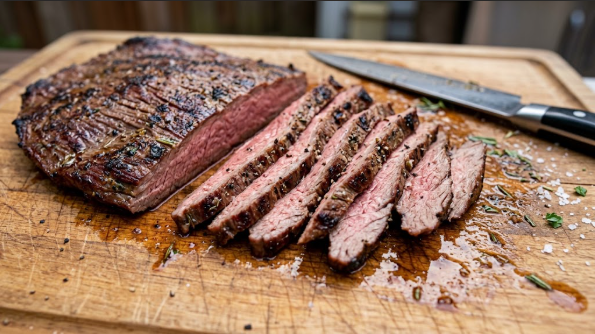
Flank: Flank steak is lean and long-grained. Grill it hot and fast, pull at 130°F (54°C), rest 5-10 minutes, and slice thinly across the grain.
Shank: The shank is the foreleg. Cross-cut shank and osso buco need a long braise in liquid, usually 2-3 hours, until the meat pulls apart.
Master Beef Cuts Chart: Method, Temps, and Times
Use this table as a quick cheat sheet. Times are approximate, since thickness and cooker temperature change everything. Always confirm with a thermometer.
| Cut | Primal | Cooker Temp | Pitmaster Pull Temp | Approx. Time |
| Ribeye (1.5 in) | Rib | 450-500°F (230-260°C) sear | 130°F (54°C) | 8-12 min |
| Prime rib roast | Rib | 225-250°F (107-121°C) | 120-125°F (49-52°C) | Varies by weight |
| Strip / T-bone | Loin | 450-500°F (230-260°C) | 130°F (54°C) | 8-12 min |
| Tenderloin / filet | Loin | 450°F (230°C) | 125-130°F (52-54°C) | 6-10 min |
| Tri-tip | Loin | 225°F (107°C) then sear | 130-135°F (54-57°C) | 45-75 min |
| Chuck roast (smoked) | Chuck | 250°F (121°C) | 200-205°F (93-96°C) | 6-8 hrs |
| Brisket (packer) | Brisket | 250°F (121°C) | 200-205°F (93-96°C) | 10-14 hrs |
| Plate short ribs | Plate | 250-275°F (121-135°C) | ~203°F (95°C) | 5-8 hrs |
| Skirt steak | Plate | 500°F+ (260°C+) | 130°F (54°C) | 4-6 min |
| Flank steak | Flank | 450-500°F (230-260°C) | 130°F (54°C) | 8-10 min |
| Eye of round | Round | 275°F (135°C) | 125-130°F (52-54°C) | 1-1.5 hrs |
| Shank (braised) | Shank | 300-325°F (150-163°C) | Fork-tender | 2-3 hrs |
These pull temps are a mix of chef-style doneness and pitmaster tenderness targets. They aren’t all safe minimums, and the next section covers what USDA requires.
How to Pick the Right Cut: A Step-by-Step Method
- Choose your cooker first. Hot grill, low smoker, or oven? A fast cooker wants tender cuts. A slow one wants tough, collagen-rich cuts.
- Match tenderness to time. If you have 20 minutes, buy from the rib or loin. If you have 8 hours, buy chuck or brisket.
- Check the thickness. Look for steaks at least 1 inch (2.5 cm) thick for grilling. Thin cuts overcook before they sear.
- Look at the marbling. Fine white flecks mean better flavor and moisture. Lean cuts like round need careful cooking.
- Read the label. Find the primal name, the grade, and the weight. Buy a bit extra, since large roasts shrink during cooking.
- Buy a thermometer. An instant-read model beats guessing every time.
If you’re new to fire management, our guide on how to start a grill covers the basics.
Beef Doneness and Food Safety
Use a food thermometer, not color or time. USDA says to cook beef steaks and roasts to a minimum of 145°F (63°C) and rest them at least three minutes, per the USDA safe minimum internal temperature chart. Ground beef must reach 160°F (71°C).
Here’s how the common doneness levels compare to the USDA minimum:
| Doneness | Pitmaster Pull Temp | After Rest* |
| Rare | 120°F (49°C) | ~125°F (52°C) |
| Medium-rare | 130°F (54°C) | ~135°F (57°C) |
| Medium | 140°F (60°C) | ~145°F (63°C) |
*Carryover cooking typically adds about 5°F (3°C), more on thick roasts.
Rare and medium-rare steaks sit below the USDA minimum. That’s a personal preference many cooks make with intact steaks, but you should know the guidance. Ground beef is different, because bacteria can be mixed throughout, so always cook burgers to 160°F (71°C).
Storage Times
Follow FoodSafety.gov’s cold food storage chart:
- Raw steaks and roasts: 3-5 days in the fridge at 40°F (4°C) or below
- Raw ground beef: 1-2 days in the fridge
- Cooked beef leftovers: 3-4 days in the fridge
- Freezer: Quality-based, roughly 4-12 months for steaks and roasts, and 3-4 months for ground beef
USDA also says not to age beef in a home refrigerator .
Related Tips for Using a Beef Cuts Chart
- Slice against the grain. This matters most for brisket, flank, skirt, and tri-tip. A sharp slicing blade helps, so check our best knives for cutting meat.
- Trim with a good knife. A flexible boning knife makes fat caps and silver skin easier. Our butcher knife guide covers solid options.
- Season early. Salt thick cuts at least 45 minutes ahead, or overnight for roasts.
- Choose wood to match the cut. Oak and hickory handle beef well. Lighter fruit woods suit leaner cuts.
- Use ground beef wisely. Chuck-heavy blends make juicy burgers and meatloaf. See what goes with meatloaf for a full dinner plan.
- Rest everything. Steaks need 5-10 minutes. Brisket needs an hour or more.
Common Mistake: Grilling a tough cut hot and fast. A chuck roast or brisket on a screaming-hot grill ends up gray and chewy, because the collagen never gets time to melt.
FAQ
What are the 8 primal cuts of beef?
The eight primals are chuck, rib, loin, round, brisket, plate, flank, and shank. USDA groups beef into four basic primals (chuck, loin, rib, and round), while butchers often split out the rest. Each section produces different retail cuts.
What is the most tender cut of beef?
Tenderloin, the muscle behind filet mignon, is generally the most tender because it does very little work. It’s lean, though, so it has milder flavor than a ribeye. For tenderness plus rich flavor, many cooks pick ribeye.
What cut of beef is best for smoking?
Brisket is the classic choice, followed by chuck roast, short ribs, and plate ribs. These cuts have plenty of collagen, which melts during long, low cooks. Smoke them at about 250°F (121°C) until probe-tender, usually around 200-205°F (93-96°C).
What is the cheapest cut of beef?
Chuck and round cuts are usually the most affordable, along with shank. They cost less because they’re tougher, but slow cooking makes them tender. Chuck roast is a standout value for pot roast, smoking, and shredding.
Which beef cuts are best for grilling?
Ribeye, strip steak, T-bone, porterhouse, tenderloin, and top sirloin grill well. Flank and skirt are great too if you cook them hot and slice them thin. Pick steaks at least 1 inch (2.5 cm) thick.
What internal temperature should beef be cooked to?
USDA says to cook steaks and roasts to 145°F (63°C) with a three-minute rest, and ground beef to 160°F (71°C). Many cooks pull steaks earlier for medium-rare. Tough cuts like brisket need 200-205°F (93-96°C) for tenderness.
Conclusion
A beef cuts chart really comes down to one question: how long will you cook it? Fast, hot cooking suits the rib and loin. Slow, patient cooking turns the chuck, brisket, plate, and shank into something special.
Keep the master table handy, buy a good thermometer, and match the cut to your cooker. Do that and you’ll stop guessing at the counter and start getting consistent results every time.
Laura Smith

I'm Laura, I like all the kind of delicious grilled foods which makes me hungry all the time I see them. That's why I built this blog to share with you all of my Grilling experiences, recipes, and all the tips about foods that I've learned from food experts.