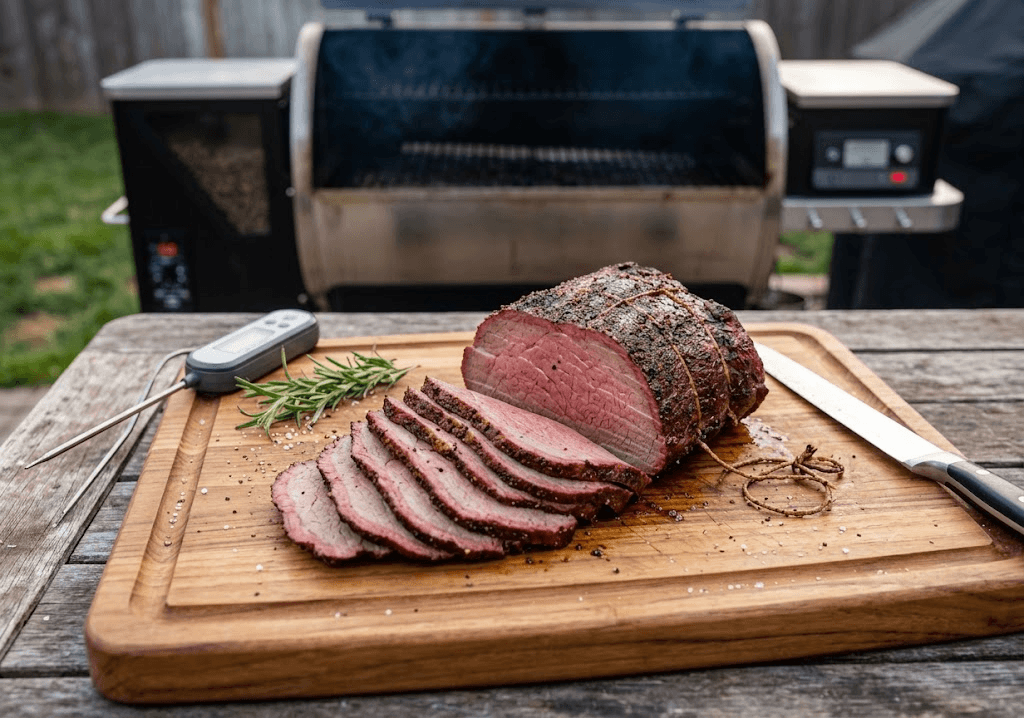
A bottom round roast is one of the cheapest beef roasts at the counter, and it has a reputation for turning out dry and tough. That reputation is mostly earned by bad cooking, not a bad cut. Cook it low, pull it at the right temperature, and slice it thin, and it makes excellent smoked roast beef.
A bottom round roast on a pellet grill is a great match. The steady heat keeps the cooking gentle, and the wood smoke adds a savory crust the meat does not have on its own. You set the temperature, drop in a probe, and let the grill work.
This guide covers everything: how to choose and trim the roast, how to season it, exact temperatures and times, and how to slice it so every piece is tender. It also covers leftovers and the mistakes that cause dry meat.
⚡ Quick Answer
Smoke a 3-4 lb (1.4-1.8 kg) bottom round roast at 250°F (121°C) for about 2-3 hours, until it hits 130°F (54°C) for medium-rare. Rest it 20 minutes, then slice thin against the grain. The USDA’s minimum safe temperature for beef roasts is 145°F (63°C) with a 3-minute rest.
Why This Bottom Round Roast on a Pellet Grill Recipe Works
Bottom round comes from the hind leg of the cow, a muscle that works hard. That means it has very little fat and a lot of connective tissue. It is lean, beefy, and firm.
Here is why smoking it on a pellet grill gets around those problems:
- Low heat is gentle. At 250°F (121°C), the outside does not overcook before the center catches up.
- A dry brine adds moisture. Salting ahead of time helps the meat hold onto juice.
- A probe thermometer removes guesswork. Lean meat goes from perfect to dry in minutes, so pulling at the right temperature matters more than the clock.
- Thin slicing does the rest. Cutting thin slices against the grain shortens the muscle fibers, so each bite feels tender.
This is not a fall-apart pot roast. Think of it as deli-style roast beef with smoky bark: pink, sliceable, and great on sandwiches. If you want a fork-tender version, there is a variation near the end.
Ingredients and Equipment
Ingredients (serves about 8)
- 1 bottom round roast, 3-4 lb (1.4-1.8 kg)
- 1 tablespoon kosher salt (use 2 teaspoons if you use fine table salt)
- 1 tablespoon coarse black pepper
- 2 teaspoons garlic powder
- 2 teaspoons onion powder
- 1 teaspoon smoked paprika
- 1 teaspoon dried thyme or rosemary
- 1-2 tablespoons olive oil or yellow mustard (as a binder)
- Spritz: 1/2 cup (120 ml) beef broth mixed with 1/2 cup (120 ml) apple cider vinegar (optional)
Equipment
- Pellet grill (any brand: Traeger, Pit Boss, Camp Chef, Recteq, and others all work)
- Pellets: oak, hickory, pecan, or a beef-friendly blend
- Instant-read thermometer and a leave-in probe thermometer
- Butcher twine
- Sharp slicing knife
- Cutting board with a groove
- Aluminum foil
- Spray bottle (optional)
Substitutions
- Other cuts: Top round, eye of round, and rump roast all work with the same method. Eye of round is leaner and cooks faster, so check it earlier.
- Rub: Swap the blend for 2 tablespoons of your favorite beef or “SPG” rub (salt, pepper, garlic).
- Binder: Worcestershire sauce works as well as oil or mustard. The binder only helps the rub stick, and the mustard flavor cooks off.
- Pellets: Oak is mild and safe. Hickory is stronger and more classic. Cherry adds color. Mesquite can overpower a lean roast, so use it sparingly or blend it.
Choosing and Prepping Your Roast
What to Look For
Pick a roast with an even, compact shape. A uniform roast cooks at the same rate from end to end. Look for bright red beef with a thin layer of fat on one side. A 3-4 lb (1.4-1.8 kg) roast is a good size, because smaller roasts overcook quickly and larger ones take much longer.
Ask the butcher to tie it for you if it comes loose. Many bottom rounds are sold in netting or already tied.
Trimming
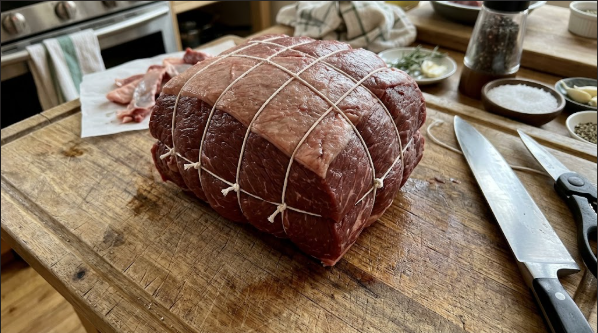
- Pat the roast dry with paper towels.
- Trim any hard, waxy fat and silver skin (the shiny, tough membrane). A sharp knife makes this easy. Our guide to the best butcher knives can help if your current blade struggles.
- Leave a thin fat cap, about 1/4 inch (6 mm), if there is one. It protects the top of the roast during the cook.
- Tie the roast with butcher twine every 1-1.5 inches (2.5-4 cm) so it holds a round, even shape.
Dry Brine (Best Results)
A dry brine is just salting the meat ahead of time. The salt pulls moisture out, dissolves, and then gets reabsorbed, which seasons the meat deeply and helps it stay juicy.
- Rub the kosher salt over the whole roast.
- Place it uncovered on a rack or plate in the refrigerator.
- Let it rest for at least 4 hours, and up to 24 hours.
The uncovered rest also dries the surface, which helps the bark form on the grill. If you are short on time, salt it right before cooking and add 5-10 minutes of extra rest at the end.
Seasoning
Right before the grill, brush on the binder. Mix the pepper, garlic powder, onion powder, paprika, and herbs. Coat the roast on all sides. Press the rub in firmly so it stays on during the cook.
🔥 Pitmaster Tip
Take the roast out of the fridge 30-45 minutes before it goes on the grill. A slightly less cold center cooks more evenly, and the surface picks up smoke faster. Do not leave it out longer than that. The USDA says perishable food should not sit out for more than 2 hours.
How to Cook a Bottom Round Roast on a Pellet Grill: Step by Step
Step 1: Preheat the Grill
Fill the hopper with your pellets. Set the pellet grill to 250°F (121°C) and let it preheat for 10-15 minutes with the lid closed. If you are new to pellet grills, our roundup of the best pellet grills for beginners covers models that hold temperature well.
Some pellet grills have a “Smoke” or low setting. If yours does, run the first 45-60 minutes at 180-225°F (82-107°C) for more smoke flavor, then raise it to 250°F (121°C).
Step 2: Insert the Probe
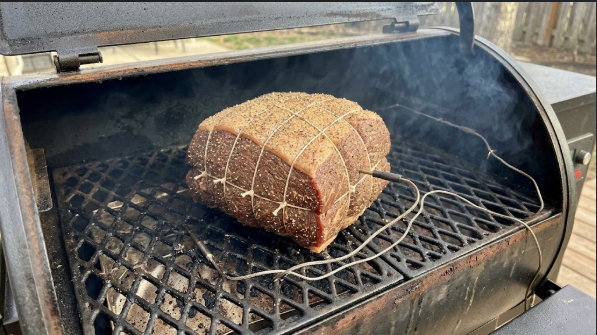
Push the leave-in probe into the center of the thickest part of the roast, going in from the side. Make sure the tip is not touching a pocket of fat or the grill grate. Plug the probe into the controller.
Step 3: Put the Roast on the Grill
Place the roast directly on the grate, fat side up. Close the lid. Resist the urge to peek, since each time you open the lid you lose heat and add cooking time.
Step 4: Smoke at 250°F (121°C)
Smoke the roast for about 2 to 3 hours. The exact time depends on the size and shape, the weather, and your grill. Start checking the temperature around the 90-minute mark.
If you want to spritz, do it once an hour. Mist the surface lightly. Do not soak it, since too much liquid softens the bark.
Step 5: Pull at 130°F (54°C)
When the probe reads 130°F (54°C), take the roast off the grill. The temperature will keep rising 5-10°F (3-6°C) while it rests, a process called carryover cooking. That puts you in the medium-rare to medium range.
Step 6: Optional Sear
For a deeper crust, crank the grill to its highest setting, usually 450-500°F (232-260°C). Pull the roast at about 120°F (49°C), sear for 5-8 minutes, and watch it closely. Take it off at 130°F (54°C) on the probe. This is a reverse sear, and it works well if your grill goes hot.
Step 7: Rest
Tent the roast loosely with foil and rest it on the cutting board for 20-30 minutes. Do not skip this step. Resting lets the juices settle back into the meat. Slice too early, and they run out onto the board.
Step 8: Slice
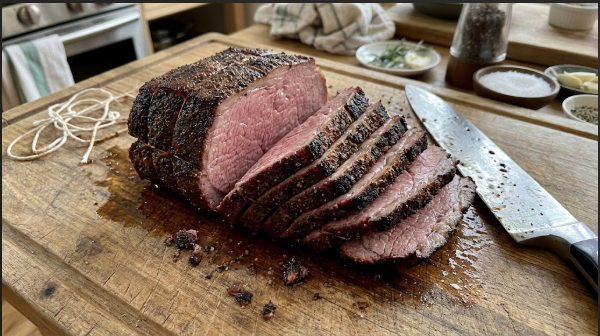
Remove the twine. Using a long, sharp knife, slice against the grain in thin slices, about 1/8 to 1/4 inch (3-6 mm) thick. A good knife for cutting meat makes clean slices without tearing the roast.
⚠️ Common Mistake
Cooking by time instead of temperature. A bottom round roast has almost no fat to protect it, so just 10-15 minutes too long can turn it dry and gray. Trust the thermometer, not the clock.
Time and Temperature Table
These are estimates for a 3-4 lb (1.4-1.8 kg) roast at 250°F (121°C). Your grill, the weather, and the roast’s shape will change the numbers, so use them as a guide.
| Doneness | Pull Temp | Final Temp After Rest | Approx. Cook Time at 250°F (121°C) |
| Medium-rare | 130°F (54°C) | 135-140°F (57-60°C) | 2-3 hours |
| Medium | 138-140°F (59-60°C) | 145°F (63°C) | 2.5-3.5 hours |
| Medium-well | 145°F (63°C) | 150-155°F (66-68°C) | 3-4 hours |
| Pulled / shredded (wrapped) | 200-205°F (93-96°C) | Same | 5-7 hours |
At 225°F (107°C), add roughly 30-60 minutes. At 275°F (135°C), subtract about 20-30 minutes. All times are approximate.
Safety note: The USDA’s safe minimum internal temperature for whole cuts of beef is 145°F (63°C) with a 3-minute rest, per the FoodSafety.gov temperature chart . Pulling a roast at 130°F (54°C) for medium-rare is a pitmaster preference, not the USDA minimum. If you want to follow the government number exactly, cook to 145°F (63°C) and expect a firmer, drier result from this lean cut.
How to Tell When It’s Done
A thermometer is your best tool, but your senses help too.
- Temperature: The probe in the thickest part of the roast reads 130°F (54°C) at the pull, and 135-140°F (57-60°C) after rest.
- Look: The outside is a deep mahogany brown with a firm, peppery bark. Inside, the slice should be rosy pink from edge to center with a thin smoke ring just under the surface.
- Feel: The roast feels firm but gives slightly when pressed. It should not feel hard or stiff.
- Juices: A little clear or pink juice on the board after slicing is normal. A pool of gray liquid means it was sliced too early or cooked too long.
Check the temperature in two or three spots with an instant-read thermometer before pulling. Roasts are often uneven, and one end may run ahead of the other.
Resting, Slicing, and Serving
Resting
Give the roast the full 20-30 minutes. It will stay warm under foil. During this time, the internal temperature rises a few degrees and the juices redistribute.
Slicing Against the Grain
Look closely at the roast. You will see thin lines running in one direction. These are the muscle fibers. Cut across them, not along them.
- Use a long, sharp slicing knife.
- Cut thin slices, no thicker than 1/4 inch (6 mm).
- Use long, smooth strokes. Do not saw.
Thin slices are the most important trick for bottom round. A thick slice of this cut can feel chewy, while a thin one melts.
Serving Ideas
- Pile slices on rolls with horseradish sauce and provolone for roast beef sandwiches.
- Serve warm slices with a quick pan au jus.
- Layer thin slices on a platter with a side of creamy horseradish or chimichurri.
What to Serve With Smoked Bottom Round RoastClassic roast beef sides work well here:
- Mashed or roasted potatoes: They soak up the juices.
- Roasted carrots and green beans: Simple vegetables balance the rich beef.
- Cornbread: Try our Redstone cornbread recipe for a sweet, tender side.
- Coleslaw or a crisp green salad: The crunch cuts through the smoke.
- Creamed spinach or mac and cheese: Hearty comfort sides for a Sunday dinner.
- Horseradish cream or chimichurri: A bright sauce lifts the lean beef.
Storing, Freezing, and Reheating Leftovers
Leftover bottom round roast makes great sandwiches, so it is worth saving.
Refrigerating
Get leftovers into the fridge within 2 hours (1 hour if it is above 90°F / 32°C). The USDA says cooked leftovers are generally good for 3-4 days in the refrigerator at 40°F (4°C) or below, per its leftovers and food safety guide]. Store slices in an airtight container.
Freezing
Wrap slices in plastic wrap or freezer paper, then place them in a freezer bag with the air pressed out. For best quality, use them within 2-3 months. Frozen food kept at 0°F (-18°C) stays safe indefinitely, according to the USDA, but the texture and flavor decline . Thaw in the refrigerator overnight.
Reheating
Gently warm slices in a skillet with a splash of beef broth, or in a covered dish in a 275°F (135°C) oven. Reheat leftovers to 165°F (74°C), the USDA’s recommended temperature for reheated leftovers. Do not overheat thin slices, since they dry out quickly. For cold sandwiches, you can skip reheating and use slices straight from the fridge.
Variations
Offset Smoker or Charcoal Grill
Hold the cooker at 250°F (121°C) and use the same pull temperatures. Use a mild hardwood like oak. If you cook with lump charcoal, our guide to lump charcoal in an offset smoker covers fire management. Set up a two-zone fire, with the roast on the cool side.
Oven Backup
No pellet grill? Roast at 250-275°F (121-135°C) on a rack in a roasting pan, until the center hits 130°F (54°C). Add 1/2 teaspoon of smoked paprika to the rub for a hint of smoke. Our recipe for perfect roast beef in the oven walks through the oven method.
Pulled Bottom Round (Fork-Tender)
For shreddable beef, smoke at 250°F (121°C) until the roast hits about 160-165°F (71-74°C) and the bark sets, then wrap it tightly in foil with 1/2 cup (120 ml) of beef broth. Return it to the grill until it hits 200-205°F (93-96°C) and a probe slides in with little resistance. Rest for 30 minutes before pulling. If you want a stovetop-style classic instead, see our Golden Corral pot roast recipe.
Different Flavors
- Garlic-herb: Add fresh rosemary, thyme, and extra garlic to the binder.
- Coffee rub: Add 1 tablespoon of finely ground coffee and 1 teaspoon of brown sugar.
- Montreal-style: Use steak seasoning and extra coarse pepper.
Troubleshooting
| Problem | Likely Cause | Fix |
| Roast is dry | Cooked past 140°F (60°C), or no rest | Pull earlier, rest 20+ minutes, slice thin |
| Roast is tough or chewy | Sliced with the grain, or slices are too thick | Slice thin and across the grain |
| Not enough smoke flavor | Grill too hot, or lid opened too often | Start at 180-225°F (82-107°C) for the first hour |
| Bark is soft | Too much spritzing, or high humidity | Spritz less and cook uncovered |
| Outside is dark but inside is raw | Grill ran too hot | Check your grill’s temperature with a separate thermometer |
| Cook is taking too long | Cold roast, cold weather, or a stall | Be patient and keep the lid closed |
| Uneven doneness | Odd shape or no twine | Tie the roast and check two or three spots |
If your grill struggles with temperature swings, make sure the fire pot is clean and the pellets are dry. A fresh, dry bag of pellets makes a noticeable difference.
Recipe Card: Bottom Round Roast on a Pellet Grill
Servings: 8
Prep time: 20 minutes (plus 4-24 hours dry brine)
Cook time: 2-3 hours
Rest time: 20-30 minutes
Grill temp: 250°F (121°C)
Pull temp: 130°F (54°C) for medium-rare
Ingredients:
- 3-4 lb (1.4-1.8 kg) bottom round roast
- 1 tbsp kosher salt
- 1 tbsp coarse black pepper
- 2 tsp garlic powder
- 2 tsp onion powder
- 1 tsp smoked paprika
- 1 tsp dried thyme or rosemary
- 1-2 tbsp olive oil or mustard
Quick steps:
- Trim and tie the roast. Dry brine with salt for 4-24 hours.
- Remove from the fridge 30-45 minutes before cooking.
- Preheat the pellet grill to 250°F (121°C).
- Brush with the binder and coat with the rub.
- Insert a probe and smoke for 2-3 hours until 130°F (54°C).
- Rest under foil for 20-30 minutes.
- Slice thin against the grain and serve.
FAQ
1. Can you smoke a bottom round roast?
Yes. Bottom round is lean, so it needs gentle heat, a dry brine, and careful temperature control. Smoke it at 250°F (121°C) until it reaches 130°F (54°C), rest it, and slice thin. Done this way, it turns out juicy, smoky, and sliceable.
2. What temperature should I smoke a bottom round roast at?
Use 225-250°F (107-121°C). Lower heat gives more smoke flavor but takes longer. At 250°F (121°C), a 3-4 lb (1.4-1.8 kg) roast takes about 2-3 hours. Higher temperatures dry out the outer layer of this lean cut faster.
3. What internal temp for bottom round roast is best?
For medium-rare, pull it at 130°F (54°C), and it will finish around 135-140°F (57-60°C) after resting. The USDA minimum safe temperature for beef roasts is 145°F (63°C) with a 3-minute rest. Going past 145°F tends to dry it out.
4. Is bottom round roast tough?
It can be, because it is a lean cut from a hard-working muscle. Gentle cooking, a dry brine, a proper rest, and thin slices against the grain make it tender enough for sandwiches and slicing. Overcooking is the most common reason it turns tough.
5. Should I wrap a bottom round roast?
Not for sliced roast beef. Wrapping softens the bark and pushes the meat toward pot-roast texture. Wrap only if you want pulled or shredded beef, in which case cook to 200-205°F (93-96°C) with a little beef broth in the foil.
6. What is the best wood for smoking roast beef?
Oak is the safest all-around choice, with mild, steady smoke. Hickory gives a stronger, classic flavor, and pecan is slightly sweeter. Cherry adds a rich color. Use mesquite sparingly, since it can overpower a lean roast.
Conclusion
A bottom round roast on a pellet grill proves that a budget cut can taste like a weekend centerpiece. Trim it, dry brine it, smoke it at 250°F (121°C), and pull it at 130°F (54°C). Rest it, then slice it thin against the grain.
The key is respecting how lean the meat is. Rely on your thermometer, keep the heat low, and never skip the rest. Do those things and your bottom round roast on a pellet grill will give you juicy, smoky roast beef with plenty left over for sandwiches. For another reliable low-and-slow method, see our guide to turkey breast at 250°F.
Laura Smith

I'm Laura, I like all the kind of delicious grilled foods which makes me hungry all the time I see them. That's why I built this blog to share with you all of my Grilling experiences, recipes, and all the tips about foods that I've learned from food experts.