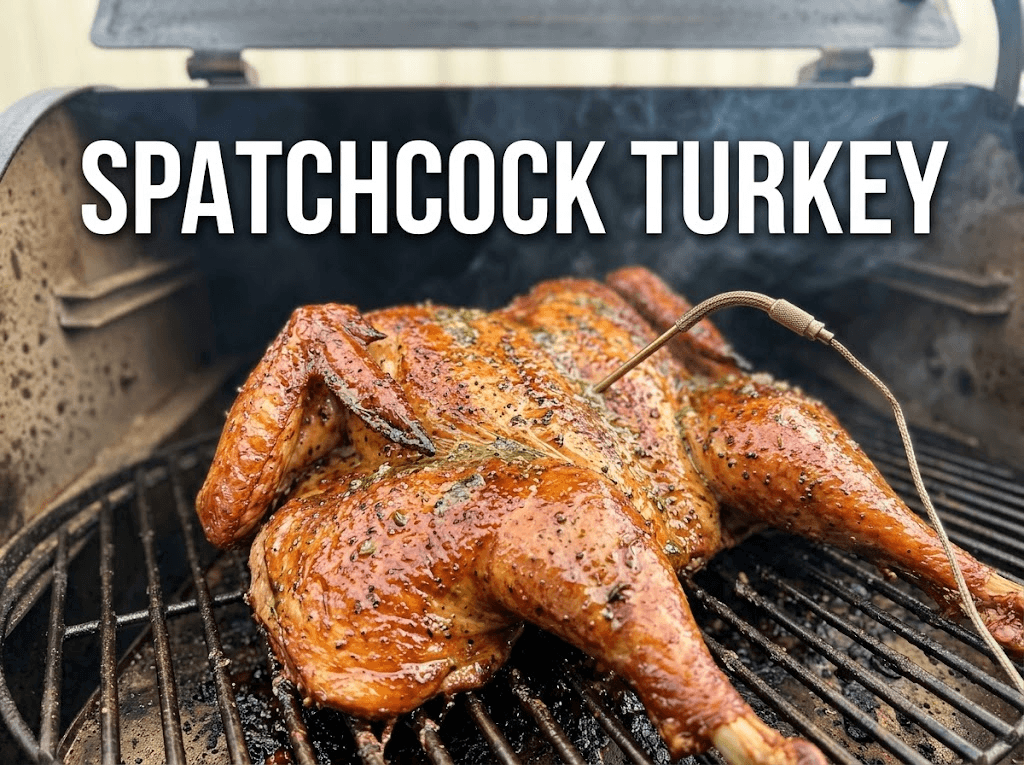
If you want a Thanksgiving bird that finishes fast and cooks evenly, spatchcock turkey on a pellet grill is the method to learn. You cut out the backbone, flatten the bird, and let the grill do the work. The result is crisp skin, juicy breast meat, and a light layer of wood smoke, usually in under three hours.
A regular whole turkey has a problem: the legs need to run hotter than the breast. Flattening the bird fixes that, because everything sits at the same height and gets the same heat. This guide walks you through every step, from thawing to carving.
Quick Answer: Dry brine a 12-14 lb (5.4-6.4 kg) spatchcocked turkey for 24-48 hours. Smoke it on a pellet grill at 300°F (149°C) for about 2.5-3 hours. Pull it when the breast hits 160°F (71°C) and the thighs hit 175°F (79°C). Rest 20-30 minutes, then carve.
Why This Spatchcock Turkey on a Pellet Grill Recipe Works
There are four reasons this method beats roasting a whole bird.
- Even cooking. A flat turkey has no deep cavity, so the thick thighs and the lean breast finish within minutes of each other.
- Faster cook time. Flattening cuts the cook time roughly in half compared with a whole bird at the same temperature.
- More crispy skin. All the skin faces up toward the heat and the fan-driven air of the pellet grill, so it renders and browns instead of turning rubbery.
- More smoke flavor. Open surface area grabs more smoke, even at higher temperatures.
A pellet grill is the ideal cooker for this job. It holds a steady temperature, feeds itself pellets, and lets you set the dial and walk away. If you are still shopping for a cooker, see our guide to the best pellet grills for beginners.
Ingredients and Equipment
Ingredients (serves 8-10 with leftovers)
- 1 fresh or fully thawed turkey, 12-14 lb (5.4-6.4 kg)
- 3 tablespoons Diamond Crystal kosher salt (or about 2 tablespoons Morton kosher salt)
- 1 tablespoon black pepper
- 2 teaspoons garlic powder
- 2 teaspoons smoked paprika
- 1 teaspoon dried thyme or poultry seasoning
- 1 teaspoon baking powder (aluminum-free, optional but helpful for skin)
- 4 tablespoons (57 g) unsalted butter, melted, or 3 tablespoons avocado oil
- 1 onion, 2 carrots, and 2 celery stalks for the drip pan (optional)
Equipment
- Pellet grill (Traeger, Pit Boss, Recteq, Camp Chef, and Z Grills all work)
- Sharp poultry shears or heavy kitchen shears
- Instant-read thermometer plus a leave-in probe
- Large rimmed sheet pan or wire rack set inside a foil pan
- Paper towels, cutting board, and a sharp carving knife
A good carving knife makes a real difference at the table. Our roundup of the best knives for cutting meat covers options for every budget.
Substitutions
| If you do not have | Use |
| Diamond Crystal salt | Morton kosher salt, but use about one-third less |
| Baking powder | Skip it; the skin will still crisp, just slightly less bubbly |
| Butter | Avocado oil or any high-heat neutral oil |
| Smoked paprika | Regular paprika plus a pinch of cayenne |
| Poultry shears | A sturdy chef’s knife, with extra care |
Choosing and Prepping the Turkey
Pick the right size
A 12-14 lb (5.4-6.4 kg) bird is the sweet spot. It fits on most grates once flattened and cooks fast. Birds over 16 lb (7.3 kg) can still be spatchcocked, but they are harder to flip and take much longer. USDA FSIS advises planning about 1 lb of turkey per person, as explained in USDA’s turkey roasting guidance.
Thaw it safely
Frozen turkeys must thaw in the refrigerator, in cold water, or in the microwave. In the fridge, plan about 24 hours for every 4-5 lb (1.8-2.3 kg), so a 14 lb bird needs about three days. See FSIS thawing guidance for cold-water and microwave timing. Do not try to spatchcock a rock-solid frozen turkey.
How to spatchcock the turkey
- Remove the neck and giblets from the cavity. Save them for gravy.
- Place the turkey breast-side down on a large cutting board, legs toward you.
- Cut along one side of the backbone with shears, from the tail up to the neck. Stay close to the spine.
- Cut along the other side and lift the backbone out. Freeze it for stock.
- Flip the turkey breast-side up. Press down firmly on the breastbone with both palms until you hear it crack and the bird lies flat.
- Tuck the wing tips behind the breast so they do not scorch.
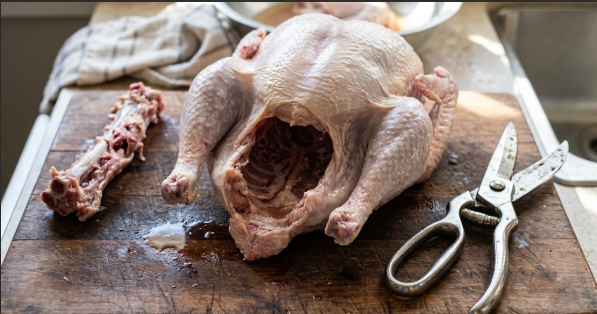
Common Mistake: Washing the turkey in the sink. USDA advises against washing raw poultry because it spreads bacteria across your kitchen, and cooking to a safe temperature kills the germs anyway (FSIS guidance on washing food). Pat the bird dry with paper towels instead.
Dry brine for juicy meat and dry skin
A dry brine is just salt and seasoning rubbed onto the turkey ahead of time. The salt pulls moisture out, dissolves into it, and pulls it back into the meat. Meanwhile the skin dries out, which is what you want for crispiness.
Mix the salt, pepper, garlic powder, paprika, thyme, and baking powder. Pat the turkey very dry. Rub the mix all over, including under the skin of the breast and thighs. Set the bird on a rack over a sheet pan and refrigerate it, uncovered, for 24-48 hours.
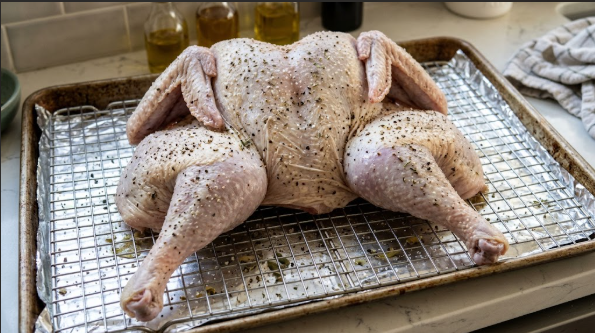
After 24 hours, the skin will look tight and slightly translucent. That is exactly right. Do not rinse off the salt.
Step-by-Step: How to Smoke a Spatchcock Turkey on a Pellet Grill
Here is the full cook, in order.
- Set up the pellet grill. Fill the hopper with apple, cherry, pecan, or a hickory blend. Fruitwoods give a mild, sweet smoke; hickory is stronger. Turkey takes smoke easily, so start mild.
- Preheat to 300°F (149°C). Let it run 15 minutes with the lid closed until the temperature holds steady. Some cooks start at 225-250°F (107-121°C) for 30 minutes to take on more smoke, then raise the heat. That works well, but is optional.
- Prep the bird. Brush the skin with melted butter or oil. Place the turkey skin-side up on the grates, or on a rack set in a foil pan with the vegetables underneath to catch drippings.
- Insert a probe. Push a leave-in probe into the thickest part of the breast, without touching bone. Place the grill’s probe or a second thermometer in a thigh.
- Cook. Close the lid and leave it alone for the first 90 minutes. Every time you open it, the temperature drops and your cook time grows.
- Check and rotate. At about 90 minutes, check the skin. If one side browns faster, rotate the pan 180 degrees. If the skin is getting too dark, tent the breast loosely with foil.
- Start temp checks. At 2 hours, begin checking with an instant-read thermometer in the breast and in the thighs, every 15 minutes.
- Pull the turkey. Remove it when the breast reads 160°F (71°C) and the thighs read 175°F (79°C). The breast will rise to 165°F (74°C) during resting.
- Rest. Move the turkey to a cutting board, tent it loosely with foil, and rest for 20-30 minutes before carving.
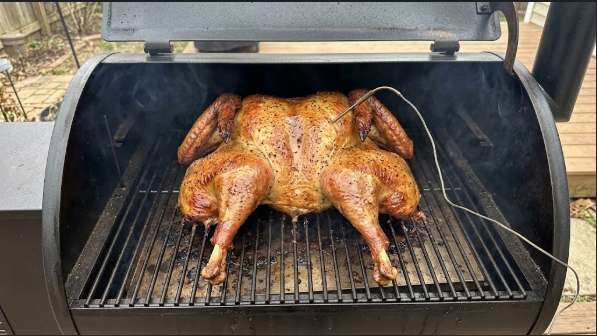
Pitmaster Tip: Place the thickest parts of the turkey, the thighs, toward the hottest side of your grill. On most pellet grills that is the side nearest the fire pot or the back. If you are unsure, check your owner’s manual, or do a simple test: lay slices of bread across the grate and see which brown first.
Do you need to cook it hotter for crispy skin?
Temperature matters here. Skin crisps best at 300-325°F (149-163°C). At 225-250°F (107-121°C) the skin can turn tough and rubbery. If your turkey has been cooking low and slow and the skin is soft, bump the grill to 375°F (191°C) for the last 15-20 minutes. For another approach to this cook, see our turkey breast at 250 guide, which explains low-temperature smoking trade-offs.
Time and Temperature Chart
| Turkey weight | Grill temp | Estimated cook time | Pull temp (breast) | Pull temp (thigh) |
| 10-12 lb (4.5-5.4 kg) | 300°F (149°C) | 2-2.5 hours | 160°F (71°C) | 175°F (79°C) |
| 12-14 lb (5.4-6.4 kg) | 300°F (149°C) | 2.5-3 hours | 160°F (71°C) | 175°F (79°C) |
| 14-16 lb (6.4-7.3 kg) | 300°F (149°C) | 3-3.5 hours | 160°F (71°C) | 175°F (79°C) |
| 12-14 lb (5.4-6.4 kg) | 275°F (135°C) | 3-3.5 hours | 160°F (71°C) | 175°F (79°C) |
| 12-14 lb (5.4-6.4 kg) | 325°F (163°C) | 2-2.5 hours | 160°F (71°C) | 175°F (79°C) |
Times are estimates. Wind, outside temperature, and grill design all change the clock, so cook to temperature, not time.
How to Tell When a Spatchcock Turkey Is Done
The only reliable way is a thermometer. The USDA’s safe minimum internal temperature for poultry is 165°F (74°C) in every part of the bird. Pitmasters pull the breast a few degrees early at 160°F (71°C) because carryover cooking carries it to 165°F (74°C) while it rests.
The thighs are different. They are dark meat with more connective tissue, so they taste best at 175-180°F (79-82°C). They are safe at 165°F (74°C), but they feel firmer and chewier at that point.
Here is what “done” looks like and feels like:
- The skin is deep golden to mahogany and crackles slightly when tapped.
- The juices run clear when you pierce the thigh.
- The leg joint wiggles loosely.
- The breast feels firm but springs back slightly.
Check the temperature in several places. Probe the thickest part of the breast, the thickest part of each thigh, and the wing joint, avoiding bone.
Resting, Carving, and Serving
Rest the turkey for 20-30 minutes on a cutting board with a loose foil tent. Resting lets the juices settle back into the meat. If you carve right away, they spill onto the board instead.
Here is the carving routine for a flat bird:
- Cut through the skin between the thigh and breast, then pull the leg quarter away and cut through the joint.
- Separate the drumstick from the thigh. Slice the thigh meat off the bone.
- Slice along the breastbone and lift each breast half off in one piece.
- Slice the breast across the grain into 1/2-inch (1.3 cm) slices.
- Remove the wings at the joint.
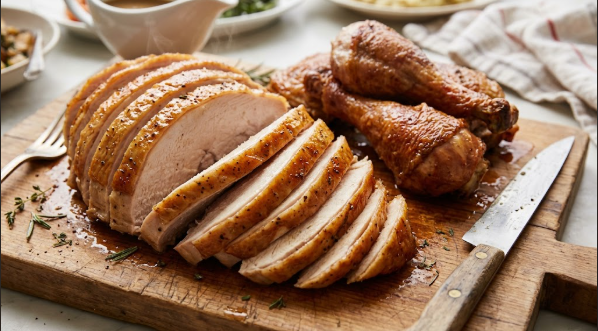
Use the pan drippings and the saved backbone and neck to make a rich gravy. A large stockpot makes homemade stock easy, and a sharp knife from our best butcher knives list makes breaking down the bird much easier.
What to Serve With Smoked Turkey
Smoked turkey pairs well with classic holiday sides:
- Mashed potatoes and turkey gravy
- Cornbread stuffing or a skillet of Redstone-style corn bread
- Roasted Brussels sprouts or green beans
- Cranberry sauce, either canned or homemade
- Mac and cheese
- Sweet potatoes with brown sugar
For dessert, try a smoked pecan pie from the same grill. For a full holiday lineup, browse our Thanksgiving smoker recipes.
Storing, Freezing, and Reheating Leftovers
Put leftovers in the fridge within 2 hours of cooking. FSIS says cooked poultry keeps for about 3-4 days in the refrigerator (FSIS leftovers and food safety). Slice or pull the meat off the bone and store it in shallow airtight containers so it cools quickly.
For the freezer, wrap portions tightly in freezer bags and press out the air. Frozen turkey stays safe indefinitely, but quality is best within 2-4 months]. Thaw in the fridge overnight.
Reheat leftovers to 165°F (74°C). A splash of broth in a covered dish or a low 300°F (149°C) oven keeps sliced breast from drying out.
Variations: Other Cookers and Flavors
Oven backup
No grill, or the weather is awful? Place the spatchcocked turkey on a rack in a sheet pan and roast at 425°F (218°C) for about 1.5-2 hours for a 12-14 lb bird, until the breast hits 160°F (71°C) and thighs reach 175°F (79°C). You lose the smoke but keep the even cooking.
Offset or charcoal smoker
Hold the cooker near 300°F (149°C) with a steady fire. Use small splits of apple or cherry wood, and keep the smoke thin and clean. Our post on lump charcoal in an offset smoker explains fire management.
Flavor ideas
- Herb butter: Mix softened butter with sage, rosemary, thyme, and garlic. Rub it under the skin before cooking.
- Cajun style: Swap the thyme and paprika for a Cajun seasoning blend. Watch the salt, since many blends are salty.
- Maple glaze: Brush a light maple syrup glaze on during the last 15 minutes.
Troubleshooting
| Problem | Likely cause | Fix |
| Rubbery skin | Cooker too cool, or skin was wet | Dry brine uncovered; cook at 300-325°F (149-163°C); finish at 375°F (191°C) |
| Dry breast | Overcooked | Pull at 160°F (71°C); use a leave-in probe |
| Undercooked thighs | Thighs not near heat | Rotate; cook until thighs reach 175°F (79°C) |
| Too salty | Wrong salt type or amount | Measure by weight; use Diamond Crystal measures |
| Skin burning | Hot spots | Tent with foil; rotate the pan |
| Bitter smoke | Dirty smoke or heavy wood | Use fruitwood; keep the fire pot clean |
Recipe Card: Spatchcock Turkey on a Pellet Grill
- Servings: 8-10
- Prep time: 30 minutes, plus 24-48 hours dry brining
- Cook time: 2.5-3 hours at 300°F (149°C)
- Rest time: 20-30 minutes
- Pull temps: Breast 160°F (71°C), thighs 175°F (79°C)
Ingredients: 12-14 lb (5.4-6.4 kg) turkey, 3 tbsp Diamond Crystal kosher salt, 1 tbsp black pepper, 2 tsp garlic powder, 2 tsp smoked paprika, 1 tsp thyme, 1 tsp baking powder, 4 tbsp (57 g) melted butter.
Short steps:
- Spatchcock the turkey, pat dry, and apply the dry brine.
- Refrigerate uncovered 24-48 hours.
- Preheat the pellet grill to 300°F (149°C) with apple or cherry pellets.
- Brush with butter and cook skin-side up, with a probe in the breast.
- Pull at 160°F (71°C) breast and 175°F (79°C) thigh.
- Rest 20-30 minutes, then carve.
Frequently Asked Questions
How long does it take to cook a spatchcock turkey on a pellet grill? A 12-14 lb (5.4-6.4 kg) spatchcocked turkey takes about 2.5-3 hours at 300°F (149°C). Smaller birds finish faster, and cooler or windy days add time. Always cook by internal temperature, not the clock, and start checking at the 2-hour mark.
What temperature is best for a spatchcock turkey? Most cooks use 300-325°F (149-163°C). That range crisps the skin and finishes the bird quickly while still absorbing smoke. Going lower, around 250°F (121°C), gives more smoke flavor but takes longer and can leave the skin soft.
Is spatchcock turkey better than a whole turkey? For most home cooks, yes. It cooks faster and more evenly, and the skin crisps better. The trade-off is that you lose the classic whole-bird presentation and the cavity for stuffing, so cook stuffing separately in a dish.
Do I need to brine a spatchcocked turkey? It is not required, but it is strongly recommended. A dry brine of kosher salt for 24-48 hours seasons the meat deeply and keeps it juicy. It also dries the skin, which helps it crisp on the grill.
What wood pellets are best for turkey? Apple, cherry, and pecan give mild, slightly sweet smoke that suits poultry. Hickory adds a stronger, bacon-like flavor. Many cooks blend a fruitwood with a bit of hickory. Avoid mesquite, which can taste harsh on turkey.
Can I spatchcock a frozen turkey? Not while it is frozen. Thaw it fully in the refrigerator first, about 24 hours per 4-5 lb (1.8-2.3 kg). A partly frozen bird is hard to cut and cooks unevenly, and it is not safe to leave it on the counter to thaw.
Conclusion
Spatchcock turkey on a pellet grill gives you the best of both worlds: a bird that cooks quickly and evenly, with crisp skin and gentle smoke. Dry brine ahead, cook at 300°F (149°C), and pull the breast at 160°F (71°C) and the thighs at 175°F (79°C). Give it a good rest before you carve.
Try it once, and you may never go back to roasting a whole bird.
Laura Smith

I'm Laura, I like all the kind of delicious grilled foods which makes me hungry all the time I see them. That's why I built this blog to share with you all of my Grilling experiences, recipes, and all the tips about foods that I've learned from food experts.