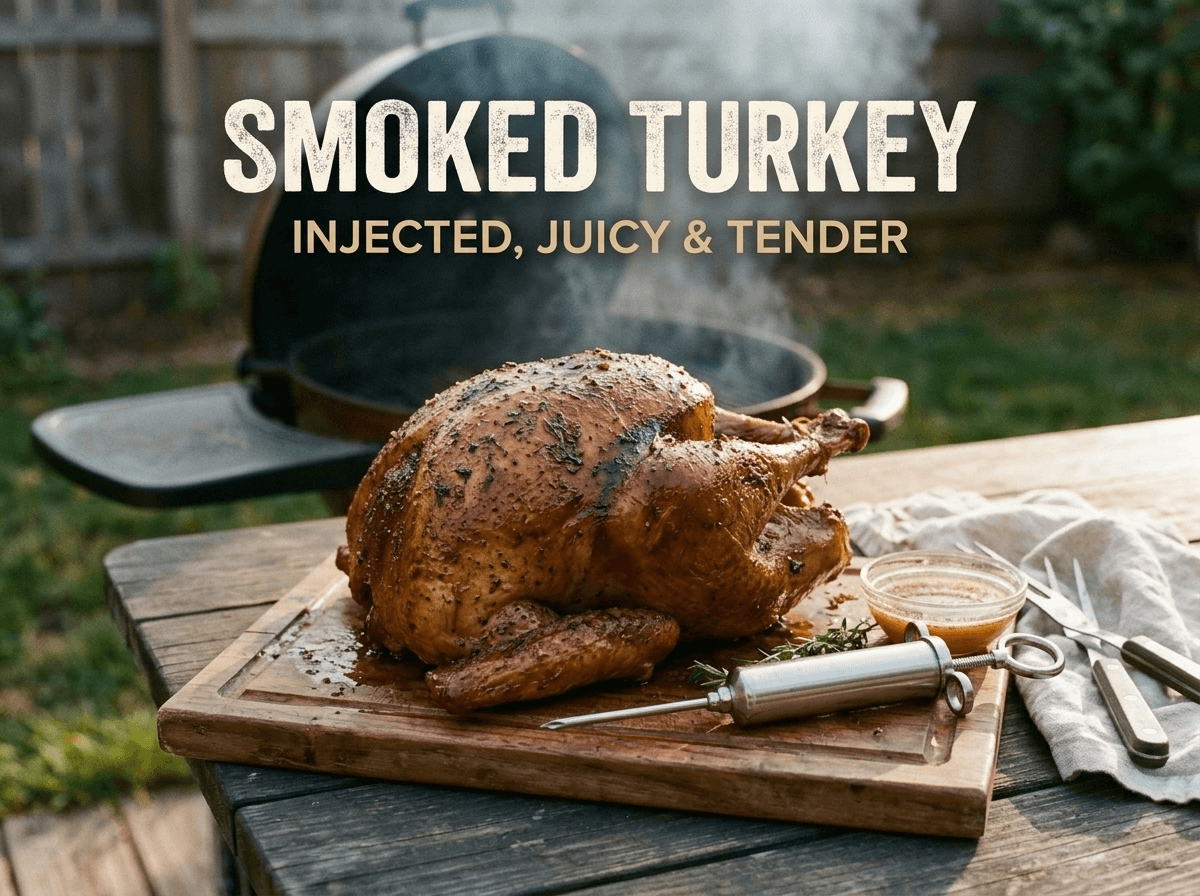
Dry breast meat is the number one complaint about holiday turkey. A good turkey injection recipe fixes that by putting seasoned, buttery liquid deep into the meat, right where a surface rub or a brine can’t reach.
I like injecting because it works from the inside out. The breast stays moist, the thighs pick up flavor, and the skin still gets crisp in the smoker. This guide gives you the exact marinade, the injection pattern, the temps, and the timing for a 12-14 lb (5.4-6.4 kg) bird.
Quick Answer
Mix 2 cups of warm, strained injection (unsalted broth, melted butter, Worcestershire, and seasonings). Inject about 1 fl oz per pound into the breast, thighs, and legs. Smoke at 275°F (135°C) for roughly 3 to 3.5 hours. Pull the breast at 160°F (71°C) and the thighs at 175°F (79°C). Rest 30 minutes.
Why This Turkey Injection Recipe Works
Turkey has two problems. The breast is lean and dries out fast, and the dark meat needs more heat than the breast to get tender. Injection helps with the first problem without hurting the second.
Here is what the liquid does:
- Adds moisture where it’s needed. Broth and butter sit inside the breast fibers instead of just on the skin.
- Seasons deeper than a rub. A rub flavors the surface. Injection carries garlic, onion, and spice into the center.
- Gives you a buffer. If you pull the bird a few degrees late, an injected turkey forgives you more than a plain one.
- Works with smoke. The skin and outer meat still pick up smoke flavor, while the inside stays juicy.
Injection won’t replace good temperature control. It is insurance, not magic, so you still need a reliable thermometer and a steady smoker.
Turkey Injection Recipe Ingredients and Equipment
This recipe makes about 2 cups of injection, enough for a 14-16 lb (6.4-7.3 kg) turkey with a little extra for the pan.
For the injection marinade
- 1 cup (240 ml) low-sodium or unsalted chicken or turkey broth
- ½ cup (115 g) unsalted butter, melted
- 2 tablespoons Worcestershire sauce
- 1 tablespoon apple cider vinegar
- 1 tablespoon low-salt Cajun or poultry seasoning
- 1 teaspoon garlic powder
- 1 teaspoon onion powder
- 1 teaspoon kosher salt
- ½ teaspoon black pepper
- ¼ teaspoon cayenne (optional)
For the turkey
- 1 whole turkey, 12-14 lb (5.4-6.4 kg), fully thawed and not pre-brined
- 2 tablespoons olive oil or melted butter for the skin
- 2 tablespoons of your favorite poultry rub or a simple mix of paprika, garlic powder, and black pepper
Equipment
- Meat injector with a ¼-inch (6 mm) needle, preferably one with a larger opening
- Fine-mesh strainer
- Instant-read thermometer and a leave-in probe
- Smoker or pellet grill
- Large rimmed pan or foil pan
- Pecan, apple, or cherry wood
Substitutions
- No chicken broth? Use apple juice for a sweeter, fruitier note.
- No Worcestershire? Use soy sauce, but cut the added salt in half.
- Dairy-free? Swap the butter for ghee or a neutral oil.
- Spicier bird? Double the cayenne and add 1 teaspoon of hot sauce.
If you cook on a pellet grill and want help choosing one, our guide to the best pellet grills for beginners covers the models that hold temperature well for long holiday cooks.
Choosing and Prepping the Turkey
Start with the right bird, because it determines whether this works at all.
Buy a natural turkey. Check the label. If it says “contains up to 8% solution,” “basted,” or “self-basting,” the turkey was already injected at the factory. Adding more will make it too salty and spongy.
Thaw it completely. A frozen turkey can’t be injected, and a partly frozen one cooks unevenly. The USDA recommends thawing in the refrigerator at about 24 hours per 4-5 lb (1.8-2.3 kg). A 14 lb bird needs about three days, per the USDA’s safe thawing guidance.
Dry the skin. Pat the turkey very dry with paper towels, inside and out. Dry skin is the secret to crisp skin in the smoker.
Trim and tuck. Remove the neck and giblets, trim loose fat around the cavity, and tuck the wing tips behind the back.
Common Mistake: Injecting a pre-brined or “enhanced” turkey, then adding a salty rub. The result tastes like a ham. Read the label, and if you can’t avoid an enhanced bird, skip the salt in the injection and rub entirely.
A note on brining
You can brine or dry brine a turkey and inject it, but be careful with salt. If you dry brine, use unsalted broth and leave the kosher salt out of the injection. For most people, injection plus a light rub is enough, and it saves a day of fridge space.
Step-by-Step Turkey Injection Recipe Instructions
Step 1: Make the injection
Warm the broth in a small saucepan over low heat. Add the melted butter, Worcestershire, vinegar, and all the seasonings. Whisk for 1-2 minutes until combined. Do not boil.
Step 2: Strain it
Pour the mixture through a fine-mesh strainer. Spice particles clog injector needles, and nothing is more annoying than a clogged needle halfway through the breast. Keep the liquid warm so the butter doesn’t solidify. If it does, reheat it gently.
Step 3: Plan your injection sites
Think of a grid, with injection points about 1.5 to 2 inches (4-5 cm) apart. You want 4 to 6 spots in each breast, 2 to 3 in each thigh, and 1 to 2 in each drumstick.

Step 4: Inject the breast
Insert the needle into the thickest part of the breast at a shallow angle, parallel to the bone. Push it in about 2 inches (5 cm). Press the plunger slowly while pulling the needle out, so the liquid spreads through the meat in a line instead of pooling in one spot.
Inject about 3 to 4 tablespoons per breast side, spread over several sites. If liquid leaks out, stop and move to another spot. A little leakage is normal.
Step 5: Inject the thighs and legs
Go in from the side of the thigh, again parallel to the bone. Use about 2 tablespoons per thigh and 1 tablespoon per drumstick. Dark meat is more forgiving, but it still benefits from the extra flavor.
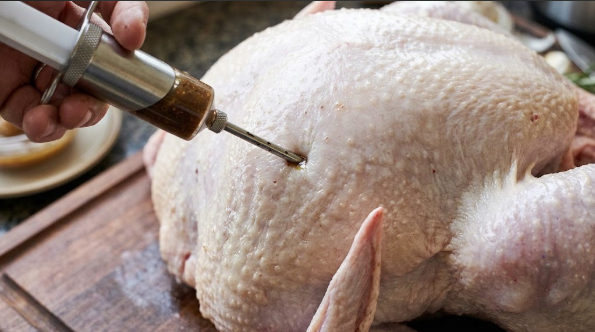
Pitmaster Tip: Inject in a fan pattern from one entry point. Enter the skin once, pull the needle almost out, change the angle, and go in again. You get more coverage with fewer holes, and fewer holes means less liquid leaking out.
Step 6: Season the skin
Rub the whole bird with olive oil or melted butter. Season the outside with your rub. Dry skin plus a thin oil layer gives you golden, crisp results at smoker temperatures.
Step 7: Let it rest
Place the injected turkey on a rack in a pan, uncovered, in the refrigerator for 2 to 12 hours. The fridge air dries the skin further, and the injected liquid spreads through the meat. If you’re short on time, 30 minutes on the counter while the smoker heats is fine, but no longer than 1 hour at room temperature.
Step 8: Fire up the smoker
Heat your smoker to 275°F (135°C). This is a good middle ground: low enough for smoke flavor, high enough to crisp the skin. Use pecan, apple, or cherry wood for a mild, sweet smoke. Hickory works, but use it sparingly, because turkey takes smoke fast.
If you cook on an offset, lump charcoal in an offset smoker burns clean and gives you steady heat for a long poultry cook.
Step 9: Smoke the turkey
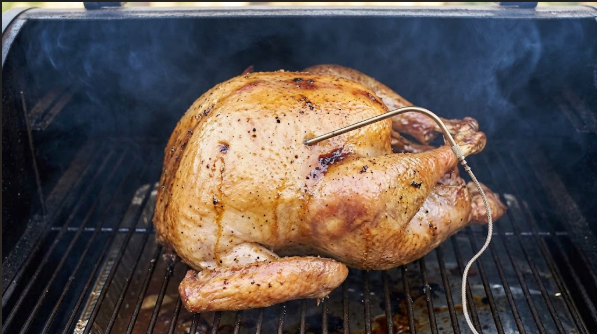
Place the turkey on the smoker, breast up. Insert a leave-in probe into the thickest part of the breast without touching bone. Put a second probe, or check with an instant-read, in the thigh.
Close the lid and leave it alone. Resist peeking, since every lid lift drops the temperature and adds time.
Step 10: Watch the temperatures
At 275°F (135°C), a 12-14 lb (5.4-6.4 kg) turkey usually takes 3 to 3.5 hours. Plan on about 13-15 minutes per pound as a rough guide, but let the thermometer decide, not the clock.
If the skin is browning too fast, tent the breast loosely with foil. If it’s still pale near the end, bump the smoker to 325°F (163°C) for the last 20-30 minutes.
Step 11: Pull and rest
Pull the turkey when the breast reads 160°F (71°C) and the thickest part of the thigh reads 175°F (79°C). Carryover cooking raises the breast to 165°F (74°C) while it rests. Move the bird to a cutting board, tent it with foil, and rest for 30 minutes.
Time and Temperature Table
| Turkey Weight | Smoker Temp | Estimated Cook Time | Pull Breast At | Pull Thigh At |
| 10-12 lb (4.5-5.4 kg) | 275°F (135°C) | 2.5-3 hrs | 160°F (71°C) | 175°F (79°C) |
| 12-14 lb (5.4-6.4 kg) | 275°F (135°C) | 3-3.5 hrs | 160°F (71°C) | 175°F (79°C) |
| 14-16 lb (6.4-7.3 kg) | 275°F (135°C) | 3.5-4 hrs | 160°F (71°C) | 175°F (79°C) |
| 12-14 lb (5.4-6.4 kg) | 325°F (163°C) | 2.5-3 hrs | 160°F (71°C) | 175°F (79°C) |
These times are estimates. Weather, wind, smoker size, and how often you open the lid all change the result. Always cook to temperature.
For a smaller option, our turkey breast at 250 guide shows the same approach for a breast-only cook.
How to Tell When the Turkey Is Done
Numbers matter, but your eyes and hands help too.
The safe minimum. The USDA says poultry must reach 165°F (74°C), per its safe minimum internal temperature chart. Use a thermometer, not color or clear juices, to check.
The pitmaster pull. I pull the breast at 160°F (71°C) because it climbs about 5°F while resting and ends at 165°F. Dark meat tastes better at 175-180°F (79-82°C), when the connective tissue has relaxed.
Visual cues:
- Skin is deep golden brown and taut
- Juices run clear when you pierce the thigh
- The leg wiggles loosely in the joint
- A probe slides into the thigh with almost no resistance
Check more than one spot. Test the breast, the thigh, and the thickest part of the wing. Avoid bone, which reads hotter and gives a false result.
Resting, Slicing, and Serving
Resting matters. Cut a hot turkey too soon and the juices end up on the board instead of in the meat. Thirty minutes is the minimum, and up to 45 minutes works fine if you tent it loosely with foil.
To carve:
- Remove the legs by cutting through the joint where the thigh meets the body.
- Separate the drumsticks from the thighs.
- Slice along the breastbone and lift each breast half off in one piece.
- Slice the breast across the grain into ½-inch (1.3 cm) pieces.
- Pull the wings off at the joint.
A sharp slicer makes this far easier. If yours is dull, see our roundup of the best knives for cutting meat.
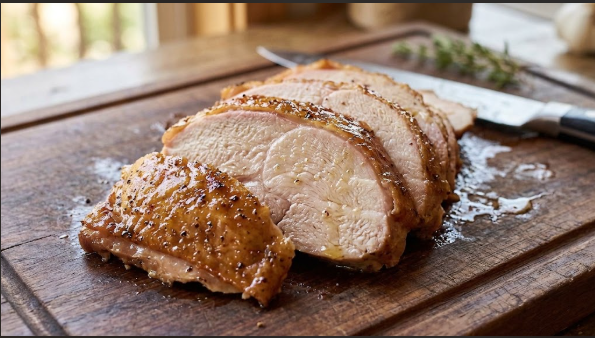
Serve warm on a platter, and pour any pan juices over the sliced meat.
What to Serve with Smoked Injected Turkey
An injected, smoked bird pairs well with classic holiday sides:
- Cornbread dressing or Redstone-style cornbread
- Garlic mashed potatoes
- Green bean casserole
- Roasted Brussels sprouts with bacon
- Cranberry sauce
- Mac and cheese
- Buttered corn
- Gravy made from pan drippings
For dessert, a smoked pecan pie keeps the smoker theme going. If you’re planning the whole meal, our Thanksgiving smoker recipes collection has sides, mains, and desserts that all use the same cooker.
Storing, Freezing, and Reheating Leftovers
Refrigerate promptly. The USDA says to get cooked food into the refrigerator within 2 hours, per its leftovers and food safety guidance. Carve the meat off the bones and store it in shallow containers so it cools fast.
Fridge life. Leftover turkey keeps 3 to 4 days at 40°F (4°C) or below.
Freezer life. Wrap portions tightly in freezer bags and squeeze out the air. Frozen at 0°F (-18°C), it stays safe indefinitely, but quality is best within about 2 to 4 months.
Reheating. Reheat leftovers to 165°F (74°C). Add a splash of broth or a pat of butter to the container, cover, and warm in a 325°F (163°C) oven so the meat doesn’t dry out.
Use the carcass. Simmer the bones for turkey stock. A large stockpot makes this easy, and the stock is great for next year’s injection base.
Variations
Pellet grill
Run the same 275°F (135°C) and use the “Smoke” or low setting for the first hour for extra smoke flavor. Pecan or apple pellets work well. Expect a slightly shorter cook than an offset because pellet grills hold very steady heat.
Offset smoker
Keep the firebox running clean with small splits and a thin blue smoke. Rotate the turkey halfway if one side is closer to the firebox. Watch the thighs, which cook faster near the heat.
Charcoal kettle
Set up two-zone cooking with coals on one side and the turkey on the other, over a drip pan. Add a chunk of apple wood every 45 minutes. Hold 300-325°F (149-163°C) and expect closer to 2.5 hours for a 12 lb bird.
Oven backup
No smoker? Roast the injected turkey on a rack at 325°F (163°C) for about 2.5 to 3 hours, pulling at the same internal temperatures. You’ll miss the smoke, but the injection still delivers a juicy bird. A rotisserie oven is another good indoor option if you own one.
Flavor swaps
- Garlic-herb: Replace the Cajun seasoning with 1 teaspoon each of thyme, sage, and rosemary.
- Sweet and smoky: Add 2 tablespoons of maple syrup and 1 teaspoon of smoked paprika.
- Citrus: Use ½ cup of orange juice in place of ½ cup of the broth.
Troubleshooting Common Problems
| Problem | Likely Cause | Fix |
| Injection leaks out right away | Needle pulled out too fast, or too much in one spot | Inject slowly and use more, smaller sites |
| Needle keeps clogging | Unstrained spices or cold butter | Strain, and keep the liquid warm |
| Turkey is too salty | Enhanced bird, or salty broth plus rub | Buy a natural turkey and use unsalted broth |
| Rubbery skin | Skin too wet, or smoker too cool | Dry well, rest uncovered in the fridge, finish at 325°F (163°C) |
| Dry breast | Overcooked | Pull at 160°F (71°C) and rest |
| Dark meat still tough | Pulled too early | Take thighs to 175-180°F (79-82°C) |
| Uneven browning | Hot spots in the smoker | Rotate the pan halfway, tent the breast with foil |
Food safety notes for injection
Injecting pushes liquid into the meat, so treat the process carefully:
- Use a clean cup for each draw. Pour the portion you need into a separate bowl. Never dip a needle that has touched raw meat back into your main batch.
- Throw out leftover injection that touched raw poultry, or bring it to a full boil before using it as a sauce.
- Wash your hands and tools with hot, soapy water after handling raw turkey. The USDA’s smoking meat guidance also covers keeping smoker temperatures high enough for safe cooking.
- Don’t leave the bird out. The danger zone is 40-140°F (4-60°C), so keep an injected turkey refrigerated until it goes on the smoker.
Recipe Card: Smoked Turkey Injection Recipe
Yield: 10-12 servings
Prep time: 30 minutes (plus 2-12 hours resting in the fridge)
Cook time: 3 to 3.5 hours at 275°F (135°C)
Rest time: 30 minutes
Total time: About 4.5 hours active, plus fridge rest
Ingredients:
- 12-14 lb (5.4-6.4 kg) natural turkey, thawed
- 1 cup (240 ml) unsalted broth
- ½ cup (115 g) melted butter
- 2 tbsp Worcestershire sauce
- 1 tbsp apple cider vinegar
- 1 tbsp low-salt Cajun seasoning
- 1 tsp each garlic powder, onion powder, kosher salt
- ½ tsp black pepper
- ¼ tsp cayenne (optional)
- 2 tbsp olive oil and 2 tbsp poultry rub for the skin
Steps:
- Warm and whisk the injection ingredients, then strain.
- Pat the turkey dry. Inject the breast, thighs, and legs at 1.5-2 inch (4-5 cm) spacing.
- Oil the skin and season with rub.
- Rest uncovered in the fridge for 2-12 hours.
- Smoke at 275°F (135°C) with pecan or apple wood.
- Pull the breast at 160°F (71°C) and the thigh at 175°F (79°C).
- Rest 30 minutes, carve, and serve.
FAQ
How much injection do you need per pound of turkey?
Plan on about 1 fluid ounce (30 ml) per pound. A 14 lb turkey takes roughly 1¾ cups. You won’t always get all of it in, because some will leak. Stop when you see the meat swell and liquid pool.
Where do you inject a turkey?
Focus on the thickest parts: both sides of the breast, the thighs, and the drumsticks. Insert the needle parallel to the bone at several sites, using a fan pattern. Skip the thin wings, which dry out fast and leak most of the liquid.
Can you inject a turkey the night before?
Yes. Injecting 2 to 12 hours ahead is common and lets the flavor spread. Keep the turkey covered or uncovered in the refrigerator at 40°F (4°C) or below. For best skin, rest it uncovered in the fridge overnight.
Should you brine and inject a turkey?
You can, but watch the salt. If you brine or dry brine, use unsalted broth and leave the added salt out of the injection. For most home cooks, injection alone gives enough moisture, and it saves a day of prep.
Does injecting a turkey make it juicier?
Yes, especially the breast. Injection puts liquid and fat deep into the meat, which helps it stay moist through a long cook. It won’t save an overcooked bird, so pull the turkey at the right temperature and rest it before carving.
Can you inject a frozen turkey?
No. A frozen or partly frozen turkey won’t absorb the liquid, and it will cook unevenly. Thaw it fully in the refrigerator first, allowing about 24 hours per 4-5 lb (1.8-2.3 kg), then inject.
Conclusion
A good turkey injection recipe gives you a juicy breast, flavorful dark meat, and plenty of margin for error, all without a messy brine bucket. Start with a natural bird, use a strained, warm marinade, and inject in a fan pattern at 1.5-2 inch spacing. Then smoke at 275°F (135°C), pull the breast at 160°F (71°C), and let it rest.
Once you’ve made this turkey injection recipe once, you can adjust it freely. Swap the broth for apple juice, change the seasonings, or switch woods. Keep the basics the same, and you’ll get a moist, smoky turkey every time.
Laura Smith

I'm Laura, I like all the kind of delicious grilled foods which makes me hungry all the time I see them. That's why I built this blog to share with you all of my Grilling experiences, recipes, and all the tips about foods that I've learned from food experts.