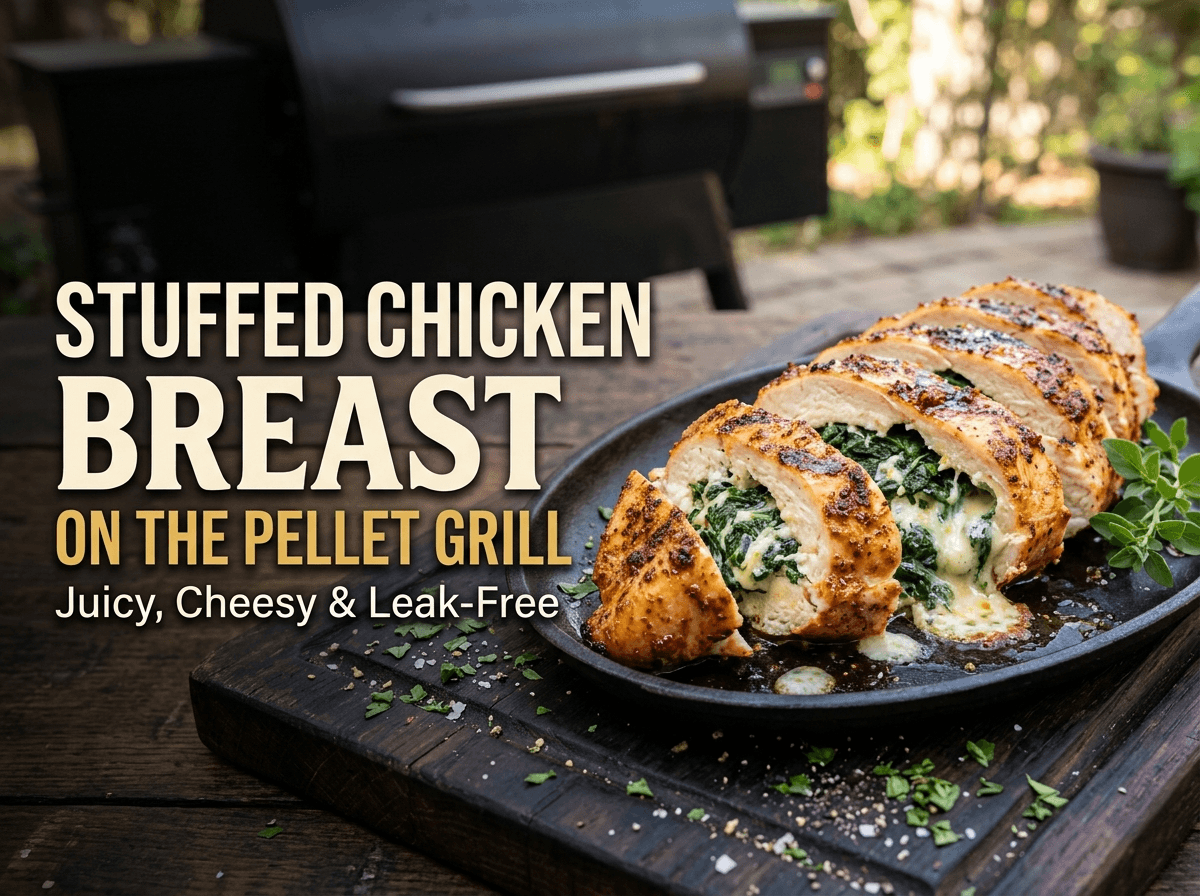
A good stuffed chicken breast turns a plain weeknight protein into something that feels like a restaurant plate. You slice a pocket into a boneless breast, pack it with a creamy spinach and cheese filling, and let the pellet grill handle the rest. What comes off the grate is moist chicken with a light kiss of smoke and a molten center.
This guide walks you through the full method at 375°F (190°C), including the thermometer habits that keep the chicken juicy and the filling safe. You’ll also get backup methods for the oven, charcoal, an offset smoker, and an air fryer, plus a troubleshooting table for the problems beginners run into most. If you’re building a weeknight rotation, our easy chicken breast recipes are a good companion to this one.
Quick Answer
Cook stuffed chicken breast on a pellet grill set to 375°F (190°C) for 35 to 45 minutes using indirect heat. Pull it when the thickest part of the meat and the center of the filling both read 165°F (74°C), the USDA’s safe minimum internal temperature for poultry. Rest it 5 minutes before slicing.
Why This Stuffed Chicken Breast Recipe Works
Boneless breasts are lean, so they dry out fast when cooked plain. Cutting a pocket and filling it adds fat and moisture right where the meat needs it. The cream cheese in the filling acts as a binder, so the spinach and mozzarella melt into a creamy center instead of running out.
Four choices make the difference:
- Moderate heat. 375°F (190°C) is hot enough to brown the outside but gentle enough that the filling heats through before the meat overcooks.
- Indirect cooking. The chicken sits away from the fire pot, so you get even heat and light smoke without scorching.
- A dry exterior. Patting the chicken dry and brushing it with oil gives you browning instead of steaming.
- Thermometer-based doneness. You cook to 165°F (74°C) in two spots, not to the clock.
The filling is also built to behave. Squeezing the spinach dry removes the water that causes most leaks, and keeping the filling to about two-thirds of the pocket leaves room for it to expand.
Ingredients and Equipment
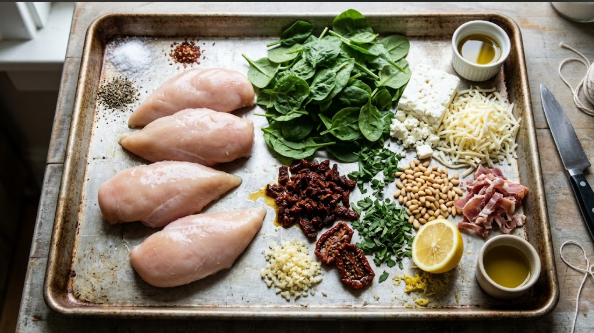
This makes four servings with four 8-ounce (225 g) breasts, about 2 lb (0.9 kg) total.
For the chicken
- 4 boneless, skinless chicken breasts, 8 oz (225 g) each
- 2 tbsp olive oil
- 2 tsp kosher salt (for the dry brine, about ½ tsp per breast)
- 1 tsp smoked paprika
- 1 tsp garlic powder
- ½ tsp onion powder
- ½ tsp black pepper
- ½ tsp dried oregano
For the filling
- 4 oz (115 g) cream cheese, softened
- 10 oz (280 g) frozen chopped spinach, thawed and squeezed very dry (about 1 cup)
- ¾ cup (85 g) shredded mozzarella
- ¼ cup (25 g) grated Parmesan
- 3 garlic cloves, minced
- ¼ tsp black pepper
- Pinch of red pepper flakes (optional)
Skip extra salt in the filling. The Parmesan and mozzarella bring plenty.
Equipment
- Pellet grill (or any grill you can set up for indirect heat)
- Instant-read thermometer, plus a leave-in probe if you have one
- Sharp paring or boning knife
- Toothpicks or kitchen twine
- A cutting board used only for raw poultry
- Sheet pan or cast iron skillet, paper towels, and foil
Substitutions
| Ingredient | Swap | Notes |
| Frozen spinach | 1 lb (0.45 kg) fresh spinach, wilted and squeezed dry | Wilted fresh spinach shrinks a lot, so plan on the full pound. |
| Mozzarella | Provolone, Swiss, or Monterey Jack | Choose a good melter. |
| Cream cheese | Mascarpone or ricotta (drained) | Ricotta is looser, so use less. |
| Smoked paprika | Regular paprika plus a pinch of cayenne | You’ll lose a little smoky depth. |
| Pellets | Apple, cherry, or pecan | Hickory works if you blend it with a fruitwood. |
If you cook on a Camp Chef, our guide to the best Camp Chef pellets breaks down which flavors suit poultry. Chicken picks up smoke quickly, so stay with mild woods and skip mesquite.
Choosing and Prepping Chicken for Stuffed Chicken Breast
Good prep takes about 25 minutes and decides whether you end up with neat, juicy breasts or a messy tray. Most of the work is in the cutting and the closing.
Pick the right breasts
Look for breasts that are similar in size, ideally 8 oz (225 g) and about 1½ inches (4 cm) thick at the thick end. Uneven sizes cook unevenly, so a very large breast and a small one on the same grate won’t finish together. If one end is thin and tapered, fold the tip under when you close the pocket.
Don’t rinse the chicken. The USDA says that washing raw poultry spreads bacteria around the sink and counters. Pat it dry with paper towels instead, then wash your hands for 20 seconds.
Cut the pocket
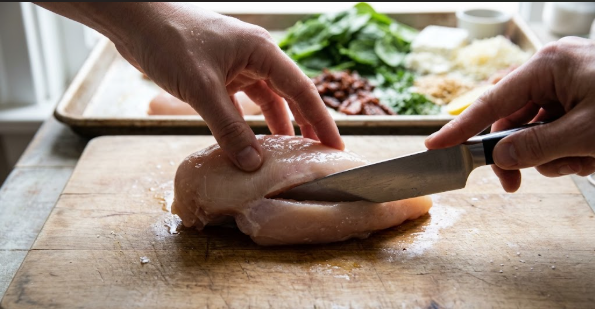
Place a breast flat on the board with your palm on top. Starting at the thickest side, slice horizontally into the middle with a sharp paring knife, stopping about ½ inch (1.3 cm) from the opposite edge and both ends. You want a deep pocket with an opening about 3 inches (7.5 cm) wide, not a fully butterflied breast.
Work slowly and keep the blade level. If you poke through the wall, don’t panic. Overlap the hole with a toothpick or two, or use that breast for a bacon-wrapped version.
Dry brine for juicier chicken
Season the outside and inside of each pocket with about ½ tsp kosher salt per breast (use about a third less if you use denser table-style kosher salt). Set the breasts on a rack over a sheet pan, uncovered, in the refrigerator for 30 minutes to 4 hours. The salt pulls in moisture and then helps the meat hold onto it as it cooks.
If you want the full science, our guide to the dry brine technique for turkey applies the same principle on a bigger bird. Keep raw chicken at 40°F (4°C) or colder the whole time.
Mix the filling
Stir the cream cheese, squeezed spinach, mozzarella, Parmesan, garlic, and pepper in a bowl until it looks like a thick, scoopable paste. Squeeze the spinach in a clean towel until almost no liquid comes out. If the mix looks loose, add another spoonful of Parmesan.
Common Mistake: wet spinach. Spinach that still holds water turns the filling into soup, and that liquid is what pushes out of the seams. Squeeze it, then squeeze it again.
Stuff and close
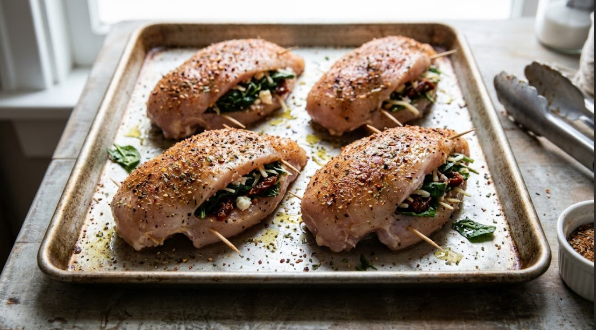
Spoon about ⅓ cup of filling into each pocket, filling it only about two-thirds full. Press the edges together and seal the opening with 3 or 4 toothpicks, weaving them in and out like a stitch, or tie the breast with kitchen twine every 1½ inches (4 cm). Brush the outside with olive oil, then coat with the spice mix.
Pitmaster Tip: chill before cooking. Put the stuffed, sealed breasts on a tray in the refrigerator for 15 to 20 minutes. The filling firms up, the pocket holds its shape, and you’ll see far fewer leaks on the grate.
Step-by-Step Instructions for Stuffed Chicken Breast
- Preheat the pellet grill. Fill the hopper with apple, cherry, or pecan pellets. Set the grill to 375°F (190°C) and let it preheat 10 to 15 minutes with the lid closed.
- Set up indirect heat. Place a sheet pan or cast iron skillet on the grate if you want a flat surface, or cook directly on the grate with the breasts away from the fire pot. Pellet grills usually cook indirectly by design.
- Insert a leave-in probe (optional). Slide the probe in from the narrow end, sideways, so the tip reaches the center of the thickest breast.
- Place the chicken. Arrange the breasts with at least 1 inch (2.5 cm) between them, seam side up. Close the lid.
- Cook for 20 minutes undisturbed. Resist peeking. Every lid opening drops the temperature and adds minutes.
- Check the temperature. At about 25 to 30 minutes, take a reading in the thickest part of the meat and in the center of the filling.
- Boost the color (optional). When the meat reads about 155°F (68°C), raise the grill to 450°F (232°C) for the last 5 minutes to deepen the browning.
- Pull at 165°F (74°C). Remove each breast when both the meat and filling read 165°F (74°C). They won’t all finish at the same moment, so pull them one at a time.
- Rest 5 minutes. Tent loosely with foil on a clean plate or board.
- Remove the toothpicks and slice. Count the toothpicks going in and coming out so none end up on a plate.
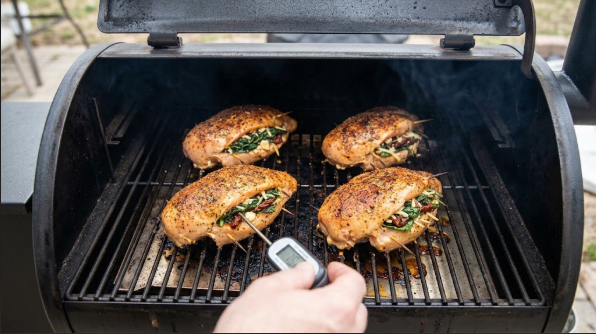
No pitmaster pull temp is lower than the safe minimum here. Unlike a thick brisket or pork butt, you’re not cooking to a tenderness number. With stuffed breasts, 165°F (74°C) at the center is both the safe target and the finishing line.
Time and Temperature Table
These times are estimates for four 8-oz (225 g) stuffed breasts about 1½ inches (4 cm) thick. Your thermometer always has the final say.
| Cooker | Set temp | Approx. time | Notes |
| Pellet grill, gentle | 325°F (163°C) | 45–55 min | Most smoke flavor, paler exterior |
| Pellet grill, recommended | 375°F (190°C) | 35–45 min | Best balance of browning and juiciness |
| Pellet grill, hot and fast | 450°F (232°C) | 25–30 min | Higher risk of leaks and dry edges |
| Charcoal kettle, two-zone | 375°F (190°C) | 35–45 min | Add a small chunk of cherry wood |
| Gas grill, indirect | 375°F (190°C) | 35–45 min | Smoker box optional |
| Oven, middle rack | 400°F (204°C) | 28–35 min | Use a rack on a sheet pan |
| Air fryer | 370°F (188°C) | 20–25 min | Flip once; smaller breasts only |
If the breasts go in straight from a cold refrigerator, add 3 to 5 minutes. Thicker breasts and denser fillings also add time.
How to Tell When Stuffed Chicken Breast Is Done
You can’t judge doneness by color, firmness, or time. USDA guidance is to never rely on color or firmness and to use a food thermometer in the thickest part of the food, away from bone, fat, or gristle. With stuffed chicken, that means two checks.
- The meat: Slide the thermometer in from the side of the breast, into the thickest part, and aim for 165°F (74°C).
- The filling: Push the probe a little deeper until the tip sits in the middle of the stuffing. This should also read 165°F (74°C), the same number the USDA lists for stuffing cooked inside poultry.
Once the numbers are right, the visual cues should line up. The outside should be golden with deeper brown edges, the seam should show a little bubbling cheese, and the breast should feel firm but springy when pressed. If one breast reads low, put it back for 3 to 5 minutes and check again.
If the meat hits 165°F (74°C) but the center is still cooler, you probably overstuffed it or used filling straight from the fridge. Let it keep cooking, tented with foil if the outside is getting dark.
Resting, Slicing, and Serving
Rest the stuffed breasts for 5 minutes before cutting. This lets the juices settle and the cheese firm up slightly, so the filling stays put when you slice. Cutting right off the grill is the fastest way to lose the creamy center on the board.
Use a sharp knife and slice each breast on a slight angle into 3 or 4 rounds, each about ½ inch (1.3 cm) thick. Fan the slices so the filling shows. A spoonful of pan juices or a little melted butter over the top adds shine.
Plate it hot, and cut the twine or pull the toothpicks before it reaches the table.
What to Serve With Stuffed Chicken Breast
The filling is rich, so the best sides add crunch, brightness, or smoke. Here are the pairings that work best.
- Vegetables: Crispy pellet grill Brussels sprouts can cook on the same grill. Grilled carrots add a little sweetness against the garlicky spinach. Grilled bell peppers bring color and a soft, smoky bite.
- Starches: Garlic mashed potatoes, buttered orzo, or herbed rice soak up the juices.
- Bread: Thick slices of grilled bread are ideal for mopping up the cheese and drippings.
- Fresh: A lemony arugula salad cuts through the cream cheese.
To save time, start the vegetables on the grill 10 minutes before the chicken goes in, or while the chicken rests.
Storing, Freezing, and Reheating Leftover Stuffed Chicken Breast
Handle leftovers promptly. Refrigerate cooked stuffed chicken breast within 2 hours of cooking, according to Michigan State University Extension, which is drawn from USDA guidance.
- Refrigerator: Per the USDA’s leftovers guidance, leftovers keep for 3 to 4 days. Store them in shallow, airtight containers.
- Freezer: Frozen leftovers keep for 3 to 4 months. They stay safe longer but can lose moisture and flavor. Wrap each breast tightly in plastic, then foil or a freezer bag.
- Thawing: Thaw in the refrigerator, cold water, or the microwave. Reheating without thawing is safe but takes longer.
- Reheating: Reheat until the center reaches 165°F (74°C) on a thermometer, covered to hold in moisture.
For the best texture, reheat in a 325°F (163°C) oven for 15 to 20 minutes, covered with foil and a splash of chicken broth in the pan. The microwave works for a quick lunch: cover the plate, use medium power, and rotate partway through.
Variations: Pellet Grill, Offset, Charcoal, and Oven Backup
Pellet grill (the main method)
The recipe above is built for a pellet grill. Pellet grills hold a steady temperature and cook with indirect heat by design, which suits stuffed breasts perfectly.
Offset smoker
Run the firebox for a steady 350–375°F (177–190°C) in the cook chamber, using small splits of oak or cherry. Place the chicken on the far side from the firebox and rotate the pan halfway through. Keep the smoke thin and clean. Heavy white smoke makes boneless chicken bitter.
Charcoal kettle
Bank hot coals on one side for a two-zone fire. Set the vents so the lid thermometer reads 375°F (190°C), add one small chunk of cherry or apple wood, and cook the chicken on the cool side with the lid closed. Expect to rotate the pan once for even color.
Gas grill
Light one or two burners, put the chicken over the unlit side, and hold 375°F (190°C). A foil smoker pouch with wood chips adds a little smoke if you want it.
Oven backup
Bake the stuffed breasts on a rack set over a sheet pan at 400°F (204°C) for 28 to 35 minutes, until both spots read 165°F (74°C). This is the same idea as our baked chicken breast, with the added step of checking the center of the filling.
Air fryer
If you’re cooking for one or two, an air fryer works. Use smaller breasts, cook at 370°F (188°C) for 20 to 25 minutes, and flip once. For the plain, unstuffed version of this method, see our air fryer chicken breast.
Flavor variations
- Caprese: Fill with fresh mozzarella, chopped basil, and sun-dried tomatoes.
- Jalapeño popper: Use cream cheese, cheddar, and diced jalapeño, then wrap in bacon.
- Broccoli cheddar: Swap the spinach for finely chopped, steamed broccoli and sharp cheddar.
- Cordon bleu style: Layer thin ham and Swiss in the pocket.
Pitmaster Tip: bacon wrap. Bacon needs more time to crisp than chicken needs to cook. Use thin-cut bacon, wrap it snugly with the ends tucked under, and finish at 450°F (232°C) for the last 5 to 8 minutes. Always judge doneness by the chicken and filling temperature, not the bacon.
Troubleshooting Stuffed Chicken Breast Problems
| Problem | Likely cause | Fix |
| Filling leaks out | Overstuffed, wet spinach, or cooked too hot | Fill two-thirds full, squeeze spinach dry, chill 15 minutes, cook at 375°F (190°C) |
| Chicken is dry | Pulled too late, thin ends overcooked, or no brine | Pull at 165°F (74°C), fold the tapered end under, dry brine next time |
| Center is cold, outside done | Too much filling or filling too cold | Use about ⅓ cup per breast, let filling sit at room temperature briefly |
| Pale, soft outside | Wet surface or too little heat | Pat dry, oil well, finish at 450°F (232°C) for 5 minutes |
| Smoke tastes bitter | Heavy wood or dirty smoke | Switch to apple, cherry, or pecan and check your fire pot |
| Stuffing falls out when sliced | Cut too soon | Rest 5 minutes and use a sharp knife |
| Breasts cook unevenly | Mixed sizes | Buy matching breasts and pull each one at its own temperature |
Food safety notes
- Use a cutting board and knife for raw chicken only, and wash them in hot, soapy water after.
- Wash your hands for 20 seconds after touching raw poultry.
- Keep raw eggs out of the filling, since the center may not heat evenly.
- Clean your thermometer probe between checks.
Stuffed Chicken Breast Recipe Card
Yield: 4 servings
Prep time: 25 minutes (plus 30 minutes to 4 hours optional dry brine and 15 minutes chill)
Cook time: 35–45 minutes
Grill temp: 375°F (190°C), indirect
Pull temp: 165°F (74°C) in the meat and the filling center
Rest time: 5 minutes
Ingredients: 4 boneless, skinless chicken breasts (8 oz/225 g each); 2 tbsp olive oil; 2 tsp kosher salt; spice mix (1 tsp smoked paprika, 1 tsp garlic powder, ½ tsp onion powder, ½ tsp black pepper, ½ tsp oregano); 4 oz (115 g) cream cheese; 10 oz (280 g) frozen spinach, squeezed dry; ¾ cup (85 g) shredded mozzarella; ¼ cup (25 g) Parmesan; 3 garlic cloves.
Short steps:
- Dry brine the chicken with salt, 30 minutes to 4 hours in the refrigerator.
- Mix the filling and cut a pocket in each breast.
- Stuff two-thirds full, seal with toothpicks, oil, and season.
- Chill 15 minutes while the grill heats to 375°F (190°C).
- Cook 35 to 45 minutes until the meat and filling both read 165°F (74°C).
- Rest 5 minutes, remove the toothpicks, and slice.
Stuffed Chicken Breast FAQ
How long does it take to cook stuffed chicken breast at 375°F?
At 375°F (190°C), 8-ounce (0.23 kg) stuffed chicken breasts usually take 35 to 45 minutes on a pellet grill with indirect heat. Thickness, stuffing density, and lid openings change the timing, so judge by thermometer, not the clock. Pull them when both the meat and the center of the filling read 165°F (74°C).
What temperature should stuffed chicken breast be?
Cook stuffed chicken breast until the thickest part of the meat and the center of the stuffing both reach 165°F (74°C). That is the USDA minimum safe temperature for poultry, and it also covers stuffing cooked inside poultry. Check two spots with an instant-read thermometer, because the filling can lag behind the meat.
How do you keep stuffed chicken breast from leaking?
Leaks usually come from overstuffing, wet filling, or cooking too hot. Fill the pocket about two-thirds full, squeeze spinach dry, and keep a ½-inch (1.3 cm) border. Close the opening with toothpicks or twine, chill the breasts 15 minutes, and cook at 375°F (190°C) instead of blasting them with high heat.
Can you make stuffed chicken breast ahead of time?
Yes. Stuff and close the breasts, cover them, and refrigerate up to 24 hours before cooking, keeping raw poultry at 40°F (4°C) or colder. Add 3 to 5 minutes to the cook time if they go in cold. You can also mix the filling a day early, which saves time on cooking day.
Can you smoke stuffed chicken breast?
Yes. Chicken absorbs smoke fast, so use mild pellets like apple, cherry, or pecan. Cook at 325°F (163°C) or higher, since low-and-slow smoker temperatures leave boneless chicken rubbery and take too long. A 375°F (190°C) pellet grill gives light smoke flavor and a browned outside.
Can you freeze stuffed chicken breast?
Yes. Wrap cooked stuffed chicken breast tightly and freeze it for up to 3 to 4 months, per USDA leftovers guidance. Thaw in the refrigerator, then reheat covered in the oven until the center reaches 165°F (74°C) on a thermometer. Frozen leftovers stay safe longer but can lose moisture and flavor.
Conclusion
The secret to great stuffed chicken breast is simple: cut a clean pocket, keep the filling dry and not overpacked, cook at 375°F (190°C), and trust your thermometer. Pull each breast at 165°F (74°C) in both the meat and the stuffing, rest it for 5 minutes, and you’ll get juicy chicken with a creamy center every time.
Once you’ve got the base method down, swap the filling for caprese, jalapeño popper, or broccoli cheddar and keep the same temperatures and times. Fire up the grill, grab your thermometer, and make this stuffed chicken breast your next weeknight win.
Laura Smith

I'm Laura, I like all the kind of delicious grilled foods which makes me hungry all the time I see them. That's why I built this blog to share with you all of my Grilling experiences, recipes, and all the tips about foods that I've learned from food experts.