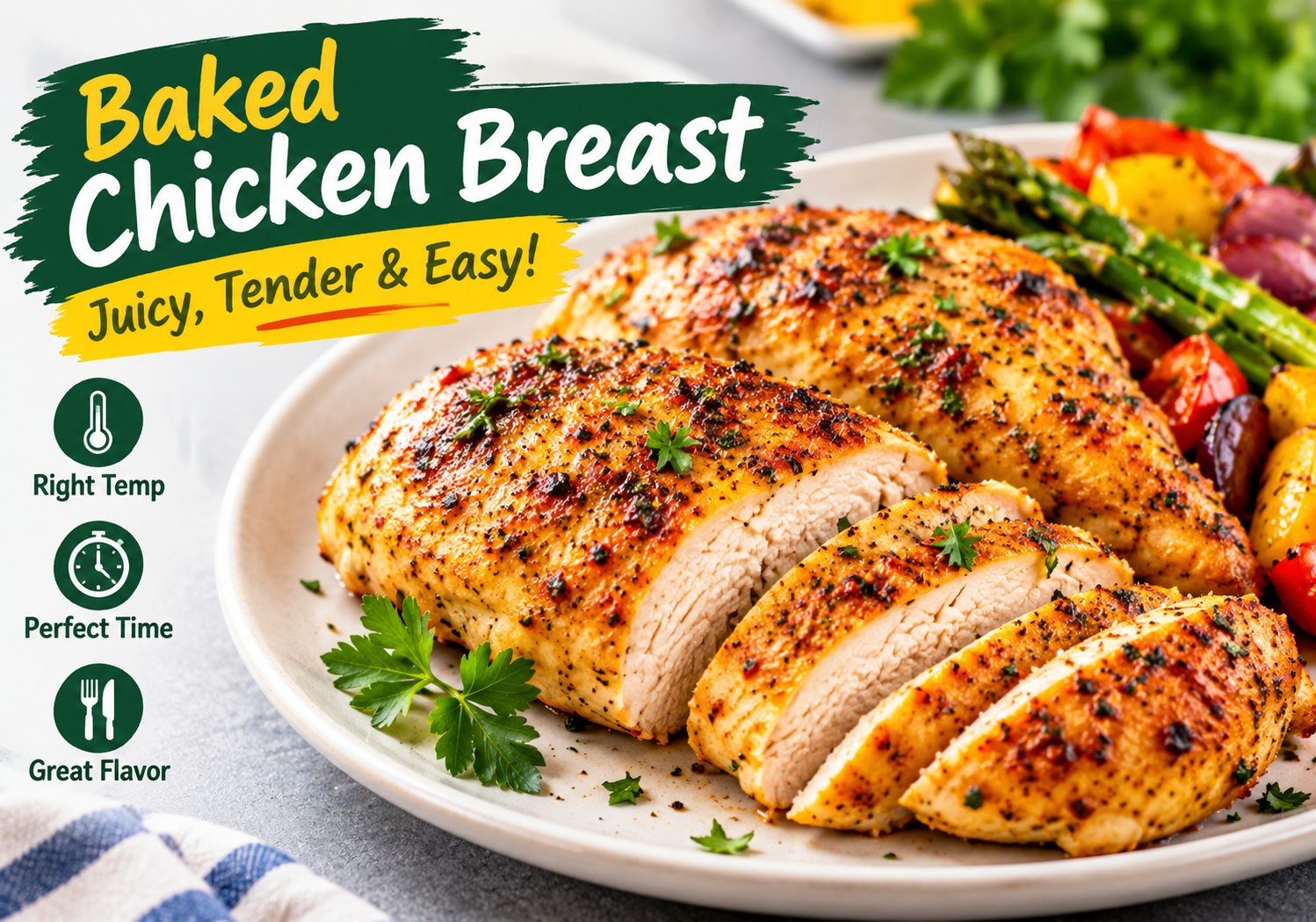
Baked chicken breast has a bad reputation. Most people have eaten a dry, stringy one and decided the cut is just boring. The cut is fine. The problem is usually thin-to-thick uneven pieces, a low oven, and no thermometer.
This recipe fixes all three. You will pound the chicken to an even thickness, give it a short brine, bake it hot, and pull it at the right internal temperature. The result is a juicy baked chicken breast with a golden, seasoned crust that works for weeknight dinners, meal prep, and a backup plan when the grill is rained out.
Quick Answer
Bake boneless, skinless chicken breasts (6-8 oz / 170-225 g each) at 425°F (220°C) for 18-25 minutes on a sheet pan. Pull them at 160-162°F (71-72°C), rest 5-10 minutes, and confirm they reach the USDA’s safe minimum of 165°F (74°C) before slicing.
Why This Baked Chicken Breast Recipe Works
Chicken breast is lean. It has very little fat to protect it, so the margin between juicy and dry is only a few degrees. Every step below is about widening that margin.
- Even thickness. A breast is thick at one end and thin at the other. The thin end overcooks while the thick end catches up. Pounding to about 3/4 inch (2 cm) cooks the whole piece at the same pace.
- Salt ahead of time. A short wet brine or dry brine helps the meat hold onto moisture while it bakes.
- High heat. At 425°F (220°C), the outside browns fast and the inside does not sit in the oven long enough to dry out.
- A thermometer. Time is a guide. Temperature is the truth. An instant-read thermometer is the single best tool for this recipe.
- Resting. The juices relax back into the meat instead of running onto the cutting board.
Ingredients and Equipment
Serves 4 | Prep: 15 minutes (plus 30 minutes brine) | Cook: 18-25 minutes
Ingredients
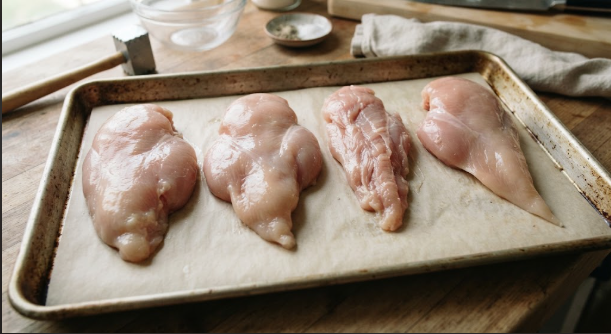
- 4 boneless, skinless chicken breasts, 6-8 oz (170-225 g) each, about 1.5-2 lb (0.7-0.9 kg) total
- 1 tablespoon olive oil
- 1 teaspoon smoked paprika
- 1/2 teaspoon garlic powder
- 1/2 teaspoon onion powder
- 1/2 teaspoon black pepper
- 1/2 teaspoon kosher salt (for the rub, in addition to the brine)
- Optional: 1/4 teaspoon cayenne or 1/2 teaspoon dried thyme
For the quick wet brine:
- 4 cups (1 liter) cool water
- 2 tablespoons kosher salt (Diamond Crystal; use about 1 tablespoon if using Morton)
Equipment
- Rimmed sheet pan (half sheet, 18 x 13 inches)
- Wire rack that fits inside the pan (optional but helpful)
- Instant-read thermometer
- Meat mallet, rolling pin, or heavy skillet
- Zip-top bag or plastic wrap
- Tongs and paper towels
Substitutions
- No smoked paprika? Use regular paprika plus a pinch of chili powder.
- Want it spicier? Swap the cayenne for chipotle powder.
- Bone-in, skin-on breasts? Skip the pounding and see the variations section for timing.
- No kosher salt? Use half as much table salt, because it packs tighter.
- Avoiding oil? Use melted butter or avocado oil. Avocado oil handles high heat well.
Choosing and Prepping Your Chicken
Pick the right breasts
Look for pieces of similar size in the package. Mixing a 5 oz breast with a 10 oz breast means one will be done long before the other. Many grocery store breasts today are very large, sometimes 10-12 oz (280-340 g). If yours are big, slice each one in half horizontally into two thin cutlets, or pound them well.
Fresh chicken should smell clean and neutral, with no sour or sharp odor. The packaging should be cold and intact.
Skip the rinse
Do not wash raw chicken in the sink. The USDA says washing poultry can spread bacteria onto your sink and counters, and cooking is what kills it. Pat the chicken dry with paper towels instead.
Pound to an even thickness
Place a breast in a zip-top bag or between two sheets of plastic wrap. Start at the thick end and pound gently with a mallet or the bottom of a heavy skillet. Work toward the thin end until the whole piece is about 3/4 inch (2 cm) thick.
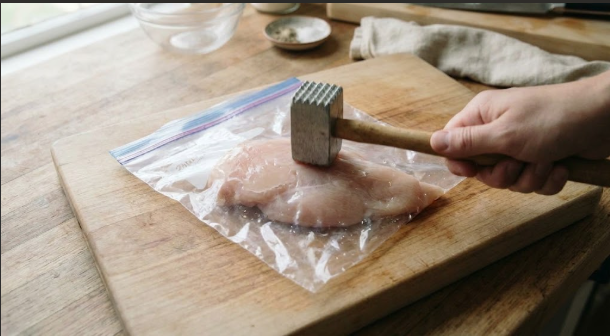
You are not trying to make it paper thin. You are trying to make it even.
Brine for juicier meat
Brining is the biggest upgrade you can make to baked chicken breast. You have two easy options.
Quick wet brine (30-60 minutes): Stir 2 tablespoons of kosher salt into 4 cups (1 liter) of cool water until dissolved. Submerge the pounded chicken, cover, and refrigerate for 30 minutes. Do not go past 1 hour, or the texture gets spongy.
Dry brine (1-12 hours): Sprinkle about 1 teaspoon of kosher salt per pound (450 g) of chicken over all sides, then place the chicken uncovered on a rack in the fridge. The salt pulls moisture out, then the meat reabsorbs it as a seasoned liquid. We cover the same method in detail in our guide to dry brining a turkey, and it works the same way on chicken.
If you dry brine, skip the 1/2 teaspoon of salt in the rub.
Pitmaster Tip
Pat the chicken completely dry after brining, and let it sit on a paper towel for 5 minutes. Dry surface equals better browning. A wet breast steams in the oven and turns pale and rubbery instead of golden.
Season
Mix the paprika, garlic powder, onion powder, pepper, and salt in a small bowl. Rub each breast with a little olive oil first, then sprinkle the seasoning evenly on both sides. Oil helps the spices stick and helps the surface brown.
Some cooks use a marinade injector for extra flavor. It is overkill for a weeknight, but if you like the idea, our turkey injection recipe shows the technique, and you can scale it down for chicken.
Step-by-Step Instructions
- Heat the oven. Place a rack in the center and preheat to 425°F (220°C). Give the oven a full 15-20 minutes to come up to temperature. Many ovens beep before they are actually hot.
- Prep the pan. Line a sheet pan with foil or parchment, or set a wire rack on top. A rack lets hot air circulate and keeps the bottom from sitting in juices.
- Pound and brine. Follow the steps above. Pat the chicken completely dry afterward.
- Oil and season. Coat each breast lightly with oil and press the seasoning onto both sides.
- Arrange the chicken. Place the breasts on the pan with at least 1 inch (2.5 cm) between them. Crowding causes steaming.
- Bake. Slide the pan into the oven and bake for 18-25 minutes. Start checking at 16 minutes.
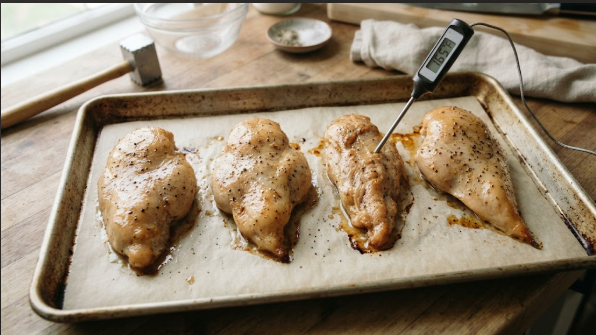
- Check the temperature. Insert an instant-read thermometer sideways into the thickest part, away from the pan. Pull the chicken at 160-162°F (71-72°C).
- Rest. Transfer the chicken to a clean plate or cutting board and let it rest, uncovered or loosely tented, for 5-10 minutes. Carryover cooking raises the temperature a few more degrees.
- Confirm and slice. Check again that the thickest part reads at least 165°F (74°C). Slice across the grain and serve.
Common Mistake
Cutting into the chicken right out of the oven to “check.” This lets the juices run out and leaves you with a dry breast and a puddle on the board. Use a thermometer instead, and give the meat time to rest.
Baked Chicken Breast Time and Temperature Table
These times are for boneless, skinless breasts pounded to about 3/4 inch (2 cm) thick, on a sheet pan in a conventional oven. Ovens vary, so always confirm with a thermometer.
| Oven Temp | 6 oz (170 g) | 8 oz (225 g) | 10-12 oz (280-340 g), unpounded | Notes |
| 350°F (175°C) | 22-26 min | 26-32 min | 35-45 min | Slower, easier to overcook edges |
| 375°F (190°C) | 20-24 min | 24-28 min | 30-40 min | Good all-purpose setting |
| 400°F (205°C) | 18-22 min | 20-25 min | 28-35 min | Reliable, good browning |
| 425°F (220°C) | 16-20 min | 18-25 min | 25-32 min | Our default for juicy results |
| 450°F (230°C) | 14-18 min | 16-20 min | 22-28 min | Fast, watch closely |
Pull at 160-162°F (71-72°C) and rest. The USDA safe minimum internal temperature for poultry is 165°F (74°C). The final temperature after resting must reach it.
How to Tell When Baked Chicken Breast Is Done
Use a thermometer. Everything else is a backup.
Temperature. The thickest part should reach 165°F (74°C) after resting. Insert the probe horizontally from the side so the tip sits in the center of the meat. If you push it straight down, you may hit the pan and get a false high reading.
Look. The surface should be opaque white with golden-brown edges and some browned spots from the paprika and oil. There should be no pink in the center.
Feel. Press the thickest part with your finger. Done chicken feels firm but still springs back a little. Raw chicken feels soft and squishy. Overdone chicken feels hard and tight.
Juices. When you slice into it, the juices should run clear or very light. A little pale liquid on the board is normal. Pink liquid means it needs more time.
One note on color: fully cooked chicken can occasionally look slightly pink near the bone or from the cooking process, and that alone is not a reliable signal. Trust the thermometer, as USDA guidance explains.
Resting, Slicing, and Serving
Rest the chicken for 5-10 minutes. This is not optional. During baking, the muscle fibers tighten and push juices toward the center. Resting lets them relax and hold that moisture.
Slice against the grain. Look for the fine lines running through the meat and cut across them. Shorter fibers make each bite more tender. For sandwiches or salads, cut thin slices on a slight angle. For dinner, serve whole or sliced into thick medallions.
A spoonful of the pan juices over the top adds flavor. For a richer finish, melt a pat of smoked butter over the hot chicken while it rests. It adds a gentle smoky note without needing a smoker for the chicken itself.
What to Serve With Baked Chicken Breast
Because baked chicken breast has a mild, savory flavor, it pairs with almost anything. A few reliable ideas:
- Vegetables: Grilled carrots bring sweetness and char. Crispy brussels sprouts from a pellet grill add crunch and smoke. Grilled bell peppers are tender and bright.
- Starches: Roasted potatoes, rice pilaf, buttered egg noodles, or a classic stuffing for BBQ night.
- Bread: Warm, charred grilled bread is great for soaking up pan juices.
- Salads and sauces: A simple green salad, a lemon-herb yogurt sauce, honey mustard, or a spoonful of pesto.
To build a plate in about 30 minutes, start the potatoes first, then the chicken, then finish with a quick vegetable while the chicken rests.
Storing, Freezing, and Reheating Leftovers
Baked chicken breast is one of the best meal prep proteins, so it is worth storing correctly.
Refrigerator. Refrigerate cooked chicken within 2 hours of cooking. Store it in a shallow airtight container, and USDA guidance says leftovers last 3-4 days in the fridge at 40°F (4°C) or below.
Freezer. Wrap slices or whole breasts tightly, or use freezer bags with the air pressed out. Per USDA freezing guidance, food kept at 0°F (-18°C) stays safe indefinitely, but quality is best within about 2-6 months for cooked poultry.
Thawing. Thaw in the refrigerator overnight, not on the counter. The USDA’s safe thawing methods are refrigerator, cold water, or microwave.
Reheating. Reheat leftovers to 165°F (74°C). For the best texture, slice the chicken, add a splash of water or broth, cover loosely, and warm in a 300°F (150°C) oven for 10-15 minutes. Microwaving works in a pinch: cover and heat in 30-second bursts at 50-70% power to avoid rubbery spots.
Variations: Pellet Grill, Offset, Charcoal, and Oven Backup
Pellet grill
Set your pellet grill to 400°F (205°C). Use mild fruitwood pellets such as apple, cherry, or pecan. Cook the chicken for 20-25 minutes until it reaches 160-162°F (71-72°C), then rest. Strong woods like hickory and mesquite can overpower a lean breast in a short cook.
Offset smoker
Chicken breast dries out in a long, low smoke, so run the offset hotter. Hold the cook chamber near 350-375°F (175-190°C) with a clean-burning fire and a light touch of fruitwood. Expect 25-35 minutes. If you want a larger smoked poultry project, our turkey breast on an offset smoker guide covers fire management in more detail.
Charcoal kettle
Set up for indirect heat, with coals on one side and chicken on the other. Aim for 400°F (205°C) and keep the lid on. Cook 20-25 minutes, turning once. Move the chicken over the coals for the last 1-2 minutes if you want some char.
Bone-in, skin-on breasts
Bone-in breasts take longer. Bake at 375°F (190°C) for 40-50 minutes, or at 425°F (220°C) for 30-40 minutes, until the thickest part hits 165°F (74°C). Pat the skin very dry and rub with oil to help it crisp. Leave them unpounded.
Oven backup
The base recipe above is the oven method, so if weather ruins the grill plans, just pull out the sheet pan. A broiler finish adds color: switch to broil for the last 1-2 minutes, and watch closely.
Troubleshooting Baked Chicken Breast
| Problem | Likely Cause | Fix |
| Dry, stringy meat | Overcooked or no brine | Pull at 160-162°F and rest. Brine next time. |
| Rubbery texture | Brined too long, or undercooked in spots | Limit wet brine to 1 hour. Check thickest part. |
| Pale, no browning | Wet surface, low oven, or crowded pan | Pat dry, use 425°F, space the pieces apart. |
| Raw center, cooked edges | Uneven thickness | Pound to 3/4 inch. Use a thermometer. |
| Bland flavor | Not enough salt or seasoning | Brine, and season both sides generously. |
| Seasoning burned | Sugar or herbs in the rub at high heat | Skip sugar. Add fresh herbs after baking. |
| White streaks or “woody” bite | Thick, large breast, sometimes called woody breast | Slice thinner, or choose smaller breasts. |
| Too much liquid in the pan | Chicken packed in solution, or crowded | Pat dry, use a rack, give space. |
Recipe Card: Baked Chicken Breast
Servings: 4 | Prep: 15 min plus 30 min brine | Cook: 18-25 min | Oven: 425°F (220°C) | Pull temp: 160-162°F (71-72°C) | Safe minimum: 165°F (74°C)
Ingredients: 4 boneless, skinless chicken breasts (6-8 oz / 170-225 g each); 1 tbsp olive oil; 1 tsp smoked paprika; 1/2 tsp garlic powder; 1/2 tsp onion powder; 1/2 tsp black pepper; 1/2 tsp kosher salt; brine of 4 cups (1 liter) water and 2 tbsp kosher salt.
Steps:
- Pound chicken to 3/4 inch (2 cm).
- Brine 30 minutes, then rinse the brine off lightly if desired and pat completely dry.
- Preheat oven to 425°F (220°C).
- Oil and season both sides.
- Bake 18-25 minutes, until 160-162°F (71-72°C) in the thickest part.
- Rest 5-10 minutes and confirm 165°F (74°C).
- Slice across the grain and serve.
Frequently Asked Questions
What temperature should baked chicken breast be?
Baked chicken breast must reach 165°F (74°C) in the thickest part to meet the USDA’s safe minimum. Many cooks pull it at 160-162°F (71-72°C) and let carryover heat finish the job during a 5-10 minute rest. Always confirm the final reading with an instant-read thermometer.
How long do you bake chicken breast at 400°F?
Boneless, skinless breasts pounded to 3/4 inch (2 cm) take about 18-25 minutes at 400°F (205°C), depending on size. Unpounded 10-12 oz (280-340 g) breasts can take 28-35 minutes. Start checking the temperature a few minutes early, since ovens run differently.
Should you cover chicken breast when baking?
No, leave it uncovered for a browned, flavorful crust. Foil traps steam and gives you pale, soft chicken. If the surface darkens too fast, tent loosely with foil for the last few minutes. Covering is more useful for thick, bone-in pieces that need longer.
Why is my baked chicken breast dry?
The usual causes are overcooking, uneven thickness, and skipping the brine. Chicken breast is lean, so a few extra degrees matter. Pound it flat, brine for 30 minutes, pull at 160-162°F (71-72°C), and rest before slicing for noticeably juicier results.
Can you bake chicken breast from frozen?
Yes, according to USDA guidance, but it takes roughly 50% longer, and seasoning will not stick well. Thawing overnight in the fridge gives better texture and lets you brine and pound it. If baking from frozen, use a thermometer and confirm 165°F (74°C).
How long does baked chicken breast last in the fridge?
Cooked baked chicken breast lasts 3-4 days when refrigerated at 40°F (4°C) or below, per USDA guidance. Cool and refrigerate it within 2 hours of cooking. For longer storage, freeze it in airtight bags, then thaw in the fridge and reheat to 165°F (74°C).
Conclusion
Great baked chicken breast comes down to a few simple habits. Pound it even, brine it briefly, bake it hot, pull it at 160-162°F (71-72°C), and rest it before you cut. Do those five things and you will get juicy, seasoned chicken from a plain sheet pan.
Once you have the base method down, you can take it to the pellet grill, the offset, or a charcoal kettle with the same temperature rules. Keep your thermometer handy, confirm 165°F (74°C), and enjoy a better baked chicken breast tonight.
Laura Smith

I'm Laura, I like all the kind of delicious grilled foods which makes me hungry all the time I see them. That's why I built this blog to share with you all of my Grilling experiences, recipes, and all the tips about foods that I've learned from food experts.