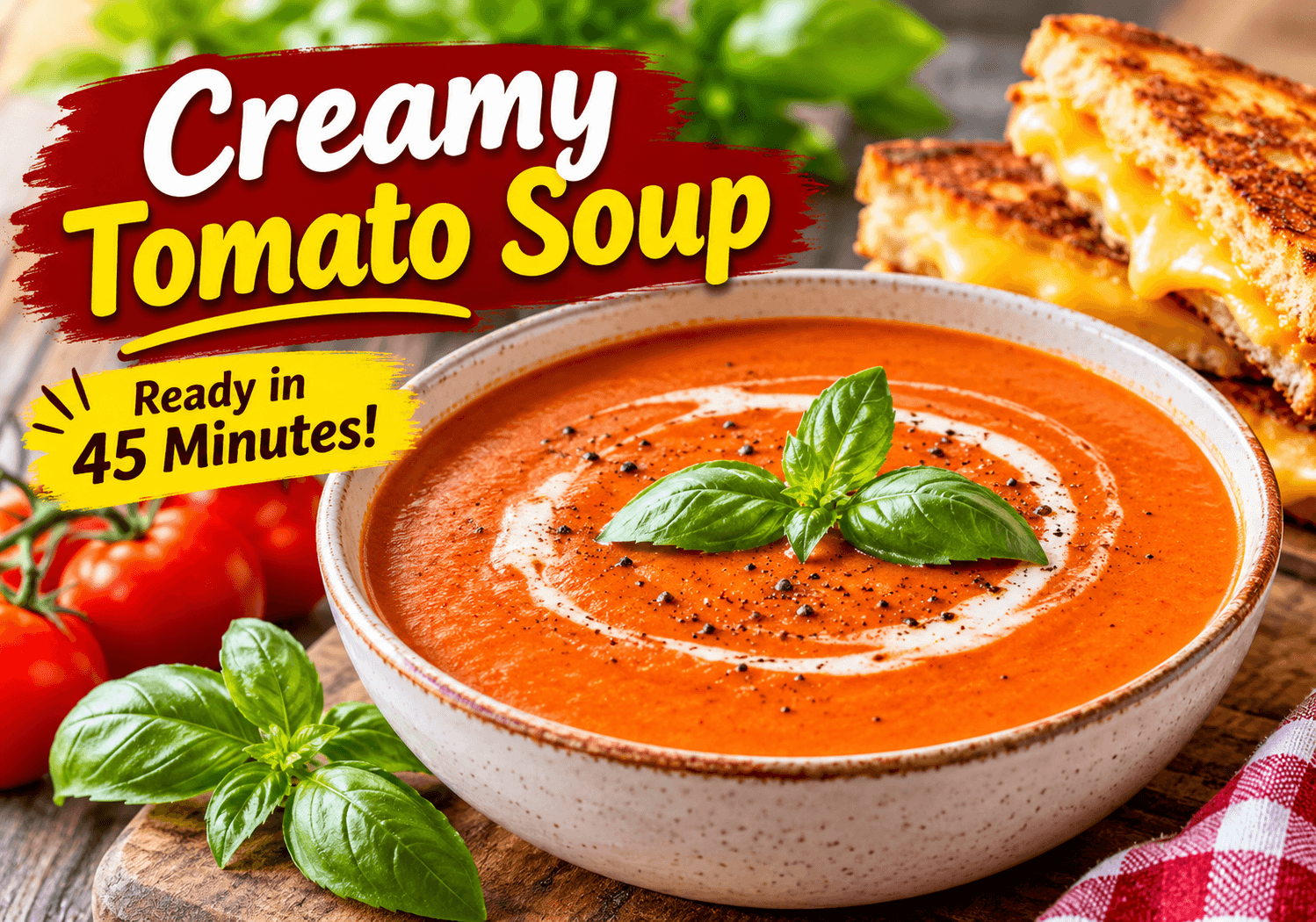
A bowl of creamy tomato soup should taste rich and bright at the same time. It should be smooth enough to coat a spoon, with a deep tomato flavor and no sharp edge. Most pots fall short because of two small mistakes: skipping the tomato paste step and adding cream at the wrong moment.
This guide fixes both. You’ll learn how to build flavor with canned or fresh tomatoes, how to blend safely, and how to add cream without curdling. It’s written for beginners, but it gives anyone a dependable creamy tomato soup recipe. You’ll also get serving ideas, storage rules, grill and oven variations, and a troubleshooting chart.
Quick Answer
For a silky creamy tomato soup, sauté onion and garlic in butter, toast tomato paste, then simmer two cans of whole tomatoes with broth for 20 minutes. Blend until smooth, stir in ¾ cup (180 ml) heavy cream off the heat, and season. Total time is 45 minutes, and leftovers must be reheated to 165°F (74°C).
Why This Creamy Tomato Soup Recipe Works
Good soup is about building layers, not adding more ingredients. This recipe uses a few steps that each do a specific job:
- Tomato paste, toasted. Cooking the paste for 2 minutes until it darkens removes the raw, tinny taste and adds depth.
- Canned whole tomatoes. They’re picked and packed ripe, so they taste better than pale grocery-store tomatoes in winter.
- Onion cooked slowly. Six to eight minutes over medium heat makes the onion sweet and soft, so it blends away to nothing.
- Cream added off the heat. This gives you a smooth texture and protects the soup from splitting.
You also control the salt, since you start with low-sodium broth. If you like simple stovetop meals, browse our easy soup recipes and our healthy soup recipes for more ideas.
Ingredients and Equipment
Ingredients (serves 6, about 2 quarts / 1.9 L)
- 2 tbsp unsalted butter
- 1 tbsp olive oil
- 1 large yellow onion, diced (about 10 oz / 0.28 kg)
- 4 garlic cloves, minced
- 3 tbsp tomato paste
- 2 cans (28 oz / 0.8 kg each) whole peeled tomatoes with their juices, about 3.5 lb (1.6 kg) total
- 2 cups (480 ml) low-sodium vegetable or chicken broth
- 1 tsp sugar
- 1 tsp dried basil, or ¼ cup chopped fresh basil
- 1 tsp kosher salt, plus more to taste
- ½ tsp black pepper
- ¾ cup (180 ml) heavy cream
- Optional: 1 Parmesan rind, ¼ tsp red pepper flakes, fresh basil for garnish
Easy Substitutions
- Whole tomatoes: Use two 28-oz cans of crushed tomatoes. They blend a bit faster.
- Heavy cream: Half-and-half works, but it’s more likely to split, so keep the heat low.
- Dairy-free: Use olive oil instead of butter and full-fat canned coconut milk instead of cream.
- Fresh tomatoes: Use 3 lb (1.4 kg) of Roma tomatoes, roasted first (see the variations below).
- Dried basil: Swap in dried oregano, or stir in pesto at the end.
- Sugar: Honey or maple syrup works, same amount.
Equipment
- 5-6 quart (4.7-5.7 L) Dutch oven or heavy pot
- Immersion blender or countertop blender
- Wooden spoon and ladle
- Instant-read thermometer (for reheating leftovers safely)
Choosing and Prepping the Ingredients
Which Tomatoes Are Best?
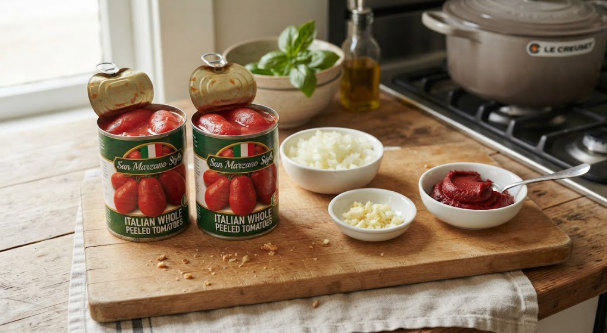
For homemade creamy tomato soup with canned tomatoes, look for whole peeled tomatoes packed in juice or purée. San Marzano-style tomatoes have a sweeter, lower-acid flavor, but any good brand works. Skip tomatoes packed with added herbs and heavy seasonings, since you can’t control the flavor.
Fresh tomatoes are best in peak summer. In other months, canned tomatoes give you a more reliable result.
Prep Before You Cook
Dice the onion into pieces about ¼ inch (6 mm) wide. They don’t need to be perfect, since the blender does the rest. Mince the garlic, open the cans, and measure the broth and cream so everything is ready.
Take the cream out of the fridge when you start. Cold cream hitting hot soup is one of the main causes of curdling.
A Quick Note on Hot Soup Safety
Blending hot liquid creates steam pressure. If you use a countertop blender, fill it no more than halfway, remove the center cap from the lid, and cover the opening with a folded towel. An immersion blender avoids this problem entirely.
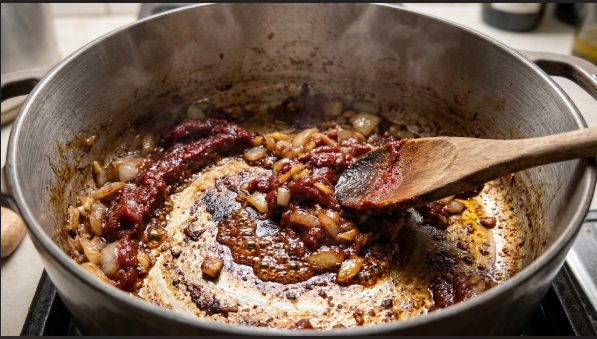
Pitmaster Tip: Toast the tomato paste. After the onion softens, push it to the sides, add the paste to the center of the pot, and stir for about 2 minutes until it turns from bright red to a darker brick color. This one step does more for flavor than any spice you can add.
Step-by-Step Instructions for Creamy Tomato Soup
Here is the full method for creamy tomato soup, from the first onion to the final taste.
- Soften the onion. Melt the butter with the olive oil in a Dutch oven over medium heat. Add the onion and ½ tsp salt. Cook 6-8 minutes, stirring often, until soft and translucent but not browned.
- Add garlic and paste. Stir in the garlic for 30-60 seconds. Add the tomato paste and cook 2 minutes, stirring, until it darkens.
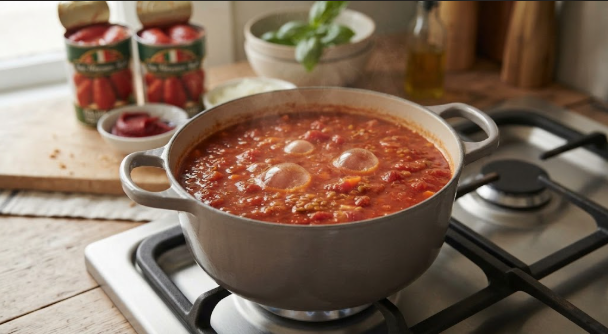
- Add the tomatoes. Pour in the canned tomatoes with their juice. Crush them with a wooden spoon or your hands. Add the broth, sugar, basil, remaining salt, pepper, and the Parmesan rind if using.
- Simmer. Bring to a boil, then lower the heat until you see small, steady bubbles. Cover partly and simmer 20-25 minutes, stirring every 5 minutes.
- Blend. Remove the Parmesan rind. Blend with an immersion blender for 1-2 minutes until completely smooth. For a countertop blender, work in batches and vent the lid.
- Temper the cream. Return the soup to the pot on low heat. Whisk ½ cup (120 ml) of hot soup into the cream, then pour the mixture back into the pot.
- Warm gently. Heat for 2-3 minutes until the soup steams and feels hot throughout, about 165°F (74°C). Do not boil.
- Taste and adjust. Add salt, pepper, or a pinch of sugar. If it tastes sharp, add ⅛ tsp baking soda, stirring slowly because it foams.
- Serve. Ladle into bowls and garnish with basil, cream, or black pepper.
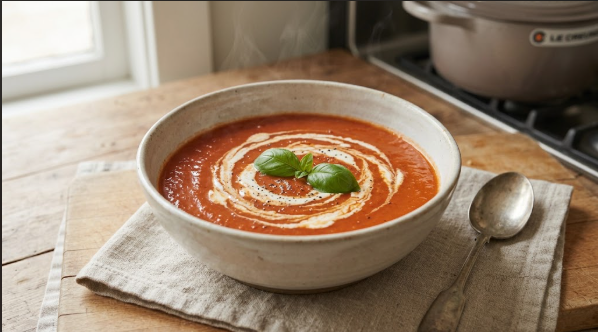
Common Mistake: Boiling the soup after adding cream. High heat can make dairy separate into small grainy bits. Once the cream goes in, keep the pot at a gentle steam and never let it bubble hard.
Time and Temperature Table
Use this chart for creamy tomato soup across different cooking methods. Times are typical ranges and vary by pot and heat source.
| Method | Heat setting | Time | Notes |
| Stovetop simmer | Low, steady bubbles | 20-25 min | The standard method in this recipe |
| Slow cooker | Low 4-6 hours or High 2-3 hours | Plus 10 min to blend | Sauté onion and paste first; add cream last |
| Oven-roasted fresh tomatoes | 400°F (200°C) | 40-50 min | 3 lb (1.4 kg) Roma halves, cut side up |
| Pellet grill roasted tomatoes | 375°F (190°C) | 45-60 min | Use apple or cherry pellets |
| Charcoal grill, indirect | About 400°F (200°C) | 30-40 min | In a cast iron skillet |
| Finishing the soup | Gentle steam | 2-3 min | Reach 165°F (74°C), no boil |
The tomatoes are done when the edges blister and the juices bubble and darken. Most of the flavor comes from those browned bits.
How to Tell When Creamy Tomato Soup Is Done
Creamy tomato soup is done when it’s thick enough to coat the back of a spoon, and a line drawn with your finger holds for a second. The color should be a warm, orangey red, lighter than the pot before the cream. The surface should be smooth, with no flecks of skin or seeds.
Check the flavor too. It should taste sweet and savory, with no raw or metallic edge. If it tastes flat, add salt a pinch at a time. If it’s sharp, add a little sugar or butter.
For serving, the soup should be steaming and hot. Reheated leftovers need to reach 165°F (74°C) in the center, which you can verify with an instant-read thermometer.
Resting and Serving
Unlike meat, soup doesn’t need a rest, but a 5-minute pause helps. The flavors settle, and the soup cools just enough to taste without burning your tongue.
Serve in warm bowls so it stays hot longer. Good finishing touches include:
- A swirl of cream or olive oil
- Fresh basil, chives, or parsley
- A crack of black pepper
- A spoonful of pesto
- Crunchy croutons or shredded Parmesan
What to Serve With Creamy Tomato Soup
Creamy tomato soup pairs with anything crisp, salty, or buttery. The classic choice is a grilled cheese, and a griddled or toasted slice of grilled bread makes the perfect dunker. For extra flavor, use a smoked cheese in the sandwich. Its smoky edge stands up to the tomato.
More pairing ideas:
- Sandwiches: Grilled cheese, BLT, or a turkey and Swiss on toasted sourdough
- Salads: A sharp arugula salad with lemon dressing balances the richness
- Crunchy toppers: Croutons, oyster crackers, or toasted pumpkin seeds
- Hearty add-ins: Cooked tortellini, rice, or white beans stirred into the bowl
- Light meals: A side of roasted vegetables and a slice of crusty bread
Storing, Freezing, and Reheating Leftovers
Cool It Fast
Don’t leave soup out. Bacteria grow quickly in the danger zone between 40°F and 140°F. Divide hot soup into shallow containers so it cools quickly, and refrigerate within 2 hours of cooking.
Refrigerator and Freezer
According to the USDA’s leftover safety guidance, leftovers keep 3-4 days in the refrigerator, or 3-4 months in a freezer set to 0°F (-18°C). Dairy can separate after freezing, so freeze the soup before adding the cream when you can. Stir the cream in after reheating.
Thaw frozen soup in the refrigerator overnight, using one of the USDA’s safe thawing methods, rather than on the counter.
Reheating
The USDA says to reheat leftovers to 165°F (74°C). Warm the soup in a pot over low heat, stirring often, and check the temperature with a thermometer. Add a splash of broth or milk if it has thickened.
Cream sauces break easily when overheated. Our guide to reheating Alfredo covers the same low-and-slow idea, and it applies here too. A microwave works for single servings. Heat in 60-second bursts, stirring each time.
Variations
Flavor Swaps
- Creamy tomato basil soup: Stir in ½ cup (about 12 g) of torn fresh basil before blending.
- Spicy: Add ½ tsp red pepper flakes with the garlic.
- Roasted garlic: Roast a whole head of garlic at 400°F (200°C) for 40 minutes and blend it in.
- Cheesy: Stir in ½ cup (about 50 g) of grated Parmesan at the end.
- Dairy-free creamy tomato soup: Use coconut milk in place of cream, and olive oil in place of butter. Our vegan dinner ideas include more plant-based meals.
Creamy Tomato Soup With Fresh Tomatoes (Roasted)
Halve 3 lb (1.4 kg) of Roma tomatoes. Toss with 2 tbsp olive oil, salt, and pepper, then roast cut side up at 400°F (200°C) for 40-50 minutes. Skip the canned tomatoes, add the roasted ones to the pot with the broth, and simmer for 10 minutes.
Pellet Grill
Set the pellet grill to 375°F (190°C) with apple or cherry pellets. Roast the tomatoes cut side up in a cast iron skillet or on a sheet pan for 45-60 minutes. Mild fruit wood adds a soft smoke. Stronger woods like hickory can overpower the tomato.
Charcoal Grill
Set up a two-zone fire and keep the tomatoes on the cooler side at about 400°F (200°C). Cook 30-40 minutes until the skins blister. Move to the hot side for the last 2 minutes if you want char.
Offset Smoker
Hold the cooking chamber at about 275°F (135°C) with a small piece of apple or oak. Roast the tomatoes for 60-75 minutes until soft and slightly shriveled. Keep the smoke light.
Slow Cooker
Sauté the onion, garlic, and paste on the stove first. Transfer to the slow cooker with the tomatoes and broth. Cook on low for 4-6 hours, blend, then add the cream for the last 15 minutes. For more set-it-and-forget-it ideas, see our crockpot soup recipes.
Oven Backup
No stovetop room? Roast the tomatoes, onion, and garlic on a sheet pan at 400°F (200°C) for 40 minutes. Move everything to a pot with the broth, simmer for 10 minutes, and blend.
Creamy Tomato Soup Troubleshooting
| Problem | Likely cause | Fix |
| Soup tastes sharp or sour | Acidic tomatoes or underdone paste | Add 1 tsp sugar, a tablespoon of butter, or ⅛ tsp baking soda |
| Grainy or curdled texture | Cream added cold or soup boiled | Blend again with an immersion blender; next time, temper the cream and keep the heat low |
| Too thin | Not enough simmer time | Simmer uncovered 5-10 minutes |
| Too thick | Over-reduced or stored overnight | Stir in broth, ¼ cup (60 ml) at a time |
| Flat taste | Under-salted or no acid | Add salt in pinches and a squeeze of lemon |
| Tinny, metallic taste | Raw paste or canned tomato flavor | Cook paste longer next time; add butter or sugar |
| Bits of tomato skin | Not blended long enough | Blend 1-2 more minutes, or strain through a fine sieve |
If you also make other tomato-based or cream-based comfort food, try our potato soup recipe for another smooth, spoonable bowl.
Creamy Tomato Soup Recipe Card
Servings: 6 | Prep time: 10 minutes | Cook time: 35 minutes | Total: 45 minutes
Ingredients: 2 tbsp butter; 1 tbsp olive oil; 1 large diced yellow onion (10 oz / 0.28 kg); 4 garlic cloves; 3 tbsp tomato paste; 2 cans (28 oz / 0.8 kg each) whole peeled tomatoes; 2 cups (480 ml) broth; 1 tsp sugar; 1 tsp dried basil; 1 tsp salt; ½ tsp pepper; ¾ cup (180 ml) heavy cream.
Short steps:
- Cook the onion in butter and oil for 6-8 minutes.
- Add garlic, then toast the tomato paste for 2 minutes.
- Add tomatoes, broth, sugar, basil, salt, and pepper.
- Simmer 20-25 minutes.
- Blend until smooth.
- Temper in the cream and warm to 165°F (74°C), without boiling.
- Adjust seasoning and serve.
FAQ
Can you freeze creamy tomato soup?
Yes, but freeze the soup before adding cream, since dairy can separate when thawed. Cool the base, portion it into freezer-safe containers, and freeze at 0°F (-18°C) for 3-4 months, per USDA guidance. Thaw overnight in the refrigerator, reheat gently, then stir in the cream.
How long does creamy tomato soup last in the fridge?
Cooked soup keeps 3-4 days in the refrigerator, according to the USDA. Refrigerate it within 2 hours of cooking, using shallow covered containers so it cools quickly. Reheat only the portion you plan to eat, and bring it to 165°F (74°C) with a food thermometer before serving.
How do you keep creamy tomato soup from curdling?
Take the pot off the heat before adding cream, and use heavy cream, which is less likely to split than milk. Warm the cream with a ladle of hot soup first, then stir it in. Keep the soup at a gentle steam, not a boil, after the cream goes in.
How do you cut the acidity in tomato soup?
Cook the tomato paste until it darkens, add 1 teaspoon of sugar, and finish with a little butter. A pinch of baking soda (⅛ teaspoon) neutralizes acid fast, but add it slowly because it foams. Taste after each change, since salt also rounds out sharp flavors.
Can you make dairy-free creamy tomato soup?
Yes. Swap the butter for olive oil and the cream for full-fat canned coconut milk, using the same ¾ cup (180 ml). Cashew cream also works. Coconut adds a slight sweetness that pairs well with tomato and basil. Stir it in off the heat, just like dairy cream.
How do you thicken creamy tomato soup?
Simmer the soup uncovered for 5-10 minutes so water evaporates. You can also blend in a slice of day-old bread, a small peeled potato cooked with the soup, or an extra tablespoon of tomato paste. Avoid flour at the end, which can taste raw and turn lumpy.
Conclusion
The best creamy tomato soup comes from a few small habits: sweating the onion slowly, toasting the paste, simmering the tomatoes until they break down, and adding cream off the heat. Follow those steps and you’ll get a smooth, bright, rich pot in 45 minutes.
Make it your own with roasted tomatoes from the grill, a spicy kick, or a dairy-free swap. Serve it with a crisp grilled cheese, and store the leftovers properly so the second bowl is as good as the first.
Laura Smith

I'm Laura, I like all the kind of delicious grilled foods which makes me hungry all the time I see them. That's why I built this blog to share with you all of my Grilling experiences, recipes, and all the tips about foods that I've learned from food experts.